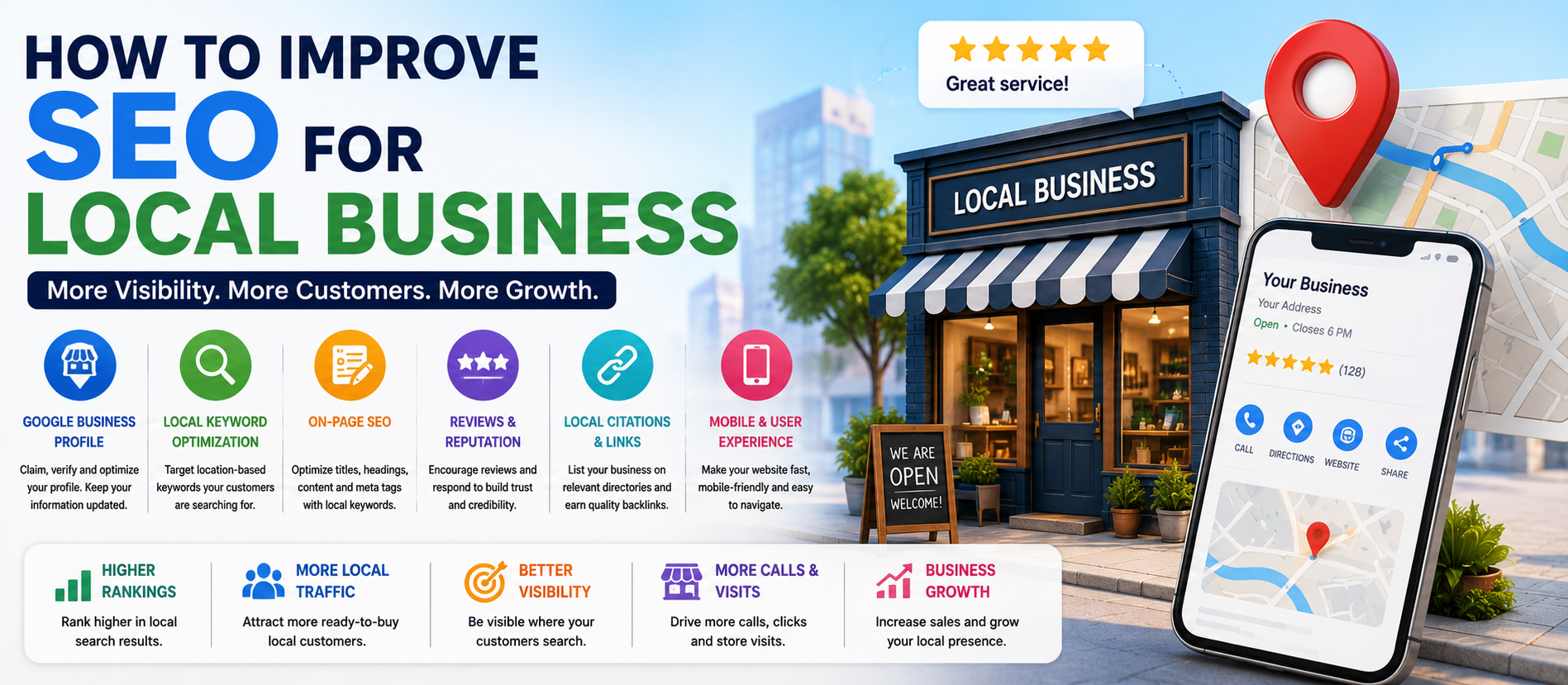
📋 Quick Summary
In this article:
How Google Evaluates Local Search Results
1. Create and Optimize Your Google Business Profile
Complete These Important Details
2. Choose the Right Business Categories
3. Maintain Consistent Business Information
4. Optimize Your Website for Local Search
A Strong Local Service Page Can Include
5. Research Local Keywords and Search Intent
6. Create Helpful Local Content
Focus Keyword: How to Improve SEO for Local Business
💡 Key Insight
Learning how to improve SEO for local business is essential for companies that depend on customers in a specific city, region, or service area. Whether you operate a restaurant, law firm, repair company, clinic, agency, retail store, or home service business, local customers need to understand what you offer, where you operate, and why they should choose you.
In 2026, local SEO is no longer limited to adding a city name to a few website pages. A successful strategy combines a complete Google Business Profile, accurate business information, useful local content, strong website fundamentals, reviews, links, and a good customer experience. It should also prepare the business for evolving search experiences, including AI-powered search.
Designfo helps businesses improve digital visibility through SEO, Local SEO, website optimization, content strategy, AEO, GEO, AI Search Optimization, paid marketing, and marketing automation.
What Is Local SEO?
Local SEO is the process of improving a business's visibility when people search for products or services connected to a location. Searches may include phrases such as “near me,” a city name, a neighborhood, or a specific service.
Local visibility can appear in traditional search results, Google Maps, Business Profile results, and other search experiences. The goal is not simply to rank for more keywords. The goal is to help the right local customers discover accurate information and take the next step.
How Google Evaluates Local Search Results
Google explains local ranking primarily through three broad factors: relevance, distance, and prominence.
- Relevance: How well the business information matches what a person is searching for.
- Distance: How far the business is from the location associated with the search.
- Prominence: How well-known and established the business appears through signals such as links, reviews, and broader recognition.
You cannot simply pay for a better organic local ranking. Instead, focus on making your business information complete, accurate, useful, and credible.
1. Create and Optimize Your Google Business Profile
Your Google Business Profile is one of the most important local SEO assets. It helps Google and potential customers understand your business.
Complete These Important Details
- Official business name
- Correct address or service area
- Primary business category
- Relevant secondary categories where appropriate
- Phone number
- Website URL
- Business hours and special hours
- Services and products
- Business description
- Relevant attributes
Keep this information accurate as your business changes. Incorrect opening hours, phone numbers, categories, or locations can create customer frustration and weaken relevance.
2. Choose the Right Business Categories
Your primary category should describe your core business as accurately as possible. Categories help search systems understand the type of services or products you provide.
Do not select unrelated categories simply to target more searches. Relevance is more useful than artificially broad targeting. Add secondary categories only when they genuinely represent important parts of the business.
3. Maintain Consistent Business Information
Your business name, address, phone number, website, and core contact information should be consistent across your own website and important online business listings.
Before creating dozens of low-value directory listings, first audit the major profiles customers actually use. Correct inaccurate information, remove duplicates when possible, and maintain a reliable source of truth.
Check Your Information On
- Your website
- Google Business Profile
- Major social profiles
- Relevant industry directories
- Local organizations and associations
- Trusted business listings
4. Optimize Your Website for Local Search
Your website gives you the space to explain services, locations, expertise, pricing approaches, processes, and customer benefits in more detail than a profile listing.
Create clear pages for important services and locations where you genuinely operate. Each page should provide unique value rather than simply replacing one city name with another.
A Strong Local Service Page Can Include
- Clear description of the service
- Who the service is for
- Relevant service-area information
- Local examples or case studies
- Frequently asked questions
- Trust signals and reviews
- Clear contact information
- A useful call to action
5. Research Local Keywords and Search Intent
Local keyword research should begin with customer language. Think about how real people describe the service, problem, product, or location.
Examples include:
- plumber in [city]
- best accountant near [location]
- emergency repair [city]
- digital marketing agency for small businesses
- [service] cost in [city]
- how to choose a [service provider]
Do not target only high-volume phrases. Longer, specific searches often reveal stronger intent and can create opportunities for service pages, FAQs, guides, and comparison content.
6. Create Helpful Local Content
Strong local SEO content answers genuine customer questions. Instead of publishing thin pages for every nearby town, create content that demonstrates useful local knowledge.
Content Ideas
- Local service guides
- Area-specific FAQs
- Local regulations or requirements where relevant
- Case studies
- Before-and-after project stories
- Buying and maintenance guides
- Local event or community resources when genuinely relevant
Focus on originality and usefulness. Search engines increasingly evaluate whether content provides meaningful value rather than simply repeating common information.
7. Build a Review Strategy
Reviews can influence customer trust and local visibility. Ask real customers for honest feedback through an appropriate follow-up process. Make the process easy, but never pressure customers or create fake reviews.
Review Best Practices
- Ask after a genuine customer experience.
- Make the review request simple.
- Do not offer misleading incentives.
- Respond professionally to positive reviews.
- Address negative feedback calmly and constructively.
- Look for recurring feedback that can improve the business.
Helpful replies demonstrate that the business values customer feedback and manages its reputation.
8. Add High-Quality Photos and Videos
Visual content can help customers understand your business before contacting you. Use authentic, relevant images of your team, location, products, completed work, or services where appropriate.
For websites, support important text with useful images and videos. Clear visual content can improve the customer experience and may also help with multimodal search experiences.
9. Improve Technical SEO
Local content cannot perform effectively if search engines cannot access or understand the site. Review essential technical foundations.
- Pages should be crawlable and indexable where intended.
- Important pages should return the correct status.
- Internal links should help users and search engines discover key pages.
- Mobile users should have a strong experience.
- Important content should be available in text.
- Duplicate pages should be reduced where practical.
- Structured data should match visible content.
Use Google Search Console to identify indexing and technical issues and monitor search performance.
10. Use Local Business Structured Data Correctly
Structured data can help communicate information about a page in machine-readable form. Use relevant markup only when it accurately represents visible page content.
Structured data is not a shortcut to guaranteed rankings. The business information on the page must remain accurate, accessible, and useful to human visitors.
11. Build Relevant Local Authority
Local prominence can be supported by genuine recognition. Seek opportunities to earn relevant mentions and links because your business contributes something useful.
Possible Opportunities
- Local business organizations
- Professional associations
- Community partnerships
- Local sponsorships
- Industry publications
- Original research or useful resources
- Newsworthy projects and events
⚠ Watch Out
Avoid buying large quantities of low-quality links. Build recognition through real relationships, useful resources, and legitimate coverage.
12. Improve User Experience and Conversions
Ranking is only part of local SEO. When customers arrive, the website should make the next step easy.
- Display a clear phone number.
- Use visible contact and booking options.
- Show service areas clearly.
- Explain what happens after an enquiry.
- Make forms simple.
- Use trust signals near important decisions.
- Test the full experience on mobile.
Measure calls, forms, bookings, purchases, and qualified leads rather than focusing only on traffic.
13. Connect Local SEO With AEO
Answer Engine Optimization (AEO) is often used to describe improving content so systems can identify useful answers to questions. For local businesses, create clear answers to the questions customers ask before choosing a provider.
Examples
- What areas do you serve?
- How much does the service cost?
- How quickly can you provide service?
- What makes your company different?
- Do you offer emergency appointments?
- What should customers expect during the process?
Place concise answers near the relevant question, then provide additional context where useful. This improves readability for people as well as search systems.
14. Improve GEO and AI Search Visibility
Generative Engine Optimization (GEO) and AI Search Optimization should build on strong SEO rather than replace it. For local businesses, accurate Business Profile details, useful website content, clear services, and strong technical accessibility are practical foundations.
Do not rely on unnecessary “AI files,” artificial keyword chunking, or other shortcuts. Create unique, expert-led content that adds information beyond generic summaries. Keep your business details current and make important content easy to find.
15. Measure Local SEO Performance
Track performance against business outcomes. Useful metrics include:
- Organic search impressions and clicks
- Visibility for important local queries
- Google Business Profile interactions
- Phone calls and direction requests
- Website enquiries
- Bookings or sales
- Conversion rate
- Qualified lead quality
Review the data regularly, identify weak points, and prioritize the improvements most likely to create business value.
Common Local SEO Mistakes to Avoid
- Using inconsistent business information.
- Ignoring the Google Business Profile.
- Creating duplicate location pages with only city names changed.
- Buying fake reviews.
- Choosing irrelevant categories.
- Targeting keywords without considering customer intent.
- Ignoring mobile usability.
- Publishing generic AI-generated content without original value.
- Buying low-quality links.
- Measuring rankings without tracking leads or sales.
How Designfo Helps Improve Local SEO
Designfo develops practical digital growth strategies for businesses that want to improve local visibility and customer acquisition.
Designfo Services
- Local SEO Strategy
- Google Business Profile Optimization
- SEO and Technical SEO
- Local Content Strategy
- Website and Landing Page Optimization
- Conversion Rate Optimization
- AEO, GEO, and AI Search Optimization
- Google Ads and Digital Marketing
- Marketing Automation
Frequently Asked Questions
How long does local SEO take?
The timeline depends on competition, location, website quality, current visibility, reputation, and the amount of useful work required. Local SEO should be treated as an ongoing process rather than a one-time task.
What is the most important factor in local SEO?
There is no single universal factor. Start with complete and accurate business information, a strong Google Business Profile, relevant services, useful website content, customer reviews, and sound technical SEO.
Can I rank in a city where I do not have an office?
You can create useful content for legitimate service areas, but visibility also depends on relevance, distance, and prominence. Do not create misleading locations or pretend to operate from addresses where the business does not genuinely exist.
Do reviews help local SEO?
Reviews can strengthen customer trust and are part of the broader signals associated with local prominence. Focus on earning authentic reviews and responding professionally.
Does AI Search Optimization replace SEO?
No. AI Search Optimization should build on the same core principles: crawlable pages, clear technical foundations, accurate business information, useful content, and a strong user experience.
Conclusion
If you want to know how to improve SEO for local business, begin with the fundamentals. Make your Google Business Profile complete and accurate, maintain consistent business information, optimize your website for relevant services and locations, create useful local content, earn authentic reviews, improve technical SEO, and make it easy for customers to contact you.
Then expand the strategy with AEO, GEO, and AI Search Optimization. The goal is not to chase every new acronym or shortcut. Build a trustworthy digital presence that clearly explains your expertise, services, location, and customer value.
Designfo
Website: www.designfo.in
Ready to Grow?
Talk to us about a strategy tailored to your brand — we will help you stand out in search, AI discovery and social.


Comments (0)
Log in to leave a comment.