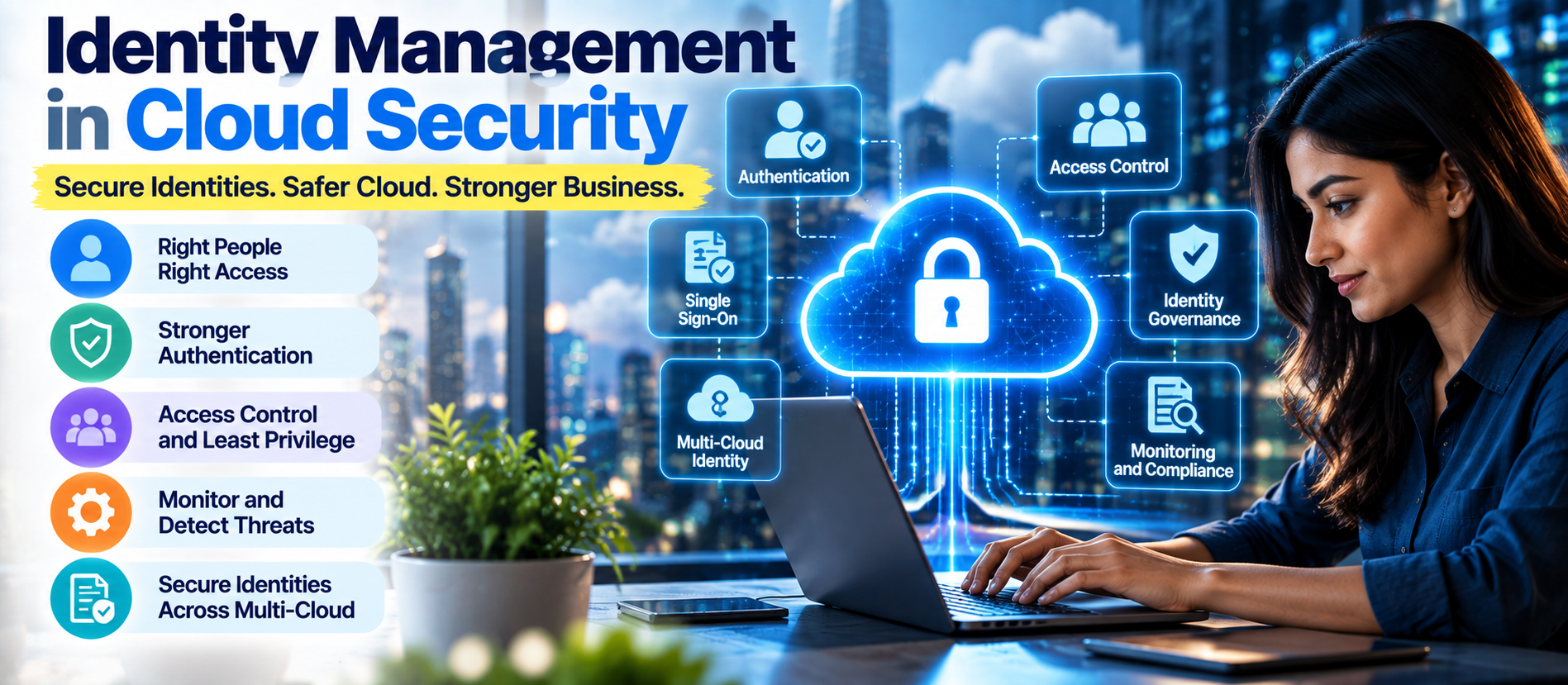
📋 Quick Summary
In this article:
What Is Identity Management in Cloud Security?
Authentication vs Authorization
Why Identity Is So Important in Cloud Environments
Core Components of Cloud Identity Management
1. Identity Lifecycle Management
2. Authentication
3. Authorization
4. Single Sign-On
5. Identity Federation
6. Privileged Access Management
Least Privilege: A Foundation of Cloud Identity Security
Introduction
Cloud security starts with a simple question: Who is allowed to access what?
Cloud platforms can host applications, databases, files, APIs, virtual machines, containers, and business-critical services. These resources may be accessed from offices, homes, mobile devices, partner networks, automated systems, and other cloud services.
This makes identity a central security control.
Identity management in cloud security is the process of creating, verifying, managing, monitoring, and removing digital identities and their access to cloud resources.
It applies to more than employees. Modern cloud environments also contain administrators, contractors, customers, applications, service accounts, APIs, containers, workloads, and automated agents.
NIST's current digital identity guidance covers identity proofing, authentication, enrollment, authenticators, federation, and related identity assertions.
Cloud identity management therefore needs to be treated as a security discipline, not simply an account-management task.
What Is Identity Management in Cloud Security?
Identity management in cloud security controls digital identities and the permissions associated with them.
A cloud identity system typically answers several questions:
- Who or what is requesting access?
- How was the identity verified?
- What resource is being requested?
- What permissions does the identity have?
- Is the requested action allowed?
- Under what conditions should access be granted?
- When should access be removed?
- Can the access event be monitored and investigated?
Identity management is closely connected to authentication and authorization, but the concepts are different.
Authentication vs Authorization
Authentication verifies identity.
For example, a user may prove identity with a password, security key, passkey, certificate, or another authenticator.
Authorization determines what that authenticated identity is allowed to do.
A user may successfully sign in but still be denied access to a sensitive database.
This distinction is essential in cloud security. A strong login process is not enough if users receive excessive permissions.
Why Identity Is So Important in Cloud Environments
Traditional networks often relied heavily on physical boundaries and internal network controls.
Cloud environments are different.
Users and workloads may access resources from many locations. Applications can communicate through APIs. Employees may use SaaS platforms. Developers may create temporary cloud resources. Automated systems may need access without a human being present.
This creates a large and dynamic identity surface.
NIST's cloud access-control guidance notes that different cloud service models require appropriate access-control approaches across IaaS, PaaS, and SaaS environments.
Identity becomes a common control point across these environments.
Core Components of Cloud Identity Management
1. Identity Lifecycle Management
Every identity has a lifecycle.
It may be created when an employee joins a company. It may change when the employee changes roles. It should normally be modified or removed when the person leaves.
The same principle applies to service accounts, applications, contractors, and other identities.
A mature lifecycle includes:
- Identity creation
- Verification
- Role assignment
- Permission changes
- Periodic review
- Suspension
- Deprovisioning
- Audit records
2. Authentication
Authentication verifies that an identity is genuine.
Cloud authentication can use passwords, hardware security keys, passkeys, certificates, biometrics, one-time codes, and other mechanisms.
NIST SP 800-63B-4 provides current technical guidance on authentication and authenticator management.
3. Authorization
Authorization determines which actions an identity can perform.
Examples include:
- Read a storage bucket
- Create a virtual machine
- Modify a database
- Deploy application code
- Manage security settings
- Access customer records
Good authorization limits access to what is actually needed.
4. Single Sign-On
Single sign-on, or SSO, allows users to authenticate through a central identity system and access multiple approved applications.
SSO can improve user experience and centralize identity controls.
It can also make identity infrastructure a high-value security component. Strong authentication, token protection, monitoring, and recovery processes are therefore important.
5. Identity Federation
Federation allows identity information to be trusted across systems or organizations.
For example, an organization may use one identity provider to access several cloud applications.
Federation can reduce duplicate accounts, but it introduces trust relationships that need careful configuration.
6. Privileged Access Management
Privileged accounts can make high-impact changes.
Examples include cloud administrators, security administrators, database administrators, and identities that can modify access policies.
These accounts require stronger controls than ordinary user accounts.
NIST guidance emphasizes minimizing privileged access and restricting elevated privileges to authorized roles.
Least Privilege: A Foundation of Cloud Identity Security
Least privilege means giving an identity only the access required to perform its authorized task.
It sounds simple, but it can be difficult in large cloud environments.
Permissions can accumulate over time. Users may move between teams. Projects may end. Temporary access may become permanent.
NIST describes least privilege as allowing only the access necessary to accomplish assigned tasks and reviewing privileges to confirm that they are still needed.
A practical least-privilege program should include:
- Role-based access
- Permission reviews
- Temporary elevated access
- Separation of duties
- Privileged account controls
- Automatic removal of unnecessary permissions
Role-Based Access Control in the Cloud
Role-Based Access Control, or RBAC, assigns permissions to roles rather than manually assigning every permission to every user.
For example, an organization might define:
- Finance Viewer
- Finance Administrator
- Developer
- Security Analyst
- Cloud Administrator
- Customer Support Agent
Users receive the role appropriate to their responsibilities.
RBAC can simplify management, but poorly designed roles can still create excessive access.
Attribute-Based Access Control
Attribute-Based Access Control, or ABAC, makes authorization decisions using attributes.
These can include:
- User department
- Job role
- Device status
- Location
- Time
- Resource sensitivity
- Application
- Risk information
ABAC can provide more flexible policies than simple role assignments.
For example, an employee might access a sensitive application only when using a managed device and approved authentication method.
Multi-Factor Authentication and Cloud Security
Passwords alone create significant risk.
Multi-factor authentication, or MFA, adds another authentication factor.
Factors can include something you know, something you have, or something you are.
NIST's identity guidelines include requirements and guidance for authentication assurance and authenticators.
MFA should be especially important for:
- Cloud administrators
- Security administrators
- Remote access
- Financial systems
- Developer platforms
- Identity provider accounts
- Accounts with access to sensitive data
Phishing-Resistant Authentication
Not every MFA method provides the same protection against phishing.
Organizations should evaluate stronger authentication methods for high-risk accounts and workflows.
Hardware-backed authenticators and passkey-based approaches can reduce some risks associated with stolen passwords and one-time codes.
The correct authentication strategy depends on the organization's systems, users, risk level, and regulatory requirements.
Identity Providers and Cloud IAM
An identity provider, or IdP, manages identities and authentication for users and sometimes other entities.
Cloud platforms also provide Identity and Access Management, commonly called IAM.
Cloud IAM systems typically define:
- Identities
- Roles
- Policies
- Resources
- Permissions
- Authentication requirements
Organizations should understand how the identity provider and each cloud provider's IAM system interact.
Identity Federation and SSO Security
Federation can simplify access, but it also creates trust dependencies.
If an identity provider is compromised, attackers may attempt to use valid authentication flows to access connected services.
For this reason, federation requires:
- Strong identity-provider security
- MFA
- Secure configuration
- Token protection
- Access reviews
- Monitoring
- Fast incident response
Why Cloud Tokens Matter
Cloud identity systems often rely on tokens and assertions.
A token can represent an authenticated session or carry information used to make an authorization decision.
If an attacker steals a valid token, the attacker may be able to act as the identity for as long as the token remains usable.
In September 2026, NIST and CISA finalized NIST IR 8587, which provides implementation guidance for protecting identity tokens and assertions from forgery, theft, and misuse. The guidance covers token verification, key management, lifecycle controls, SSO, federation, API access, and continuous monitoring.
This is an important development because identity security increasingly involves protecting sessions and tokens, not only passwords.
Token Lifecycle Management
Identity tokens should have appropriate lifecycle controls.
Organizations should consider:
- Token issuance
- Token expiration
- Token validation
- Token revocation
- Token storage
- Key protection
- Detection of suspicious token use
NIST IR 8587 specifically highlights lifecycle controls, token verification, cryptographic key management, and revocation-related mechanisms.
Privileged Identity Management
Privileged identity management focuses on high-impact accounts and permissions.
A strong program should identify:
- Who has administrative access
- Which resources they can control
- Why the access is required
- How long the access is needed
- How privileged actions are logged
- How emergency access is handled
Organizations can reduce risk by using temporary or just-in-time access where appropriate instead of leaving powerful permissions permanently active.
Cloud Service Accounts and Workload Identities
Human users are only one part of cloud identity management.
Applications and workloads also need identities.
Examples include:
- Virtual machines
- Containers
- Server less functions
- CI/CD pipelines
- Data-processing jobs
- APIs
- Automation systems
- AI services and agents
These identities should not automatically receive broad permissions.
Each workload should have an identity appropriate to its function.
Why Workload Identity Matters
A compromised application identity can be as dangerous as a compromised employee account.
Imagine a cloud application that only needs to read records from one database. If its identity can also delete storage, modify IAM policies, and create administrators, a compromise could have a much larger impact.
Workload least privilege limits the potential damage.
Identity Management and Zero Trust
Zero trust places strong emphasis on identity and continuous access decisions.
Identity management supports zero trust by maintaining accurate identities, credentials, roles, and access attributes.
NIST's zero-trust architecture materials describe identity management as a component for creating and managing user and device accounts, identity records, roles, and access attributes, including least-privilege management.
A zero-trust approach does not mean “trust nobody” in a simplistic sense. It means access should be based on verified identity, authorization, context, and policy rather than broad assumptions about network location.
Device Identity and Cloud Access
A user's identity is only one part of an access decision.
The device also matters.
An organization may want to know:
- Is the device managed?
- Is the operating system supported?
- Are security updates installed?
- Is endpoint protection active?
- Is the device encrypted?
- Is the device compliant with company policy?
Combining user identity with device signals can improve access decisions.
Identity Governance
Identity governance is the management framework around identities and access.
It includes policies, ownership, approvals, reviews, reporting, and accountability.
Good governance answers:
- Who owns each application?
- Who approves access?
- Who reviews access?
- What happens when a role changes?
- How quickly are former employees removed?
- How are privileged accounts monitored?
Access Reviews
Access should not be granted once and forgotten.
Periodic access reviews help identify permissions that are no longer necessary.
Reviews should focus on:
- Inactive accounts
- Unused permissions
- Former employees
- Role changes
- Contractor access
- Privileged permissions
- External identities
- Service accounts
Identity Threats in Cloud Security
Credential Theft
Attackers may steal passwords through phishing, malware, credential stuffing, or other techniques.
Session and Token Theft
Attackers may attempt to steal session information so they can reuse an already authenticated session.
Privilege Escalation
An attacker may attempt to move from a low-privilege identity to a higher-privilege role.
Account Takeover
A compromised identity may provide access to applications, data, or cloud resources.
Over-Permissioned Accounts
Excessive access increases the potential impact of compromise.
Orphaned Accounts
Accounts that remain active after they are no longer needed create unnecessary attack paths.
Misconfigured Federation
Incorrect trust relationships can create unexpected access.
Compromised Workload Identities
Applications and automated systems can become targets when their credentials or tokens are exposed.
Identity Monitoring and Detection
Identity management is not complete without monitoring.
Security teams should watch for unusual identity behavior.
Useful signals can include:
- Unexpected login locations
- Impossible travel patterns where relevant
- Repeated authentication failures
- New administrator assignments
- Unusual privilege changes
- New application registrations
- Unexpected token use
- Access to unusual resources
- Large permission changes
Monitoring should produce useful alerts rather than overwhelming security teams with noise.
Identity Analytics and Risk-Based Access
Modern identity platforms can use contextual signals to support risk-based access decisions.
For example, an organization may require additional verification when a login comes from an unusual device or involves a sensitive application.
Risk-based systems should be carefully configured and tested. Automated decisions can produce false positives and false negatives.
Human review may remain important for high-impact events.
Identity Management for APIs
Cloud applications depend heavily on APIs.
APIs need authentication and authorization too.
API identity controls should address:
- Who can call the API?
- What can the caller do?
- Which resources can it access?
- How long are credentials valid?
- How are secrets stored?
- How are compromised credentials revoked?
NIST's 2026 token guidance specifically addresses API access alongside SSO and federation.
Secrets Management and Identity Security
Applications often require credentials, API keys, certificates, or other secrets.
These secrets should not be hard-coded into source code or stored in public repositories.
Use dedicated secrets-management mechanisms where appropriate.
Rotate credentials based on risk and system requirements.
Limit which workloads can retrieve each secret.
Identity Security for AI Systems and Agents
AI systems introduce new identity questions.
An AI agent may call APIs, access documents, retrieve information, or perform actions on behalf of a user or organization.
The key question becomes:
What identity is the AI system using, and what is it authorized to do?
AI agents should not automatically inherit unrestricted user permissions.
Organizations should consider separate workload identities, scoped permissions, approval controls, logging, and strong token protection.
NIST's 2026 token guidance includes considerations related to AI and identity infrastructure, reflecting the growing importance of protecting identity mechanisms used by automated systems.
Identity Management and SaaS Applications
Businesses may use dozens or hundreds of SaaS applications.
Centralized identity management can help organizations control access across these services.
SSO can reduce password reuse. Automated provisioning can speed onboarding. Automated deprovisioning can reduce lingering access.
However, every connected application creates another trust relationship.
Review third-party applications regularly.
Identity Lifecycle Automation
Automation can improve both security and efficiency.
For example:
- HR records a new employee.
- The identity platform creates the employee account.
- The employee receives approved baseline access.
- Managers approve additional application access.
- Role changes trigger permission updates.
- Termination triggers account suspension and deprovisioning.
Automation reduces manual work and can make security controls more consistent.
Cloud Identity Best Practices
- Use centralized identity management where practical.
- Require MFA for sensitive accounts.
- Use phishing-resistant authentication for high-risk access where appropriate.
- Apply least privilege.
- Separate administrative accounts from ordinary user accounts.
- Review privileged access regularly.
- Remove inactive identities quickly.
- Use workload identities instead of shared credentials where possible.
- Protect tokens and secrets.
- Monitor identity events.
- Review federation relationships.
- Use secure SSO configuration.
- Apply access policies based on business need.
- Document identity ownership.
- Test incident-response procedures.
How to Build a Cloud Identity Management Strategy
Step 1: Inventory Identities
Identify human users, privileged users, contractors, service accounts, applications, workloads, APIs, and external identities.
Step 2: Map Access
Document which identities can access which resources.
Step 3: Identify Excessive Permissions
Look for administrator privileges, unused roles, broad policies, and permanent access that is not required.
Step 4: Strengthen Authentication
Implement MFA and stronger authentication methods based on risk.
Step 5: Centralize Where Appropriate
Use an identity provider and SSO architecture where it improves control and visibility.
Step 6: Automate Lifecycle Changes
Connect identity changes to approved HR and business workflows.
Step 7: Protect Tokens and Secrets
Use secure storage, validation, expiration, and revocation mechanisms.
Step 8: Monitor and Review
Continuously monitor identity events and conduct periodic access reviews.
Step 9: Test Incident Response
Practice what happens when an identity provider, administrator account, token, or workload identity is compromised.
Common Cloud Identity Mistakes
- Using shared administrator accounts
- Allowing permanent administrative access
- Skipping MFA for privileged users
- Failing to remove former employees
- Ignoring service accounts
- Giving applications excessive permissions
- Hard-coding secrets
- Ignoring token security
- Failing to review third-party access
- Creating too many broad IAM policies
- Not monitoring identity events
- Assuming successful authentication means safe access
Cloud Identity Management for Small Businesses
Small businesses do not need an enormous identity architecture to improve security.
Start with the basics.
- Use a reputable identity provider.
- Enable MFA.
- Remove former employees quickly.
- Use unique accounts.
- Do not share administrator passwords.
- Limit administrative permissions.
- Keep recovery information secure.
- Review connected applications.
- Use secure password management.
- Train employees to recognize phishing.
These controls can create a strong foundation before more advanced identity governance is introduced.
Cloud Identity Management for Enterprises
Large organizations need stronger governance because identity environments can become highly complex.
Enterprise programs may include:
- Identity governance and administration
- Privileged access management
- Customer identity management
- Workforce identity
- Machine identity
- Cloud-native IAM
- SSO and federation
- Identity analytics
- Access certification
- Automated provisioning
- Security information and event management
Measuring Identity Security
Security teams can track measurable indicators.
| Metric What It Shows | |
| MFA coverage | How widely strong authentication is deployed |
| Privileged accounts | How many high-impact identities exist |
| Inactive accounts | Potential unnecessary access |
| Access review completion | Whether permissions are being reviewed |
| Deprovisioning time | How quickly access is removed |
| Excessive permissions | Potential least-privilege gaps |
| Identity-related incidents | Trends in account and access threats |
| Token incidents | Potential session and token-security problems |
Frequently Asked Questions
What is identity management in cloud security?
It is the process of managing digital identities and controlling their access to cloud resources. It includes identity lifecycle management, authentication, authorization, access reviews, privileged access, federation, and monitoring.
Why is IAM important in cloud security?
Cloud resources are accessed by many users, applications, devices, and automated workloads. IAM helps ensure that only authorized identities receive appropriate access.
What is the difference between authentication and authorization?
Authentication verifies who or what is requesting access. Authorization determines what that identity is allowed to do.
What is least privilege?
Least privilege means giving an identity only the access required to perform its authorized task.
Why is MFA important for cloud accounts?
MFA adds additional authentication factors and can reduce the impact of stolen passwords. It is especially important for privileged and sensitive accounts.
What is cloud IAM?
Cloud IAM is the set of identity and access-control capabilities used to manage who can access cloud resources and which actions they can perform.
What is privileged access management?
Privileged access management focuses on controlling, monitoring, and limiting high-impact administrative access.
What are workload identities?
Workload identities represent applications, services, containers, virtual machines, automated jobs, and other non-human entities that need to access cloud resources.
Why are cloud tokens important?
Tokens can represent authenticated sessions or carry information used for access decisions. If stolen or misused, they may enable unauthorized access. NIST's 2026 IR 8587 provides current guidance on protecting tokens and assertions.
How does identity management support zero trust?
Identity management provides accurate identities, authentication, roles, and access attributes that can support policy-based and least-privilege access decisions.
How often should cloud access be reviewed?
The appropriate frequency depends on risk, regulations, business processes, and the type of access. High-risk and privileged access generally deserves more frequent review.
Final Cloud Identity Security Checklist
- Inventory all human and non-human identities.
- Use strong authentication.
- Enable MFA for sensitive accounts.
- Apply least privilege.
- Control privileged access.
- Separate administrator accounts from ordinary accounts.
- Review permissions regularly.
- Automate onboarding and offboarding.
- Protect tokens and secrets.
- Monitor authentication and authorization events.
- Secure SSO and federation.
- Manage workload identities carefully.
- Review third-party application access.
- Test identity incident response.
- Measure identity-security performance.
Conclusion
Identity management has become a core part of cloud security.
Cloud environments are no longer defined by a single office network. Employees, contractors, applications, devices, APIs, workloads, and automated systems can all require access to digital resources.
💡 Key Insight
That makes identity one of the most important security boundaries.
A strong cloud identity program combines accurate identity records, strong authentication, careful authorization, least privilege, privileged access controls, secure federation, workload identity, token protection, monitoring, and regular access reviews.
The goal is not simply to make login convenient. The goal is to make access appropriate.
Current NIST guidance reinforces this direction. Its digital identity guidelines address identity proofing, authentication, and federation, while the September 2026 NIST IR 8587 focuses on protecting identity tokens and assertions from forgery, theft, and misuse across cloud, SSO, federation, and API scenarios.
For organizations moving deeper into cloud computing, identity should be designed as part of the security architecture from the beginning.
Secure the identity. Limit the access. Monitor the activity. Review the permissions.
For more practical cybersecurity, AI, cloud, digital transformation, and technology insights, visit Digiifrog.
Disclaimer: This article is for general educational and informational purposes. Cloud identity architecture, authentication requirements, compliance obligations, and access-control practices vary by organization, technology, industry, and jurisdiction. Organizations should evaluate their own security requirements and obtain professional advice where appropriate.
Sources and Further Reading
- NIST SP 800-63-4 — Digital Identity Guidelines.
- NIST SP 800-63B-4 — Authentication and Authenticator Management.
- NIST SP 800-210 — General Access Control Guidance for Cloud Systems.
- NIST IR 8587 — Protecting Tokens and Assertions from Forgery, Theft, and Misuse.
- NIST guidance on implementing Zero Trust Architecture.
Ready to Grow?
Talk to us about a strategy tailored to your brand — we will help you stand out in search, AI discovery and social.

Comments (0)
Log in to leave a comment.