📋 Quick Summary
In this article:
1. Teach Employees What Phishing Really Looks Like
2. Make Verification a Normal Business Habit
3. Build a Simple Phishing Reporting Process
4. Use Phishing-Resistant MFA
5. Teach Employees Never to Share MFA Codes
6. Strengthen Email Security
7. Protect Accounts With Strong Identity Controls
8. Use Role-Based Phishing Training
9. Run Safe Phishing Simulations
10. Measure Behavior, Not Just Course Completion
11. Make Reporting Non-Punitive
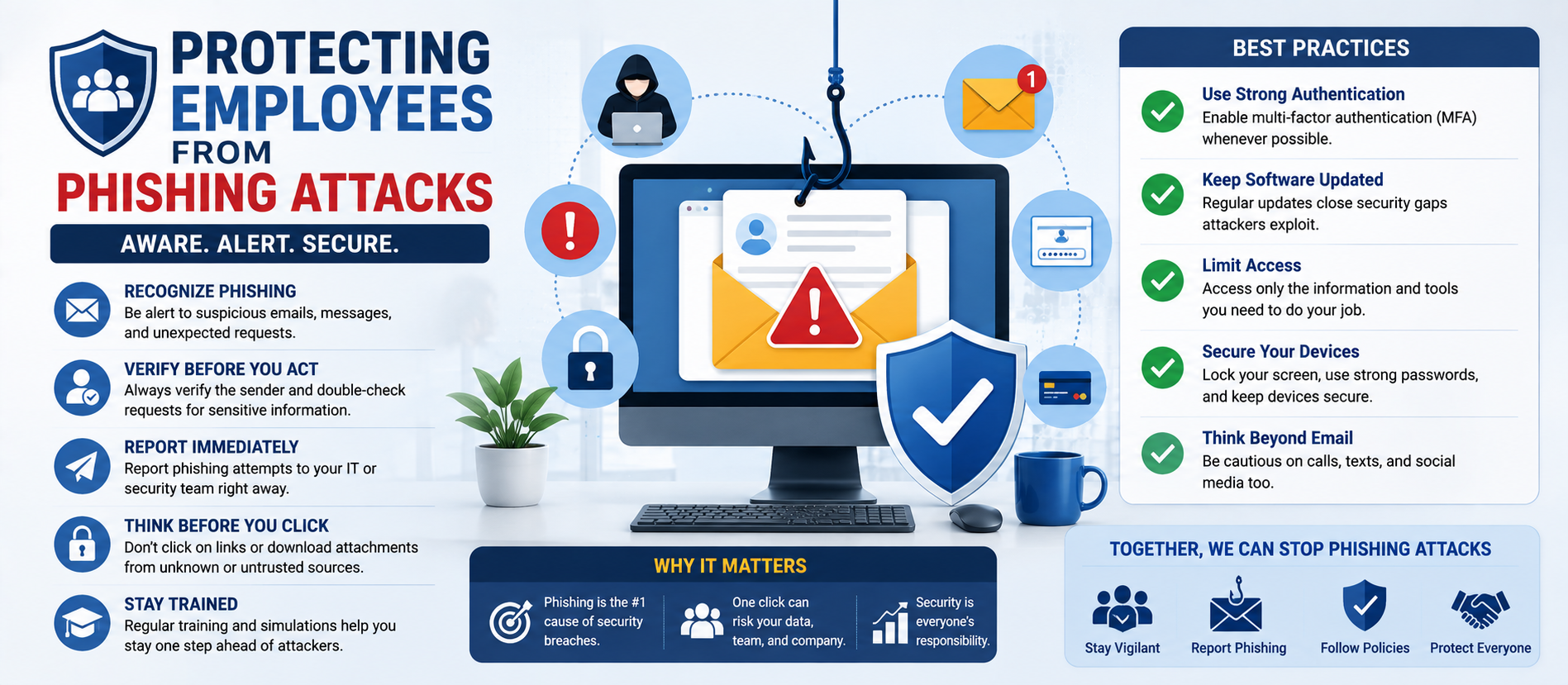
Protecting employees from phishing attacks requires more than telling staff to “be careful with email.” Modern phishing campaigns can imitate trusted brands, coworkers, suppliers, executives, cloud services, and login pages. Attackers may use urgency, fear, curiosity, payment requests, fake document-sharing notices, or stolen business context to persuade employees to click, sign in, transfer money, or disclose information.
💡 Key Insight
Employees are an important part of an organization's security defense, but they should not be treated as the only security control. Strong email security, identity protection, phishing-resistant multi-factor authentication (MFA), access controls, reporting processes, endpoint security, and regular training should work together.
CISA recommends phishing awareness training, rapid reporting of suspected phishing, email protections, and phishing-resistant MFA. NIST also recommends cybersecurity learning programs designed to produce behavior change and continuously improve through measurement. citeturn0search25turn0search2
This WordPress-ready HTML article is prepared for Digiifrog (www.digiifrog.com) with SEO, AEO, GEO, and AI Search optimization.
What Is a Phishing Attack?
Phishing is a form of social engineering in which an attacker attempts to manipulate a person into revealing information, opening malicious content, visiting a fraudulent website, approving an unauthorized request, or taking another action that benefits the attacker.
Phishing can arrive through email, text messages, collaboration platforms, social media, phone calls, or other communication channels. A campaign may target one employee or thousands of people.
1. Teach Employees What Phishing Really Looks Like
⚠ Watch Out
Employees should learn to recognize patterns rather than memorize a fixed list of suspicious words. Warning signs can include unexpected login requests, urgent payment demands, unusual attachments, requests for passwords or MFA codes, unfamiliar domains, unexpected invoices, and messages that create strong emotional pressure.
NIST's phishing research emphasizes that phishing is a human-centered problem and that awareness programs can help people identify suspicious messages in realistic contexts. citeturn0search11turn0search0
2. Make Verification a Normal Business Habit
Training should teach employees what to do when a request feels unusual. If a manager suddenly asks for a large payment, a supplier requests new bank details, or an executive asks for sensitive documents, employees should verify the request through a trusted communication channel.
Verification should not depend on replying to the suspicious message. Employees can call a known number, start a new conversation, or use an established internal process.
3. Build a Simple Phishing Reporting Process
Employees need a fast and obvious way to report suspicious messages. A reporting button in the email client, a dedicated security mailbox, or an internal reporting workflow can make the process easier.
Employees should know that reporting a suspicious message is a positive security behavior—even when the message turns out to be legitimate. CISA guidance recommends promptly reporting phishing incidents and developing a documented incident-response plan. citeturn0search25
4. Use Phishing-Resistant MFA
MFA adds protection when a password is stolen, but not every MFA method provides the same resistance to phishing. CISA strongly recommends moving toward phishing-resistant MFA, and notes that some common methods can still be targeted by attackers. citeturn0search24
Organizations should prioritize phishing-resistant MFA for privileged accounts and other high-value access. CISA also recommends MFA for services such as email, file sharing, and financial accounts. citeturn0search24turn0search25
5. Teach Employees Never to Share MFA Codes
An employee may correctly understand that MFA is important but still approve a fraudulent login request. Attackers can trigger repeated authentication prompts or create fake login pages designed to capture credentials and authentication information.
Employees should treat unexpected MFA prompts as potential security events and report them rather than approving them simply to make the notifications stop.
6. Strengthen Email Security
Employee awareness works better when technology blocks obvious threats before messages reach inboxes. Email security controls can filter malicious links, attachments, domains, and suspicious messages.
CISA guidance also recommends email authentication technologies such as SPF and DKIM and filtering mechanisms that block known malicious indicators. citeturn0search27
7. Protect Accounts With Strong Identity Controls
Use unique credentials, appropriate password policies, MFA, least privilege, and separate privileged accounts. Remove inactive accounts and unnecessary access promptly.
CISA notes that MFA reduces the impact of compromised passwords and recommends phishing resistance as an important factor when selecting MFA solutions. citeturn0search26
8. Use Role-Based Phishing Training
Not every employee faces the same phishing risk. Finance teams may encounter payment fraud and invoice scams. HR employees may receive fake résumé attachments or requests involving employee records. Executives may be targeted for impersonation and business-email-compromise attempts. IT administrators may face credential theft aimed at privileged systems.
NIST's security-learning guidance supports tailoring training to organizational roles and environments rather than treating every learner identically. citeturn0search1turn0search2
9. Run Safe Phishing Simulations
Simulated phishing exercises can help organizations understand how employees respond to realistic messages. NIST's Phish Scale provides a method for evaluating the human difficulty of phishing emails used in awareness programs. citeturn0search0
Simulations should be designed for learning, not embarrassment. Employees should receive useful feedback and have a clear way to improve.
10. Measure Behavior, Not Just Course Completion
A security awareness program should not be judged only by how many employees completed a training module. Better measures can include reporting rates, time to report, repeat-risk patterns, simulation outcomes, MFA adoption, and the number of successful phishing incidents.
NIST recommends a lifecycle approach to cybersecurity and privacy learning programs, including metrics and evaluation methods that help organizations improve programs as needs change. citeturn0search2
11. Make Reporting Non-Punitive
Employees are more likely to report mistakes when they believe the organization wants to fix problems rather than punish people for making honest errors. A culture of rapid reporting can reduce the time between a phishing click and security-team intervention.
Use reports to improve controls, training, and processes.
12. Protect Sensitive Information With Access Controls
Even if a phishing attack succeeds, least privilege can limit what an attacker can reach. Employees should receive only the access needed for their roles, while sensitive systems should have additional controls.
Separate administrator accounts, conditional access, session controls, device security, and monitoring can reduce the impact of compromised credentials.
13. Prepare for Business Email Compromise
Phishing is not always about stealing passwords. Attackers may impersonate executives, vendors, customers, or partners to request money, change payment instructions, obtain confidential documents, or redirect communications.
Organizations should establish verification rules for financial transactions and sensitive requests. For example, changing supplier bank details should require an independent verification step.
14. Create a Phishing Incident Response Plan
The organization should define what happens after an employee reports a suspicious message or admits that they clicked a malicious link. The process may include isolating the affected device, resetting credentials, reviewing authentication logs, checking mailbox activity, blocking malicious domains, and determining whether data was accessed.
15. Build a Layered Defense
The strongest phishing defense combines people, processes, and technology. A practical layered approach includes security awareness, phishing-resistant MFA, secure email gateways, identity controls, endpoint protection, web filtering, logging, backups, incident response, and regular testing.
No single control can stop every phishing campaign. Layering controls creates multiple opportunities to prevent, detect, and contain an attack.
Employee Phishing Protection Checklist
- Train employees to recognize modern social-engineering tactics.
- Teach independent verification for unusual requests.
- Provide a simple phishing-reporting mechanism.
- Implement phishing-resistant MFA where practical.
- Never ask employees to share passwords or MFA codes.
- Use email filtering and authentication controls.
- Apply least privilege and separate privileged accounts.
- Tailor training to high-risk roles.
- Use realistic simulations for learning.
- Measure reporting behavior and incident outcomes.
- Maintain a documented phishing-response process.
- Review controls and training regularly.
SEO, AEO, GEO and AI Search Optimization
SEO content about phishing protection should target searches such as “how to protect employees from phishing,” “employee phishing training,” “phishing prevention for businesses,” and “phishing awareness best practices.”
AEO should directly answer questions such as “How can companies prevent employee phishing attacks?”, “What should employees do when they receive a suspicious email?”, and “Does MFA stop phishing?”
GEO and AI Search optimization can be improved with clear definitions, actionable checklists, current CISA and NIST guidance, role-specific examples, structured headings, FAQs, and concise answers.
Frequently Asked Questions About Protecting Employees From Phishing
How can a company protect employees from phishing?
Use layered protection: employee awareness training, simple reporting, strong email security, phishing-resistant MFA, least privilege, identity monitoring, incident response, and regular testing. CISA recommends combining training with technical controls rather than relying on awareness alone. citeturn0search25turn0search27
What should an employee do after clicking a phishing link?
Report the incident immediately through the organization's established channel. The security team may need to isolate the device, reset credentials, revoke sessions, review logs, and determine whether information was accessed.
Does MFA prevent phishing?
MFA provides an important additional layer, but not every MFA method is phishing-resistant. CISA recommends phishing-resistant MFA because some common MFA methods can still be attacked. citeturn0search24turn0search26
How often should employees receive phishing training?
Training should be ongoing and updated as threats and business systems change. NIST recommends a lifecycle approach that includes regular evaluation and improvement rather than treating awareness as a one-time activity. citeturn0search2
Conclusion
Protecting employees from phishing attacks requires a security culture supported by strong technology and clear processes. Employees should know how phishing works, how to verify unusual requests, how to report suspicious activity, and why unexpected MFA prompts should be treated seriously.
At the same time, organizations should not place the entire burden on employees. Phishing-resistant MFA, secure email controls, least privilege, identity monitoring, incident response, and layered security can reduce the consequences of human mistakes.
NIST's current cybersecurity learning guidance emphasizes continuous improvement, behavior change, role-based learning, and measurement. CISA likewise recommends phishing awareness training, reporting, email protections, and phishing-resistant MFA. citeturn0search2turn0search25
For businesses seeking modern websites, cybersecurity content, automation, SEO, AEO, GEO, and AI Search optimization, Digiifrog can help. Visit www.digiifrog.com.
Quick Answer: How Can Businesses Protect Employees From Phishing?
Businesses can reduce phishing risk by combining employee awareness training with phishing-resistant MFA, strong email filtering, identity and access controls, easy incident reporting, role-based simulations, least privilege, and a documented response process. Employees should be encouraged to verify unusual requests and report suspicious messages immediately rather than handling them alone.
Important Note
This article is educational content and is not a substitute for a professional cybersecurity assessment. Organizations should adapt phishing controls and training to their systems, workforce, threat environment, regulatory obligations, and risk tolerance.
Ready to Grow?
Talk to us about a strategy tailored to your brand — we will help you stand out in search, AI discovery and social.
Comments (0)
Log in to leave a comment.