📋 Quick Summary
In this article:
Quick Answer: What Kitchen Remodeling Trends Do Homeowners Love?
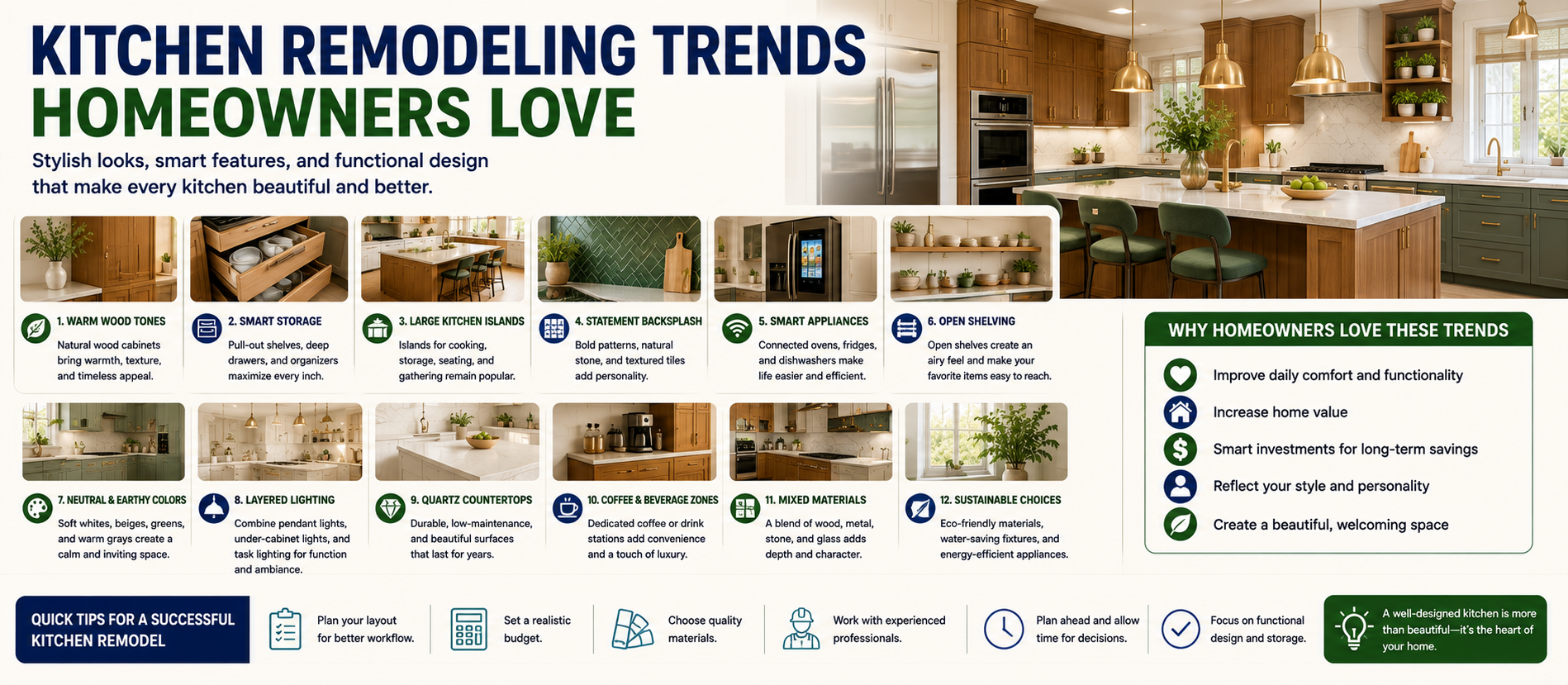
1. Warm Wood Cabinets Are Bringing Character Back
2. Smarter Storage Is Becoming a Top Priority
3. Specialty Zones Make Kitchens More Personal
4. Kitchen Islands Are Becoming More Functional
5. Natural and Organic Materials Create a Warmer Look
6. Statement Backsplashes Add Personality
7. Layered Lighting Is Essential
8. Integrated and Panel-Ready Appliances Create a Cleaner Look
9. Transitional Design Remains a Safe Choice
Focus Keyword: Kitchen Remodeling Trends Homeowners Love
The kitchen has become more than a place to prepare meals. It is often a space for family time, entertaining, remote work, storage, and everyday routines. Because of this, homeowners are looking for kitchen remodeling ideas that improve both appearance and function.
Today's most popular kitchen remodeling trends focus on practical design. Homeowners want better storage, easier movement, durable materials, useful lighting, personalized work zones, and designs that can remain appealing for years. Style still matters, but function is becoming a major reason for remodeling.
This guide explores kitchen remodeling trends homeowners love and explains why these ideas are becoming popular. The goal is not to tell every homeowner to follow every trend. A successful kitchen remodel should fit the home, the available space, the household's routines, and the project budget.
Digiifrog creates useful, clear, and search-optimized digital content for businesses and service providers. Visit www.digiifrog.com.
Quick Answer: What Kitchen Remodeling Trends Do Homeowners Love?
Popular kitchen remodeling trends include warm wood cabinetry, improved storage, dedicated activity zones, large or highly functional islands, natural-looking materials, slab backsplashes, layered lighting, integrated appliances, smart technology, accessible features, and personalized spaces such as coffee or beverage stations.
The strongest trend is a shift toward kitchens that work better in everyday life. Instead of remodeling only for appearance, many homeowners are using renovation projects to improve storage, organization, comfort, and long-term usability.
1. Warm Wood Cabinets Are Bringing Character Back
Warm wood cabinetry is a major direction in modern kitchen design. Wood adds texture and visual depth while helping the room feel more natural and comfortable.
Homeowners can use wood throughout the kitchen or combine it with painted cabinets. Light and medium tones can create an open appearance, while darker woods can add contrast and a more dramatic feel.
Popular approaches include:
- Natural wood grain on lower cabinets.
- Wood islands paired with lighter perimeter cabinets.
- White oak and other warm-toned finishes.
- Mixed wood and painted cabinet designs.
- Flat or simple cabinet fronts that allow the material to stand out.
The appeal of wood is its ability to work with several styles. It can fit a transitional kitchen, a modern space, an organic design, or a more traditional room.
2. Smarter Storage Is Becoming a Top Priority
A beautiful kitchen can still be frustrating if it does not provide enough useful storage. Homeowners increasingly want storage that supports daily routines and reduces visible clutter.
Modern kitchen storage can include:
- Deep drawers for cookware.
- Pullout organizers.
- Vertical storage for trays and cutting boards.
- Pantry cabinets.
- Walk-in or butler's pantries.
- Hidden appliance storage.
- Built-in recycling and waste systems.
- Drawer dividers and custom organizers.
The goal is not simply to add more cabinets. It is to make existing space easier to use. A well-planned drawer near the cooking area can be more useful than a large cabinet located across the room.
3. Specialty Zones Make Kitchens More Personal
One major remodeling trend is the creation of dedicated areas for specific activities. Instead of using every counter for every task, homeowners are designing zones that support the way they actually live.
Popular Kitchen Zones
- Coffee and espresso stations.
- Beverage centers.
- Baking stations.
- Breakfast areas.
- Snack storage.
- Pet feeding areas.
- Prep stations.
- Hidden small-appliance areas.
A dedicated zone can improve organization and reduce traffic in the main cooking area. For example, a coffee station can allow one person to prepare a drink while another person uses the main countertop for cooking.
4. Kitchen Islands Are Becoming More Functional
The kitchen island remains a popular feature, but homeowners increasingly expect it to do more than provide extra counter space.
A modern island may include:
- Deep storage drawers.
- Seating.
- A sink or cooking surface.
- Integrated appliances.
- Charging areas.
- Specialized storage.
- A different countertop material for visual interest.
Before choosing a large island, consider the available space and walking paths. An oversized island can create circulation problems in a smaller kitchen. The best island is one that provides useful workspace without making the room feel crowded.
5. Natural and Organic Materials Create a Warmer Look
Many homeowners are moving toward materials with natural texture and visual variation. Wood, stone, textured tile, and other organic-looking finishes can make a kitchen feel less like a showroom and more connected to the rest of the home.
Popular material directions include:
- Natural or natural-looking stone.
- Quartz and quartzite surfaces.
- Wood cabinetry and flooring.
- Handcrafted or textured tile.
- Warm neutral finishes.
- Mixed materials with complementary textures.
The key is balance. A kitchen does not need every surface to be highly textured. Combining a few natural materials with simpler finishes can create a calm and cohesive design.
6. Statement Backsplashes Add Personality
Backsplashes are becoming a stronger design feature. Homeowners may use color, texture, pattern, unusual tile shapes, or continuous slab materials to create a focal point.
A statement backsplash can work especially well behind a range or on a prominent wall. It can introduce personality without requiring every cabinet or countertop to use a bold finish.
When selecting a backsplash, consider:
- Ease of cleaning.
- Grout maintenance.
- Color coordination.
- Durability.
- How the material looks with lighting.
- Whether the design will remain appealing over time.
Large-format slabs can create a seamless look, while tile can offer more pattern and texture. The right choice depends on maintenance preferences and the overall design.
7. Layered Lighting Is Essential
Good kitchen lighting is no longer limited to one ceiling fixture. A well-designed kitchen often uses several layers of light for different purposes.
Common Lighting Layers
- Ambient lighting for overall visibility.
- Task lighting for counters and work areas.
- Under-cabinet lighting.
- Interior cabinet lighting.
- Pendant lighting over an island.
- Decorative statement fixtures.
Layered lighting can improve safety and make the kitchen feel more inviting. It also gives homeowners more control. Bright task lighting may be useful while cooking, while softer lighting can create a comfortable setting for dining or entertaining.
8. Integrated and Panel-Ready Appliances Create a Cleaner Look
Integrated appliances help create a more unified kitchen appearance. Panel-ready refrigerators and dishwashers can blend with surrounding cabinetry, reducing visual interruptions.
This approach is especially useful in open-plan homes where the kitchen is visible from living and dining areas. It can make the room feel more connected to the rest of the home.
Integrated appliances may increase design and installation complexity, so homeowners should include appliance specifications early in the planning process.
9. Transitional Design Remains a Safe Choice
Many homeowners prefer a kitchen that combines traditional warmth with modern simplicity. This approach is often described as transitional design.
A transitional kitchen may use:
- Simple cabinet profiles.
- Warm neutral colors.
- Natural materials.
- Modern lighting.
- Classic proportions.
- Limited decorative detail.
The appeal is longevity. A highly themed kitchen can feel tied to a specific period, while a balanced design may adapt more easily to changing furniture, paint colors, and accessories.
10. Soft Neutrals, Greens, and Blues Add Color Carefully
Neutral colors remain useful because they work with many materials and can create a calm base. At the same time, homeowners are using green and blue to add personality.
Color can appear on:
- Cabinets.
- The island.
- The backsplash.
- Wallpaper.
- Accent walls.
- Decorative accessories.
Instead of using many competing colors, a controlled palette often produces a more cohesive result. A neutral kitchen can also gain character through wood grain, metal finishes, tile texture, and lighting.
11. Curves and Soft Shapes Add Visual Comfort
Kitchen design is gradually moving beyond rigid rectangular forms. Rounded islands, curved peninsulas, arched openings, and softer architectural details can make a space feel more relaxed.
Curved features should still support practical movement. A beautiful rounded island should not reduce needed work space or make storage difficult.
12. Smart Kitchen Technology Is Becoming More Practical
Smart technology is increasingly being used to improve convenience rather than simply add novelty. Depending on the household, useful features may include connected appliances, app-controlled lighting, touchless or advanced fixtures, and built-in charging.
Technology should solve a real problem. Before investing in a connected feature, ask:
- Will the household actually use it?
- Is it easy to control?
- Can it be maintained or updated?
- Does it improve convenience, safety, or efficiency?
A kitchen does not need to become fully automated. A few carefully selected features may provide more long-term value than a large number of complex devices.
13. Accessibility and Aging-in-Place Design Are Growing in Importance
Homeowners are increasingly thinking about how a kitchen can remain comfortable as their needs change. Accessible and aging-in-place ideas can also improve convenience for people of different ages and abilities.
Features may include:
- Wide, clear pathways.
- Easy-to-reach storage.
- More drawers and fewer deep lower cabinets.
- Comfortable work heights.
- Thoughtful lighting.
- Easy-to-use hardware.
- Reduced physical barriers.
Not every kitchen needs every accessibility feature. The best approach is to consider the household's present and future needs during the planning stage.
14. Wellness-Focused Kitchens Support Healthy Routines
Kitchen design can support healthier routines through better organization, ventilation, lighting, food storage, and easier meal preparation.
Examples include:
- Strong ventilation systems.
- Organized food storage.
- Spacious refrigerators.
- Dedicated produce or beverage areas.
- Easy access to frequently used tools.
- Connections to outdoor spaces where practical.
Wellness-focused design does not require a specific visual style. It is mainly about making the kitchen comfortable and useful for the people who use it.
15. Open Layouts Are Being Refined, Not Always Maximized
Open kitchens remain popular, but homeowners are also looking for ways to control clutter and define activities. A completely open room is not always the answer.
Modern layouts may use islands, peninsulas, partial separations, pantries, or specialized prep spaces to maintain connection while improving organization.
The best layout depends on how many people use the kitchen and how often cooking, entertaining, working, and other activities happen at the same time.
16. Hidden Storage Helps Keep Counters Clear
Small appliances can quickly fill valuable countertop space. Appliance garages, pantry storage, and dedicated cabinets can keep frequently used items accessible without leaving them permanently visible.
This trend supports a cleaner appearance without requiring homeowners to give up useful equipment. The key is convenience. If storage is difficult to reach, appliances may simply return to the counter.
17. Mixed Materials Create Depth Without Excessive Decoration
Homeowners are mixing wood, stone, metal, paint, and tile to create visual interest. A successful mixed-material design usually uses a limited palette and repeated tones.
For example, a kitchen might combine warm wood cabinets, a light stone countertop, a textured backsplash, and simple metal hardware. The materials are different, but the colors and overall mood remain connected.
18. Better Ventilation Is Both a Functional and Design Upgrade
Ventilation is an important part of kitchen planning. A well-designed vent hood can help manage cooking-related smoke, odors, and heat. It can also become a visual feature.
Homeowners can choose a concealed hood, a simple integrated design, or a more prominent statement hood. The choice should consider cooking habits, kitchen layout, local requirements, and the selected appliance.
19. Sustainable Choices Are Becoming Part of the Planning Conversation
Some homeowners are considering durability, efficient appliances, responsible material selection, and long product life when planning a remodel.
A sustainable choice is not limited to one product category. Keeping a cabinet layout that still works, selecting durable materials, repairing where practical, and choosing appliances that match actual household needs can all support a more thoughtful remodeling strategy.
Always review current product specifications and local requirements before making efficiency or environmental claims.
20. The Best Trend Is a Kitchen Designed for the Household
Not every trend belongs in every home. A family that cooks large meals may need extensive prep space. A small household may prefer a compact beverage station and simplified storage. Someone planning to remain in the home for many years may prioritize accessibility and durable materials.
Before selecting finishes, make a list of daily problems with the existing kitchen. Common questions include:
- Is there enough storage?
- Are counters easy to use?
- Do people block each other while cooking?
- Is the lighting adequate?
- Are frequently used items easy to reach?
- Does the layout support entertaining?
- What features cause daily frustration?
These answers should guide the remodeling plan.
How to Combine Trends Without Creating a Dated Kitchen
Homeowners do not need to copy an entire showroom. A more balanced approach is to use a durable foundation and add personality through elements that are easier to update.
For example:
- Choose a practical cabinet layout.
- Select durable countertops.
- Invest in useful lighting.
- Add personality through color, hardware, tile, and fixtures.
- Prioritize storage before decorative extras.
This approach can help the kitchen remain useful even as design preferences change.
Kitchen Remodeling Budget Priorities
A remodeling budget should reflect both the desired appearance and the work required to make the kitchen function properly. Major costs may include cabinetry, labor, appliances, countertops, plumbing, electrical work, lighting, flooring, permits, and unexpected repairs.
💡 Key Insight
Before choosing decorative upgrades, make sure the budget accounts for essential work. Hidden conditions, outdated wiring, plumbing changes, structural needs, and material delays can affect the project.
It is useful to rank features by priority:
- Essential repairs and required work.
- Layout and functionality.
- Storage.
- Durable surfaces and appliances.
- Lighting and ventilation.
- Decorative upgrades.
This does not mean decorative elements are unimportant. It simply helps homeowners protect the most important parts of the project first.
Questions to Ask Before Starting a Kitchen Remodel
About the Layout
- Does the current layout create traffic problems?
- Where are the main preparation and cooking areas?
- Will the island improve function or reduce space?
- Is there enough room for doors, drawers, and appliances to operate?
About Storage
- What items need dedicated storage?
- Would more drawers improve access?
- Is a pantry or specialty zone useful?
- Where should small appliances be stored?
About Style
- Which materials fit the rest of the home?
- Which elements are timeless foundations?
- Where can personality be added?
- Will the color palette remain comfortable over time?
About the Project
- What permits or approvals may be required?
- How will plumbing and electrical changes affect the scope?
- What is the expected project sequence?
- How will temporary kitchen needs be managed?
- How will unexpected conditions be handled?
SEO, AEO, GEO, and AI Search Optimization for Kitchen Remodeling Businesses
Kitchen remodeling companies can improve digital visibility by publishing clear answers to real homeowner questions. Traditional SEO benefits from useful service pages, organized headings, and relevant search terms. AEO benefits from direct answers and FAQ-style content. GEO and AI Search optimization benefit from specific, accurate information that explains processes, options, and local service details.
Useful topics include:
- What are the latest kitchen remodeling trends?
- How do I plan a kitchen remodel?
- What kitchen layout is best for my home?
- How can I add more kitchen storage?
- Are wood cabinets a good choice?
- What should a kitchen remodeling estimate include?
- How do I choose kitchen countertops?
- What smart kitchen features are worth considering?
For local search visibility, businesses should clearly describe their service areas, remodeling services, process, experience, project examples, contact information, and relevant credentials. Local content should provide useful information instead of repeating location names without context.
Frequently Asked Questions
What is the biggest kitchen remodeling trend right now?
Function-focused design is one of the strongest directions. Homeowners are investing in better storage, specialty zones, useful islands, improved lighting, and layouts that support everyday routines.
Are wood kitchen cabinets popular?
Yes. Warm wood cabinetry is a major design direction because it adds texture and warmth while working with modern, transitional, and natural styles.
What kitchen features add convenience?
Popular convenience features include deep drawers, pantry storage, pullout organizers, under-cabinet lighting, beverage stations, integrated appliances, and carefully selected smart technology.
Are open kitchens still popular?
Yes, but many homeowners are refining open layouts with better storage, specialized work zones, and design features that help manage clutter and traffic.
How can I make a kitchen look modern without following every trend?
Start with a practical layout and durable materials. Add modern character through lighting, hardware, backsplash choices, paint, and other elements that can be updated more easily.
What should I prioritize in a kitchen remodel?
Priorities depend on the household, but layout, storage, essential repairs, durable surfaces, lighting, ventilation, and daily usability should usually be considered before purely decorative upgrades.
Final Thoughts
The kitchen remodeling trends homeowners love today have one major idea in common: the kitchen should work better. Warm materials, smarter storage, personalized zones, integrated technology, improved lighting, accessible design, and thoughtful layouts are all ways to create a more useful space.
The best remodel does not need every popular feature. It should solve the problems of the existing kitchen and support the people who use it. A clear plan, realistic budget, suitable materials, and professional guidance can help turn current trends into long-term value.
For clear, practical, SEO-friendly, AEO-ready, GEO-focused, and AI Search optimized digital content, visit Digiifrog at www.digiifrog.com.
Disclaimer: This article is for general informational purposes only. Kitchen remodeling costs, permits, building requirements, electrical work, plumbing requirements, product specifications, and other project conditions vary by location and property. Consult qualified professionals and verify applicable local requirements before beginning a remodeling project.
Ready to Grow?
Talk to us about a strategy tailored to your brand — we will help you stand out in search, AI discovery and social.

Comments (0)
Log in to leave a comment.