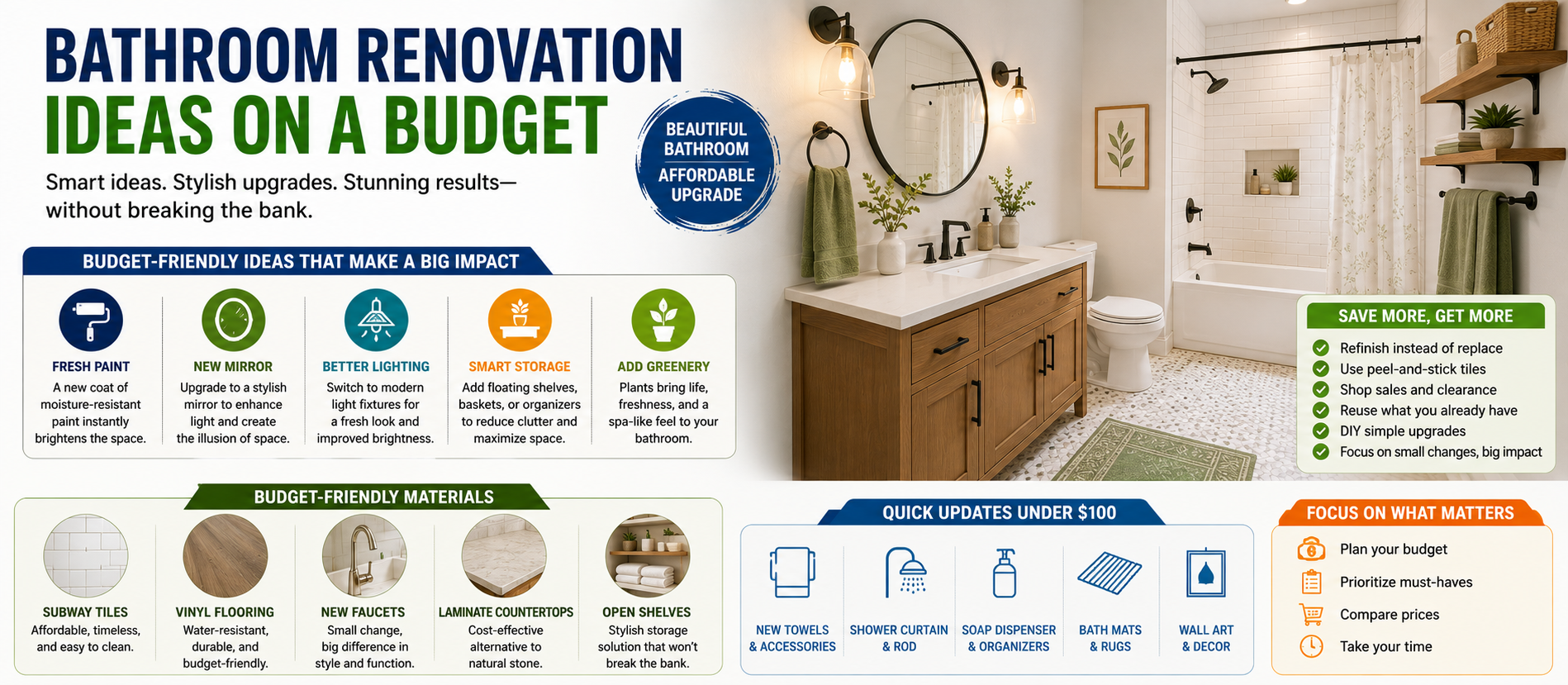
📋 Quick Summary
In this article:
What Is a Budget Bathroom Renovation?
Why Bathroom Renovations Can Become Expensive
1. Set a Clear Bathroom Renovation Budget
2. Keep the Existing Layout
3. Refresh Rather Than Replace Everything
4. Paint the Bathroom Walls
5. Use Light Colors Strategically
6. Upgrade the Bathroom Mirror
7. Improve Bathroom Lighting
8. Replace Cabinet Handles and Hardware
9. Add Open Shelving
10. Use Vertical Storage
💡 Key Insight
Renovating a bathroom does not always require a luxury budget or a complete demolition. With thoughtful planning, the right priorities, and a clear distinction between essential repairs and cosmetic improvements, homeowners can create a cleaner, more modern, functional bathroom without spending unnecessarily.
Bathroom renovation ideas on a budget work best when money is directed toward the parts of the room that affect safety, water management, durability, and daily convenience first. Waterproofing, plumbing, drainage, ventilation, electrical safety, and damaged surfaces should receive priority before decorative upgrades. Current renovation guidance for Indian homes also emphasizes maintaining the existing layout where possible because moving plumbing and drainage can increase labor and project complexity. citeturn0search1turn0search2
A budget renovation can include simple changes such as repainting, replacing cabinet hardware, upgrading lighting, installing a larger mirror, improving storage, changing fixtures, refreshing grout, or replacing selected tiles. More extensive projects may involve new sanitaryware, waterproofing, plumbing upgrades, flooring, shower areas, or a complete bathroom redesign.
The key is to decide which improvements create the greatest practical and visual impact for the money available. A small bathroom can often look significantly better without changing its footprint. Budget-friendly design guidance frequently recommends keeping the existing plumbing layout, using practical materials, improving lighting and mirrors, and adding compact storage rather than making unnecessary structural changes. citeturn0search2turn0search3
This WordPress-ready HTML article is prepared for Digiifrog (www.digiifrog.com) with a strong focus on SEO, AEO, GEO, and AI Search optimization.
What Is a Budget Bathroom Renovation?
A budget bathroom renovation is a planned improvement project that focuses spending on essential repairs and high-impact upgrades rather than expensive structural changes. It does not necessarily mean choosing the cheapest available products. Instead, it means getting the best combination of function, durability, appearance, and cost.
For example, keeping a toilet, basin, shower, and drain in their existing locations can reduce plumbing work. Replacing an outdated mirror, light fixture, faucet, cabinet handles, or shower fitting may create a noticeable visual improvement without requiring a complete rebuild.
For Indian homes, current renovation cost guides point out that small bathrooms do not always cost proportionally less than larger bathrooms because fixed costs such as sanitaryware, plumbing, electrical work, labor minimums, doors, and other essential components remain significant. citeturn0search0
Why Bathroom Renovations Can Become Expensive
Bathrooms combine several building systems in a small space. Plumbing, electrical work, waterproofing, drainage, tiling, ventilation, fixtures, cabinetry, and finishing all have to work together.
Renovation can also uncover hidden problems behind old tiles, floors, walls, or fixtures. Current Indian renovation guidance notes that demolition and rebuilding can reveal issues that were not visible before the project began. citeturn0search1
This is why a realistic budget should include a contingency rather than allocating every available rupee or dollar to visible finishes.
1. Set a Clear Bathroom Renovation Budget
Start by deciding how much you can comfortably spend. Divide the budget into essential work, functional upgrades, cosmetic improvements, and contingency funds.
- Essential: waterproofing, leaks, drainage, unsafe electrical work, damaged plumbing, structural repairs.
- Functional: storage, lighting, ventilation, efficient fixtures, better shower hardware.
- Cosmetic: paint, accessories, mirrors, decorative hardware, selected tile upgrades.
- Contingency: unexpected plumbing, substrate, waterproofing, or repair issues.
Do not begin by choosing expensive tiles and then discover that the budget has no room for necessary waterproofing or plumbing repairs.
2. Keep the Existing Layout
⚠ Watch Out
One of the most effective ways to control renovation costs is to avoid moving major plumbing and drainage points unless there is a compelling reason. Keeping the toilet, basin, shower, and floor drain in approximately the same locations can reduce demolition, pipework, labor, and finishing changes.
This strategy is particularly useful for compact bathrooms where a complete layout change may produce a relatively small functional benefit compared with its cost. Design guidance for low-cost Indian bathrooms similarly recommends maintaining the existing layout where possible. citeturn0search2
3. Refresh Rather Than Replace Everything
Before removing a bathroom cabinet, mirror, shower enclosure, or vanity, ask whether the existing item can be cleaned, repaired, painted, refinished, or upgraded with new hardware.
A dated vanity can sometimes look substantially better with a new finish, handles, countertop accessories, or improved lighting. A sound mirror may only need better lighting around it rather than complete replacement.
4. Paint the Bathroom Walls
A fresh coat of suitable bathroom paint can create a significant visual difference at relatively low material cost. Choose a product appropriate for humid environments and prepare the surface properly.
Do not paint over active leaks, damp walls, peeling material, or mold caused by unresolved moisture. Repair the underlying problem first.
5. Use Light Colors Strategically
Light and visually simple color schemes can make compact bathrooms feel brighter and more open. White, soft gray, warm neutral, pale green, muted blue, and other light tones can work well depending on the room's natural and artificial lighting.
Color is not the only factor affecting perceived space, but combining lighter surfaces with good lighting and a large mirror can create a stronger sense of openness.
6. Upgrade the Bathroom Mirror
A larger or better-positioned mirror can become a major visual feature without requiring major construction. Mirrors can also reflect available light and make a compact room feel more spacious.
Current small-bathroom design advice frequently highlights mirrors as one of the relatively simple upgrades capable of creating a strong visual effect. citeturn0news28
7. Improve Bathroom Lighting
Lighting can change the appearance and usability of a bathroom dramatically. Consider a combination of general illumination and focused lighting around the mirror or vanity.
Replace outdated fixtures with appropriate modern options while ensuring that electrical work is performed safely and according to local requirements. Wet and damp locations require suitable electrical products and installation practices.
8. Replace Cabinet Handles and Hardware
Small hardware changes can make older cabinetry look more contemporary. Replacing handles, knobs, towel hooks, and other accessories is generally less expensive than replacing the entire cabinet.
Choose finishes that coordinate rather than mixing too many unrelated styles.
9. Add Open Shelving
Open shelves can provide inexpensive storage for towels, toiletries, baskets, and decorative items. They are especially useful where a full vanity or cabinet would make the room feel crowded.
Keep frequently used items organized and avoid overloading shelves, because visual clutter can make a small bathroom feel even smaller.
10. Use Vertical Storage
When floor space is limited, use the walls. Tall cabinets, narrow shelving, wall-mounted organizers, towel rails, and medicine cabinets can provide useful storage without taking up much floor area.
Compact bathrooms benefit from using vertical space because the floor remains relatively open for movement.
11. Add an Under-Sink Storage Solution
Pedestal sinks can look attractive but often provide little storage. A compact cabinet, freestanding unit, skirt, or narrow trolley can add practical storage without replacing the sink.
Recent design guidance specifically suggests under-sink cabinets, sink skirts, and narrow storage trolleys as ways to improve storage around pedestal sinks. citeturn0news26
12. Refresh Grout Instead of Replacing All Tiles
If tiles are structurally sound but the grout looks dirty or discolored, cleaning or renewing grout may produce a major visual improvement without the cost of removing the entire tile installation.
However, cracked tiles, loose tiles, persistent dampness, or failed waterproofing should be investigated before cosmetic grout work.
13. Replace Only Damaged Tiles
Full tile replacement is not always necessary. If most tiles remain in good condition, replacing a limited number of damaged tiles can reduce material and labor costs.
Keep a few spare tiles from the original installation if possible. Matching discontinued tiles years later can be difficult.
14. Consider a Feature Wall
Instead of using expensive premium tile throughout the bathroom, consider using a more affordable tile for most surfaces and a distinctive finish in one carefully selected area.
A feature wall behind the vanity or shower can create visual interest while limiting the quantity of expensive material required.
15. Choose Budget-Friendly Ceramic Tiles
Ceramic tiles can offer a practical balance of appearance, availability, and cost for many bathroom applications. Budget-focused Indian renovation guidance also recommends practical tile choices rather than automatically selecting expensive imported finishes. citeturn0search2turn0search6
Compare tile thickness, slip characteristics, intended application, water resistance, installation requirements, and long-term maintenance before buying.
16. Use Large-Format Tiles Carefully
Large-format tiles can create fewer visible grout lines and may make some small bathrooms feel more continuous. Design experts also suggest that larger tiles can reduce the number of grout lines that visually break up a compact room. citeturn0news28
However, large tiles can require a suitably flat substrate and skilled installation. They are not automatically cheaper simply because fewer tiles are used.
17. Upgrade the Showerhead
A new showerhead can improve the shower experience without changing the entire bathroom. Water-efficient models can also reduce water use.
Current consumer guidance highlights WaterSense-labeled low-flow showerheads as an example of a water-saving upgrade in markets where the WaterSense program applies. citeturn0news24
18. Install a Water-Efficient Faucet
Faucets and aerators can provide another relatively simple efficiency upgrade. A properly selected aerator can reduce water flow while maintaining useful performance.
For products carrying recognized efficiency labels, check the relevant standards in your country rather than assuming every low-flow product performs equally.
19. Consider a Water-Efficient Toilet
If the existing toilet is old, inefficient, damaged, or repeatedly problematic, replacement may be worthwhile. Efficient toilet models can reduce water consumption without sacrificing normal functionality when correctly selected and installed.
Water-saving product specifications vary by market, so compare certified performance information before purchasing.
20. Do Not Cut Costs on Waterproofing
Waterproofing is one of the areas where budget renovation should not mean the cheapest possible solution. A decorative finish can be replaced later; hidden water damage can become expensive.
Current bathroom renovation guidance for India repeatedly emphasizes waterproofing as a critical part of the project. citeturn0search1turn0search6
Use an appropriate waterproofing system for the substrate and installation conditions, and follow the manufacturer's preparation and curing requirements.
21. Inspect Plumbing Before Closing Walls
If tiles or walls are being removed, use the opportunity to inspect accessible plumbing. Old or damaged pipes, leaking joints, corroded fittings, or poor connections may be easier to address while surfaces are open.
Do not replace plumbing automatically without assessing its condition. The goal is to prevent unnecessary work while avoiding the mistake of closing up a known problem.
22. Improve Bathroom Ventilation
Ventilation is important because bathrooms generate moisture. A properly functioning exhaust fan or suitable natural ventilation can help manage humidity and reduce persistent condensation.
If the bathroom repeatedly develops dampness, peeling paint, or mildew, investigate ventilation and moisture sources before repainting or replacing finishes.
23. Upgrade the Exhaust Fan
If the existing exhaust fan is noisy, ineffective, or poorly positioned, a replacement may improve comfort and moisture management. Select a model suitable for the bathroom size and installation conditions.
Electrical installation should be performed safely and according to applicable local requirements.
24. Replace the Shower Curtain
A new shower curtain can create an inexpensive visual update. Choose a simple pattern or solid color that coordinates with the rest of the room.
For rental properties or very tight budgets, this can provide a noticeable improvement without changing the shower structure.
25. Update Towel Rails and Accessories
Towel rails, toilet-paper holders, hooks, shelves, and small accessories can make an older bathroom feel dated. Replacing a coordinated group can create a more intentional design.
Install accessories securely and avoid drilling into areas where waterproofing or hidden utilities could be damaged.
26. Refresh the Vanity
If the vanity cabinet is structurally sound, consider cleaning, repainting, replacing handles, improving internal storage, or updating the countertop rather than replacing the entire unit.
Make sure any paint or finish used on bathroom cabinetry is appropriate for the material and moisture exposure.
27. Choose a Compact Vanity
If the existing vanity takes up too much space, a compact model can improve circulation. Wall-mounted or floating designs can create more visible floor area, which may make a small bathroom feel less crowded.
Wall-mounted fixtures and compact storage are commonly recommended in budget-focused small bathroom design. citeturn0search2
28. Use a Shower Curtain Instead of Expensive Glass
A shower curtain can be significantly less expensive than a custom glass enclosure. It also provides flexibility if you want to change colors or patterns later.
Glass can create a more open visual effect, but it can involve higher material, hardware, installation, and maintenance costs.
29. Choose Simple, Timeless Design
Budget renovations benefit from avoiding overly complicated design choices. A simple palette, coordinated fixtures, practical storage, and clean lines can remain attractive for years.
Spending heavily on a short-lived trend can increase the likelihood of another cosmetic renovation later.
30. Mix Affordable and Premium Elements
You do not have to choose between an entirely cheap bathroom and an entirely luxury bathroom. Use the budget strategically.
- Save on large background surfaces where practical.
- Spend more on critical waterproofing.
- Invest in a reliable faucet or shower fitting.
- Use a quality mirror and good lighting.
- Choose durable hardware in high-use areas.
- Use decorative accents selectively.
31. Shop and Compare Prices
Compare prices across local suppliers, showrooms, online stores, and contractors. Ask for itemized quotations so you can see where the money is going.
Current Indian budget renovation guidance emphasizes comparing supplier prices and focusing spending on essential upgrades rather than expensive decorative changes. citeturn0search6
32. Buy Standard Sizes Where Possible
Standard-size sinks, toilets, vanities, mirrors, and fixtures are often easier to source and replace than unusual custom sizes. Standard products can also reduce installation complexity.
Before buying, confirm measurements and connection compatibility.
33. Plan Materials Before Demolition
Do not begin demolition without a clear plan for replacement materials. Delays caused by missing tiles, fixtures, fittings, or hardware can extend labor costs and make a bathroom unusable for longer.
Create a checklist containing every major item before work begins.
34. Keep a Renovation Contingency
Older bathrooms can contain hidden issues. A budget should therefore include an emergency reserve for unexpected repairs.
A contingency is especially important when demolition may expose damaged waterproofing, corroded plumbing, deteriorated substrate, or electrical problems.
35. Avoid Changing Too Many Things at Once
If the budget is limited, prioritize improvements with the greatest impact. A bathroom does not need a new floor, wall tile, vanity, toilet, shower, mirror, lighting system, and door simultaneously to feel updated.
Phased renovation can be a practical strategy when the existing infrastructure is sound.
36. Phase the Renovation
A phased project might begin with essential repairs and waterproofing, followed by lighting, storage, paint, and accessories. Later, you can replace a vanity or decorative feature when the budget allows.
This approach works best when the phases are planned together so that later work does not require undoing earlier improvements.
37. Decide What You Can DIY
Some cosmetic tasks may be appropriate for experienced homeowners, such as painting, installing certain accessories, assembling furniture, or organizing storage.
Plumbing, electrical work, waterproofing, gas-related equipment, structural changes, and other specialized tasks should be handled according to local regulations and by qualified professionals where required.
38. Do Not DIY Waterproofing Without Knowledge
Waterproofing failures can affect the bathroom and adjacent rooms or properties. Application methods, substrate preparation, curing, detailing around drains and penetrations, and compatibility between materials all matter.
Saving labor money on a critical waterproofing system can become expensive if the work fails.
39. Improve Safety on a Budget
Safety improvements can offer high value. Consider non-slip flooring where appropriate, secure grab points when needed, good lighting, clear floor space, and proper drainage.
Wet bathrooms can create fall hazards. A 2026 research direction on bathroom safety also emphasizes the importance of understanding interactions between people, wet surfaces, constrained layouts, and support features. citeturn0academia54
40. Make the Bathroom More Accessible
If the bathroom is used by older adults or people with mobility limitations, consider accessibility during renovation rather than treating it as an afterthought.
Depending on the household, useful improvements may include wider clearances, appropriately positioned grab bars, safer shower access, better lighting, contrasting surfaces, and reduced trip hazards.
41. Create a Better Small Bathroom Layout
Small bathrooms benefit from clear circulation. Avoid placing storage where it blocks the door, shower, toilet, or basin.
Measure the room carefully before purchasing fixtures. A product that looks compact in a showroom may be too large for your actual space.
42. Use One Consistent Fixture Finish
Using a consistent finish for faucets, shower fittings, handles, and accessories can make an inexpensive bathroom feel more coordinated.
Mixing finishes can work, but it requires deliberate design. A single finish is often easier to manage on a tight budget.
43. Upgrade the Bathroom Door
If the existing door is damaged or visually outdated, refinishing or repainting it may be more affordable than replacement. If space is extremely limited, a suitable sliding or space-saving door can improve circulation, but changing the door system may require additional construction.
44. Refresh the Floor Without Rebuilding Everything
If the floor is sound but unattractive, there may be options for cosmetic improvement depending on the existing material and local product availability. However, bathroom floors must continue to provide appropriate drainage and slip performance.
Do not cover a damaged or leaking floor simply to save money.
45. Use Decorative Accessories Carefully
Towels, baskets, plants suitable for bathroom conditions, artwork, trays, and small decorative items can create personality without major construction.
A few coordinated pieces usually look better than filling every available surface.
46. Budget Bathroom Renovation Cost Factors
There is no universal bathroom renovation price because cost depends on location, room size, labor, materials, plumbing condition, electrical work, waterproofing, demolition, disposal, tile selection, fixtures, and project scope.
Current 2026 Indian renovation guides describe wide ranges and emphasize that full renovations can cost substantially more than cosmetic refreshes because demolition, waterproofing, plumbing, electrical work, tiling, and labor are added together. citeturn0search1turn0search7
For this reason, a realistic project should be priced using an itemized scope rather than a single generic per-square-foot number.
47. Budget-Friendly Bathroom Renovation Priorities
A practical priority order is:
- Fix leaks and plumbing problems.
- Correct drainage problems.
- Address waterproofing.
- Improve unsafe electrical conditions.
- Improve ventilation and moisture control.
- Repair damaged walls, floors, or substrates.
- Upgrade essential fixtures.
- Improve lighting and storage.
- Refresh paint and grout.
- Add decorative accessories.
This approach protects the budget from being consumed by cosmetic upgrades while important building problems remain unresolved.
48. Common Budget Renovation Mistakes
Choosing Looks Over Function
A beautiful tile does not compensate for poor waterproofing or drainage.
Moving Plumbing Without a Strong Reason
Changing the layout can add labor, pipework, demolition, and finishing costs.
Buying Fixtures Before Measuring
Incorrect dimensions can create expensive returns or installation problems.
Ignoring Ventilation
Persistent moisture can damage paint, grout, cabinetry, and other finishes.
Using the Cheapest Materials Everywhere
Low purchase price can become expensive if products fail quickly or are difficult to maintain.
Skipping Professional Work for Critical Systems
Plumbing, electrical, waterproofing, and structural tasks can have consequences beyond the bathroom itself.
49. How to Hire a Bathroom Renovation Professional
Ask for a detailed written quotation that identifies demolition, disposal, waterproofing, plumbing, electrical work, tiling, fixtures, labor, and cleanup.
- Check relevant licenses or credentials where applicable.
- Verify insurance where appropriate.
- Ask for references or recent project examples.
- Confirm who will perform plumbing and electrical work.
- Ask how waterproofing will be tested or documented.
- Clarify payment milestones.
- Confirm warranty terms.
- Define what happens if hidden damage is discovered.
50. Bathroom Renovation Timeline
A cosmetic refresh can be relatively quick, while a full renovation can take considerably longer. Demolition, plumbing, waterproofing, curing, tiling, electrical work, fixture installation, and finishing all require coordination.
Do not rush waterproofing or curing simply to meet a preferred completion date. Current renovation guidance emphasizes that bathrooms involve multiple stages and that hidden conditions can affect the timeline. citeturn0search4
51. Smart Bathroom Upgrades on a Budget
Smart technology does not have to mean an expensive connected bathroom. Useful options can include efficient lighting controls, humidity-aware ventilation, water-use monitoring, leak sensors, or simple timers.
Choose technology based on a real household need rather than installing connected devices simply because they are fashionable.
52. Water-Saving Bathroom Improvements
Water-efficient fixtures can provide long-term savings. Current consumer guidance highlights efficient toilets, low-flow showerheads, and low-flow faucets or aerators as relatively practical water-saving upgrades. citeturn0news24
Always check the applicable efficiency standards and product certifications in your market.
53. Bathroom Renovation and Energy Efficiency
Energy efficiency can also be improved through efficient lighting, appropriate ventilation controls, and efficient hot-water equipment. If a water heater or geyser is being replaced, compare energy ratings and household requirements.
Do not install electrical products in wet locations without appropriate safety considerations and qualified installation.
54. Luxury Looks Without a Luxury Budget
A premium appearance often comes from consistency rather than expensive materials. A coordinated palette, clean grout lines, good lighting, a large mirror, simple hardware, and uncluttered storage can make a modest bathroom feel more polished.
Spend selectively on one or two focal points instead of making every component a premium feature.
55. Future Trends in Budget Bathroom Renovation
Bathroom renovation is increasingly influenced by water efficiency, compact storage, smart controls, digital design tools, accessible layouts, durable materials, and AI-assisted visualization.
Digital design tools can help homeowners compare layouts and colors before purchasing materials. AI-based visualization can also support concept development, although final decisions should be based on real measurements, material specifications, installation requirements, and professional advice.
56. Key Bathroom Renovation Trends for 2026
- Compact and space-saving layouts
- Wall-mounted or floating storage
- Large mirrors
- Efficient water fixtures
- Layered bathroom lighting
- Simple, coordinated fixture finishes
- Durable easy-maintenance surfaces
- Accessible bathroom features
- Smart leak and humidity monitoring
- AI-assisted bathroom visualization
Bathroom Renovation, SEO, AEO, GEO and AI Search
Bathroom renovation companies can also benefit from a strong digital content strategy. SEO helps renovation businesses appear in traditional search results. AEO focuses on direct answers to homeowner questions. GEO helps content become useful within generative search experiences, while AI Search optimization emphasizes structured, trustworthy, useful, and location-relevant information.
A bathroom renovation website should clearly explain remodeling services, waterproofing, plumbing, tiling, fixture installation, small bathroom design, budget renovation options, service areas, project timelines, cost factors, and frequently asked questions.
Helpful content can answer questions such as how to renovate a bathroom on a budget, how to reduce bathroom renovation costs, whether plumbing should be moved, what waterproofing costs, which tiles are practical, and how to make a small bathroom look larger.
Frequently Asked Questions About Bathroom Renovation Ideas on a Budget
What is the cheapest way to renovate a bathroom?
Keeping the existing layout, refreshing paint, improving lighting, updating the mirror and hardware, renewing grout, adding storage, and replacing only damaged or outdated fixtures can reduce costs compared with a full structural renovation.
How can I renovate a small bathroom on a budget?
Keep the plumbing layout, use compact fixtures, improve lighting, add vertical storage, use a larger mirror, choose a simple color palette, and spend money first on waterproofing and essential repairs.
Should I change the bathroom layout?
Only if the existing layout has a significant functional problem. Keeping plumbing and drainage locations can reduce demolition and labor costs. citeturn0search2
What should I not cheap out on in a bathroom renovation?
Do not compromise on waterproofing, drainage, plumbing integrity, electrical safety, structural repairs, or proper installation. These areas can create expensive problems if they fail.
How can I make a bathroom look expensive without spending a lot?
Use coordinated finishes, good lighting, a large mirror, uncluttered storage, clean grout, simple colors, quality-looking hardware, and one or two carefully selected focal features.
Are large tiles good for small bathrooms?
They can make a small bathroom feel more continuous because fewer grout lines are visible, but installation requirements and material costs should be considered. citeturn0news28
Can I renovate a bathroom in phases?
Yes. A phased plan can address essential repairs first and cosmetic improvements later, provided the phases are coordinated so future work does not undo completed work.
Is professional bathroom renovation worth it?
Professional help can be especially valuable for waterproofing, plumbing, electrical work, tiling, drainage, structural repairs, and complex layout changes. Cosmetic tasks may be suitable for capable DIY homeowners depending on local rules and experience.
Conclusion
The best bathroom renovation ideas on a budget focus on smart priorities rather than simply choosing the cheapest materials. Keep the existing layout when practical, repair leaks and plumbing problems first, protect the bathroom with proper waterproofing, improve ventilation, and then invest in high-impact visual upgrades such as paint, lighting, mirrors, storage, hardware, and selected tile improvements.
A small bathroom can look significantly more modern without a complete rebuild. Current design guidance supports strategies such as maintaining the existing layout, using compact storage, improving lighting, choosing practical materials, and using mirrors to create a stronger sense of space. citeturn0search2turn0news28
The most important rule is not to cut costs on hidden systems simply to afford decorative finishes. Waterproofing, drainage, plumbing, electrical safety, ventilation, and sound substrates protect the renovation investment. Cosmetic elements can be changed later, but water damage and failed infrastructure can become expensive.
For businesses looking to improve their digital presence, automate customer inquiries, build AI-powered websites, implement SEO, AEO, GEO, AI Search optimization, and develop modern technology solutions for renovation and home-service companies, Digiifrog can help. Visit www.digiifrog.com to learn more.
Quick Answer: What Are the Best Bathroom Renovation Ideas on a Budget?
The most effective budget bathroom upgrades are to keep the existing plumbing layout, prioritize waterproofing and repairs, refresh paint, improve lighting, install a larger mirror, add compact storage, update hardware and fixtures, renew grout, use practical tiles, improve ventilation, and choose water-efficient products. Spend first on safety, waterproofing, plumbing, drainage, and ventilation, then use affordable cosmetic improvements to create the visual transformation.
Research Notes
This article incorporates current 2026 renovation and design guidance reviewed from published sources covering bathroom renovation costs, low-cost Indian bathroom design, water-saving upgrades, small-bathroom ideas, and bathroom safety research. Costs and product availability vary by location, property condition, labor market, and project scope.
Ready to Grow?
Talk to us about a strategy tailored to your brand — we will help you stand out in search, AI discovery and social.


Comments (0)
Log in to leave a comment.