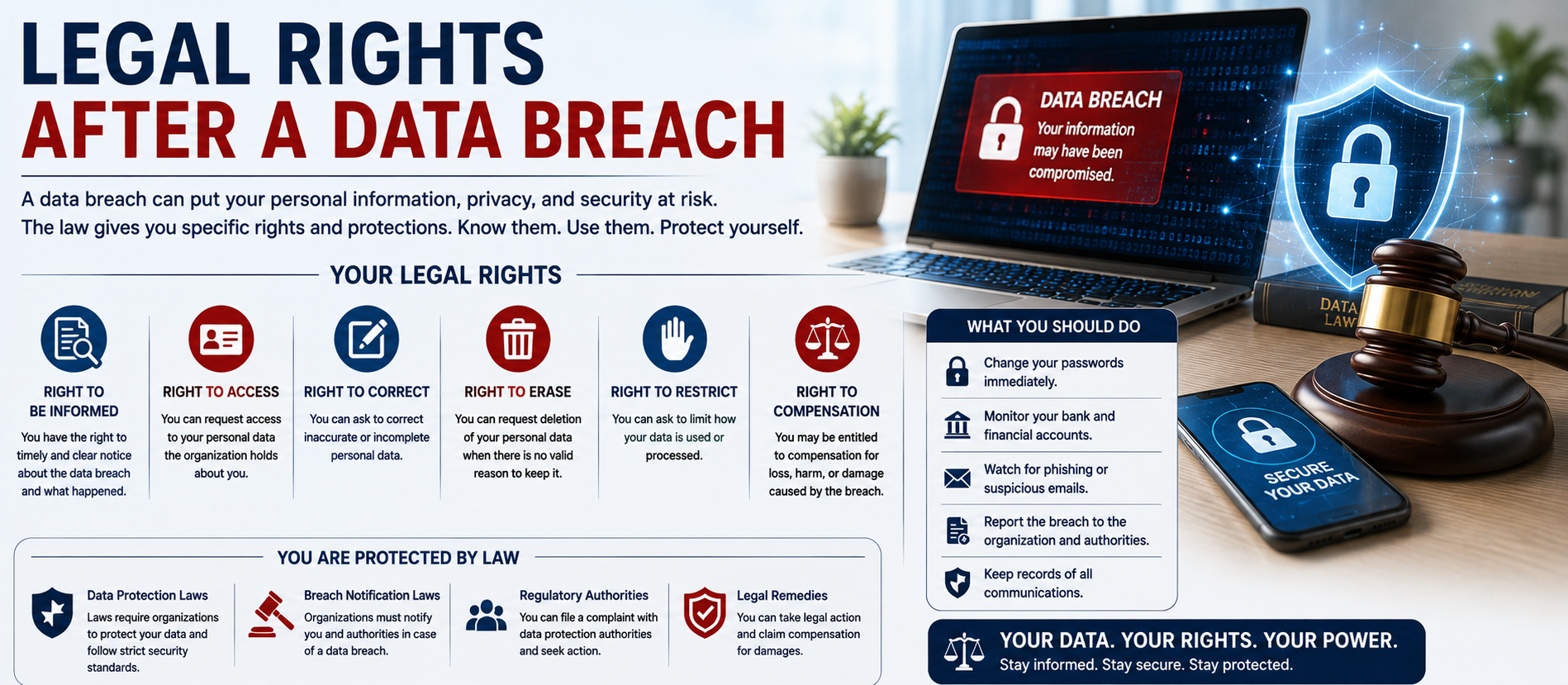
📋 Quick Summary
In this article:
Common Examples of Data Breaches
Why a Data Breach Can Be Serious
India's Data Protection Framework
Your Right to Know About a Personal Data Breach
A Useful Breach Notice Should Help You Understand:
Your Right to Seek Information About Your Personal Data
Your Right to Correction and Erasure
Your Right to Use a Grievance Redressal Process
Your Complaint Should Clearly State:
The Data Protection Board of India
Can You Claim Compensation After a Data Breach?
A data breach can expose personal information to unauthorized access, loss, theft, disclosure or misuse. The affected information may include names, email addresses, phone numbers, passwords, financial details, identity documents, health-related records, business information or other digital data.
A breach can create serious risks. Criminals may use stolen information for phishing, identity theft, account takeover, financial fraud or other harmful activity.
This article explains legal rights after a data breach from an India-focused perspective. It uses simple and direct language. It also explains the current Digital Personal Data Protection framework, breach-related obligations, grievance options, cybersecurity reporting and the practical steps individuals and organizations should consider.
India's Digital Personal Data Protection Act, 2023 defines a personal data breach broadly to include unauthorized processing or accidental disclosure, acquisition, sharing, use, alteration, destruction or loss of access to personal data that compromises confidentiality, integrity or availability.
The Digital Personal Data Protection Rules, 2025 were notified on 13 November 2025. Their commencement is phased. Therefore, the exact obligations and effective dates must be checked against the official notification and enforcement timeline before relying on a specific requirement.
Digiifrog creates clear, useful and search-friendly content for modern users through SEO, AEO, GEO and AI Search Optimization.
What Is a Data Breach?
A data breach happens when information is accessed, exposed, lost, stolen, altered or used without proper authorization, or when a security failure compromises the confidentiality, integrity or availability of data.
Under the Digital Personal Data Protection Act, 2023, a personal data breach includes unauthorized processing or accidental disclosure, acquisition, sharing, use, alteration, destruction or loss of access to personal data when confidentiality, integrity or availability is compromised.
Common Examples of Data Breaches
- A hacker gains access to a customer database.
- Passwords are exposed because of a security weakness.
- An employee accidentally sends personal information to the wrong person.
- A laptop containing customer data is lost or stolen.
- A cloud storage bucket is publicly accessible by mistake.
- Ransomware affects systems containing personal information.
- A third-party vendor suffers a security incident.
- An organization loses access to important personal data because of a system failure.
A data breach is not limited to a dramatic hacking incident. Human error, poor access controls and accidental disclosure can also create serious legal and security concerns.
Why a Data Breach Can Be Serious
The impact depends on the type of information involved and how it can be misused.
⚠ Watch Out
For example, exposure of an email address may create phishing risks. Exposure of passwords may lead to account takeover. Exposure of identity documents or financial information can create a greater risk of fraud.
Affected individuals may face:
- Identity theft
- Financial fraud
- Unauthorized account access
- Phishing and social engineering
- Harassment or stalking
- Reputational damage
- Loss of privacy
- Misuse of identity documents
Businesses may also face operational disruption, loss of customer trust, contractual disputes, regulatory action and significant incident-response costs.
India's Data Protection Framework
India's modern personal-data framework includes the Digital Personal Data Protection Act, 2023, along with the Digital Personal Data Protection Rules, 2025 and related notifications.
The Act is designed to regulate the processing of digital personal data while recognizing both the individual's right to protect personal data and the need to process personal data for lawful purposes.
The Act uses important terms:
- Data Principal: The individual to whom the personal data relates.
- Data Fiduciary: The person who determines the purpose and means of processing personal data.
- Data Processor: A person who processes personal data on behalf of a Data Fiduciary.
- Personal Data: Data about an individual who is identifiable by or in relation to that data.
- Personal Data Breach: A qualifying security or processing event that compromises confidentiality, integrity or availability of personal data.
The exact legal position can depend on which provisions are in force and applicable at the relevant time. The DPDP Rules, 2025 contain a phased commencement schedule, so organizations should always review the current official enforcement timeline.
Your Right to Know About a Personal Data Breach
One of the most important issues after a breach is notification.
The Digital Personal Data Protection Act provides for obligations relating to personal data breaches. The 2025 Rules provide further detail regarding breach-related notice requirements, but those requirements are subject to the phased commencement schedule in the official notification.
As the legal framework becomes applicable according to its notified timeline, breach notices may be expected to provide meaningful information about the incident and the steps being taken.
If you receive a breach notification, do not ignore it.
A Useful Breach Notice Should Help You Understand:
- What happened.
- When the incident was discovered or occurred, if known.
- What categories of personal data may be affected.
- What risks may result.
- What steps the organization has taken.
- What actions you should take to protect yourself.
- How you can contact the organization or use its grievance process.
Your Right to Seek Information About Your Personal Data
The DPDP Act provides Data Principals with rights relating to access to information about their personal data, subject to the Act's framework and applicable exemptions.
After a suspected or confirmed breach, you may want to ask:
- Does your organization hold my personal data?
- What personal data was involved?
- Was my information shared with a third party?
- Who can I contact for a grievance?
- What security measures are being taken after the incident?
The practical method for exercising these rights can depend on the organization and the provisions currently in force.
Your Right to Correction and Erasure
The DPDP Act includes a right to correction, completion, updating and erasure of personal data, subject to the statutory framework.
This may become relevant after a breach if your information is inaccurate, outdated or no longer needed for a lawful purpose.
However, erasure is not an absolute right in every situation. An organization may need to retain information where retention is required by law or otherwise permitted under the applicable legal framework.
Your Right to Use a Grievance Redressal Process
If you believe an organization has mishandled your personal data, the first practical step is often to use the organization's grievance mechanism.
Keep your communication in writing where possible.
Your Complaint Should Clearly State:
- Your name and contact details.
- The organization involved.
- The incident or concern.
- The approximate date.
- The personal data you believe may be affected.
- Any evidence or screenshots.
- The action or information you are requesting.
Save copies of your complaint and every response.
The Data Protection Board of India
The DPDP Act establishes the Data Protection Board of India. The Board has functions and powers under the statutory framework relating to personal-data protection and compliance.
In 2025, the Government also issued notifications concerning the establishment of the Board as part of implementation of the DPDP framework.
The correct process for making a complaint or pursuing a grievance should be checked against the official procedure and the provisions currently in force when the issue arises.
Can You Claim Compensation After a Data Breach?
A common question is: Can I automatically receive compensation after a data breach?
The answer is not always simple.
A breach does not automatically mean that every affected person will receive a payment. The available remedy depends on the applicable law, the facts, the type of harm, the organization involved and the forum handling the dispute.
Possible legal claims may arise under different laws or contractual arrangements depending on the circumstances. For example, a person may have separate rights if financial fraud, identity theft, breach of contract, negligence or another legal wrong is involved.
For a serious case involving actual loss, legal advice can help identify the available remedies.
What Should You Do Immediately After Receiving a Data Breach Notice?
Act quickly. The first few hours and days can be important.
- Read the notification carefully. Identify what data may have been exposed.
- Change affected passwords. Start with email and financial accounts.
- Use strong, unique passwords. Do not reuse the same password across multiple services.
- Enable multi-factor authentication. This can reduce the risk of unauthorized access.
- Watch for phishing messages. Attackers often use breach information to create convincing scams.
- Review bank and payment activity. Report suspicious transactions promptly through the appropriate channels.
- Keep evidence. Save the breach notice, suspicious messages and relevant account records.
- Contact the organization. Use its official support or grievance channel.
- Do not share OTPs or passwords. A legitimate support team should not need your banking OTP or account password.
Protecting Yourself From Phishing After a Breach
Many people are harmed not by the original breach, but by scams that follow it.
Criminals may pretend to be the affected company, a bank, a government department or a cybersecurity team.
Warning Signs Include:
- Urgent threats demanding immediate action.
- Requests for passwords or OTPs.
- Unexpected links or attachments.
- Messages asking you to install remote-access software.
- Requests for payment to “secure” your account.
- Minor spelling changes in a company name or domain.
Instead of clicking a link in a suspicious message, open the official website or app yourself and contact the organization through a verified channel.
What If Financial Information Was Exposed?
Take immediate protective action if banking or payment information may have been compromised.
- Review recent transactions.
- Contact the relevant bank or payment provider through official channels.
- Change account credentials where appropriate.
- Enable transaction alerts.
- Report unauthorized transactions promptly.
- Keep records of all complaints and reference numbers.
If you believe you are facing an active cyber fraud situation, use the appropriate official cybercrime or banking-reporting channels without delay.
Cyber Incident Reporting and CERT-In
Data breaches can also create cybersecurity reporting obligations for organizations.
CERT-In's Cyber Security Directions and published FAQ explain that covered cyber incidents, including data breaches or data leaks identified in the relevant incident categories, must be reported within the prescribed reporting timeline. The CERT-In FAQ states that reportable incidents under the directions are to be reported within six hours of noticing the incident or being brought to notice about such incident.
For organizations, this means incident response should not wait until every technical detail is known. The CERT-In FAQ states that available information can be reported first, with additional information supplied later within a reasonable time.
Businesses should check whether a particular incident and entity fall within the applicable reporting requirements.
What Businesses Should Do After Discovering a Data Breach
A weak response can make a breach worse. Organizations need a structured incident-response process.
Step 1: Contain the Incident
Stop the unauthorized access where possible. Disable compromised accounts, revoke access tokens, isolate affected systems and preserve evidence.
Step 2: Preserve Evidence
Do not immediately destroy logs or evidence. Technical records may be important for investigation, reporting and legal review.
Step 3: Determine What Happened
Investigate:
- How did the incident occur?
- When did it begin?
- What systems were affected?
- What personal data was involved?
- How many individuals may be affected?
- Is the threat still active?
Step 4: Assess Legal and Regulatory Duties
Check the current DPDP implementation timeline, applicable rules, CERT-In reporting requirements, sector-specific obligations, contracts and any foreign privacy obligations that may apply to the organization.
Step 5: Notify the Required Parties
Notification obligations depend on the applicable legal framework and the stage of implementation of relevant provisions. Do not use an outdated checklist.
Step 6: Communicate Clearly With Affected Individuals
Use simple language. Explain the risk and provide practical steps. Avoid vague statements that create more confusion.
Step 7: Fix the Root Cause
A breach response is incomplete if the organization restores systems but does not correct the underlying weakness.
Reasonable Security Safeguards
Data protection is not only about responding after an incident. Organizations should take reasonable security safeguards to prevent personal data breaches.
A practical security program may include:
- Access controls
- Multi-factor authentication
- Encryption where appropriate
- Patch and vulnerability management
- Employee security training
- Secure backups
- Vendor risk management
- Logging and monitoring
- Incident-response planning
- Regular testing and review
No organization can guarantee that a breach will never happen. The legal and practical question is often whether reasonable and appropriate safeguards were in place and whether the organization responded properly.
Third-Party and Vendor Data Breaches
Many companies use cloud providers, payment processors, marketing platforms, HR systems and other vendors.
If a vendor suffers a breach, the impact may still affect the company and its customers.
Good Vendor Governance Should Include:
- Due diligence before onboarding.
- Clear data-processing terms.
- Security requirements.
- Incident-notification clauses.
- Audit or assurance rights where appropriate.
- Clear responsibility for cooperation during an incident.
- Procedures for returning or deleting data when the relationship ends.
Organizations should understand where their data is stored and which third parties can access it.
Data Breaches and Employee Information
Customer information is not the only information at risk.
A breach may expose employee records, salary information, identity documents, attendance data or other workplace information.
Employers should apply the same basic principles:
- Identify the affected data.
- Contain the incident.
- Review applicable notification duties.
- Communicate responsibly.
- Help affected employees understand practical risks.
- Improve the security controls that failed.
Common Mistakes After a Data Breach
1. Waiting Too Long
Delay can increase harm. It can also create compliance problems where reporting deadlines apply.
2. Hiding the Incident
Trying to hide a serious incident can damage trust and may increase legal exposure.
3. Providing Vague Information
Affected individuals need useful information, not generic statements.
4. Ignoring Phishing Risks
Attackers often use public knowledge of a breach to launch new scams.
5. Fixing Only the Immediate Technical Problem
Organizations should investigate the root cause and review whether similar weaknesses exist elsewhere.
6. Failing to Preserve Evidence
Logs, timelines and technical records may be important for investigation and regulatory reporting.
A Simple Checklist for Individuals
- Save the breach notification.
- Identify the accounts and data affected.
- Change compromised passwords.
- Enable multi-factor authentication.
- Monitor financial and important online accounts.
- Watch for phishing and impersonation attempts.
- Contact the organization through official channels.
- Use the grievance process if necessary.
- Keep copies of complaints and responses.
- Seek professional legal advice for serious loss or complex cases.
A Simple Checklist for Businesses
- Activate the incident-response plan.
- Contain the incident.
- Preserve evidence and logs.
- Identify affected systems and data.
- Assess the number of affected individuals.
- Review current legal and regulatory reporting duties.
- Coordinate legal, security, management and communications teams.
- Notify the required authorities and affected persons when applicable.
- Provide practical protection advice.
- Fix the root cause and document lessons learned.
How to Make a Data Breach Complaint
Start by identifying the organization that controls or manages the relevant personal data.
Use the organization's official privacy, support or grievance channel. Keep the complaint factual.
Include:
- Your identity and contact information.
- The date you discovered the issue.
- The nature of the suspected breach.
- The type of data involved.
- Copies of relevant notices or screenshots.
- The action you want the organization to take.
If the matter is not resolved, consider the next available remedy under the applicable legal framework. The correct authority or forum can depend on the type of organization, the law involved and the nature of the harm.
SEO, AEO, GEO and AI Search Optimization for Data Privacy Content
People increasingly ask direct questions through search engines and AI systems.
Examples include:
- What are my legal rights after a data breach?
- Does a company have to notify me about a data breach?
- Can I complain about misuse of my personal data?
- What should I do if my password is leaked?
- How should a company respond to a cyber incident?
SEO helps privacy and legal content become discoverable.
AEO focuses on answering direct user questions clearly.
GEO helps structure content for generative search experiences.
AI Search Optimization focuses on clarity, context, useful headings and direct answers supported by reliable information.
For legal and privacy content, readability is important. Complex rules should be explained in simple language without removing necessary legal qualifications.
How Digiifrog Supports Modern Legal and Privacy Content
Digiifrog helps create useful, structured and search-friendly digital content.
- SEO Content Strategy
- AEO and Answer-Focused Content
- GEO and Generative Search Optimization
- AI Search Optimization
- Legal and Business Content Development
- Digital Branding Strategy
Frequently Asked Questions
What is a personal data breach?
Under India's Digital Personal Data Protection Act, 2023, a personal data breach includes unauthorized processing or accidental disclosure, acquisition, sharing, use, alteration, destruction or loss of access to personal data that compromises confidentiality, integrity or availability.
What should I do if my personal data is exposed?
Change affected passwords, enable multi-factor authentication, monitor important accounts, watch for phishing attempts, preserve evidence and contact the affected organization through an official channel.
Can I ask an organization what personal data it holds about me?
The DPDP Act provides rights relating to access to information about personal data, subject to the statutory framework and applicable exemptions. The exact procedure depends on the applicable provisions and implementation timeline.
Can I complain after a data breach?
Yes, depending on the circumstances. Start with the organization's grievance mechanism and then consider the relevant legal or regulatory process available for your case.
Do all data breaches have to be reported to CERT-In?
Not every security event is automatically identical. Organizations should assess whether the incident falls within the reportable categories and requirements under the applicable CERT-In directions and related guidance.
Do all provisions of the DPDP Rules, 2025 apply immediately?
No. The notification contains a phased commencement schedule. Organizations and individuals should check the official notification and current enforcement timeline for the provisions relevant to their situation.
Can a company be penalized for poor data security?
The DPDP Act provides a penalty framework for specified breaches of obligations, including failure to observe the obligation to take reasonable security safeguards and failure to meet applicable breach-notice obligations. Actual liability depends on the law in force, the facts and the relevant proceeding.
Conclusion
Legal rights after a data breach depend on the facts, the type of data involved and the legal framework that applies at the relevant time.
💡 Key Insight
For individuals, the most important actions are simple: understand what happened, secure your accounts, watch for fraud, preserve evidence and use the appropriate grievance or complaint process.
For businesses, a data breach should trigger a structured response. Contain the incident. Preserve evidence. assess the affected data. Review current reporting duties. Communicate clearly. Fix the root cause.
India's data protection framework is evolving through the DPDP Act, the DPDP Rules, 2025 and related implementation notifications. Because commencement is phased, current official sources should always be checked before making a legal or compliance decision.
Legal Disclaimer: This article is for general educational and informational purposes only. It does not constitute legal advice. Data protection, cybersecurity and breach-reporting obligations may depend on the facts, the type of organization, applicable laws, sector-specific regulations, contracts and the current enforcement status of relevant legal provisions. Consult a qualified legal or cybersecurity professional for advice on a specific incident.
Digiifrog
Website: www.digiifrog.com
Ready to Grow?
Talk to us about a strategy tailored to your brand — we will help you stand out in search, AI discovery and social.


Comments (0)
Log in to leave a comment.