📋 Quick Summary
In this article:
Legal Separation vs Divorce: The Main Difference
Why Do Couples Choose Legal Separation?
Benefits and Financial Concerns
Marriage Status After Legal Separation
Debt and Financial Responsibilities
When a marriage faces serious problems, a couple may consider living separately, legal separation, or divorce. These choices can have very different legal consequences. Understanding legal separation vs divorce can help people make informed decisions.
Legal separation usually allows spouses to live apart while remaining legally married. Divorce generally ends the legal marriage. The exact meaning of legal separation and divorce varies by country, state, and jurisdiction.
This guide explains the main differences in clear language. It covers marriage status, children, property, finances, insurance, taxes, inheritance, and remarriage.
What Is Legal Separation?
Legal separation is a formal arrangement in which married spouses live separately while remaining legally married. Depending on local law, a court order or legally recognized agreement may define the rights and responsibilities of each spouse.
A legal separation may address many of the same issues discussed in divorce, including:
- Child custody and parenting arrangements.
- Child support.
- Spousal support or maintenance.
- Financial responsibilities.
- Use of the family home.
- Payment of debts.
- Property arrangements.
The important difference is that the marriage itself usually continues after legal separation.
What Is Divorce?
Divorce is the legal process that ends a marriage. Once a divorce becomes legally final, the spouses are generally no longer married to each other.
A divorce may address children, support, property, debts, and other financial responsibilities. After divorce, many legal rights connected with marriage end or change.
In many jurisdictions, a divorced person may remarry after the divorce is final, subject to applicable legal requirements.
Legal Separation vs Divorce: The Main Difference
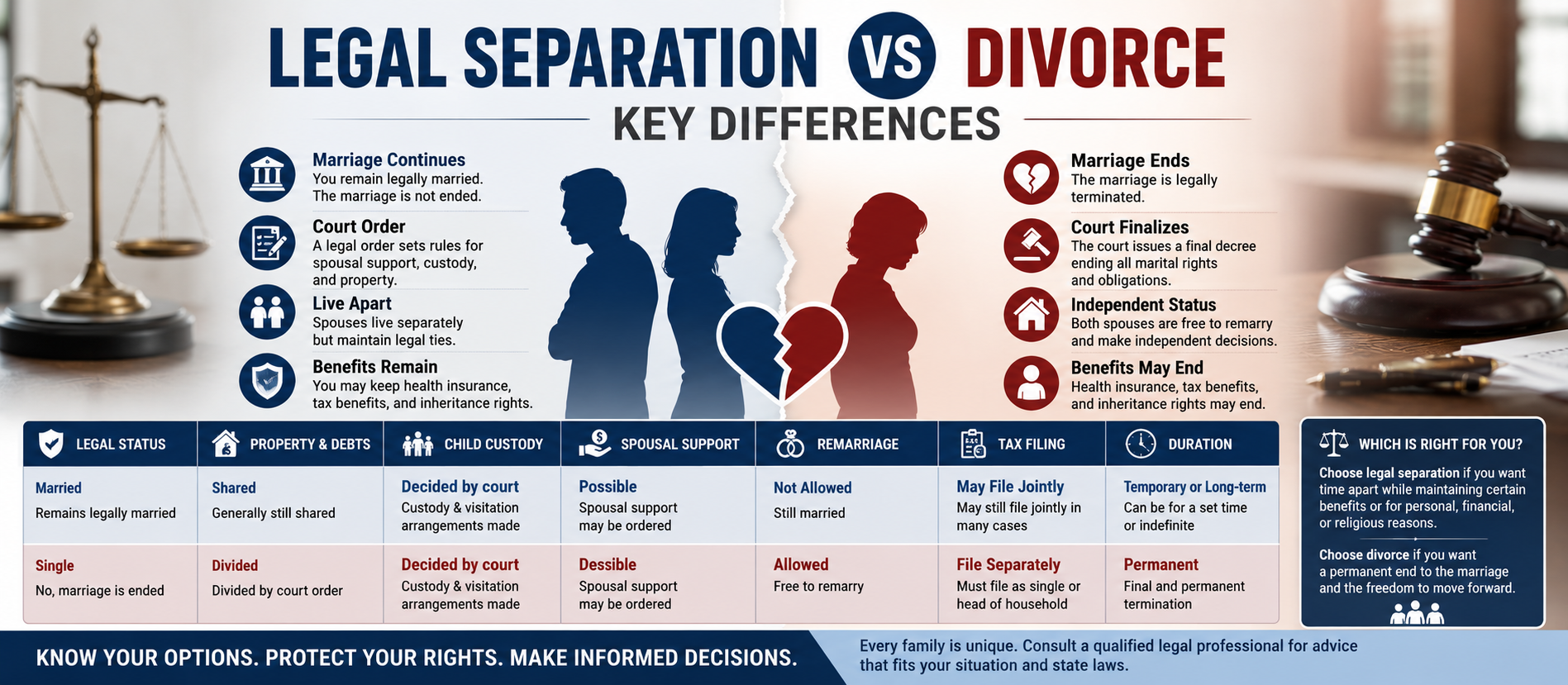
The simplest difference is marriage status. With legal separation, spouses usually remain legally married. With divorce, the legal marriage generally ends.
This difference can affect inheritance, insurance, taxes, benefits, financial planning, and the ability to remarry.
| Issue Legal Separation Divorce | ||
| Marriage status | Usually remains legally married | Marriage is legally ended |
| Living arrangements | Spouses may live separately | Former spouses usually live separately |
| Children | May be addressed legally | May be addressed legally |
| Support | May include child or spousal support | May include child or spousal support |
| Property | May be addressed by agreement or court order | Usually addressed during the divorce process |
| Remarriage | Generally unavailable while still married | May be possible after the divorce is final |
Why Do Couples Choose Legal Separation?
People choose legal separation for different reasons. Every family situation is unique.
Religious or Personal Beliefs
Some people have religious or personal beliefs that make divorce difficult or undesirable. Legal separation may provide a structured way to live apart without formally ending the marriage.
Time to Consider the Future
Some couples are uncertain about divorce. Legal separation may provide time and space while financial and parenting issues are addressed.
Benefits and Financial Concerns
Remaining legally married may affect access to certain insurance, pension, or employment benefits. These rules can be complicated and should be checked carefully.
Children and Family Stability
Parents may want clear legal arrangements for children and financial support while they consider the future of the relationship.
Marriage Status After Legal Separation
Legal separation usually does not end the marriage. Even when spouses live in different homes and have a formal agreement, they may still be legally married.
Depending on local law, a legally separated spouse may continue to have certain rights connected with inheritance, benefits, insurance, or marital status.
The exact effect depends on the separation agreement, court order, and laws of the jurisdiction.
Marriage Status After Divorce
A final divorce generally ends the legal marriage. The spouses become former spouses, although some obligations may continue.
After divorce, people may need to review and update:
- Wills and estate plans.
- Beneficiary designations.
- Insurance policies.
- Bank and financial accounts.
- Emergency contacts.
- Property records.
- Financial documents.
A divorce order may still create continuing obligations, including child support, parenting responsibilities, or spousal support.
Property Division
Property is often one of the most important issues in family law. Couples may own homes, vehicles, savings, investments, businesses, and other assets.
During legal separation, spouses may agree on who uses or manages certain property. The arrangement may be temporary or long-term.
During divorce, property issues are commonly addressed as part of ending the financial relationship. The outcome may depend on:
- When the property was acquired.
- How the property is legally owned.
- Whether the property is marital or separate under local law.
- Financial contributions.
- Existing agreements.
- Applicable family and property laws.
Property is not automatically divided equally in every jurisdiction.
Debt and Financial Responsibilities
Separation and divorce can both involve debt. Couples may have mortgages, loans, credit accounts, or business obligations.
A legal agreement may state which spouse is responsible for a particular debt. However, an agreement between spouses may not always change the rights of an outside lender.
For example, if both spouses signed a loan, the lender may still have rights against both borrowers. Understanding this difference is important.
Child Custody and Parenting Arrangements
Legal separation and divorce can both involve arrangements for children. Parents may need to decide where children will live, how parenting time will work, and how important decisions will be made.
Depending on local law, arrangements may address:
- Physical custody or residence.
- Legal decision-making authority.
- Parenting schedules.
- Education.
- Healthcare.
- Travel arrangements.
- Communication between parents.
In many jurisdictions, the welfare or best interests of the child are important legal considerations.
Child Support
Child support may apply in both legal separation and divorce. It generally helps meet a child's financial needs.
The amount and calculation method depend on local law. Courts may consider income, parenting arrangements, healthcare costs, education expenses, and other legally relevant factors.
Spousal Support or Maintenance
One spouse may seek financial support from the other during legal separation or after divorce. The terminology may include spousal support, maintenance, or alimony.
The availability and amount depend on local law and individual circumstances. Factors may include income, earning capacity, length of marriage, financial needs, career sacrifices, and employment opportunities.
Support is not automatically awarded in every case.
Health Insurance and Benefits
Insurance and employment benefits can be an important reason for comparing legal separation with divorce.
In some situations, a legally separated spouse may remain eligible for certain benefits. In other situations, separation may change eligibility. Divorce may also end access to benefits connected with a former spouse.
Rules can depend on insurance contracts, employer policies, government benefit rules, local laws, and court orders.
Never assume that legal separation guarantees continued insurance coverage. Check directly with the benefit provider or plan administrator.
Inheritance and Estate Planning
Legal separation and divorce can have different effects on inheritance rights.
Because legally separated spouses may remain married, some inheritance rights may continue unless changed by law, a court order, or estate planning documents.
After divorce, inheritance rights may change significantly. The effect of divorce on wills and beneficiary designations depends on local law.
People should consider reviewing:
- Wills.
- Trusts.
- Life insurance beneficiaries.
- Retirement account beneficiaries.
- Powers of attorney.
- Healthcare directives.
Can You Remarry?
This is one of the clearest differences between legal separation and divorce.
A legally separated person usually remains legally married. Therefore, remarriage is generally not available until the existing marriage legally ends.
After a divorce becomes final, remarriage may be possible, subject to any waiting periods or legal requirements.
Is Legal Separation Easier Than Divorce?
Not always. Both processes can involve legal documents, financial disclosure, negotiations, court procedures, and decisions about children.
Legal separation may be simpler in some situations. However, if a couple later divorces, they may need to complete another legal process.
The best option depends on personal goals, finances, family needs, and local law.
Important Questions Before Choosing
- Do we want to remain legally married?
- Is reconciliation possible?
- Are religious or personal beliefs important?
- How will the decision affect our children?
- What property and debts do we have?
- Will insurance or benefits change?
- How could taxes be affected?
- What happens to inheritance rights?
- Does either spouse plan to remarry?
- What legal options exist locally?
How to Prepare for Legal Separation or Divorce
Gather Important Documents
Collect income records, bank statements, tax documents, property records, insurance information, debt records, and retirement account information.
Understand Your Financial Position
Create a list of assets, debts, monthly expenses, and income. Accurate information can make negotiations easier.
Focus on Children's Needs
Consider stable schedules, education, healthcare, communication, and long-term financial needs.
Avoid Major Financial Decisions Without Advice
Before selling property, transferring assets, or closing important accounts, understand possible legal consequences.
Seek Professional Guidance
A qualified family law professional can explain the options available under local law.
Common Mistakes to Avoid
- Ignoring financial documents.
- Making informal promises without understanding consequences.
- Assuming verbal agreements are always enforceable.
- Hiding assets or income.
- Using children as part of a conflict.
- Ignoring legal or court deadlines.
- Failing to update estate planning documents.
- Assuming insurance benefits will continue.
- Making major financial transfers without advice.
Legal Separation and Divorce in the Digital Age
In 2026, family law matters can involve shared online accounts, cloud storage, cryptocurrency, digital subscriptions, social media, and digital financial records.
Important digital considerations include:
- Changing account passwords.
- Reviewing shared cloud access.
- Protecting personal and financial information.
- Documenting digital assets.
- Reviewing online financial accounts.
- Understanding rules about digital evidence.
Do not access another person's private account without legal authority. Privacy and computer access laws may apply.
SEO, AEO, GEO and AI Search Optimization
People increasingly search for legal information through search engines, answer engines, and AI-powered platforms.
SEO helps useful content become visible in search results. AEO, or Answer Engine Optimization, focuses on direct answers to common questions. GEO, or Generative Engine Optimization, helps AI systems understand structured information.
⚠ Watch Out
Family law content should use clear headings and simple language. However, optimization must never replace legal accuracy because laws vary by jurisdiction.
Digiifrog focuses on modern digital growth strategies, including SEO, AEO, GEO, and AI Search optimization. Clear and structured content can support both human readers and modern search technologies.
Frequently Asked Questions
What is the main difference between legal separation and divorce?
Legal separation usually allows spouses to remain legally married, while divorce generally ends the legal marriage.
Can legally separated spouses live in different homes?
Yes. Legal separation generally involves living separately, although requirements depend on the jurisdiction.
Can child custody be decided during legal separation?
Yes, in many jurisdictions. A separation agreement or court order may address parenting arrangements and child support.
Can you remarry after legal separation?
Generally, no. A legally separated person usually remains legally married until the marriage legally ends.
Does legal separation divide property?
It may address property and financial responsibilities, depending on local law and the legal agreement or court order.
Is legal separation better than divorce?
There is no single answer. The best choice depends on personal goals, family circumstances, finances, benefits, beliefs, and local law.
Conclusion
The decision between legal separation vs divorce can have long-term consequences. Legal separation usually allows spouses to live apart while remaining legally married. Divorce generally ends the marriage.
Both options can involve decisions about children, property, debts, financial support, and future planning. The right choice depends on personal circumstances and the laws that apply.
💡 Key Insight
Before making a major decision, understand your legal options, gather important financial information, and consider qualified professional advice. Clear information and careful planning can help people make better decisions during a difficult period.
Digiifrog
Website: www.digiifrog.com
Digital Growth Through SEO, AEO, GEO & AI Search Optimization.
Ready to Grow?
Talk to us about a strategy tailored to your brand — we will help you stand out in search, AI discovery and social.

Comments (0)
Log in to leave a comment.