📋 Quick Summary
In this article:
Life Insurance vs Term Insurance at a Glance
Difference in Maturity Benefits
Term Insurance for Working Professionals
Introduction
Life insurance is designed to provide financial protection against the risk of death. It can help protect dependants, replace lost income, support long-term financial planning, or provide benefits linked to savings and retirement goals.
When people compare life insurance vs term insurance, one point often creates confusion. Term insurance is itself a type of life insurance. The real comparison is usually between a pure term insurance plan and other life insurance products that may combine protection with savings, investment, or maturity benefits.
IRDAI explains that life insurance products can be designed for different needs. It describes term insurance as a product that provides a fixed amount on death during the contract period. Other life insurance products can combine protection with savings or provide benefits at maturity.
This article explains the difference in simple language. It covers coverage, premiums, policy duration, maturity benefits, cash value, financial goals, common mistakes, and questions to ask before buying a policy.
What Is Life Insurance?
Life insurance is a broad category of insurance that provides financial benefits based on the terms of a life insurance contract. A life insurance policy can be structured in different ways.
Some policies focus mainly on protection. Others combine insurance with savings or investment-related features. Some provide a benefit if the policyholder survives until the end of the policy term, while others focus on a death benefit.
The exact benefit depends on the product. Therefore, the phrase “life insurance” alone does not describe one single type of policy.
What Is Term Insurance?
Term insurance is a form of life insurance that provides protection for a specified period, known as the policy term. If the insured person dies during the covered period and the claim meets the policy conditions, the nominee can receive the applicable death benefit.
Pure term insurance is mainly designed for protection. It generally does not have a maturity benefit in which the sum assured is paid simply because the insured survives the term.
IRDAI's consumer information describes a term insurance product as providing a fixed amount on death during the period of the contract.
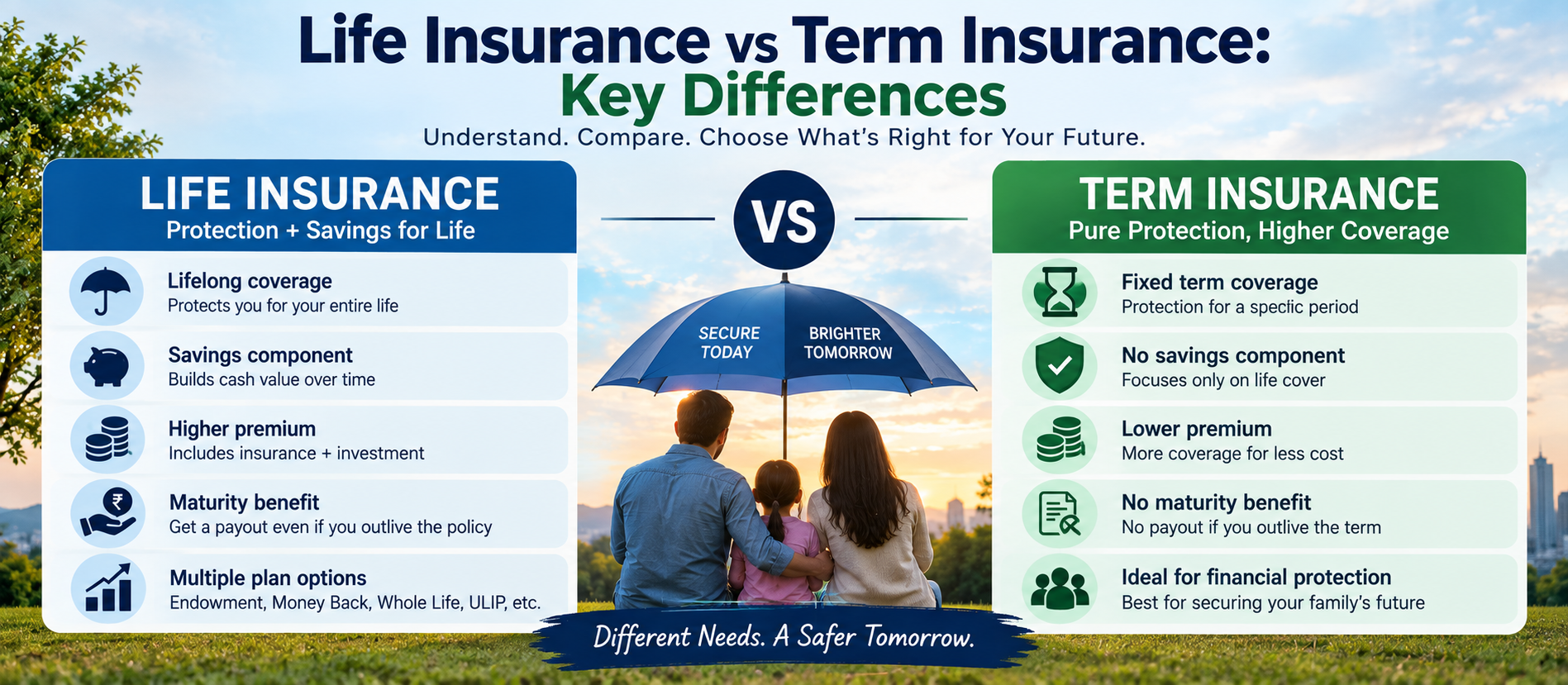
Life Insurance vs Term Insurance at a Glance
| Feature Life Insurance Term Insurance | ||
| Meaning | Broad category of life insurance products | A specific type of life insurance |
| Main purpose | Can provide protection, savings, investment, or retirement-related benefits depending on product | Mainly income and family protection |
| Policy term | Depends on the product | Fixed period selected at purchase |
| Death benefit | Depends on policy | Usually the core benefit |
| Maturity benefit | May be available in some products | Pure term plans generally do not pay a maturity benefit |
| Premium | Varies widely by product | Often structured mainly around protection and policy risk |
| Savings feature | May be included | Usually absent in pure term insurance |
| Cash value | May exist in some product types | Usually not available in a pure term plan |
The Most Important Difference
The most important difference is the purpose of the policy.
A pure term insurance plan is primarily a protection product. It is designed to provide a death benefit if the insured dies during the policy term.
Other life insurance products may have more than one purpose. They can combine life cover with savings, guaranteed benefits, bonuses, investment-linked features, or retirement-related benefits depending on the product.
Because products vary, compare the actual policy benefits instead of relying only on the label “life insurance.”
Difference in Policy Duration
Term insurance has a defined policy period. You choose the term based on your protection needs and the product's available options.
For example, a person may select a term that covers major earning years, outstanding financial responsibilities, or the period during which depend ants rely heavily on their income.
Other life insurance products may have different policy structures. Some can provide benefits over a fixed period, while whole-life products are designed around much longer protection.
Always check the policy term, premium-paying term, and maturity date. These can be different concepts.
Difference in Premiums
Premium is the amount paid to keep the policy in force according to its payment schedule.
A pure term insurance plan generally focuses on death protection without a savings component. Because of this structure, its premium can be lower than some life insurance products that combine insurance with savings or other benefits, when comparing policies with similar life cover and relevant assumptions.
However, premium should not be compared in isolation. Age, health, lifestyle information, sum assured, policy term, payment frequency, product design, riders, and underwriting can affect the price.
Difference in Maturity Benefits
A maturity benefit is a payment made when the policy reaches its maturity date and the policy conditions are satisfied.
Pure term insurance normally focuses on the death benefit during the term. If the insured survives the full term, a standard pure term plan generally does not provide a maturity payout.
Some term products may have a return-of-premium feature or other special structure. That is different from a basic pure term plan and may have different pricing and conditions.
Other life insurance products may provide maturity benefits. The amount and conditions depend on the policy.
Death Benefit Comparison
Both term insurance and other life insurance products can provide a death benefit. The difference is in the product design and the conditions attached to that benefit.
With a pure term plan, the death benefit is generally the central purpose of the policy. If the insured dies during the policy term and the claim is payable under the contract, the nominee receives the applicable benefit.
With savings-oriented life insurance, the death benefit can include components defined by the specific policy. Some products may include bonuses or other benefits subject to policy terms.
Protection vs Savings
This is another major difference.
Pure term insurance is mainly about protection. It is useful when the main goal is to create a financial safety net for depend ants.
Some other life insurance products combine protection with savings. They may be designed for people who want insurance alongside a structured savings feature.
These products should be evaluated based on their complete benefit illustration, charges, guarantees, non-guaranteed benefits, liquidity, and policy conditions.
Why Income Protection Matters
For a family, the financial impact of the death of an earning member can be significant. Household expenses can continue even when income suddenly stops.
Possible financial responsibilities include:
- Home loan or other debt.
- Children's education.
- Daily household expenses.
- Parents' support.
- Future family goals.
- Business or professional liabilities.
- Long-term savings needs.
Life insurance can help create a financial benefit for depend ants. The required amount should be linked to actual financial responsibilities rather than chosen only because a certain premium looks affordable.
Term Insurance for Working Professionals
Working professionals often have income-based responsibilities. A term insurance policy can be used to create protection during the years when depend ants may rely on that income.
A practical approach is to review current income, debts, family expenses, future goals, existing investments, and existing insurance before deciding the amount of cover.
Life insurance needs can change. A person who gets married, has children, buys a home, or takes on a large loan may need to review their protection level.
Life Insurance With Savings Features
Some life insurance policies combine insurance and savings. These products can have a different structure from pure term insurance.
Depending on the product, benefits may include a maturity amount, guaranteed benefits, bonuses, or other features. Some products may also have surrender or withdrawal rules.
Do not assume that every policy with a maturity value will provide the same return or flexibility. Read the benefit illustration and policy wording carefully.
Term Insurance and Return of Premium
Some term insurance products offer a return-of-premium feature. Under such a structure, the policy may return specified premiums if the insured survives the policy term, subject to the product terms.
This can make the premium different from a basic pure term plan. The key is to compare the actual benefits and total premiums rather than assuming that a return-of-premium option is identical to pure term insurance.
What About Riders?
Riders are optional or additional benefits that may be attached to a life insurance policy, subject to product availability and policy conditions.
Examples can include benefits related to accidental death, critical illness, disability, or waiver of future premiums. The available riders differ between insurers and products.
Riders can change the premium. They should be selected based on a genuine financial need, not simply because they are available.
Term Insurance vs Whole Life Insurance
Whole life insurance is a type of life insurance designed to provide coverage for a much longer period than a typical term plan, subject to the policy structure.
A pure term plan covers a selected term. Whole life products may have different premium structures, benefits, cash value features, and conditions.
These products serve different planning needs. The right comparison depends on your objective, financial responsibilities, budget, and the exact product.
How to Compare Life Insurance Policies
Do not compare policies only by premium. Use a complete checklist.
- Sum assured or death benefit.
- Policy term.
- Premium amount.
- Premium-paying term.
- Death benefit conditions.
- Maturity benefit, if any.
- Guaranteed and non-guaranteed benefits.
- Rider benefits.
- Exclusions.
- Claim process.
- Grace period and lapse rules.
- Revival conditions.
- Loan or surrender provisions, where applicable.
- Tax treatment under the applicable law.
How to Estimate Your Life Insurance Need
There is no universal formula that works for every household. A useful starting point is to identify the financial loss your family would face if your income stopped.
Consider:
- Current annual family expenses.
- Outstanding loans and liabilities.
- Future education expenses.
- Future major family goals.
- Support required by depend ants.
- Existing savings and investments.
- Existing life insurance cover.
- Inflation and expected income changes.
The goal is to understand the gap between what your family may need and the resources already available.
Common Mistakes When Buying Term Insurance
Choosing Cover Only From the Premium
The cheapest policy is not automatically suitable. Compare the coverage and conditions first.
Choosing Too Little Cover
A small policy may not provide enough support for loans, education, and household expenses.
Ignoring Policy Term
Protection should match the period when your depend ants are likely to need financial support.
Hiding Health Information
Provide accurate information in the proposal form. Medical history, lifestyle details, occupation, and other requested information should be disclosed honestly.
Ignoring Existing Policies
Review all existing life insurance before buying additional cover. Your total protection should be considered together.
Common Mistakes When Buying Savings-Oriented Life Insurance
- Buying a policy without understanding the maturity benefit.
- Not checking the premium-paying period.
- Ignoring surrender conditions.
- Confusing guaranteed and non-guaranteed benefits.
- Not reading the benefit illustration.
- Assuming investment returns without checking product terms.
- Buying a product that does not match the financial goal.
What Documents Should You Review?
Before purchasing a life insurance policy, review the proposal form, policy schedule, benefit illustration, product brochure, policy wording, premium details, exclusions, and applicable customer information.
IRDAI maintains official information on life insurance products and product terms and conditions. Consumers should use the current documents applicable to the specific product they are considering.
Claim Process: What Families Should Know
Nominees should know that a life insurance claim normally requires documentation and an assessment under the policy terms.
💡 Key Insight
Keep the policy document and insurer contact information accessible. A family member should know that the policy exists and where the important documents are stored.
IRDAI advises policyholders and consumers to understand claim procedures so they know what to do when a covered event occurs.
If a claim dispute occurs, use the insurer's grievance process and the applicable regulatory grievance mechanisms. IRDAI also provides information on policyholder protection and the Insurance Ombudsman process.
Tax Considerations
Life insurance premiums and benefits can have tax implications under Indian tax law. The rules can depend on the policy type, issue date, premium structure, amount of benefit, and prevailing legislation.
Tax rules can change. Do not buy a policy only for a tax benefit. Check the current rules and obtain professional tax advice when necessary.
Life Insurance vs Term Insurance: Which One Is Different for Your Goal?
The answer depends on the goal.
If the main objective is financial protection for depend ants during working years, a pure term insurance product is designed around that protection need.
If the objective includes protection plus a savings or maturity component, another type of life insurance may be relevant.
This is not a universal product recommendation. The right choice depends on your financial situation, policy details, risk needs, and long-term goals.
Questions to Ask Before Buying
- How much death benefit does my family need?
- How long should the protection continue?
- What will my total premium be?
- Is the premium payable for the full policy term?
- Is there a maturity benefit?
- Are any benefits guaranteed?
- What benefits depend on future performance or bonuses?
- What riders are available?
- What exclusions apply?
- What happens if I miss a premium?
- What are the revival rules?
- What documents will my nominee need for a claim?
Simple Example
Imagine a 35-year-old earning member has a home loan, two children, and regular household expenses. The person's primary concern is protecting the family if the income suddenly stops.
A pure term plan can be structured around that protection requirement. The family receives the applicable death benefit if the insured dies during the covered term and the claim is payable under the policy.
Another person may have a different objective. They may want life protection combined with a structured savings feature and may therefore compare other life insurance products.
The two situations show why the first step should be identifying the financial goal. Product selection should come after that step.
Quick Comparison Checklist
- Purpose: Protection or protection plus savings?
- Duration: How long is coverage needed?
- Premium: What can you sustainably pay?
- Death benefit: How much does the family need?
- Maturity: Is there a maturity benefit?
- Flexibility: What are the surrender, revival, and other conditions?
- Riders: Which additional risks need coverage?
- Claim: Is the process clear?
Frequently Asked Questions
Is term insurance a type of life insurance?
Yes. Term insurance is a form of life insurance designed to provide protection for a specified period.
What is the main difference between life insurance and term insurance?
Life insurance is a broad category. Term insurance is one specific type within that category. Other life insurance products may combine protection with savings, investment, or maturity benefits.
Does term insurance provide a maturity benefit?
A basic pure term plan generally does not provide a maturity benefit if the insured survives the full term. Specific products with return-of-premium or other features can work differently.
Why is term insurance mainly used for income protection?
Its core structure is focused on providing a death benefit during the selected policy term. This can help protect depend ants from the financial impact of lost income.
Can life insurance include savings?
Yes. Some life insurance products combine protection with savings or other benefits. The exact features depend on the product.
Is a lower premium always better?
No. Compare the benefit amount, policy term, exclusions, claim conditions, riders, maturity benefits, and other terms along with the premium.
Can I have more than one life insurance policy?
It can be possible to hold multiple policies, subject to insurer underwriting and applicable rules. Your total coverage should be reviewed as part of your overall financial plan.
Should I choose life insurance only for tax benefits?
No. The primary decision should be based on your protection and financial planning needs. Tax treatment should be considered using current law.
Conclusion
Understanding life insurance vs term insurance becomes easier when you first separate the product category from the specific policy design.
Life insurance is a broad category. Term insurance is a protection-focused form of life insurance that covers a defined period. Other life insurance products can combine protection with savings, maturity benefits, or other features.
Before buying any policy, identify your financial goal. Then compare the death benefit, policy term, premium, maturity benefits, exclusions, riders, claim process, and other conditions.
The most useful policy is not simply the one with the lowest premium or the largest headline benefit. It is the policy whose terms match the financial protection need you are trying to address.
About Digiifrog
Digiifrog publishes easy-to-understand content about insurance, finance, technology, marketing, business, and digital growth.
Website: www.digiifrog.com
Disclaimer: This article is for general educational purposes only. Life insurance products, benefits, premiums, exclusions, tax treatment, underwriting, and claim rules vary by insurer, product, policyholder, and applicable law. Always read the latest policy documents and consult a qualified insurance or financial professional for advice about your individual circumstances.
Ready to Grow?
Talk to us about a strategy tailored to your brand — we will help you stand out in search, AI discovery and social.
Comments (0)
Log in to leave a comment.