📋 Quick Summary
In this article:
Why Local SEO Is Important for Small Businesses
1. Claim and Verify Your Google Business Profile
2. Choose the Most Relevant Business Category
3. Keep Your Business Information Consistent
4. Build a Strong Local Website Foundation
Important Local Website Elements
5. Optimize for Local Search Intent
6. Create Location-Specific Content That Adds Real Value
7. Build a Review Generation Strategy
8. Add High-Quality Photos and Videos
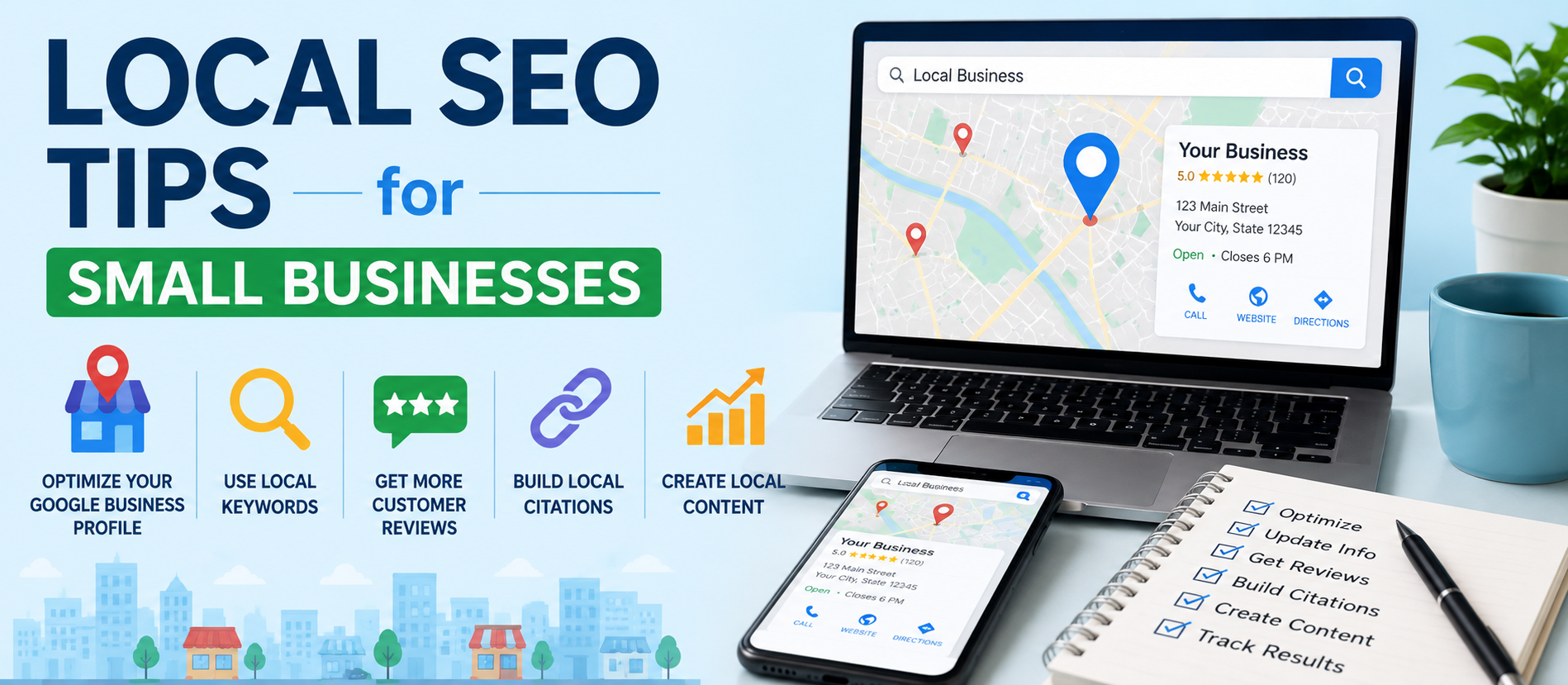
For a small business, being visible when nearby customers search for products or services can make a major difference to revenue. Local SEO helps businesses improve their visibility in location-based searches, Google Maps, local search results, and other discovery experiences. It connects a business with people who are already looking for something it offers in a particular area.
Local SEO is no longer limited to adding a city name to a website page. Modern local search depends on accurate business information, relevance, distance, prominence, helpful website content, customer reviews, technical SEO, and a strong overall digital presence. Google explains that local results are primarily influenced by relevance, distance, and prominence, while complete and accurate Business Profile information can help a business appear for relevant searches. citeturn0search1turn0search2
This guide provides practical Local SEO Tips for Small Businesses that can be implemented without requiring a huge marketing budget. It also explains how SEO, AEO, GEO, and AI Search Optimization can support local visibility as search becomes increasingly conversational.
Company: Designfo
Website: www.designfo.in
Contact: +91 9831037463
What Is Local SEO?
Local SEO is the process of improving a business's online presence so it can be discovered by customers searching for products, services, or businesses in a specific geographic area. A local search might include a location explicitly, such as "digital marketing agency in Kolkata," or it might use local intent such as "digital marketing agency near me."
Local search can generate valuable traffic because the user often has a clear commercial or service-related need. Someone searching for a plumber, dentist, restaurant, repair company, photographer, or marketing agency nearby may be much closer to taking action than someone performing a broad informational search.
Why Local SEO Is Important for Small Businesses
Small businesses frequently compete against larger brands with bigger advertising budgets. Local SEO gives them an opportunity to compete on relevance, proximity, reputation, and local expertise.
- Helps nearby customers discover your business.
- Improves visibility in Google Search and Maps.
- Supports phone calls, website visits, directions, and enquiries.
- Builds trust through reviews and accurate business information.
- Creates a long-term organic acquisition channel.
- Helps service-area businesses reach the communities they serve.
Google's current guidance recommends keeping Business Profile information complete and accurate, verifying the profile, keeping hours updated, responding to reviews, and adding photos and videos. citeturn0search1turn0search5
1. Claim and Verify Your Google Business Profile
One of the first priorities for a local business should be claiming and verifying its Google Business Profile. A verified profile gives a business greater control over the information customers see in Google Search and Google Maps.
Make sure the profile accurately represents the real-world business. Include the correct business name, primary category, phone number, website, hours, service area, and other relevant attributes.
Google states that businesses with complete and accurate information are more likely to appear in relevant local results. citeturn0search1
2. Choose the Most Relevant Business Category
⚠ Watch Out
Your primary category helps communicate what your business actually does. Avoid selecting a category simply because it has a popular keyword. Choose the category that most accurately describes your core business.
Where relevant, add additional categories that accurately describe secondary services. Avoid adding categories that do not represent genuine offerings, because inaccurate information can create confusion and undermine trust.
3. Keep Your Business Information Consistent
💡 Key Insight
Consistency is a fundamental part of Local SEO. Your business name, address or service area, phone number, website, hours, and core description should be accurate across important online properties.
Check your:
- Website
- Google Business Profile
- Social media profiles
- Industry directories
- Local directories
- Professional associations
- Review platforms
Google's Business Profile guidelines emphasize representing a business consistently as it is recognized in the real world. citeturn0search4
4. Build a Strong Local Website Foundation
Your website should clearly explain who you are, what you offer, where you operate, and how customers can contact you. A local website should not force visitors or search engines to guess your service area.
Important Local Website Elements
- Clear business name and contact information
- Service descriptions
- Location or service-area information
- Business hours
- Contact and enquiry options
- Customer testimonials
- Useful FAQs
- Fast mobile experience
Create useful service pages instead of one generic page containing every service. If you serve several meaningful areas, create location-focused pages only when each page offers genuinely useful information for customers in that area.
5. Optimize for Local Search Intent
Keyword research for Local SEO should focus on what customers actually search for when they need your service. Think beyond exact-match phrases.
For example, a customer may search for:
- Service + city
- Service + neighborhood
- Best service + location
- Service near me
- Emergency service + location
- Cost of service + location
- Service provider + nearby area
Use natural language throughout your website rather than repeating the same location keyword unnaturally. Search engines are increasingly capable of understanding meaning and context.
6. Create Location-Specific Content That Adds Real Value
Local content should be more than a city name inserted into an existing article. Create resources that genuinely help people in the areas you serve.
Examples include:
- Local buying guides
- Area-specific service advice
- Local pricing considerations
- Seasonal maintenance guides
- Neighborhood service information
- Local case studies
- Community event coverage
- Frequently asked local questions
Original local experiences can make content more useful and help establish your business as a knowledgeable participant in its community.
7. Build a Review Generation Strategy
Reviews are an important part of local reputation. Encourage genuine customers to share honest feedback after a successful interaction. Make the process easy, but do not attempt to manipulate reviews or pressure customers into posting misleading information.
Respond professionally to reviews, including negative reviews. A thoughtful response can demonstrate that your business listens to customers and takes service quality seriously. Google specifically recommends responding to reviews as part of improving the customer-facing quality of a Business Profile. citeturn0search1
Good Review Practices
- Ask genuine customers for honest feedback.
- Make review instructions easy to follow.
- Respond professionally and promptly.
- Never create fake reviews.
- Use feedback to improve operations.
8. Add High-Quality Photos and Videos
Visual content can help customers understand what your business looks like and what you offer. Upload current, authentic photos rather than relying entirely on stock imagery.
Depending on the business, useful visuals may include:
- Storefront or office
- Team members
- Products
- Completed projects
- Service processes
- Equipment
- Before-and-after examples
- Customer-facing facilities
Google recommends adding photos and videos to Business Profiles to help customers understand a business and its offerings. citeturn0search1
9. Optimize for Mobile Users
Local searches frequently happen when customers are already on the move. A slow or difficult mobile website can turn a high-intent visitor into a lost opportunity.
Make sure mobile users can quickly:
- Call your business.
- Find your location.
- Request directions.
- Submit an enquiry.
- Understand your services.
- View opening hours.
Use responsive design, compressed images, readable typography, simple navigation, and prominent calls to action.
10. Create Dedicated Service Pages
If your business offers multiple services, create dedicated pages for important offerings. A strong service page should explain the problem, your solution, benefits, process, service area, common questions, and next step.
For example, instead of a single page titled "Services," a marketing agency might create separate pages for Local SEO, technical SEO, marketing automation, website development, and AI Search Optimization.
11. Use LocalBusiness Structured Data Where Appropriate
Structured data gives search engines explicit information about the meaning of your page. Google provides specific documentation for LocalBusiness structured data and recommends using the most specific appropriate business subtype. citeturn0search0turn0search3
Depending on the business, structured data can communicate information such as name, address, telephone number, opening hours, URL, and other supported properties.
Structured data does not guarantee a particular search appearance. It should accurately represent information that is visible and relevant on the page.
12. Strengthen Local Citations and Mentions
Local citations are online references to a business's name and relevant business information. Quality matters more than simply collecting hundreds of directory links.
Focus on reputable, relevant sources such as:
- Industry associations
- Local chambers
- Established directories
- Local publications
- Community organizations
- Relevant professional websites
Avoid low-quality directories created only for links. Your objective should be to build a credible local footprint.
13. Earn Local Backlinks Naturally
Links from respected local organizations can strengthen your website's authority. Instead of purchasing large quantities of low-quality links, create reasons for legitimate organizations to mention your business.
Consider:
- Sponsoring relevant community initiatives.
- Publishing original local research.
- Participating in industry events.
- Providing expert commentary.
- Collaborating with complementary local businesses.
Google notes that prominence can be influenced by information such as links from other websites and reviews. citeturn0search1
14. Create a Local Content and Social Strategy
Social media does not replace Local SEO, but it can support local brand awareness and create opportunities for engagement. Share community activities, new services, customer stories, educational tips, events, and useful local information.
Keep your branding and business information consistent. The goal is to make your company recognizable and useful within the communities you serve.
15. Optimize for Voice and Conversational Search
Local queries are often conversational. People may ask questions such as "Where can I find a reliable electrician nearby?" or "What is the best time to visit this store?"
This is where AEO becomes useful. Create concise answers to common questions, followed by deeper explanations. Use natural language rather than forcing exact-match keywords.
16. Combine Local SEO with GEO and AI Search Optimization
Search is increasingly conversational, and businesses need to think about how their information may be interpreted by AI-powered discovery systems. Generative Engine Optimization (GEO) and AI Search Optimization focus on making business information clear, useful, consistent, and authoritative.
Local AI Search Priorities
- Keep business facts accurate.
- Publish locally relevant expert content.
- Answer customer questions directly.
- Build topical authority.
- Earn legitimate third-party mentions.
- Use clear entity information.
- Maintain a technically accessible website.
No legitimate strategy can guarantee that an AI system will recommend a particular business. The goal is to create a strong, trustworthy digital presence that can be understood across search and AI experiences.
17. Track the Right Local SEO Metrics
Ranking alone is not enough. Measure whether local visibility produces meaningful business outcomes.
- Google Business Profile interactions
- Website organic traffic
- Phone calls
- Direction requests
- Website enquiries
- Appointment requests
- Lead conversion rate
- Review growth and sentiment
- Local keyword visibility
Use analytics and Search Console alongside Business Profile insights to identify which pages, queries, and services create valuable actions.
18. Avoid Common Local SEO Mistakes
Small businesses can waste time and money by using shortcuts that create little long-term value.
- Creating duplicate location pages.
- Keyword stuffing city and neighborhood names.
- Using inaccurate business information.
- Creating fake reviews.
- Buying low-quality backlinks.
- Ignoring negative customer feedback.
- Using outdated business hours.
- Publishing thin local content.
- Ignoring mobile performance.
- Expecting immediate results.
A Practical 90-Day Local SEO Plan
Small businesses can implement local search improvements progressively instead of trying to change everything at once.
Days 1–30: Foundation
- Claim and verify your Business Profile if eligible.
- Correct business information.
- Review categories and services.
- Audit website contact and location information.
- Improve mobile usability.
- Identify important local search intents.
Days 31–60: Content and Reputation
- Create or improve core service pages.
- Publish useful local content.
- Build a legitimate review process.
- Add high-quality business photos.
- Identify relevant local citation opportunities.
- Start earning relevant local mentions.
Days 61–90: Authority and Optimization
- Implement appropriate structured data.
- Strengthen internal linking.
- Expand successful content clusters.
- Improve pages that receive impressions but few clicks.
- Measure leads and conversions.
- Refine the strategy based on performance data.
How Designfo Helps Small Businesses with Local SEO
Designfo helps businesses build a stronger local digital presence through practical, data-driven strategies. Our services can combine Local SEO, technical SEO, content strategy, AEO, GEO, AI Search Optimization, website development, marketing automation, analytics, and conversion optimization.
Designfo Digital Growth Services
- Local SEO
- Google Business Profile Optimization
- Technical SEO
- AI Search Optimization
- Answer Engine Optimization
- Generative Engine Optimization
- Local Content Strategy
- Website Design and Development
- Marketing Automation
- Conversion Rate Optimization
Frequently Asked Questions
What is the most important Local SEO tip for a small business?
Start with accurate and complete business information. If your Business Profile and website do not clearly communicate what you do, where you operate, and how customers can contact you, other optimization efforts become less effective.
How long does Local SEO take to work?
Results vary by market, competition, business history, website quality, and authority. Local SEO should be treated as a long-term growth strategy rather than a guaranteed quick ranking tactic.
Does Google Business Profile help Local SEO?
Yes. For eligible businesses, a verified Business Profile can help customers find accurate business information across Google Search and Maps. Google recommends keeping the profile complete, accurate, and up to date. citeturn0search5
What are the main Local SEO ranking factors?
Google says local results are mainly based on relevance, distance, and prominence. These factors help determine which businesses are appropriate for a customer's search and location. citeturn0search1
Should every business create multiple Google Business Profiles?
No. Businesses should follow Google's eligibility and representation guidelines. Google advises that there should generally be only one profile per business and that service-area businesses should configure their service area appropriately. citeturn0search4turn0search15
Can Local SEO help service-area businesses?
Yes. Eligible service-area businesses can define the areas where they provide services. Google advises businesses that do not serve customers at their address to remove the address from the profile and use a service area instead. citeturn0search15
How does AEO help local businesses?
Answer Engine Optimization helps businesses structure useful answers to common customer questions. This can support visibility across search experiences where users expect direct, conversational answers.
Conclusion
Local SEO for small businesses is about more than ranking for a city keyword. It is about building a trustworthy, accurate, useful, and locally relevant digital presence. Start with your Google Business Profile and website foundation, maintain consistent business information, create genuinely helpful local content, earn authentic reviews and mentions, improve technical performance, and measure the actions that matter to your business.
As search becomes more conversational, combine traditional SEO with AEO, GEO, and AI Search Optimization. The businesses that consistently provide accurate information and useful customer experiences will be better positioned to compete for local discovery across evolving search platforms.
Company: Designfo
Website: www.designfo.in
Contact: +91 9831037463
Ready to Grow?
Talk to us about a strategy tailored to your brand — we will help you stand out in search, AI discovery and social.


Comments (0)
Log in to leave a comment.