📋 Quick Summary
In this article:
What Are Low-Code and No-Code Platforms?
Low-Code Platforms
No-Code Platforms
Why Businesses Are Adopting Low-Code and No-Code Solutions
How Low-Code Platforms Work
How No-Code Platforms Work
Major Benefits of Low-Code and No-Code Platforms
1. Faster Development
2. Reduced Development Costs
3. Increased Business Agility
4. Empowerment of Non-Technical Users
In today's fast-paced digital economy, businesses need software solutions that can be developed, deployed, and updated quickly. Traditional software development often requires highly skilled programmers, lengthy development cycles, and significant budgets. However, a new generation of development tools is transforming the way applications are created. These tools are known as Low-Code and No-Code Software Platforms.
Low-code and no-code technologies have emerged as game-changing solutions that enable organizations to build applications, automate workflows, and accelerate digital transformation with minimal or no programming knowledge. As businesses seek greater agility and efficiency, these platforms are becoming increasingly popular across industries.
This comprehensive guide explores the benefits, features, trends, use cases, challenges, and future of low-code and no-code software platforms while highlighting their impact on SEO, AEO, GEO, and AI-powered search strategies.
What Are Low-Code and No-Code Platforms?
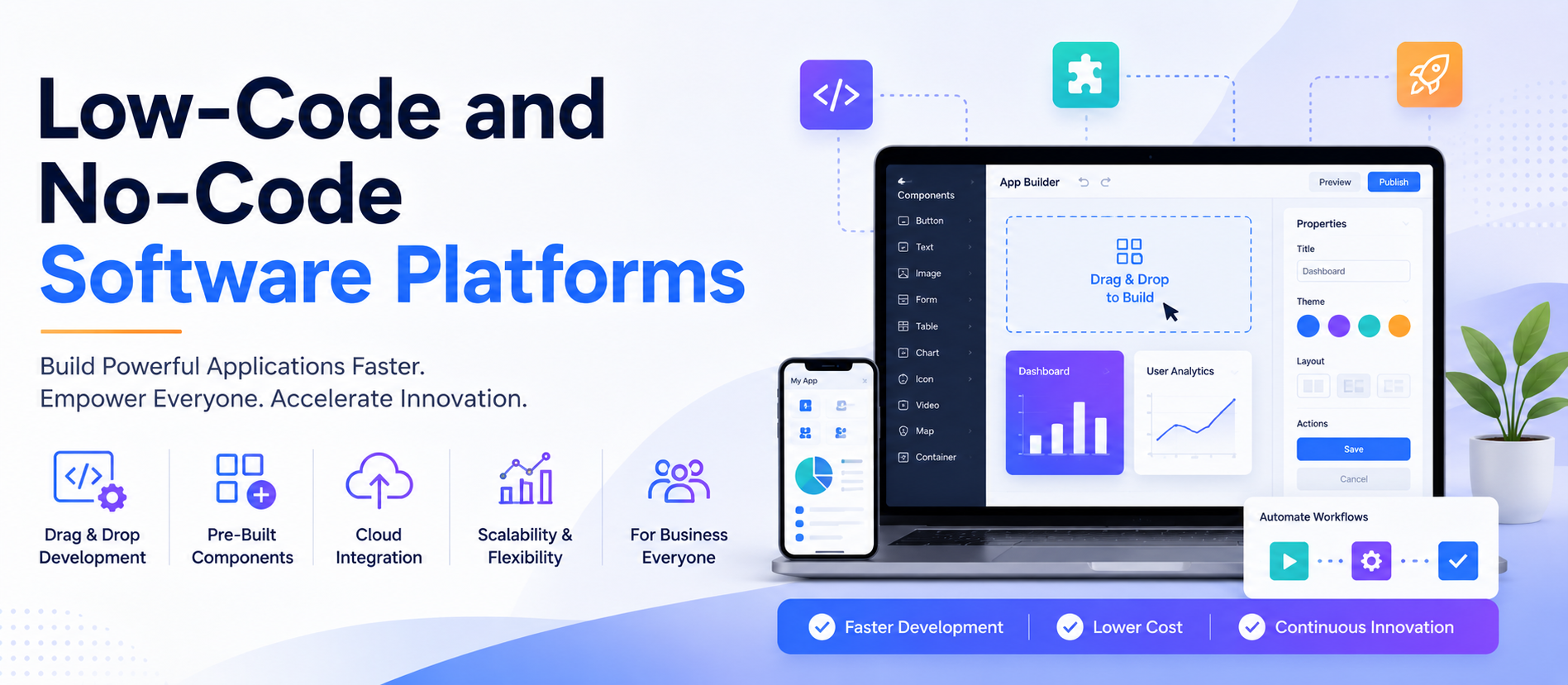
Low-code and no-code platforms are software development environments that allow users to create applications through graphical interfaces, drag-and-drop tools, visual workflows, and pre-built components instead of traditional coding.
Low-Code Platforms
Low-code platforms require minimal coding knowledge. Developers can use visual tools to build applications while still having the flexibility to add custom code when necessary.
No-Code Platforms
No-code platforms are designed for non-technical users. Business professionals, marketers, HR managers, and entrepreneurs can create applications without writing any code.
Both approaches significantly reduce development complexity and accelerate project delivery.
Why Businesses Are Adopting Low-Code and No-Code Solutions
The demand for digital applications continues to grow faster than the availability of software developers. Organizations face increasing pressure to innovate quickly while controlling costs.
Low-code and no-code platforms help solve these challenges by enabling faster development and empowering non-technical users to participate in digital transformation initiatives.
Key Drivers of Adoption:
- Developer shortages
- Digital transformation demands
- Remote work requirements
- Business process automation needs
- Cost reduction initiatives
- Faster time-to-market goals
How Low-Code Platforms Work
Low-code development platforms provide visual environments where users assemble applications using reusable components and templates.
Developers can:
- Drag and drop interface elements
- Configure workflows visually
- Integrate databases
- Connect APIs
- Customize business logic
- Add advanced coding when required
This hybrid approach combines speed with flexibility.
How No-Code Platforms Work
No-code platforms focus on simplicity and accessibility.
Users can build applications through:
- Visual editors
- Workflow builders
- Form generators
- Template libraries
- Pre-built integrations
- Automated processes
Business users can create solutions without relying heavily on IT departments.
Major Benefits of Low-Code and No-Code Platforms
1. Faster Development
Traditional software projects can take months or even years to complete. Low-code and no-code platforms significantly reduce development timelines.
Applications can often be created within days or weeks rather than months.
2. Reduced Development Costs
Organizations spend less on development resources because fewer specialized programmers are required.
Reduced coding effort leads to lower project costs and better resource utilization.
3. Increased Business Agility
Businesses can respond quickly to changing market conditions by updating applications and workflows without lengthy development cycles.
4. Empowerment of Non-Technical Users
Citizen developers can create business solutions independently, reducing dependence on IT teams.
5. Improved Collaboration
Business teams and developers can work together more effectively using visual development environments.
Common Applications of Low-Code and No-Code Platforms
Organizations use these platforms across a wide variety of business functions.
Popular Use Cases Include:
- Customer Relationship Management (CRM)
- Human Resource Management
- Project Management
- Inventory Tracking
- Workflow Automation
- Customer Portals
- Internal Business Applications
- Data Collection Systems
- Approval Processes
- Marketing Automation
These platforms support both simple and sophisticated business solutions.
Low-Code vs No-Code: Understanding the Difference
Low-Code
- Requires limited coding knowledge
- Suitable for developers and IT teams
- Supports advanced customization
- Handles complex enterprise applications
- Offers greater flexibility
No-Code
- Requires no programming skills
- Designed for business users
- Uses visual tools exclusively
- Ideal for simple to moderate applications
- Faster learning curve
Organizations often use both approaches depending on project complexity.
Industries Benefiting from Low-Code and No-Code Development
Healthcare
- Patient management systems
- Appointment scheduling
- Workflow automation
Finance
- Compliance workflows
- Customer onboarding systems
- Risk management tools
Education
- Learning management solutions
- Student portals
- Administrative automation
Retail
- Inventory management
- Customer engagement platforms
- Sales tracking systems
Manufacturing
- Production monitoring
- Supply chain tracking
- Maintenance management
Artificial Intelligence and Low-Code Development
Artificial Intelligence is increasingly being integrated into low-code and no-code platforms.
AI-powered capabilities include:
- Automated code generation
- Workflow recommendations
- Predictive analytics
- Intelligent automation
- Natural language application creation
- Smart business insights
AI further accelerates application development while reducing technical complexity.
Workflow Automation Through Low-Code Platforms
One of the most valuable uses of low-code software is workflow automation.
Organizations can automate repetitive tasks such as:
- Employee onboarding
- Expense approvals
- Customer support requests
- Invoice processing
- Lead management
- Document approvals
Automation improves productivity while reducing human errors.
Security Considerations
💡 Key Insight
Security remains an important factor when adopting low-code and no-code solutions.
Organizations should evaluate:
- Data encryption
- Access controls
- Identity management
- Compliance certifications
- Audit logging
- Backup capabilities
Leading platforms now include enterprise-grade security features to protect business data.
Integration Capabilities
Modern businesses rely on multiple software systems.
Successful low-code and no-code platforms provide integration capabilities for:
- CRM systems
- ERP software
- Email platforms
- Payment gateways
- Cloud storage services
- Business intelligence tools
These integrations create connected digital ecosystems.
Challenges of Low-Code and No-Code Development
While these platforms offer significant advantages, organizations should understand potential limitations.
Common Challenges:
- Vendor lock-in risks
- Customization limitations
- Scalability concerns
- Governance requirements
- Security oversight needs
- Complex integration scenarios
Proper planning and platform selection help mitigate these risks.
Emerging Trends in Low-Code and No-Code Software
1. AI-Assisted Development
Artificial intelligence is enabling users to create applications using natural language prompts.
2. Hyperautomation
Organizations are combining automation, AI, and low-code platforms to streamline entire business processes.
3. Citizen Developer Programs
Businesses are actively training employees to build applications independently.
4. Enterprise Adoption
Large organizations are increasingly deploying low-code platforms for mission-critical applications.
5. Multi-Experience Development
Platforms now support web, mobile, desktop, and conversational experiences from a single development environment.
How Low-Code Platforms Support SEO, AEO, GEO, and AI Search
Modern businesses must optimize digital assets for search visibility and AI-driven discovery.
SEO (Search Engine Optimization) benefits from rapid deployment of optimized websites, portals, and content management systems.
AEO (Answer Engine Optimization) becomes easier when organizations can quickly structure content and workflows for voice search and AI assistants.
GEO (Generative Engine Optimization) requires content and systems that can be efficiently understood and referenced by generative AI platforms.
Low-code and no-code solutions accelerate the implementation of these digital strategies.
Why Digiifrog Recommends Low-Code and No-Code Platforms
At Digiifrog, we recognize that businesses need agile technology solutions to remain competitive in an increasingly digital world.
Low-code and no-code platforms empower organizations to innovate faster, reduce costs, improve operational efficiency, and support AI-driven growth strategies.
By enabling rapid application development and workflow automation, these platforms help businesses focus on growth rather than technical complexity.
Website: www.digiifrog.com
The Future of Software Development
The future of software development will be increasingly driven by low-code and no-code technologies. As AI capabilities advance and business requirements become more dynamic, organizations will seek tools that enable rapid innovation without requiring extensive technical expertise.
Businesses that embrace low-code and no-code platforms today will gain greater agility, faster time-to-market, improved productivity, and stronger competitive advantages tomorrow.
Whether you are a startup, small business, or enterprise organization, low-code and no-code software platforms represent one of the most important technology trends shaping the future of digital transformation.
Ready to Grow?
Talk to us about a strategy tailored to your brand — we will help you stand out in search, AI discovery and social.

Comments (0)
Log in to leave a comment.