📋 Quick Summary
In this article:
What Does Inflation Have to Do With Debt?
1. Start With a Complete Debt Inventory
2. Prioritize High-Interest Debt
4. Protect Your Emergency Fund
5. Avoid Funding Inflation With Credit Cards
6. Review Variable-Rate Debt
Refinancing, Consolidation and Balance Transfers
8. Negotiate or Shop for Better Credit Terms
10. Separate Fixed-Rate and Variable-Rate Debt
13. Do Not Ignore Minimum Payments
15. Avoid Taking New Debt for Lifestyle Spending
16. Build a Debt-Reduction Budget
💡 Key Insight
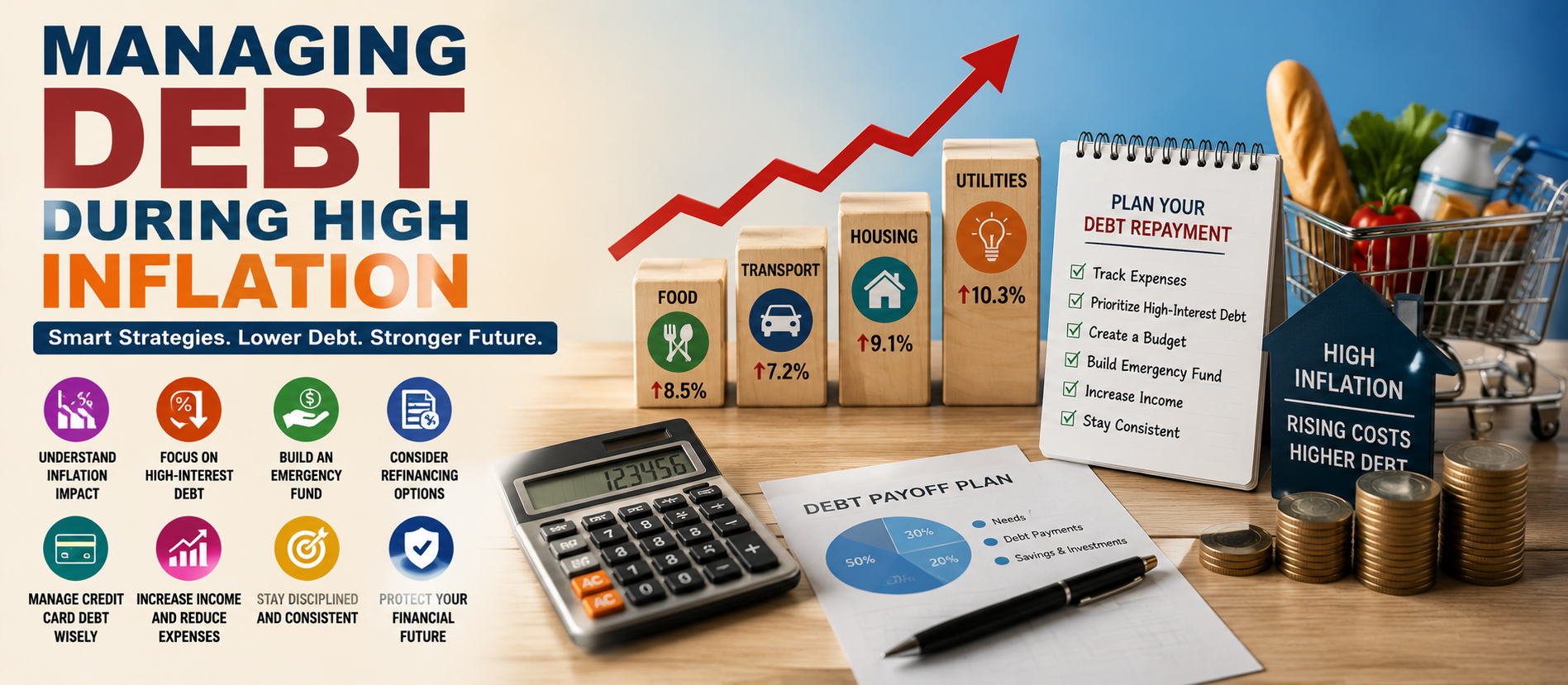
Managing debt during high inflation can be challenging because household expenses may rise while borrowing costs remain elevated. When groceries, housing, transportation, utilities, insurance, and other essentials become more expensive, families may have less cash available for debt payments. At the same time, variable-rate borrowing such as many credit cards can become particularly costly.
Inflation does not affect every debt in the same way. A fixed-rate loan may become easier to manage in real terms if income rises over time, while variable-rate debt can become more expensive as interest rates change. The best strategy is therefore not simply to “pay debt faster,” but to understand each balance, prioritize expensive borrowing, protect essential cash flow, and avoid creating new high-cost debt.
Current U.S. data illustrate why borrowing costs deserve attention. The Federal Reserve's July 2026 Monetary Policy Report said consumer-credit borrowing costs remained elevated, with credit-card and auto-loan balances having picked up in recent months. citeturn0search13 The Federal Reserve's May 2026 Financial Stability Report also noted that auto and credit-card delinquencies remained high relative to the past decade. citeturn0search8
Credit-card debt can be especially expensive. CFPB research found that average APRs on credit-card accounts assessed interest reached 22.8% in 2023, while APR margins also reached historically high levels. citeturn0search0
This WordPress-ready HTML article is prepared for Digiifrog (www.digiifrog.com) with SEO, AEO, GEO, and AI Search optimization.
What Does Inflation Have to Do With Debt?
Inflation means that the general price level of goods and services is rising. Debt is a contractual obligation with a payment schedule and interest cost. When these two forces interact, a household can experience pressure from both sides: everyday expenses may increase while borrowing remains expensive.
The impact depends on the type of debt, whether the interest rate is fixed or variable, how quickly income changes, and whether the household has enough emergency savings.
1. Start With a Complete Debt Inventory
Before changing a repayment strategy, list every debt. Record the outstanding balance, interest rate or APR, minimum payment, due date, remaining term, and whether the rate is fixed or variable.
Include credit cards, personal loans, auto loans, student loans, mortgages, buy-now-pay-later balances, and other obligations. A complete inventory prevents high-cost balances from being overlooked.
2. Prioritize High-Interest Debt
When interest rates are high, expensive debt can consume a large portion of each payment. The highest-interest-rate method directs extra money toward the debt with the highest rate while maintaining minimum payments on other balances.
The CFPB identifies the highest-interest-rate method as one approach to debt reduction because it targets the debts costing the most interest first. citeturn0search5
This approach can be particularly useful when credit-card APRs are much higher than rates on other loans.
4. Protect Your Emergency Fund
Using every available dollar to repay debt can leave a household vulnerable to the next unexpected expense. A car repair, medical bill, job interruption, or urgent home expense can force new borrowing if there is no accessible cash reserve.
Keep an appropriate emergency cushion while aggressively addressing expensive debt. The right amount depends on income stability, essential expenses, insurance, and household circumstances.
5. Avoid Funding Inflation With Credit Cards
When prices rise, it can be tempting to put groceries, utilities, or other necessities on a credit card and pay only the minimum. This can turn a temporary budget problem into long-term debt because interest continues to accumulate.
CFPB guidance notes that credit-card interest is often calculated daily, meaning that paying down the balance sooner can reduce interest costs. citeturn0search11
If credit is being used for essentials every month, the underlying budget problem should be addressed rather than treated as a permanent financing solution.
6. Review Variable-Rate Debt
Variable-rate debt deserves special attention during periods of elevated borrowing costs. A rate increase can raise the payment or increase the amount of interest paid, depending on the loan structure.
Check whether your debt has a variable APR, how often the rate can change, and whether there are opportunities to move to a lower-cost structure.
Refinancing, Consolidation and Balance Transfers
Lower-rate refinancing, consolidation, or a balance transfer can reduce interest costs in some cases, but compare fees, promotional periods, the post-promotion rate, loan term, and total repayment cost. A lower monthly payment does not necessarily mean a lower total cost.
8. Negotiate or Shop for Better Credit Terms
Consumers should not assume that the first available credit product is the cheapest. Compare rates, fees, balance-transfer terms, and other conditions before moving debt.
CFPB research published in 2024 found that, in its survey data, the largest credit-card issuers charged substantially higher interest rates than smaller banks and credit unions, suggesting that shopping around can sometimes matter. citeturn0search2
Any new offer should be evaluated for fees, promotional-period expiration, eligibility requirements, and the rate that applies afterward.
10. Separate Fixed-Rate and Variable-Rate Debt
Fixed-rate debt has a payment structure that generally does not change because market rates move, subject to the loan contract. Variable-rate debt can change as its reference rate changes.
During inflationary periods, this distinction can be important. A household may choose to prioritize variable or high-rate debt while continuing scheduled payments on lower-cost fixed-rate borrowing.
13. Do Not Ignore Minimum Payments
Even when focusing on one target debt, continue making required minimum payments on other accounts. Missing payments can lead to fees, additional interest, credit damage, and other consequences.
⚠ Watch Out
Use a bill calendar or automatic reminders to avoid accidental late payments. CFPB guidance recommends organizing monthly bills and tracking what is owed as part of debt management. citeturn0search5turn0search12
15. Avoid Taking New Debt for Lifestyle Spending
High inflation can create pressure to maintain a previous lifestyle even when real purchasing power has fallen. Financing discretionary purchases can make the problem worse.
Before borrowing, ask whether the purchase is necessary, whether the payment fits the budget, and what the total cost will be after interest and fees.
16. Build a Debt-Reduction Budget
A useful budget starts with take-home income and subtracts essential living costs, minimum debt payments, savings needs, and discretionary spending. The amount left can become the extra debt-payment budget.
Review the budget regularly because inflation can change grocery, housing, transportation, and utility costs. A debt plan that worked last year may need to be adjusted.
18. Manage Debt Without Stopping All Long-Term Saving
Paying expensive debt should be a priority, but completely abandoning long-term saving may also create problems. Where an employer retirement contribution match is available, for example, the decision to reduce contributions should consider the value of that benefit.
The appropriate balance depends on the debt rate, emergency savings, employer benefits, investment goals, and household circumstances.
SEO, AEO, GEO and AI Search Optimization
SEO content about inflation and debt should target useful searches such as “how to manage debt during inflation,” “pay off credit card debt,” “high inflation debt strategies,” and “how inflation affects loans.”
AEO should directly answer questions such as “Should I pay off high-interest debt during inflation?”, “Does inflation make debt easier to repay?”, and “How can I reduce credit-card interest?”
GEO and AI Search optimization can be strengthened with clear definitions, location-specific borrowing information, current official data, structured headings, practical examples, FAQs, and transparent limitations. Financial content should distinguish general education from personalized financial advice.
Debt Management Checklist During High Inflation
- List every debt, rate, balance, and due date.
- Identify variable-rate and high-interest balances.
- Pay minimums on all accounts on time.
- Target the highest-cost debt or use a consistent snowball strategy.
- Keep an appropriate emergency reserve.
- Compare refinancing and consolidation carefully.
- Avoid new high-interest borrowing for discretionary spending.
- Review the household budget as prices change.
- Look for practical ways to increase income.
- Use windfalls strategically.
- Seek qualified help before debt becomes unmanageable.
Frequently Asked Questions About Managing Debt During Inflation
Should I pay off high-interest debt during inflation?
High-interest debt is generally a strong repayment priority because reducing the balance eliminates future interest charges. The CFPB specifically identifies the highest-interest-rate method as a debt-reduction strategy. citeturn0search5
Does inflation make fixed-rate debt easier to repay?
Inflation can reduce the purchasing-power value of fixed future payments if income also rises, but the effect depends on wages, expenses, taxes, and the loan's actual interest rate. It does not make expensive debt automatically beneficial.
How can I reduce credit-card interest?
Pay balances down faster, compare lower-rate products, consider eligible balance-transfer offers carefully, and avoid carrying new balances. Credit-card interest may be calculated daily, so earlier repayment can reduce interest costs. citeturn0search11
Should I stop saving to pay off debt?
Not necessarily. Maintain an appropriate emergency reserve and consider important employer retirement benefits while directing additional cash toward expensive debt. The right balance depends on your financial situation.
Conclusion
Managing debt during high inflation requires a combination of cost control, careful borrowing, disciplined repayment, and protection against unexpected expenses. Inflation can make everyday life more expensive, while elevated borrowing costs can make revolving debt particularly difficult to eliminate.
Start by understanding every debt you owe. Prioritize high-interest balances, protect an emergency cushion, compare refinancing options carefully, avoid unnecessary new borrowing, and update the household budget as prices change.
Current Federal Reserve data show that consumer borrowing costs remain elevated, while credit-card and auto-loan balances have increased in recent months. citeturn0search13 This makes proactive debt management especially important for households that carry variable-rate or high-interest balances.
For finance websites, personal-finance platforms, businesses, and service providers seeking modern websites, content marketing, automated lead generation, SEO, AEO, GEO, and AI Search optimization, Digiifrog can help. Visit www.digiifrog.com.
Quick Answer: How Should You Manage Debt During High Inflation?
During high inflation, list all debts, prioritize high-interest and variable-rate balances, make every minimum payment on time, maintain an appropriate emergency reserve, reduce unnecessary spending, compare refinancing options carefully, and avoid taking on new expensive debt. Inflation may reduce the real burden of some fixed-rate debt, but high-interest credit-card borrowing can remain extremely costly.
Important Note
Interest rates, inflation, taxes, credit rules, and debt-relief options vary by country, lender, and individual circumstances. U.S. regulatory and market references in this article are provided as examples and should not be treated as universal rules. This article is educational content, not personalized financial, credit, tax, or legal advice.
Ready to Grow?
Talk to us about a strategy tailored to your brand — we will help you stand out in search, AI discovery and social.
Comments (0)
Log in to leave a comment.