📋 Quick Summary
In this article:
Why Employment Laws Are Changing
Remote Worker Classification Rules
Working Hours and Overtime Compliance
Remote Workplace Safety Requirements
Data Privacy and Employee Monitoring Laws
Cybersecurity Responsibilities
Remote Work Expense Reimbursement
Cross-Border Employment Challenges
Tax Implications for Remote Workers
Remote Employee Benefits and Equal Treatment
Remote work has transformed the global employment landscape. What began as a temporary solution during major disruptions has evolved into a permanent workforce model adopted by businesses of all sizes. Companies now hire employees across cities, states, and even countries, creating new opportunities while introducing complex legal and compliance challenges.
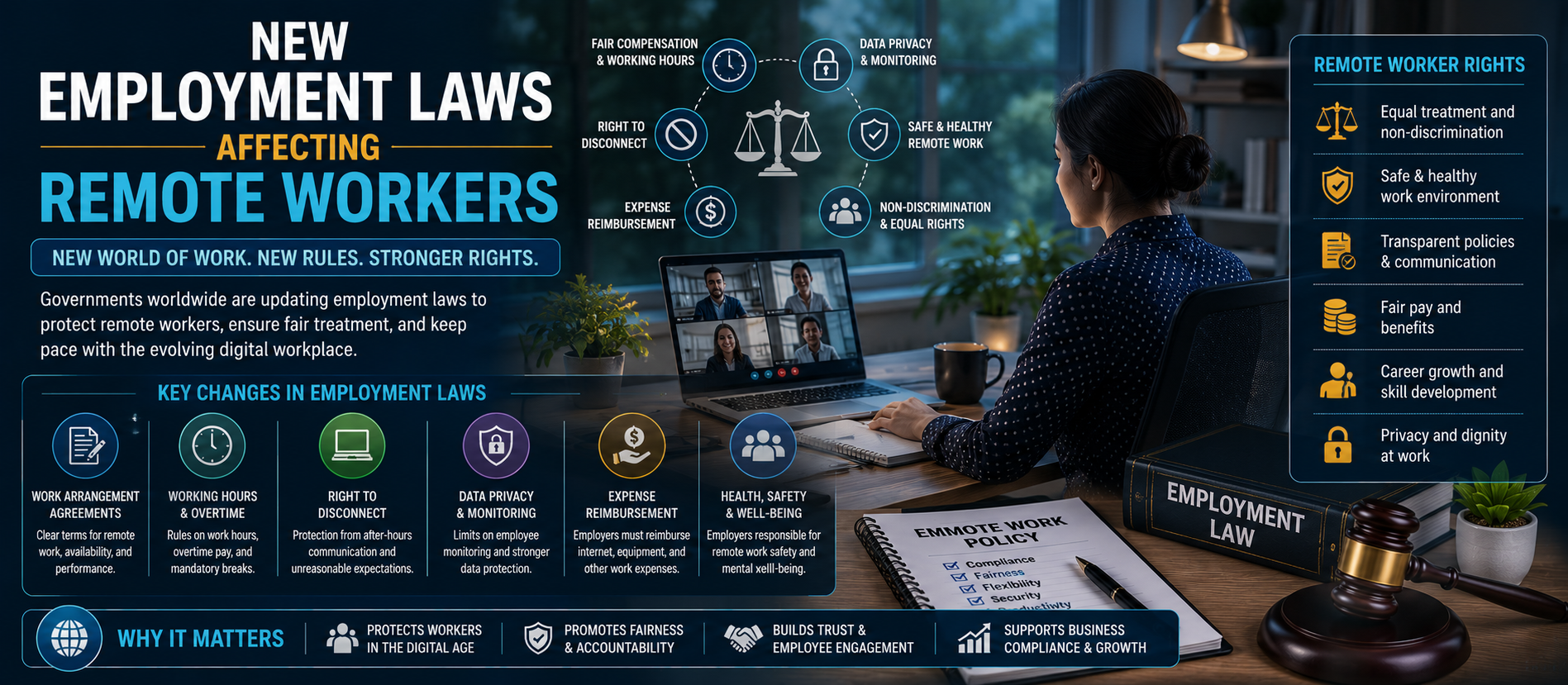
As remote work continues to expand, governments and regulatory authorities are updating employment laws to address issues such as employee classification, workplace safety, working hours, data privacy, taxation, compensation, cybersecurity, and cross-border employment.
Both employers and remote employees must understand these evolving legal requirements to ensure compliance, reduce risks, and maintain productive working relationships.
This comprehensive guide explores new employment laws affecting remote workers in 2026, legal responsibilities for employers, employee rights, emerging compliance trends, and best practices for navigating the future of remote work.
The Rise of Remote Work
Remote work has become a mainstream employment model across industries including technology, finance, marketing, consulting, customer support, education, healthcare administration, and professional services.
Benefits of remote work include:
- Flexible schedules
- Reduced commuting time
- Access to global talent
- Lower operating costs
- Improved work-life balance
- Increased productivity in many sectors
However, these benefits have also created new legal questions that lawmakers are increasingly addressing.
Why Employment Laws Are Changing
Traditional employment laws were largely designed for office-based workplaces. Remote work challenges many assumptions regarding supervision, workplace safety, attendance, payroll administration, and employee rights.
Modern employment laws now focus on:
- Remote worker protections
- Digital workplace rights
- Cross-border employment
- Data privacy compliance
- Remote workplace safety
- Flexible scheduling regulations
These changes aim to balance flexibility with worker protections.
Remote Worker Classification Rules
One of the most significant legal issues involves employee classification.
Businesses must correctly distinguish between:
- Employees
- Independent contractors
- Freelancers
- Consultants
- Temporary workers
Misclassification can lead to penalties, tax liabilities, wage disputes, and legal claims.
New regulations increasingly focus on ensuring workers receive appropriate protections based on their actual working relationships rather than job titles.
Working Hours and Overtime Compliance
Tracking working hours becomes more complicated when employees work remotely.
Modern employment regulations increasingly address:
- Time tracking requirements
- Overtime eligibility
- Break periods
- Workload management
- After-hours communications
Employers must maintain accurate records while respecting employee privacy.
The Right to Disconnect
Several jurisdictions have introduced or considered "right to disconnect" regulations.
These rules generally seek to protect employees from excessive after-hours communications and work demands.
Potential benefits include:
- Improved mental health
- Reduced burnout
- Better work-life balance
- Healthier workplace culture
Employers increasingly establish communication policies to support compliance.
Remote Workplace Safety Requirements
Workplace safety obligations do not disappear simply because employees work from home.
Emerging regulations may require employers to address:
- Ergonomic workstations
- Health and safety guidance
- Remote work assessments
- Injury reporting procedures
- Work-related accident documentation
Employers and employees often share responsibility for maintaining safe work environments.
Data Privacy and Employee Monitoring Laws
Many employers use monitoring tools to manage remote workforces.
Examples include:
- Productivity tracking software
- Time monitoring tools
- Screen activity systems
- Location tracking applications
- Communication monitoring platforms
New privacy regulations increasingly require transparency regarding monitoring practices.
Employees often have legal rights concerning how personal data is collected, stored, and used.
Cybersecurity Responsibilities
Remote work significantly increases cybersecurity risks.
Organizations must address:
- Secure device management
- Password policies
- Data encryption
- Multi-factor authentication
- Remote network security
- Cybersecurity training
Many data protection laws now require stronger safeguards for remote work environments.
Remote Work Expense Reimbursement
Some jurisdictions require employers to reimburse employees for necessary business expenses incurred while working remotely.
Examples may include:
- Internet costs
- Office equipment
- Software subscriptions
- Communication tools
- Work-related utilities
Reimbursement requirements vary depending on local employment laws.
Cross-Border Employment Challenges
Many businesses now hire remote workers across different countries.
This creates legal considerations involving:
- Employment contracts
- Tax obligations
- Immigration compliance
- Payroll administration
- Local labor laws
- Data protection requirements
International remote employment often requires specialized legal guidance.
Tax Implications for Remote Workers
Remote work can affect taxation for both employers and employees.
Potential issues include:
- Income tax obligations
- Payroll tax compliance
- Multi-jurisdiction reporting
- Permanent establishment risks
- Cross-border tax exposure
Tax treatment depends heavily on location and employment arrangements.
Remote Employee Benefits and Equal Treatment
Employment laws increasingly address equal treatment of remote workers.
Remote employees may be entitled to:
- Equal compensation opportunities
- Benefits eligibility
- Training programs
- Promotion opportunities
- Performance evaluations
⚠ Watch Out
Employers should avoid policies that unintentionally disadvantage remote employees.
Anti-Discrimination Protections
Remote workers remain protected by employment discrimination laws.
Employers should ensure compliance regarding:
- Hiring practices
- Promotion decisions
- Compensation structures
- Accessibility accommodations
- Performance evaluations
Equal treatment remains a core legal obligation regardless of work location.
Remote Work and Accessibility Requirements
Employers may need to provide reasonable accommodations for employees with disabilities.
Remote work environments may require:
- Accessible technology
- Assistive software
- Flexible scheduling
- Specialized equipment
Accessibility obligations continue to evolve alongside workplace technology.
Digital Harassment and Workplace Conduct
Remote work has created new forms of workplace misconduct.
Examples include:
- Harassing messages
- Inappropriate video meeting behavior
- Cyberbullying
- Digital intimidation
- Online discrimination
Employers remain responsible for maintaining respectful work environments.
Employment Contracts for Remote Workers
Modern remote work arrangements often require detailed contracts.
Important provisions may address:
- Work location
- Working hours
- Compensation
- Data security obligations
- Confidentiality requirements
- Termination procedures
Clear agreements help reduce misunderstandings and legal disputes.
AI and Automated Workforce Management
Artificial intelligence is increasingly used to manage remote teams.
Applications include:
- Productivity analytics
- Performance monitoring
- Scheduling systems
- Recruitment tools
- Workforce planning
Regulators are paying closer attention to transparency, fairness, and bias concerns associated with automated decision-making.
Employer Best Practices for Compliance
Organizations can reduce legal risks by implementing proactive compliance strategies.
- Develop remote work policies
- Review employment contracts
- Conduct privacy assessments
- Implement cybersecurity controls
- Provide employee training
- Monitor legal developments
Strong governance helps organizations adapt to evolving employment laws.
Future Trends in Remote Work Regulation
Several trends are likely to influence future employment laws.
- Expanded privacy protections
- Greater worker flexibility rights
- Cross-border labor regulations
- AI workplace governance
- Enhanced cybersecurity requirements
- Digital workplace standards
Remote work regulation will continue evolving alongside technological change.
SEO, AEO, GEO, and AI Search for Employment Law Education
Employers and employees increasingly rely on online resources to understand changing employment laws.
SEO (Search Engine Optimization) helps legal content rank on Google and Bing.
AEO (Answer Engine Optimization) improves visibility in direct-answer search experiences.
GEO (Generative Engine Optimization) enhances discoverability in AI-generated responses.
AI Search Optimization ensures employment law content remains accessible through modern AI-powered search platforms.
Accessible legal education helps organizations maintain compliance and informed decision-making.
Frequently Asked Questions
Do remote workers have the same legal rights as office employees?
In many jurisdictions, remote employees generally receive the same core employment protections as office-based workers.
Can employers monitor remote employees?
Monitoring may be permitted under applicable laws, but transparency and privacy requirements often apply.
Who pays for remote work expenses?
Requirements vary by jurisdiction, employer policy, and employment agreements.
Do remote workers qualify for overtime?
Eligibility depends on applicable labor laws and employee classification.
Are employment laws changing because of remote work?
Yes. Governments continue updating regulations to address emerging workplace realities and technological developments.
Conclusion
New employment laws affecting remote workers reflect the rapid transformation of modern workplaces. As organizations embrace distributed workforces, lawmakers are adapting legal frameworks to address privacy, safety, compensation, cybersecurity, worker classification, and cross-border employment challenges.
Employers that proactively review policies, strengthen compliance programs, and monitor regulatory developments will be better positioned to manage legal risks. Likewise, employees who understand their rights and responsibilities can navigate remote work arrangements more effectively.
For more expert insights on employment law, business compliance, digital growth, SEO, AEO, GEO, and AI Search optimization, visit Digiifrog.
Digiifrog
Website: www.digiifrog.com
Digital Marketing, SEO, AEO, GEO & AI Search Solutions for Modern Businesses.
Ready to Grow?
Talk to us about a strategy tailored to your brand — we will help you stand out in search, AI discovery and social.


Comments (0)
Log in to leave a comment.