📋 Quick Summary
In this article:
Quick Answer: What Are the Biggest Office Real Estate Trends in 2026?
1. The Office Market Is Recovering, but the Recovery Is Selective
2. Flight-to-Quality Is One of the Biggest Investment Themes
3. Hybrid Work Is Changing Office Design
4. Flexible Office Space Is Becoming a Core Requirement
5. GCCs Are Driving Office Demand in India
6. India Office Demand Remains Strong in 2026
7. Bengaluru Remains a Key Office Investment Market
8. Hyderabad, Pune, Chennai and Delhi-NCR Also Matter
9. Rental Growth Is Becoming an Important Signal
10. Green Buildings Are Becoming More Valuable
11. AI Is Changing the Office Investment Equation
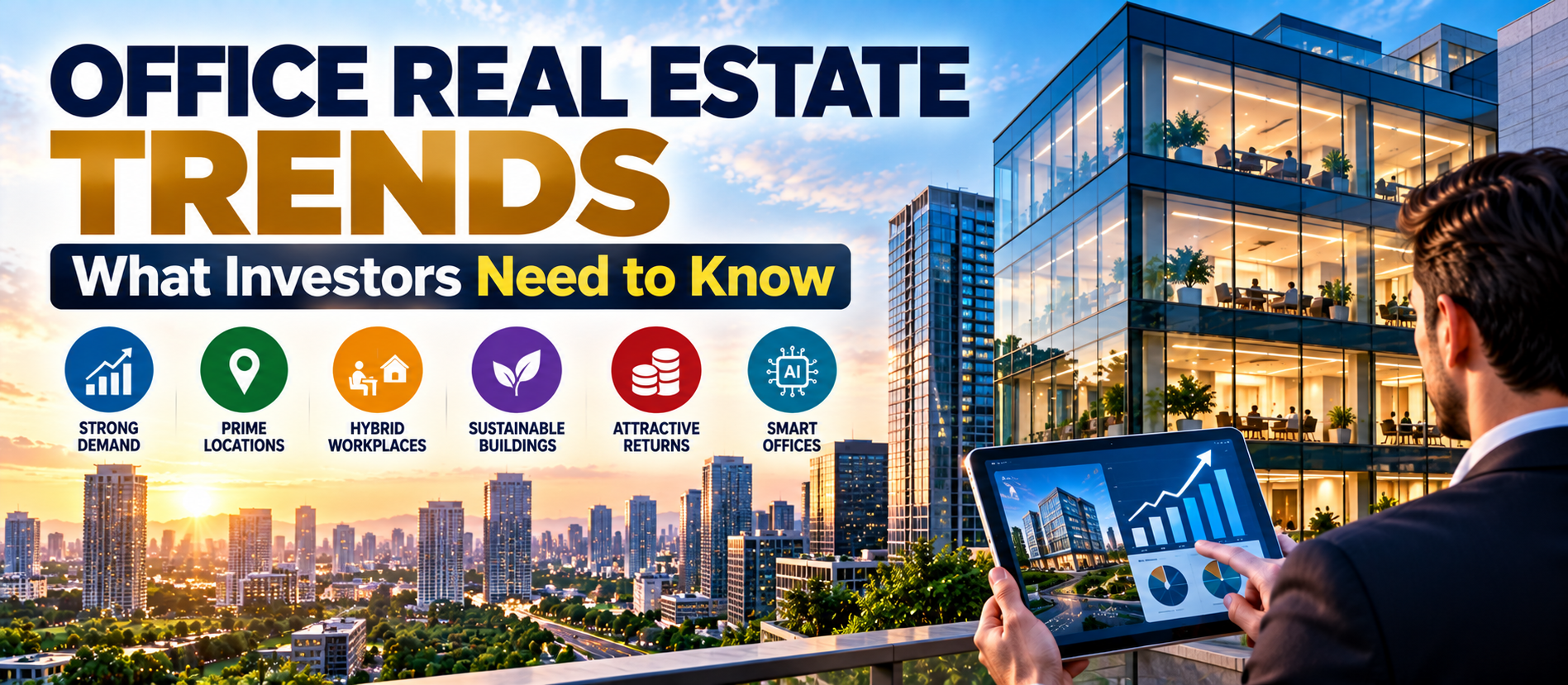
The office real estate market is changing. But it is not disappearing.
Hybrid work, artificial intelligence, flexible offices, sustainability, rising operating costs, and changing employee expectations are reshaping how companies use office space. These changes create risks for some properties. They also create new opportunities for investors who understand what occupiers want.
In 2026, the biggest question is no longer whether people will work from offices. The better question is what kind of office will attract people, businesses, and investment capital?
The answer is becoming clearer. Quality matters more. Location matters more. Flexibility matters more. Technology matters more. Buildings that support collaboration, employee experience, energy efficiency, and business growth can have a stronger competitive position than older offices that offer little beyond desks and meeting rooms.
This article explains the most important office real estate trends for 2026 and what investors should consider before buying, developing, financing, or repositioning an office property.
Quick Answer: What Are the Biggest Office Real Estate Trends in 2026?
The major office real estate trends include:
- Strong demand for high-quality and well-located offices.
- Hybrid work becoming a permanent part of workplace strategy.
- Growth in flexible and managed office space.
- Global Capability Centres (GCCs) driving office demand in India.
- AI changing workplace design and long-term space planning.
- Greater demand for smart, data-enabled buildings.
- Growing importance of green certification and energy efficiency.
- Flight-to-quality, with occupiers preferring better buildings.
- Increasing interest in office REITs and institutional ownership.
- Greater separation between prime assets and obsolete or poorly located buildings.
For investors, these trends suggest that simply owning an office building is not enough. Asset quality, tenant quality, location, operating efficiency, and adaptability are becoming central to investment performance.
1. The Office Market Is Recovering, but the Recovery Is Selective
Global office leasing has continued to recover in 2026. JLL reported that global office leasing in the first half of 2026 reached a new post-pandemic high, while the global vacancy rate declined to 16.5%. The recovery is not uniform, but demand for better-quality space is becoming more visible.
This is important for investors.
The office market should not be treated as one single asset class. Two buildings in the same city can perform very differently.
A modern Grade A building near a major business district may attract strong tenants. An older building with weak infrastructure may face longer vacancy periods, higher incentives, and greater capital expenditure.
This creates a growing divide between high-quality offices and secondary offices.
2. Flight-to-Quality Is One of the Biggest Investment Themes
Companies are becoming more selective about where employees work.
💡 Key Insight
Hybrid work means employees may not come to the office every day. That makes the office experience more important, not less important.
If employees are going to commute, the workplace needs to offer a reason to make the journey.
That can include:
- Better collaboration areas
- High-quality meeting spaces
- Natural light
- Good air quality
- Reliable technology
- Food and beverage options
- Fitness and wellness facilities
- Social spaces
- Strong transport access
- Modern security systems
JLL's 2026 global outlook highlights a stronger focus on high-quality workplaces and reports that many organizations increasingly value building quality, amenities, and AI-enabled buildings.
Investor lesson: A property with better fundamentals may outperform a cheaper property that requires extensive modernization.
3. Hybrid Work Is Changing Office Design
Hybrid work has not eliminated offices. It has changed their purpose.
Companies are increasingly using offices for collaboration, meetings, training, culture, innovation, and team interaction rather than requiring employees to sit at assigned desks every day.
CBRE's 2026 Global Workplace & Occupancy Insights reported office utilization at 53%, up from 38% in 2024 and 35% in 2023. It also found that collaboration is a major reason employees come into the office.
This creates a different demand profile.
Investors should look for buildings that can support changing layouts rather than buildings designed around rigid desk arrangements.
Flexible floor plates, efficient building systems, strong connectivity, and attractive common areas can make a property easier to lease and reposition.
4. Flexible Office Space Is Becoming a Core Requirement
Flexible workspace is no longer only for freelancers and small startups.
Large corporations are also using flexible space to manage uncertainty, support expansion, create project teams, and test new locations.
Flexible space can include:
- Serviced offices
- Managed offices
- Coworking spaces
- Shorter lease commitments
- Project-based workspace
- Satellite offices
- Hybrid office hubs
Colliers projects that flexible workspace operators could account for 20% to 25% of India's Grade A office demand in 2026. It also expects India's flexible office stock to reach roughly 85–90 million square feet in 2026.
For investors, this can create both an opportunity and a risk.
The opportunity is that flexible operators can become major tenants and can help landlords increase utilization.
The risk is that flexible workspace can have a different operating model from a traditional long-term lease. Investors need to understand the operator's financial strength, lease structure, revenue model, and tenant diversification.
5. GCCs Are Driving Office Demand in India
Global Capability Centres are one of the strongest structural drivers of India's office market.
GCCs have expanded beyond traditional back-office operations. Many now perform technology, engineering, finance, analytics, research, product development, and other high-value functions.
JLL reported that GCCs accounted for 41.7% of India's office leasing volume in H1 2026, while activity increased 14.2% year over year.
CBRE's Q3 2026 figures also showed GCCs accounting for about 41% of quarterly office space take-up and about 42% over the first nine months of the year.
This matters because GCC tenants can require large, modern, technology-enabled workplaces.
Investors in Bengaluru, Hyderabad, Chennai, Pune, Delhi-NCR, Mumbai, and other major office markets should monitor GCC expansion plans closely.
6. India Office Demand Remains Strong in 2026
India is one of the most important office real estate markets in the Asia-Pacific region.
JLL reported that India's H1 2026 office leasing volume reached 37.9 million square feet, the second-highest first-half performance on record. Net absorption reached 26.9 million square feet, the highest for any first half, while vacancy across the top seven cities fell to 14.5%.
CBRE reported approximately 21 million square feet of office absorption in Q3 2026, taking nine-month absorption to about 66.4 million square feet, the highest nine-month total recorded.
These numbers show why institutional investors continue to monitor Indian offices closely.
However, investors should not treat national growth as a guarantee for every property. Micro-market selection remains critical.
7. Bengaluru Remains a Key Office Investment Market
Bengaluru continues to dominate India's office market because of its technology ecosystem, talent base, startup environment, GCC presence, and expanding corporate infrastructure.
Colliers expects Bengaluru to account for close to one-third of India's office leasing and supply additions in 2026. JLL also reported that Bengaluru led H1 2026 office leasing and net absorption.
For investors, Bengaluru offers strong structural demand but also requires careful asset selection because supply can vary significantly between submarkets.
8. Hyderabad, Pune, Chennai and Delhi-NCR Also Matter
India's office growth is becoming more diversified.
Hyderabad has benefited from technology, GCC, life sciences, and corporate expansion. Pune remains important for technology, engineering, manufacturing, and services. Chennai has a strong technology and industrial base. Delhi-NCR has a large and diversified corporate ecosystem.
JLL's H1 2026 data placed Bengaluru, Hyderabad, Pune, and Delhi-NCR among the leading contributors to net absorption.
Investors should compare markets based on tenant diversity, infrastructure, rental growth, vacancy, new supply, and long-term employment growth.
9. Rental Growth Is Becoming an Important Signal
Office rents are an important part of investment performance.
JLL reported year-over-year rental growth across all major Indian office markets in Q2 2026. Hyderabad recorded the strongest increase at 11.9%, followed by Delhi-NCR at 7.7% and Bengaluru at 5.4%. Kolkata recorded 4.3% growth.
Rental growth can improve property income and potentially support capital values.
But investors should be careful when using past rental growth to forecast future returns.
A property with high historical rent growth may face strong new supply. A property in a slower-growth market may have more stable occupancy.
Always analyze both rent growth and vacancy risk.
10. Green Buildings Are Becoming More Valuable
Sustainability is moving from a corporate responsibility issue to a real estate investment issue.
Energy-efficient buildings can reduce operating costs. They can also support corporate ESG goals and make it easier for occupiers to meet internal sustainability targets.
CBRE reported that green-certified buildings represented 80% of new office supply completions in India in Q3 2026 and 82% of leasing activity.
This is a strong signal for investors.
Green certification alone does not make a property valuable. But energy performance, efficient cooling, water management, indoor environmental quality, renewable energy, and climate resilience can improve the long-term competitiveness of an office asset.
11. AI Is Changing the Office Investment Equation
Artificial intelligence is one of the most important long-term variables in commercial real estate.
AI can affect office demand in two opposite ways.
First, AI can increase productivity and reduce the number of people needed for some tasks.
Second, AI can create new roles, new business models, technology investment, and demand for specialized talent.
JLL describes the emerging impact as a divergence rather than a simple reduction in office demand. The effect will depend on how augmentation, displacement, and job creation interact within different industries and markets.
This means investors should not make a simple assumption such as “AI will reduce office demand.”
The better question is:
Which industries are likely to expand because of AI, and what kind of space will those industries need?
12. AI-Enabled Buildings Are Becoming More Important
AI is also changing the buildings themselves.
Smart office buildings can use sensors, analytics, automation, and building management systems to improve:
- Energy consumption
- Occupancy planning
- Heating and cooling
- Security
- Maintenance
- Space utilization
- Employee experience
JLL's 2026 workplace research reports that 66% of organizations show a preference for AI-enabled buildings over basic building management, highlighting the growing importance of technology in workplace decisions.
Investors should therefore evaluate a building's technology infrastructure as carefully as its physical structure.
13. Location Still Matters
Technology has changed the workplace, but location has not become irrelevant.
Good office locations can provide access to:
- Skilled employees
- Public transport
- Airports
- Residential communities
- Retail and food services
- Hotels
- Education institutions
- Other corporate offices
Employees are more likely to accept hybrid office attendance when the workplace is accessible and convenient.
For investors, this means location should be evaluated at the micro-market level, not only at the city level.
14. Transit-Oriented Office Markets Can Gain an Advantage
Transport connectivity can influence office demand.
Properties near metro stations, major highways, airports, and strong public transportation networks may have an advantage because commuting time directly affects employee experience.
In growing cities, investors should monitor planned infrastructure rather than relying only on today's connectivity.
However, infrastructure announcements should be treated carefully. A proposed project is not the same as a completed project.
15. Office Vacancy Is Still a Critical Metric
Vacancy affects rental income and asset value.
High vacancy can lead to:
- Lower rental income
- Higher tenant incentives
- Longer leasing periods
- Higher marketing costs
- More pressure on landlords
- Lower property valuations
JLL reported that vacancy across India's top seven office markets fell to 14.5% in H1 2026, the lowest level in five years.
Investors should still examine vacancy by submarket and building class because city-level averages can hide major differences.
16. New Supply Can Create Future Pressure
A market can have strong demand and still experience rental pressure if a large amount of new office space enters at the same time.
Before buying an office asset, study the development pipeline.
Ask:
- How much Grade A supply is under construction?
- Where will the new buildings be located?
- Which tenants are likely to occupy them?
- Will the new supply offer better technology or amenities?
- Will competing rents be lower?
CBRE reported record-high new office completions in India's first nine months of 2026, with approximately 51 million square feet of supply added.
Strong demand can absorb supply, but investors should always understand the pipeline.
17. Older Buildings May Need Repositioning
Older offices do not automatically become bad investments.
Some can become attractive through renovation and repositioning.
Possible upgrades include:
- Modern lobby design
- Improved elevators
- Better HVAC systems
- Energy-efficient lighting
- Smart access control
- High-speed connectivity
- New meeting areas
- Food and beverage facilities
- Green certification
- Improved landscaping
The investment question is whether the expected increase in rent, occupancy, and asset value justifies the renovation cost.
18. Office REITs Are Expanding Investor Access
Directly buying an office building requires significant capital and operational expertise.
Real Estate Investment Trusts can provide another way to gain exposure to income-producing commercial real estate.
Colliers estimates that more than 380 million square feet of existing Grade A office stock in India could potentially be listed in future REITs. It also reported that about 141 million square feet was already listed under four office REITs at the time of its 2026 outlook.
For investors, REITs can offer greater diversification and liquidity than direct ownership, although they carry market, interest-rate, management, and asset-specific risks.
19. Tenant Quality Matters
A building's value depends partly on who occupies it.
A strong tenant with a good financial position and a longer lease can provide greater income stability than a weak tenant with a short commitment.
Review:
- Tenant financial strength
- Lease duration
- Rent escalation terms
- Security deposits
- Renewal probability
- Industry exposure
- Tenant concentration
A building that depends on one large tenant can have significant concentration risk.
20. Lease Structure Can Be More Important Than Headline Rent
Two office buildings may have the same headline rent but very different investment outcomes.
Review the complete lease structure.
Important items include:
- Lease term
- Escalation clauses
- Rent-free periods
- Tenant improvement obligations
- Maintenance responsibilities
- Security deposits
- Break clauses
- Renewal options
- Termination rights
Investors should calculate the effective rent after incentives instead of looking only at the advertised rent.
21. Operating Costs Can Change Investment Returns
Office buildings can have significant operating costs.
These may include:
- Electricity
- Cooling
- Security
- Cleaning
- Property management
- Repairs
- Elevator maintenance
- Insurance
- Common-area maintenance
- Property taxes
Energy efficiency can therefore have a direct impact on net operating income.
When comparing two similar buildings, do not compare only rental income. Compare net operating income after operating costs.
22. Interest Rates Still Matter
Office real estate is sensitive to financing costs.
Higher borrowing costs can reduce investment returns and put pressure on property valuations. Lower financing costs can improve affordability and support transaction activity.
Investors should model several interest-rate scenarios instead of assuming one fixed financing cost.
Stress-test the investment against:
- Higher interest rates
- Lower rent growth
- Higher vacancy
- Higher maintenance costs
- Longer lease-up periods
23. Office Investment Is Becoming More Institutional
Institutional investors are increasingly focused on commercial assets that can deliver predictable income and long-term growth.
Recent Indian real estate investment data also shows strong institutional interest in office assets. Financial Express reported that office properties accounted for 35% of private-equity inflows into Indian real estate during the first half of FY27, based on Anarock data.
This institutional interest can support liquidity and development, but it can also increase competition for high-quality assets.
24. What Makes an Office Property Attractive in 2026?
A strong office asset typically has several of the following characteristics:
- Prime or emerging location
- Strong transport connectivity
- Modern building specifications
- Efficient floor plates
- Strong natural light
- Reliable power and connectivity
- Energy-efficient systems
- Green certification or strong sustainability credentials
- High-quality amenities
- Flexible space capability
- Diverse tenant base
- Longer lease commitments
- Healthy rental growth potential
- Strong local employment growth
25. What Office Properties Should Investors Be Careful About?
Some assets require additional caution.
- Buildings with persistent high vacancy
- Properties in declining business districts
- Buildings with poor transport access
- Assets requiring major capital expenditure
- Properties dependent on one weak tenant
- Buildings with outdated technology infrastructure
- Properties with inefficient energy systems
- Assets facing large new supply nearby
- Properties with complicated legal or title issues
- Buildings with weak property management
A low purchase price does not automatically mean a good investment.
26. The Rise of the Experience-Driven Office
The office is becoming more like a destination.
Companies want spaces that support culture, collaboration, creativity, and employee engagement.
This is changing building design.
Future-ready offices may include hospitality-style lobbies, shared lounges, wellness areas, flexible meeting rooms, outdoor spaces, restaurants, cafés, event areas, and technology-enabled collaboration zones.
For investors, the key is to identify which amenities actually improve leasing performance. Spending heavily on attractive features without tenant demand can reduce returns.
27. Data Should Drive Office Investment Decisions
Investors now have access to more property and market data than ever before.
Useful metrics include:
- Occupancy rate
- Effective rent
- Net absorption
- Vacancy
- Tenant retention
- Lease expiry schedule
- Rental growth
- Operating expenses
- Energy consumption
- Capital expenditure
AI and analytics can help investors identify patterns and compare properties faster.
But technology should support human judgment. Data quality remains important, and AI outputs should be checked against actual property conditions.
28. A Simple Office Investment Scorecard
Before investing, score the property from 1 to 5 across the following categories.
| Factor What to Examine | |
| Location | Transport, talent, business ecosystem and future infrastructure |
| Building quality | Age, specifications, amenities and flexibility |
| Tenant quality | Financial strength, industry and lease duration |
| Rental growth | Historical performance and future demand |
| Vacancy risk | Building and submarket vacancy |
| Supply risk | Upcoming competing developments |
| Operating cost | Energy, maintenance and management costs |
| Technology | Connectivity, smart systems and data infrastructure |
| Sustainability | Energy performance, certification and climate resilience |
| Exit potential | Future buyer and REIT/institutional demand |
29. How to Evaluate an Office Investment Step by Step
Step 1: Study the Micro-Market
Do not begin with the building. Begin with the location.
Step 2: Study Demand
Identify the industries expanding in the area.
Step 3: Analyze Comparable Buildings
Compare rents, occupancy, amenities and tenant profiles.
Step 4: Review the Tenant Mix
Understand concentration and lease expiry risk.
Step 5: Calculate Net Operating Income
Subtract realistic operating costs from rental income.
Step 6: Stress-Test Financing
Model higher interest rates and slower rental growth.
Step 7: Estimate Capital Expenditure
Budget for future modernization and major repairs.
Step 8: Evaluate Exit Options
Ask who will buy the asset in five or ten years.
30. Key Office Real Estate Trends Investors Should Watch
| Trend Investor Implication | |
| Hybrid work | Demand shifts toward flexible, experience-led offices |
| Flight-to-quality | Prime assets can outperform weaker buildings |
| GCC expansion | Creates strong demand for modern office space in India |
| Flexible offices | Creates new leasing and operating models |
| AI | Changes workplace demand and building technology |
| Green buildings | Can improve efficiency and tenant appeal |
| REIT growth | Broadens access and may support institutional liquidity |
| Rising construction costs | Can make existing high-quality assets more valuable |
| Data-driven management | Improves operational efficiency and decision-making |
Frequently Asked Questions
Is office real estate a good investment in 2026?
Office real estate can be attractive in 2026, but performance depends heavily on location, building quality, tenant demand, financing, vacancy, and lease structure. Strong markets with high-quality assets can offer better prospects than weaker secondary properties.
What is the biggest office real estate trend in 2026?
One of the biggest trends is flight-to-quality. Companies increasingly prefer offices that support collaboration, employee experience, technology, sustainability, and flexibility.
Is hybrid work reducing office demand?
Hybrid work is changing office demand rather than eliminating it. Many companies are using offices differently, with greater emphasis on collaboration, meetings, culture, and flexible space.
Why are GCCs important for office investors in India?
GCCs are expanding their role from traditional back-office functions to technology, engineering, analytics, research, product development, and other high-value activities. This creates demand for modern, high-quality office space.
Should investors buy older office buildings?
Older buildings can work if the purchase price allows for profitable repositioning. Investors should calculate renovation costs, expected rent improvement, vacancy risk, and future competitiveness before buying.
Are green buildings better investments?
Green buildings can have advantages through lower operating costs, stronger tenant appeal, regulatory resilience, and ESG alignment. However, the investment case still depends on purchase price, location, rent, occupancy, and operating economics.
How does AI affect office real estate?
AI can change office demand by affecting productivity, job creation, workforce structure, and space requirements. It is also increasing demand for smart building systems and data-driven workplace management.
What should investors check before buying an office property?
Check location, tenant quality, lease terms, vacancy, rental growth, operating costs, upcoming supply, capital expenditure, financing, building technology, sustainability, legal documentation, and exit potential.
Final Takeaway for Office Investors
The office real estate market is entering a more selective phase.
The old model was simple: buy a building, lease the space, collect rent, and wait for appreciation.
The new model is more demanding.
Investors must understand how companies work. They must understand how employees use offices. They must understand technology, sustainability, tenant demand, capital costs, and the competitive supply pipeline.
The best office properties are increasingly becoming productive workplaces rather than simple containers for desks.
That distinction matters.
A high-quality building in the right location can benefit from strong tenant demand, rental growth, lower vacancy, institutional interest, and future liquidity. A poorly positioned or outdated property can face the opposite cycle.
For 2026 and beyond, investors should focus less on the question, “Is office real estate dead?” and more on the question, “Which office assets will remain valuable as the workplace changes?”
That is where the strongest investment opportunities are likely to emerge.
Conclusion
Office real estate remains an important part of the commercial property market. The sector is evolving, not disappearing.
Hybrid work, GCC expansion, flexible offices, AI, sustainability, smart buildings, and flight-to-quality are changing the definition of a successful office asset.
For investors, the strategy should be clear: focus on strong locations, quality buildings, resilient tenant demand, realistic income assumptions, efficient operations, flexible design, and long-term adaptability.
Do not invest based only on a high headline yield. Study the tenant. Study the lease. Study the building. Study the competition. Study future supply. Then stress-test the numbers.
The future of office real estate will belong to buildings that help businesses perform better.
About Digiifrog
Digiifrog provides digital marketing, SEO, AI search optimization, content strategy, web development, and online growth solutions for businesses. Learn more about digital growth opportunities at www.digiifrog.com.
Disclaimer: This article is for general educational and informational purposes only. Real estate investments involve financial risk. Market conditions, tax rules, regulations, financing costs, lease laws, and investment returns vary by location and property. The information in this article should not be treated as financial, legal, tax, or investment advice. Investors should conduct independent due diligence and consult qualified local professionals before making investment decisions.
Ready to Grow?
Talk to us about a strategy tailored to your brand — we will help you stand out in search, AI discovery and social.


Comments (0)
Log in to leave a comment.