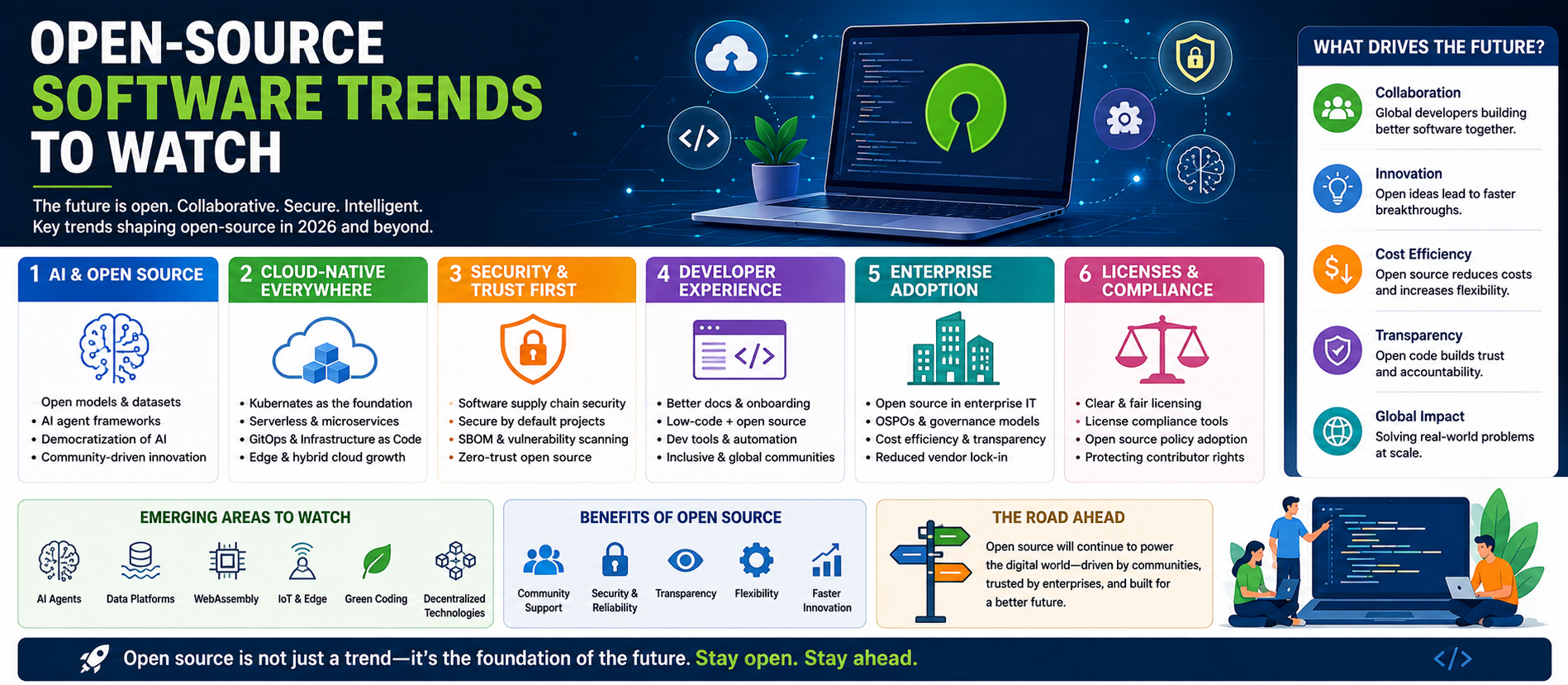
📋 Quick Summary
In this article:
Quick Answer: What Are the Biggest Open-Source Trends in 2026?
Why Open Source Matters More Than Ever
1. Open-Source AI Moves from Experimentation to Production
2. Agentic AI Creates Demand for Open Standards
3. Cloud-Native Infrastructure Becomes the Operating Layer for AI
4. Digital Sovereignty and Vendor Lock-In Become Major Adoption Drivers
5. Software Supply-Chain Security Becomes a Core Open-Source Requirement
6. Open Source Program Offices Become Strategic Governance Centers
Open-source software is entering a new stage in 2026. It is no longer viewed only as a low-cost alternative to proprietary software. For many organizations, open source is now part of their cloud strategy, AI strategy, cybersecurity planning, digital sovereignty, and long-term technology architecture.
💡 Key Insight
The ecosystem is also changing quickly. AI is increasing the amount of code being created. Agentic systems are creating demand for open standards and interoperability. Kubernetes has become a core production layer for modern applications and AI workloads. At the same time, software supply-chain security, licensing, compliance, and sustainable project maintenance have become more important.
This guide explains the most important open-source software trends to watch in 2026. The language is simple and direct. The goal is to help developers, businesses, technology leaders, startups, and digital teams understand where the ecosystem is moving.
Digiifrog creates structured, readable, and search-friendly content about software, technology, AI, education, and digital growth.
Quick Answer: What Are the Biggest Open-Source Trends in 2026?
The biggest trends are the growth of open-source AI and agentic infrastructure, stronger cloud-native adoption, greater concern about vendor lock-in and digital sovereignty, increased focus on software supply-chain security, more mature Open Source Program Offices, changing licensing strategies, and greater pressure to make open-source maintenance sustainable.
GitHub's 2026 outlook describes open source as being shaped by rapid AI growth and an increasingly global developer community. The 2026 State of Open Source Report also shows that avoiding vendor lock-in has become a major adoption driver, while the Linux Foundation and CNCF are highlighting open infrastructure for AI, agents, cloud-native systems, and security.
Why Open Source Matters More Than Ever
Modern software rarely consists of code written entirely by one company. Applications depend on frameworks, libraries, databases, operating systems, containers, observability tools, AI frameworks, and other reusable components.
⚠ Watch Out
This makes open source a foundational part of modern technology. Organizations use it to build faster, avoid unnecessary vendor dependence, participate in innovation, customize systems, and create interoperable technology stacks.
But wider adoption also creates responsibility. Teams need to know what components they use, who maintains them, what licenses apply, whether vulnerabilities exist, and how critical dependencies will be supported in the future.
1. Open-Source AI Moves from Experimentation to Production
Open-source and open-weight AI models are becoming an important part of enterprise technology strategy. Organizations want more flexibility in how they run, customize, evaluate, and integrate AI systems.
In 2026, the Linux Foundation's research and events increasingly focus on open-source AI, scalable AI infrastructure, agentic systems, and open standards. The foundation has also highlighted the need to address the priorities and challenges created by the growing use of generative AI and agents.
For businesses, this trend means AI architecture is becoming less dependent on a single model or provider. Teams may combine different models, frameworks, vector databases, orchestration tools, evaluation systems, and deployment environments.
What to watch
- Open and open-weight foundation models.
- Self-hosted AI deployments.
- Open AI evaluation tools.
- Open inference infrastructure.
- Model orchestration.
- Private and hybrid AI environments.
- AI frameworks designed for production workloads.
2. Agentic AI Creates Demand for Open Standards
AI systems are moving beyond simple chat interfaces. Agents can use tools, access services, retrieve information, and perform multi-step tasks. This creates a major interoperability challenge.
If every AI provider uses a completely different way to connect models, tools, identities, and services, organizations can become locked into fragmented ecosystems. Open standards and open infrastructure can help create more portable and interoperable agent systems.
The Linux Foundation's 2026 program and research activity show growing attention to MCP, agent infrastructure, agent identity, discovery, and AI interoperability.
Why this matters
Organizations will increasingly need ways to connect agents safely across different tools and services. Open protocols can reduce integration friction and support broader ecosystems.
3. Cloud-Native Infrastructure Becomes the Operating Layer for AI
Cloud-native technology is no longer an experimental architecture for many organizations. Containers, Kubernetes, service platforms, Git Ops, observability, and automation have become core parts of production infrastructure.
The CNCF's 2026 annual survey states that Kubernetes is now a backbone of production infrastructure for cloud-native applications and AI workloads. It reports that 82% of container users run Kubernetes in production.
This matters because AI workloads need scalable deployment, networking, storage, observability, scheduling, security, and automation. Open cloud-native projects are increasingly part of that foundation.
Technologies to watch
- Kubernetes.
- Open Telemetry.
- Git Ops tools.
- Platform engineering projects.
- Infrastructure control planes.
- Cloud-native AI tooling.
- Open model serving and orchestration.
CNCF project analysis has also highlighted continued contributor growth in Kubernetes, Open Telemetry, Backstage, Git Ops projects such as Argo and Flux, and multi-cloud control-plane technologies.
4. Digital Sovereignty and Vendor Lock-In Become Major Adoption Drivers
Cost savings will always matter, but open source is increasingly connected to long-term control. Organizations want the ability to move workloads, change providers, inspect technology, and avoid becoming dependent on a single vendor.
The 2026 State of Open Source Report found that avoiding vendor lock-in was cited by 55% of respondents and represented a significant year-over-year increase. The concern was particularly strong among organizations in Europe.
This trend is connected to digital sovereignty. Governments and organizations are increasingly asking where critical software runs, who controls the infrastructure, how portable data is, and whether systems can continue operating if a vendor changes its strategy.
5. Software Supply-Chain Security Becomes a Core Open-Source Requirement
Open-source dependencies can accelerate development, but they can also create security and maintenance challenges. A single vulnerable library can affect many applications and organizations.
In 2026, security discussions increasingly focus on dependency visibility, software inventories, vulnerability management, provenance, signed artifacts, and supply-chain resilience. The Linux Foundation has announced new initiatives focused on defending critical open-source software and strengthening resilience against AI-enabled cyber threats.
Key practices to watch
- Software Bills of Materials, or SBOMs.
- Dependency inventories.
- Signed software artifacts.
- Automated vulnerability scanning.
- Provenance and build integrity.
- Open-source dependency policies.
- Faster patch management.
The important change is cultural as well as technical. Security is moving earlier into the development process.
6. Open Source Program Offices Become Strategic Governance Centers
As organizations use more open-source software, they need formal processes for managing it. An Open Source Program Office, often called an OSPO, can coordinate policy, compliance, contributions, security, licensing, and relationships with open-source communities.
Linux Foundation research describes a broader evolution in which OSPOs are moving beyond simple compliance functions and becoming strategic governance hubs with growing responsibilities around risk management, AI oversight, and software supply-chain security.
For larger organizations, open source is becoming too important to manage through informal rules alone.
7. Licensing and Compliance Become More Complex
Open-source software is not the same as software without conditions. Different licenses can create different obligations. Organizations must understand how licenses apply to source code, modifications, redistribution, hosted services, dependencies, and commercial products.
The growth of AI also creates new questions. The software, model weights, training data, datasets, and generated outputs may all have different legal and licensing considerations.
What organizations should do
- Maintain an inventory of dependencies.
- Review licenses before production use.
- Define clear contribution policies.
- Monitor license changes.
- Separate legal review from technical assumptions.
- Document AI-related assets and usage rights.
Licensing should not be treated as a last-minute legal task. It should be part of software governance.
8. Sustainable Open Source Becomes a Business Priority
Many critical projects are maintained by relatively small groups of contributors. As global usage grows, the pressure on maintainers can increase.
GitHub's 2026 outlook emphasizes that open source is scaling rapidly and that sustainable processes are becoming as important as code.
Sustainability can include:
- Funding maintainers.
- Improving documentation.
- Reducing maintainer burnout.
- Supporting security reviews.
- Building contributor communities.
- Improving governance.
- Helping projects manage growing user demand.
Companies that depend heavily on open-source projects may increasingly contribute money, engineering time, testing, documentation, or security support.
9. AI-Generated Code Increases the Need for Code Review
AI coding tools can help developers write code faster. However, faster code creation can also increase the amount of code that needs review, testing, maintenance, and security validation.
GitHub identifies AI as a major force affecting the future of open source and points to both opportunities and pressures created by rapid ecosystem growth.
In 2026, successful teams are likely to focus on:
- Automated testing.
- Code review.
- Dependency validation.
- Security scanning.
- Clear repository governance.
- Maintainer review of AI-generated contributions.
AI can increase productivity, but it does not remove the need for engineering judgment.
10. Observability Becomes More Important in Complex Open Systems
Modern applications are distributed across services, containers, APIs, cloud platforms, and AI systems. When something fails, teams need visibility across the entire system.
Open Telemetry has become one of the most significant open-source projects in the observability ecosystem, and CNCF has described its rapid contributor growth and central role in the cloud-native landscape.
The next stage of observability will include not only traditional applications but also AI models, agents, tool calls, retrieval systems, latency, cost, and policy decisions.
11. Platform Engineering Continues to Grow
Developers increasingly expect internal platforms that make infrastructure easier to use. Instead of requiring every team to manage Kubernetes, CI/CD, observability, security, and cloud configuration directly, platform teams can provide reusable workflows.
Open-source projects such as Backstage have helped popularize the idea of internal developer portals and platform engineering. CNCF's project analysis identifies Backstage as a major project addressing developer experience challenges.
The trend is moving toward simpler developer experiences built on powerful open infrastructure.
12. Multi-Cloud and Hybrid Strategies Remain Important
Organizations increasingly use a combination of public cloud, private infrastructure, edge environments, and specialized AI hardware. Open-source technologies can provide common tools across these environments.
This does not mean every company should use multiple clouds. It means portability and architectural flexibility are becoming more valuable.
Technologies that provide common deployment models, configuration systems, control planes, and observability across environments are likely to remain important.
13. Open Data Becomes Part of the AI Infrastructure Discussion
AI systems depend on more than models. They also need high-quality data, metadata, standards, and ways to exchange information.
The Linux Foundation's 2026 activity includes growing work around open data, AI asset exchange, mapping data, and AI-native documents.
As AI systems become more integrated with business processes, organizations will need better methods for sharing and governing data without creating unnecessary fragmentation.
14. Security and Regulation Will Shape Project Design Earlier
Regulation and cybersecurity requirements are changing how software is designed and maintained. Security is increasingly becoming a lifecycle issue rather than a final checklist.
Linux Foundation research in 2026 includes work on Cyber Resilience Act awareness and readiness, reflecting growing attention to the responsibilities of software manufacturers, stewards, and developers.
Open-source projects and the companies that deploy them will need better processes for vulnerability disclosure, maintenance, documentation, and software lifecycle management.
15. Open Source Communities Become More Global
Open source is becoming increasingly international. GitHub reported approximately 36 million new developers joining its community in 2025 and described the ecosystem as a global phenomenon rather than a local one.
This creates opportunities for more diverse contributors and stronger global communities. It also creates challenges involving documentation, time zones, language, governance, and sustainable moderation.
Open-Source Trends at a Glance
| Trend Why It Matters | |
| Open AI | More flexibility in model deployment and AI infrastructure. |
| Agent standards | Supports interoperability between AI systems and tools. |
| Cloud native | Provides production infrastructure for applications and AI. |
| Digital sovereignty | Reduces dependency on a single provider or platform. |
| Supply-chain security | Improves visibility and management of software dependencies. |
| OSPO maturity | Brings governance, compliance, and strategic oversight. |
| Sustainable maintenance | Supports the long-term health of critical projects. |
| AI-generated code | Increases the need for review, testing, and governance. |
| Observability | Helps teams understand complex distributed systems. |
| Platform engineering | Improves the developer experience on complex infrastructure. |
How Businesses Should Prepare
1. Build an Open-Source Inventory
Know which libraries, frameworks, containers, and tools are used across your systems.
2. Create Clear Governance
Define who can approve new dependencies, review licenses, publish open-source code, and respond to vulnerabilities.
3. Invest in Supply-Chain Security
Use dependency monitoring, SBOMs where appropriate, secure build practices, and reliable patch processes.
4. Avoid Unnecessary Vendor Lock-In
Evaluate portability before making long-term technology decisions.
5. Prepare for AI Interoperability
Choose AI architectures that can evolve as models, tools, and standards change.
6. Support Critical Projects
If your business depends heavily on an open-source project, consider contributing funding, engineering support, testing, documentation, or security resources.
7. Train Developers
Open-source success depends on technical knowledge, but also on security, licensing, collaboration, and responsible contribution practices.
Open Source and SEO, AEO, GEO, and AI Search
People searching for open-source software often ask direct questions:
- What are the top open-source trends in 2026?
- Why is open source important for AI?
- What is an OSPO?
- How does open source reduce vendor lock-in?
- Why is software supply-chain security important?
- What is the future of Kubernetes?
SEO helps useful technology content appear in search results.
AEO focuses on answering questions clearly and directly.
GEO structures information so generative search systems can better understand context.
AI Search Optimization focuses on clear headings, direct answers, structured comparisons, factual context, and readable language.
How Digiifrog Supports Technology Content
Digiifrog creates structured content for software businesses, technology companies, AI platforms, education providers, and digital brands.
- SEO Content Strategy
- AEO and Answer-Focused Content
- GEO and Generative Search Optimization
- AI Search Optimization
- Open-Source and Software Content
- AI and Technology Content
Frequently Asked Questions
What are the biggest open-source software trends in 2026?
The biggest trends include open-source AI, agent interoperability, cloud-native AI infrastructure, digital sovereignty, software supply-chain security, stronger OSPO governance, licensing complexity, and sustainable project maintenance.
Why is open source important for AI?
Open technologies can provide flexibility, transparency, interoperability, and greater control over AI infrastructure. Organizations can combine models, frameworks, tools, and deployment systems based on their own requirements.
Is Kubernetes still growing in importance?
Yes. CNCF's 2026 survey describes Kubernetes as a production foundation for both cloud-native applications and AI workloads, with 82% of container users running it in production.
What is an Open Source Program Office?
An OSPO is a function that helps an organization manage open-source use and contribution. Its responsibilities may include policy, licensing, security, compliance, community engagement, and strategic governance.
Why is vendor lock-in increasing open-source adoption?
Organizations want more control over technology choices and the ability to move workloads or change providers. The 2026 State of Open Source Report identifies avoiding vendor lock-in as a major adoption driver.
What is the biggest security challenge for open source?
One major challenge is managing the growing number of dependencies and maintaining visibility into vulnerabilities, versions, provenance, and critical software components.
Conclusion
The most important open-source software trends in 2026 show that open source is becoming more strategic.
Open AI is expanding. Agentic systems need interoperable standards. Kubernetes and cloud-native infrastructure are supporting production applications and AI workloads. Businesses are using open source to reduce vendor lock-in and improve technology flexibility. At the same time, security, licensing, governance, and sustainable maintenance are becoming more important.
The future of open source will not be defined only by whether software is free to access. It will be shaped by how effectively organizations collaborate, govern risk, support maintainers, secure software supply chains, and build interoperable systems.
The organizations that treat open source as a strategic capability rather than simply a collection of free tools will be better prepared for the next stage of AI, cloud, and software innovation.
Disclaimer: This article is for general educational and informational purposes. Open-source project features, licenses, standards, security requirements, regulations, and market conditions can change. Review official documentation and obtain appropriate technical or legal advice before making major implementation or licensing decisions.
Digiifrog
Website: www.digiifrog.com
Ready to Grow?
Talk to us about a strategy tailored to your brand — we will help you stand out in search, AI discovery and social.
Comments (0)
Log in to leave a comment.