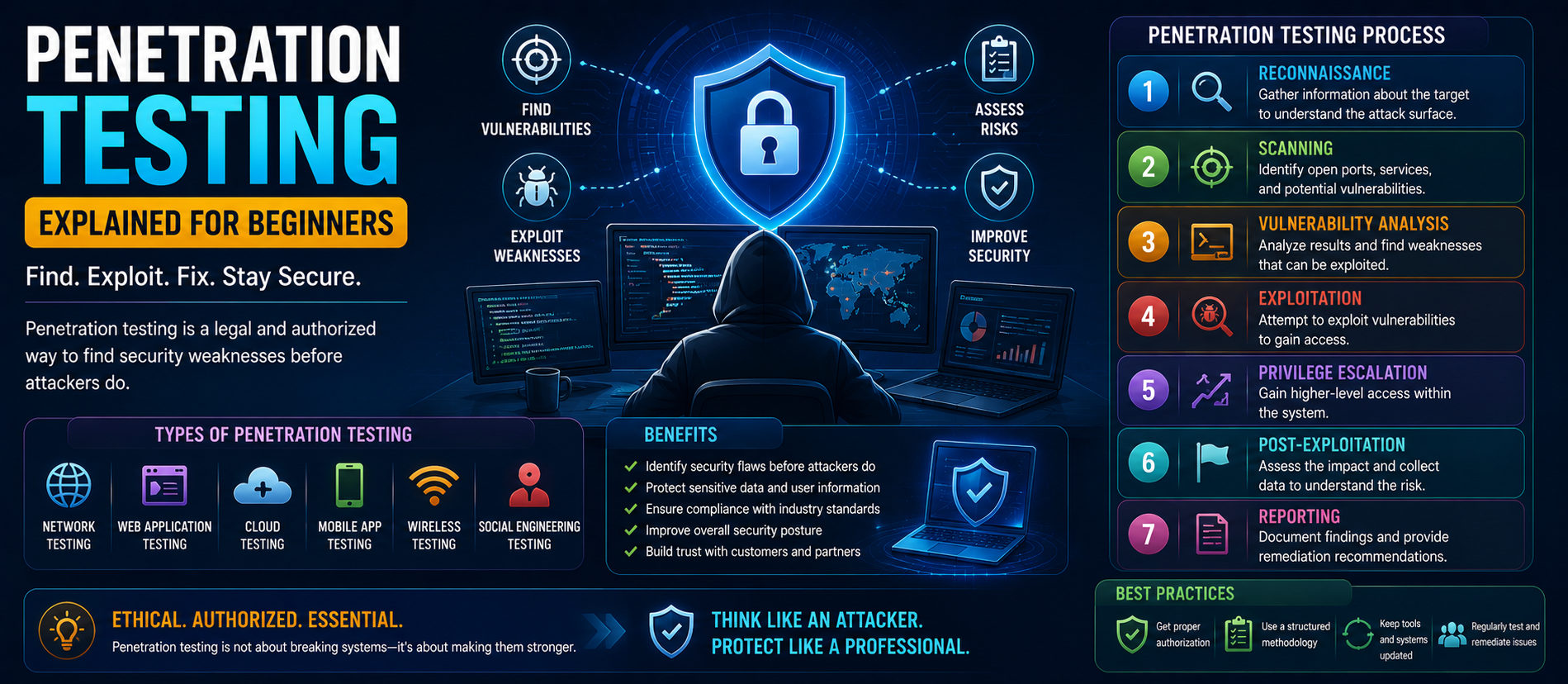
📋 Quick Summary
In this article:
Why Penetration Testing Matters
Penetration Testing vs. Vulnerability Scanning
Common Types of Penetration Testing
The Penetration Testing Process
As cyber threats become more advanced, businesses can no longer rely solely on firewalls, antivirus software, and automated scanners. One of the most effective ways to evaluate real-world security is through penetration testing, often called ethical hacking. A penetration test simulates the techniques used by cybercriminals to identify weaknesses before attackers exploit them.
What Is Penetration Testing?
Penetration testing is a controlled security assessment where authorized security professionals attempt to exploit vulnerabilities in systems, networks, web applications, cloud environments, APIs, or wireless infrastructure. The objective is to discover security weaknesses and recommend practical remediation before they are abused.
Why Penetration Testing Matters
- Identifies hidden vulnerabilities.
- Validates existing security controls.
- Reduces cyber risk.
- Supports regulatory compliance.
- Protects customer data.
- Strengthens business resilience.
Penetration Testing vs. Vulnerability Scanning
Vulnerability scanners automatically identify known weaknesses, while penetration testing goes further by attempting to exploit those weaknesses safely to understand their real business impact.
Common Types of Penetration Testing
- Network Penetration Testing
- Web Application Testing
- Cloud Security Testing
- Wireless Network Testing
- API Security Testing
- Mobile Application Testing
- Social Engineering Assessments
Testing Approaches
Black Box Testing
The tester has little or no prior knowledge of the target environment, simulating an external attacker.
Gray Box Testing
The tester receives limited information, providing a balance between realism and efficiency.
White Box Testing
The tester has detailed knowledge of the environment, enabling comprehensive security analysis.
The Penetration Testing Process
- Planning and defining scope.
- Reconnaissance and information gathering.
- Vulnerability identification.
- Controlled exploitation.
- Post-exploitation analysis.
- Reporting and remediation guidance.
- Retesting after fixes.
Common Vulnerabilities Found
- Weak passwords
- Missing security patches
- SQL Injection
- Cross-Site Scripting (XSS)
- Misconfigured cloud services
- Broken authentication
- Excessive user permissions
Best Practices
- Test regularly.
- Define clear objectives.
- Use experienced ethical hackers.
- Fix critical findings quickly.
- Retest after remediation.
- Combine penetration testing with continuous monitoring.
Penetration Testing and AI
💡 Key Insight
Artificial Intelligence can assist security teams by prioritizing vulnerabilities, identifying attack paths, and improving reporting. Human expertise remains essential for validating findings, understanding business context, and safely conducting exploitation.
SEO, AEO & GEO Optimization
Create authoritative content with clear headings, practical examples, structured FAQs, and accurate explanations so both traditional search engines and AI assistants can easily understand and reference the information.
AEO & GEO Optimized FAQs
What is penetration testing?
Penetration testing is an authorized security assessment that simulates real cyber attacks to identify and verify exploitable vulnerabilities.
Who needs penetration testing?
Businesses, government agencies, healthcare providers, financial institutions, educational organizations, and any company handling sensitive information benefit from regular penetration testing.
How often should penetration testing be performed?
Organizations should test at least annually and after significant infrastructure, application, or cloud environment changes.
Does penetration testing prevent cyber attacks?
It does not prevent attacks by itself, but it helps organizations identify and fix weaknesses before attackers can exploit them.
Conclusion
Penetration testing is one of the most effective ways to evaluate cyber security readiness. Combined with Zero Trust, secure development practices, continuous monitoring, employee awareness, backups, and strong governance, regular penetration testing helps organizations reduce cyber risk and improve resilience in 2026 and beyond.
For more expert insights on Cyber Security, Ethical Hacking, SEO, AEO, GEO, AI Search Optimization, Cloud Security, and Digital Transformation, visit Digiifrog at www.digiifrog.com.
Ready to Grow?
Talk to us about a strategy tailored to your brand — we will help you stand out in search, AI discovery and social.

Comments (0)
Log in to leave a comment.