📋 Quick Summary
In this article:
Potential advantages of a personal loan
Potential disadvantages of a personal loan
Potential advantages of a gold loan
Potential disadvantages of a gold loan
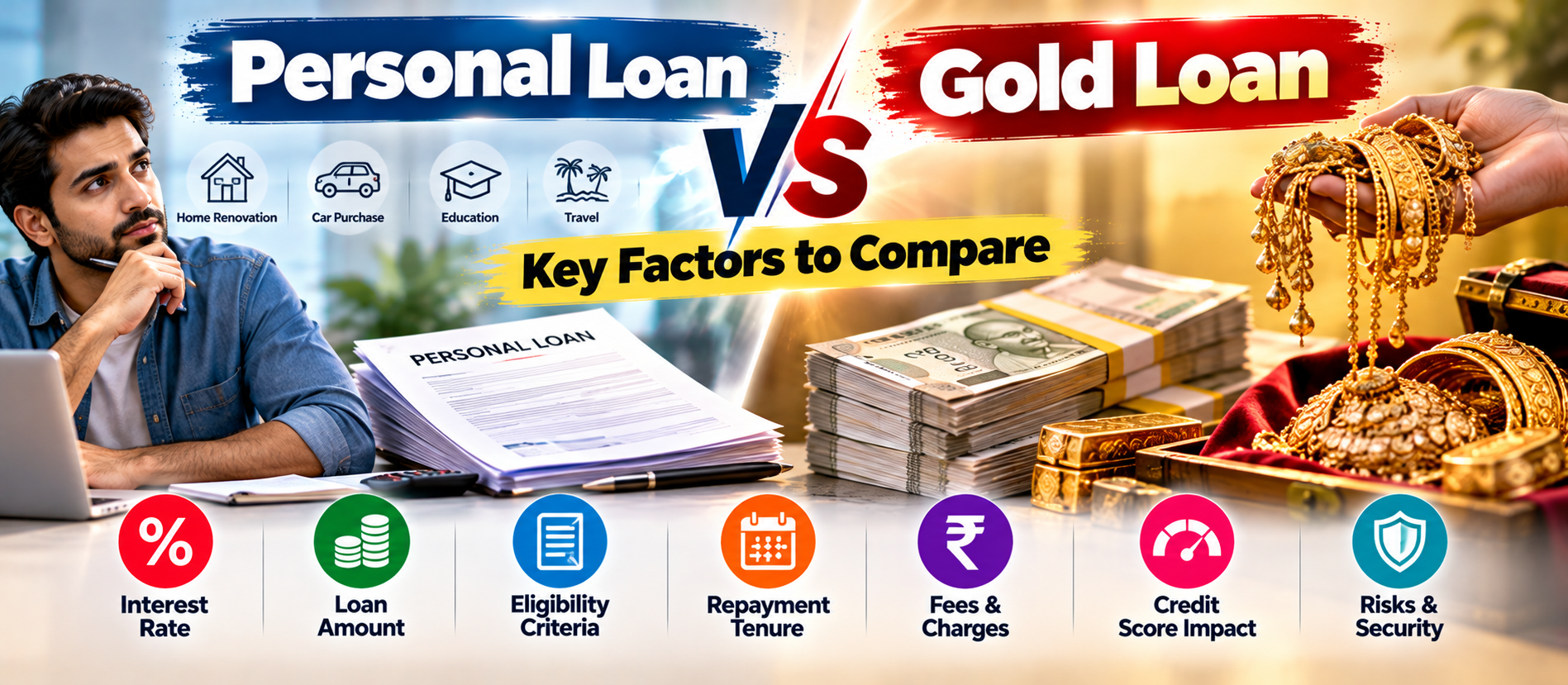
Personal Loan vs. Gold Loan: Quick Comparison
1. Compare the Interest Rate and Total Cost
2. Understand How the Loan Amount Is Decided
3. Check Eligibility and Approval Requirements
4. Compare Repayment Structures Carefully
💡 Key Insight
When you need money for a medical bill, education expense, home repair, family event, or another important need, a loan may help cover the gap. Two options people often compare in India are personal loans and gold loans. Both can provide funds, but they work in different ways.
A personal loan is usually an unsecured loan. This means you do not normally pledge an asset as collateral. The lender assesses factors such as income, credit history, existing debt, and repayment capacity. A gold loan is a secured loan. You pledge eligible gold jewellery or other accepted gold collateral, and the lender assesses its purity, net weight, and value before deciding how much to lend.
⚠ Watch Out
Neither option is automatically better for everyone. A gold loan may offer a lower rate in some cases, but it puts pledged gold at risk if you fail to repay. A personal loan avoids pledging jewellery, but it can have a higher interest rate or stricter income and credit requirements. The right choice depends on the total cost, repayment schedule, urgency, and your ability to repay on time.
This guide compares the two options in simple language, with an India-focused checklist to help you make a more informed decision. Rates and conditions vary by lender and can change. Treat examples as illustrations, not as loan offers.
What Is a Personal Loan?
A personal loan is money borrowed from a bank or other regulated lender for an eligible personal purpose. Many personal loans do not require collateral. The lender makes a decision based on its credit policy and your financial profile.
Depending on the lender, the application may involve identity and address verification, income proof, bank statements, employment or business details, and a credit report. Existing customers with a strong repayment history may find the process simpler, but approval is never guaranteed.
Personal loans are often repaid through fixed monthly instalments, known as EMIs. Each EMI usually includes principal and interest. The loan agreement states the rate, tenure, fees, due dates, and conditions for early repayment or default.
Potential advantages of a personal loan
- You generally do not need to pledge gold or another asset.
- The repayment schedule is often structured through monthly EMIs.
- The loan may be useful when you need a defined amount for a planned expense.
- You can keep jewellery and other personal assets in your possession.
Potential disadvantages of a personal loan
- The interest rate may be higher than that of a secured loan.
- Approval and pricing can depend strongly on income, credit history, and existing obligations.
- Processing fees and other charges can increase the total borrowing cost.
- Missing EMIs can harm your credit profile and may lead to collection action under the loan agreement and applicable law.
What Is a Gold Loan?
A gold loan is a loan secured by eligible gold jewellery, ornaments, or other gold items accepted under the lender’s policy. The lender assesses the gold’s purity and net weight and determines its eligible value. The loan amount is generally only a portion of that assessed value.
Gold loans may be offered by banks and regulated non-bank lenders. Their terms can differ. Some products require monthly EMIs. Others may allow interest payments during the term with the principal payable at the end, or may offer an overdraft structure. You must understand the repayment model before signing.
Gold loans can be useful when a borrower owns eligible gold and needs funds for a short-term expense. However, the pledged items are held as collateral. If the borrower does not repay according to the agreement, the lender may begin the prescribed process to recover the outstanding amount, which can ultimately include selling the pledged gold after following applicable rules and notices.
Potential advantages of a gold loan
- Gold collateral may help eligible borrowers access credit even when their unsecured-loan profile is limited.
- The interest rate may be lower than an unsecured personal loan, depending on the lender and product.
- Some lenders offer relatively quick processing after valuation and verification.
- Different repayment structures may be available, depending on the product.
Potential disadvantages of a gold loan
- Your jewellery remains pledged until the loan is repaid and the lender releases it.
- Failure to repay can put the pledged gold at risk.
- The amount you can borrow depends on purity, net gold weight, valuation, and the lender’s permitted loan-to-value ratio.
- Valuation, processing, storage, or other applicable charges may affect the total cost.
- Bullet repayment structures can create a large payment obligation at the end of the term.
Personal Loan vs. Gold Loan: Quick Comparison
| FactorPersonal loanGold loan | ||
| Collateral | Usually unsecured | Eligible gold is pledged |
| Key assessment | Income, credit profile, existing debt, repayment capacity | Gold purity, net weight, value, plus borrower and KYC checks |
| Interest rate | Can be higher because there is usually no collateral | May be lower, but varies by lender and scheme |
| Loan amount | Based on eligibility and lender policy | Limited by eligible gold value and applicable loan-to-value rules |
| Repayment | Often monthly EMIs | EMI, bullet repayment, or overdraft may be available |
| Primary risk | Debt burden, charges, credit impact, collection action | Debt burden plus risk to pledged gold |
| Access to asset | No gold needs to be pledged | Gold is generally held by the lender until closure |
| Best comparison metric | Total repayment and annualised cost | Total repayment, fees, repayment timing, and collateral risk |
This is a general comparison, not a guarantee. Read the exact product terms and the lender’s current disclosures before applying.
1. Compare the Interest Rate and Total Cost
The interest rate matters, but it is not the only cost. A loan may include a processing fee, valuation fee, documentation charge, applicable taxes on fees, late-payment charges, or prepayment charges where permitted by the agreement and rules. Compare the amount you will actually receive with the total amount you must repay.
Ask each lender for a written repayment schedule and the applicable annual percentage rate (APR) or equivalent cost disclosure where provided. An annualised cost measure can help you compare products with different fee structures. Do not compare one lender’s advertised starting rate with another lender’s final approved rate.
Illustrative example
Suppose you borrow ₹1,00,000 for one year. For a simplified illustration, assume a flat annual interest calculation with no fees:
- At 12% simple interest, interest would be ₹12,000.
- At 16% simple interest, interest would be ₹16,000.
The difference is ₹4,000 before fees and other costs. Real loans are often calculated on a reducing balance, and actual EMI-based interest will depend on the rate, tenure, repayment dates, and charges. Use the lender’s official calculator or written repayment schedule to compare actual offers.
A gold loan with a lower advertised rate may still be less suitable if it requires a large final payment that you cannot confidently meet. Likewise, a personal loan with a higher rate may be expensive if the tenure is long. Compare the total cost and the timing of every payment.
2. Understand How the Loan Amount Is Decided
For a personal loan, the lender may consider monthly income, employment or business stability, credit history, existing EMIs, age, and internal eligibility rules. A high income does not automatically guarantee approval. Existing debt and irregular cash flow can reduce the amount offered.
For a gold loan, the lender assesses the eligible gold. Jewellery value is not always the same as the amount you paid at the shop. Making charges, stones, and other non-gold components may not count toward the eligible collateral value. Purity and net gold weight are important.
Regulatory requirements can also limit the loan amount relative to the value of the gold. The applicable rules depend on the regulated lender, loan category, and current directions. The Reserve Bank of India issued its Lending Against Gold and Silver Collateral Directions, 2025, with detailed requirements for covered lenders. Check the latest RBI directions and the lender’s current policy rather than relying on a general online percentage. Visit the Reserve Bank of India.
Do not assume that every gram of jewellery will produce the same loan amount. Ask the lender to record the tested purity, net weight, valuation, applicable loan-to-value ratio, charges, and amount sanctioned. Keep the receipt and loan documents.
3. Check Eligibility and Approval Requirements
Personal loan eligibility often depends on your credit profile and repayment capacity. Lenders may check your credit report, income documents, employment details, bank transactions, and existing obligations. A thin credit history or high debt-to-income burden may lead to a smaller offer, a higher rate, or rejection.
Gold loan eligibility depends in part on whether you can legally pledge the gold and whether the items meet the lender’s acceptance and valuation rules. Identity verification and other required checks still apply. A gold loan is not automatically guaranteed simply because you have jewellery.
If you are comparing both products, ask for the eligibility criteria before submitting multiple applications. Several formal loan applications within a short period may result in multiple credit enquiries, depending on how the lender reports them. Avoid applying widely without comparing the basic terms first.
4. Compare Repayment Structures Carefully
Repayment structure can matter as much as the interest rate. A personal loan commonly uses EMIs that combine principal and interest. This can make monthly budgeting easier because the instalment amount and schedule are stated in the agreement.
Gold loans can have different repayment formats. In an EMI-based product, principal and interest are repaid over the term. In a bullet-repayment product, interest may be payable during the term or together with the principal at maturity, depending on the scheme. Some products offer overdraft facilities, where interest is calculated on the amount used under the account’s terms.
Bullet repayment can look convenient because the principal does not have to be repaid every month. But it can create a large amount due at the end. Before choosing it, decide exactly where the final payment will come from. Do not rely on an uncertain future bonus, sale, or investment return.
Questions to ask before signing
- What is the exact EMI or periodic interest payment?
- When is the principal due?
- Can the loan be repaid early, and what charges apply?
- What happens if a payment is late?
- Are rates fixed or variable during the term?
- What steps are followed if the loan becomes overdue?
- When and how will pledged gold be released after full repayment?
5. Understand the Risk to Your Gold
The biggest difference between the two options is collateral. With a gold loan, your gold is pledged to secure the debt. If you fail to repay and do not resolve the default, the lender may proceed under the contract and applicable rules to sell the collateral after the required process.
For many families, jewellery has financial and emotional value. It may be a wedding gift, a family heirloom, or a reserve for emergencies. Before pledging it, consider whether you could handle the consequences if you cannot repay on time.
Ask how the gold will be assayed, documented, stored, insured where applicable, and returned. Keep a copy of the valuation and pledge receipt. Confirm the grievance process and the procedure for collecting your gold after the account is closed.
A personal loan does not put the pledged jewellery at risk because no gold is usually pledged. But this does not mean a personal loan has no consequences for default. Missed payments can add charges, damage your credit history, and lead to collection or legal action according to the agreement and applicable law.
6. Think About the Loan Tenure
A shorter tenure can reduce the time over which interest accrues, but it usually means higher monthly payments. A longer tenure may make EMIs more manageable, but it can increase the total interest paid. The best tenure is one that balances cost with a realistic budget.
For short-term needs, a gold loan may be worth comparing if you have eligible collateral and a clear repayment plan. For a larger expense that needs to be repaid gradually, a personal loan may fit better if the EMI is affordable and the total cost is acceptable. These are general patterns, not rules for every borrower.
Do not borrow for a longer period than you need just because the lender offers it. Also avoid choosing a very short tenure if the required payments would leave too little for rent, food, bills, insurance, and other essential costs.
7. Consider Your Credit Score and Future Borrowing
A personal loan application may rely heavily on your credit report and score, although lenders use their own eligibility policies. Timely payments can help build a positive repayment record. Missed or delayed payments can hurt your profile and make future borrowing more difficult or expensive.
Gold loans also involve credit and repayment obligations. Do not assume that pledging gold removes the need to repay or that the loan cannot affect your credit record. Ask the lender how the product is reported and what happens if the account becomes overdue.
Before borrowing, review your current EMIs and other commitments. A new loan should fit your budget without forcing you to take another loan to make the payments. If you are already struggling with debt, speak to your lender about available options before adding more borrowing.
8. Check Fees, Penalties, and Other Conditions
The loan’s headline interest rate does not tell the whole story. Fees can vary by lender, loan amount, customer type, and scheme. For gold loans, valuation or assaying charges may apply. For personal loans, a processing fee may be charged. Applicable taxes may be added to certain fees.
Also check late-payment charges, cheque or mandate return charges, prepayment or foreclosure terms, and any fees connected with account closure. Ask for the charges in writing and compare the total amount payable.
Do not rely only on verbal promises from an agent. Read the key facts statement, sanction letter, agreement, and fee schedule. If any term is unclear, ask the lender to explain it before you accept the loan.
9. When Might a Personal Loan Be More Suitable?
A personal loan may be worth considering when:
- You do not want to pledge family jewellery or do not have eligible gold.
- You have stable income and a credit profile that qualifies for reasonable terms.
- You prefer a predictable EMI schedule.
- You need a defined amount and can repay it from regular income.
- The total cost is acceptable after comparing the rate, fees, and tenure.
Even if you qualify, borrow only what you need. A lender’s maximum approved amount is not a recommendation to borrow the full amount. Calculate the EMI alongside your existing expenses and savings needs.
10. When Might a Gold Loan Be More Suitable?
A gold loan may be worth considering when:
- You have eligible gold that you are comfortable pledging.
- You need funds for a short-term or clearly defined purpose.
- The total cost is lower than the personal loan offer available to you.
- You understand the repayment structure and can meet every due date.
- You have a credible plan to repay and reclaim the pledged gold.
Do not take a gold loan simply because the approval process appears quick. Consider the value of the jewellery, the consequences of default, and whether the loan solves a temporary cash-flow issue or adds to a deeper financial problem.
11. A Practical Checklist Before You Decide
Use this checklist to compare actual offers from banks or regulated lenders:
- Confirm the lender’s identity and regulatory status.
- Write down the amount you need and the purpose of the loan.
- Compare the approved rate, total interest, fees, and total repayment.
- Check the EMI or bullet-payment amount and due dates.
- Review early repayment and overdue rules.
- For a gold loan, verify the purity, net weight, valuation, and pledged-item receipt.
- Ask how and when the gold will be released after repayment.
- Check whether the payment schedule fits your monthly budget.
- Keep a copy of the sanction letter, key facts statement, and loan agreement.
- Avoid borrowing if you do not have a realistic repayment plan.
12. Common Mistakes to Avoid
- Choosing only by interest rate: Fees and repayment timing can change the true cost.
- Borrowing the maximum offered: Borrow according to your need and repayment capacity.
- Ignoring the final payment: A bullet-repayment gold loan can require a large amount at maturity.
- Underestimating collateral risk: Pledged gold may be sold if the loan remains unpaid after the prescribed process.
- Taking a new loan to repay an old one: This can create a debt cycle if the underlying cash-flow problem remains.
- Not reading the documents: Check fees, penalties, interest method, and default procedures.
- Using unverified loan agents: Apply through the lender’s official website, branch, or verified channel.
Frequently Asked Questions
1. Which is cheaper: a personal loan or a gold loan?
A gold loan may have a lower interest rate because it is secured by collateral, but this is not guaranteed. Compare the actual approved rate, all fees, the repayment schedule, and total amount payable for both offers.
2. Can I get a gold loan without a good credit score?
Gold collateral can be an important part of the lender’s assessment, but KYC, credit checks, income or repayment assessment, and other requirements may still apply. Approval depends on the lender and product.
3. Can the lender sell my gold if I miss a payment?
Default can put pledged gold at risk. The lender must follow the applicable agreement and legal or regulatory process. Read the default and auction provisions carefully and contact the lender immediately if you expect difficulty paying.
4. Does a personal loan require collateral?
Most standard personal loans are unsecured, so they do not usually require gold or property as collateral. The lender still assesses eligibility and can take action under the agreement if you default.
5. Is a gold loan always approved quickly?
Not always. Processing time depends on the lender, documentation, gold testing, verification, and application details. Ask the lender for the expected timeline and do not assume approval is guaranteed.
6. Which loan is better for a medical emergency?
There is no universal answer. Compare how quickly the funds can be made available, the total cost, the repayment schedule, and the risk to any collateral. Also check whether insurance, employer support, savings, or a payment plan could reduce the amount you need to borrow.
7. Can I repay a gold loan early?
Early repayment may be possible, but the rules and charges depend on the product and applicable terms. Confirm the exact amount required to close the account and the process for collecting your gold.
8. What documents should I keep for a gold loan?
Keep the sanction letter, loan agreement, valuation or assay record, pledge receipt, payment receipts, and closure confirmation. After repayment, obtain written confirmation that the account is closed and the gold has been released.
Conclusion: Compare Cost, Repayment, and Risk
A personal loan and a gold loan can both provide access to funds, but they solve the borrowing need in different ways. A personal loan usually avoids collateral but may cost more and depend strongly on your credit and income profile. A gold loan uses eligible gold as security and may offer competitive pricing, but your jewellery is at risk if you fail to repay.
Before making a decision, compare the actual interest rate, fees, total repayment, tenure, monthly cash flow, early repayment terms, and default consequences. For a gold loan, also consider the personal value of the pledged items and make sure you understand the release process.
The best loan is not necessarily the one with the lowest advertised rate or the fastest approval. It is the loan that meets your real need at a reasonable total cost and has a repayment plan you can realistically follow.
At Digiifrog, we aim to make financial decisions easier to understand through clear, practical information. Compare offers carefully and borrow only after reviewing your budget.
Disclaimer
This article is for general educational purposes only. It is not financial, legal, or credit advice. Interest rates, fees, eligibility requirements, and regulatory directions can change. Loan terms vary by lender and product. Check current official disclosures and the full agreement before borrowing. Seek qualified professional advice if you need guidance for your circumstances.
Official Resources
- Reserve Bank of India: Official Website and Regulations
- RBI: Guidance on Lending Against Gold Collateral
- SBI Personal Gold Loan: Product Terms and Repayment Options
- SBI Personal Loan Interest Rate Information
- Digiifrog
Ready to Grow?
Talk to us about a strategy tailored to your brand — we will help you stand out in search, AI discovery and social.

Comments (0)
Log in to leave a comment.