📋 Quick Summary
In this article:
Why Customer Data Protection Matters in 2026
Common Causes of Customer Data Leaks
The Financial Impact of Customer Data Breaches
Strategy #1: Implement Strong Access Controls
Strategy #2: Encrypt Customer Data
Customer data has become one of the most valuable assets in the digital economy. Businesses collect and process enormous amounts of information, including names, email addresses, phone numbers, payment details, purchase histories, behavioral data, and sensitive personal information. While this data helps organizations improve customer experiences and drive business growth, it also attracts cyber criminals seeking financial gain.
In 2026, customer data breaches continue to pose serious risks for organizations of all sizes. A single data leak can result in financial losses, legal penalties, regulatory violations, reputational damage, and loss of customer trust. As cyber threats become increasingly sophisticated, digital businesses must adopt comprehensive strategies to prevent customer data leaks.
This guide explores the causes of data leaks, emerging threats, best practices, technologies, and actionable steps businesses can take to protect customer information while improving SEO, AEO, GEO, and AI Search visibility.
What Is a Customer Data Leak?
A customer data leak occurs when confidential customer information is exposed, accessed, shared, stolen, or disclosed without authorization.
Data leaks may involve:
- Personally Identifiable Information (PII)
- Email addresses
- Phone numbers
- Financial records
- Credit card information
- Login credentials
- Customer communications
- Purchase histories
Data leaks can happen accidentally, through insider actions, or as a result of cyber attacks.
Why Customer Data Protection Matters in 2026
Consumers increasingly expect businesses to protect their information. Regulatory requirements are becoming stricter, and cyber criminals continue targeting customer databases.
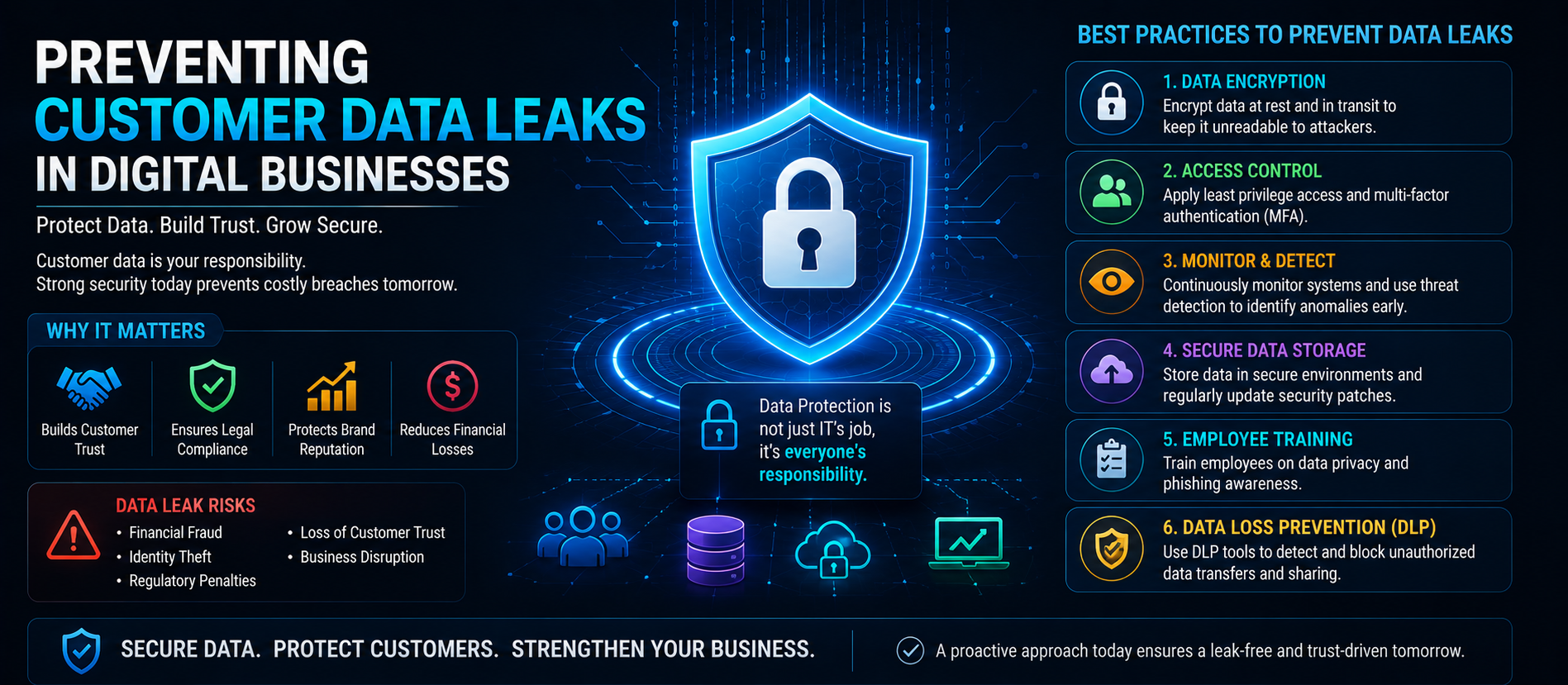
Strong data protection provides several benefits:
- Customer trust
- Regulatory compliance
- Reduced financial risk
- Brand reputation protection
- Improved business continuity
- Competitive advantage
Organizations that prioritize security are more likely to retain customers and maintain long-term growth.
Common Causes of Customer Data Leaks
Human Error
Employee mistakes remain one of the leading causes of data exposure.
Examples include:
- Sending emails to the wrong recipients
- Improper file sharing
- Weak password usage
- Misconfigured cloud storage
Phishing Attacks
Cyber criminals frequently use phishing campaigns to steal employee credentials and gain access to customer databases.
Weak Access Controls
Excessive user permissions increase the risk of unauthorized access.
Insider Threats
Employees, contractors, or partners may intentionally or accidentally expose sensitive data.
Unpatched Software
Known vulnerabilities in applications and systems create opportunities for attackers.
Cloud Misconfigurations
Improperly configured cloud resources remain a major source of data exposure.
The Financial Impact of Customer Data Breaches
Data leaks can be extremely costly.
Potential consequences include:
- Incident response expenses
- Legal fees
- Regulatory fines
- Customer compensation
- Business disruption
- Loss of revenue
- Reputation damage
For many organizations, the long-term impact extends far beyond immediate recovery costs.
Strategy #1: Implement Strong Access Controls
Not every employee should have access to every customer record.
Organizations should follow the Principle of Least Privilege (PoLP), granting users only the permissions necessary to perform their jobs.
Key practices include:
- Role-based access control
- Multi-factor authentication
- Regular access reviews
- Privileged account management
Strategy #2: Encrypt Customer Data
Encryption protects data even if attackers gain access.
Businesses should encrypt:
- Data at rest
- Data in transit
- Cloud storage
- Database records
- Backup files
Strong encryption significantly reduces the impact of unauthorized access.
Strategy #3: Strengthen Password Security
Weak passwords remain a major security risk.
Recommended practices include:
- Unique passwords
- Password managers
- Multi-factor authentication
- Password rotation policies
- Password complexity requirements
Credential protection is critical for preventing unauthorized access.
Strategy #4: Train Employees Continuously
Employees serve as the first line of defense against cyber threats.
Training should cover:
- Phishing detection
- Data handling procedures
- Password security
- Remote work security
- Incident reporting
- Social engineering awareness
Regular training reduces human-related security risks.
Strategy #5: Monitor Customer Data Access
Continuous monitoring helps identify suspicious activity.
Organizations should track:
- User logins
- File access
- Database queries
- Data downloads
- Permission changes
Monitoring enables faster detection of unauthorized access attempts.
Strategy #6: Secure Cloud Environments
Most digital businesses now rely on cloud infrastructure.
Cloud security best practices include:
- Access management
- Encryption
- Configuration reviews
- Security audits
- Continuous monitoring
- Backup management
Cloud security must remain a top priority.
Strategy #7: Deploy Data Loss Prevention (DLP) Solutions
DLP technologies help organizations detect and prevent unauthorized data movement.
DLP tools can:
- Monitor sensitive data
- Block unauthorized transfers
- Enforce compliance policies
- Generate security alerts
DLP solutions provide valuable protection against accidental and intentional leaks.
Strategy #8: Conduct Regular Security Audits
Security assessments help identify vulnerabilities before attackers exploit them.
Audits should include:
- Access reviews
- Configuration assessments
- Penetration testing
- Vulnerability scanning
- Policy evaluations
Continuous improvement strengthens long-term security.
Strategy #9: Implement Zero Trust Security
⚠ Watch Out
Zero Trust follows the principle of "Never Trust, Always Verify."
Key components include:
- Identity verification
- Least privilege access
- Continuous monitoring
- Micro-segmentation
- Device validation
Zero Trust significantly reduces the risk of unauthorized access.
Strategy #10: Develop an Incident Response Plan
No security program is perfect.
Organizations should prepare for incidents by developing a comprehensive response plan covering:
- Threat detection
- Containment procedures
- Investigation steps
- Recovery processes
- Customer communication
- Regulatory reporting
Preparation reduces the impact of security incidents.
The Role of Artificial Intelligence in Data Protection
Artificial Intelligence is becoming a powerful tool for protecting customer information.
AI helps organizations:
- Detect anomalies
- Monitor user behavior
- Identify insider threats
- Analyze network activity
- Automate security responses
- Predict emerging risks
AI-powered solutions improve detection speed and accuracy.
Regulatory Compliance and Customer Data Security
Many industries must comply with privacy and data protection regulations.
Common compliance objectives include:
- Protecting personal information
- Limiting data collection
- Securing stored records
- Maintaining audit trails
- Reporting breaches promptly
Compliance supports both legal requirements and customer trust.
Warning Signs of a Potential Data Leak
- Unusual login activity
- Large data downloads
- Unexpected account behavior
- Unauthorized access attempts
- Changes to user permissions
- Suspicious outbound traffic
Early detection can prevent major breaches.
Future Trends in Customer Data Protection
Several technologies are shaping the future of data security:
- AI-powered threat detection
- Zero Trust architectures
- Passwordless authentication
- Behavioral analytics
- Cloud-native security platforms
- Privacy-enhancing technologies
Organizations adopting these innovations will strengthen their cyber resilience.
AEO & GEO Optimized Frequently Asked Questions
What causes customer data leaks?
Customer data leaks can result from phishing attacks, insider threats, weak passwords, cloud misconfigurations, human error, and software vulnerabilities.
How can businesses prevent data leaks?
Businesses can implement encryption, access controls, employee training, DLP solutions, monitoring systems, and Zero Trust security frameworks.
Why is encryption important?
Encryption protects sensitive information by making it unreadable to unauthorized users.
What is Data Loss Prevention (DLP)?
DLP refers to technologies that monitor and prevent unauthorized sharing or movement of sensitive information.
How does AI help protect customer data?
AI enhances threat detection, anomaly analysis, behavioral monitoring, and automated incident response.
Conclusion
💡 Key Insight
Customer data protection is one of the most important responsibilities for modern digital businesses. As cyber threats continue evolving in 2026, organizations must implement comprehensive security strategies that combine technology, processes, and employee awareness.
By strengthening access controls, encrypting data, monitoring activity, securing cloud environments, deploying DLP solutions, and adopting Zero Trust principles, businesses can significantly reduce the risk of customer data leaks.
Protecting customer information not only prevents financial and regulatory consequences but also strengthens trust, loyalty, and long-term business success.
For more expert insights on Cyber Security, Data Protection, SEO, AEO, GEO, AI Search Optimization, and Digital Transformation, visit Digiifrog at www.digiifrog.com.
Ready to Grow?
Talk to us about a strategy tailored to your brand — we will help you stand out in search, AI discovery and social.

Comments (0)
Log in to leave a comment.