📋 Quick Summary
In this article:
What Is Machine Learning in Cyber Security?
Why Machine Learning Matters in 2026
Top Machine Learning Applications
1. Threat Detection
2. Malware Classification
3. Phishing Detection
4. User and Entity Behavior Analytics (UEBA)
5. Network Traffic Analysis
6. Fraud Detection
7. Vulnerability Prioritization
8. Automated Incident Response
Machine Learning (ML) has become one of the most powerful technologies in modern cyber security. As cyber threats become more sophisticated, organizations need intelligent systems capable of detecting anomalies, identifying malicious behavior, and responding to attacks faster than traditional rule-based security solutions. In 2026, Machine Learning is helping businesses strengthen cyber resilience through automated threat detection, predictive analytics, behavioral monitoring, and real-time incident response.
This WordPress-ready guide explores how Machine Learning applications in cyber security are transforming digital defense. The content is optimized for SEO, AEO, GEO, and AI Search optimization to maximize visibility across modern search platforms.
What Is Machine Learning in Cyber Security?
Machine Learning is a branch of Artificial Intelligence that enables computer systems to learn from data, identify patterns, and make predictions without being explicitly programmed for every scenario. In cyber security, ML continuously analyzes network traffic, user behavior, endpoint activity, and threat intelligence to identify suspicious events.
Why Machine Learning Matters in 2026
- Detects threats faster than manual analysis.
- Reduces false positives.
- Improves incident response.
- Strengthens cloud and endpoint security.
- Scales with growing data volumes.
Top Machine Learning Applications
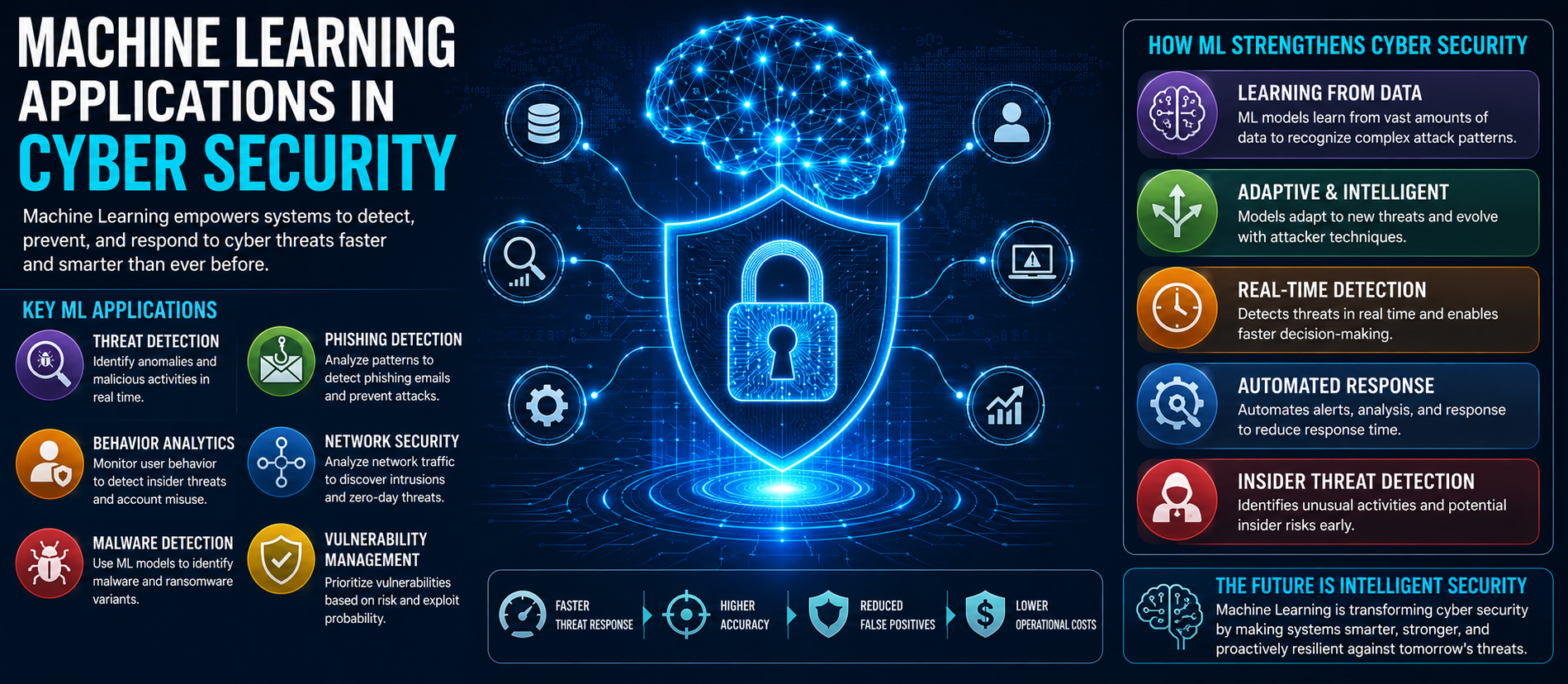
1. Threat Detection
ML models identify unusual behavior that may indicate malware, ransomware, phishing, or insider threats.
2. Malware Classification
Algorithms analyze file behavior and code patterns to identify known and previously unseen malware variants.
3. Phishing Detection
Machine Learning evaluates email content, sender reputation, URLs, and attachment behavior to block phishing attacks.
4. User and Entity Behavior Analytics (UEBA)
Behavioral analytics detect unusual login patterns, privilege escalation, impossible travel, and insider threats.
5. Network Traffic Analysis
ML continuously monitors network flows to identify anomalies, lateral movement, and command-and-control communication.
6. Fraud Detection
Financial institutions use ML to identify suspicious transactions and account takeover attempts in real time.
7. Vulnerability Prioritization
Predictive analytics help security teams focus on vulnerabilities most likely to be exploited.
8. Automated Incident Response
AI-driven security platforms automatically isolate compromised devices, block malicious IP addresses, and trigger response workflows.
Benefits of Machine Learning
- Faster detection
- Continuous monitoring
- Improved accuracy
- Scalable protection
- Reduced analyst workload
Challenges
- Data quality requirements
- Adversarial AI attacks
- Model bias
- Privacy concerns
- Need for continuous training
Best Practices
- Combine ML with Zero Trust security.
- Deploy EDR, XDR, and SIEM platforms.
- Update models regularly.
- Validate AI-generated alerts.
- Maintain employee cyber security awareness.
SEO, AEO & GEO Optimization
Use structured headings, semantic keywords, FAQ sections, practical examples, and authoritative content so both search engines and AI assistants can accurately understand and recommend your content.
AEO & GEO Optimized FAQs
How is Machine Learning used in cyber security?
Machine Learning detects threats, analyzes behavior, identifies malware, improves phishing detection, and automates security operations.
Can Machine Learning stop ransomware?
It can detect ransomware behavior early and support rapid containment, although it should be combined with strong security controls and backups.
What industries benefit most?
Healthcare, finance, manufacturing, government, education, retail, and cloud service providers all benefit from ML-powered cyber security.
Conclusion
Machine Learning is reshaping cyber security by enabling faster threat detection, intelligent automation, and proactive defense against modern attacks. Organizations that combine Machine Learning with Zero Trust, continuous monitoring, skilled security professionals, and strong governance will be better prepared for the evolving cyber threat landscape in 2026 and beyond.
For more expert insights on Cyber Security, AI Search Optimization, SEO, AEO, GEO, Cloud Security, and Digital Transformation, visit Digiifrog at www.digiifrog.com.
Ready to Grow?
Talk to us about a strategy tailored to your brand — we will help you stand out in search, AI discovery and social.


Comments (0)
Log in to leave a comment.