📋 Quick Summary
In this article:
Why Quantum Computing Matters for Cyber Security
Breaking Public-Key Encryption
Harvest Now, Decrypt Later
Identity and Digital Signatures
Preparing for the Post-Quantum Era
Post-Quantum Cryptography
AI, Cloud, and Quantum Security
SEO, AEO & GEO Best Practices
Quantum computing is rapidly evolving from a research concept into a technology with the potential to transform industries including finance, healthcare, logistics, pharmaceuticals, and cyber security. While quantum computers promise breakthroughs in scientific discovery and optimization, they also introduce significant cyber security challenges. Many of today's encryption methods were designed for classical computers and could eventually become vulnerable to sufficiently powerful quantum systems.
This WordPress-ready guide explains how quantum computing works, its impact on cyber security, the future risks businesses should understand, and practical strategies to prepare for the post-quantum era. The article is optimized for SEO, AEO, GEO, and AI Search optimization.
What Is Quantum Computing?
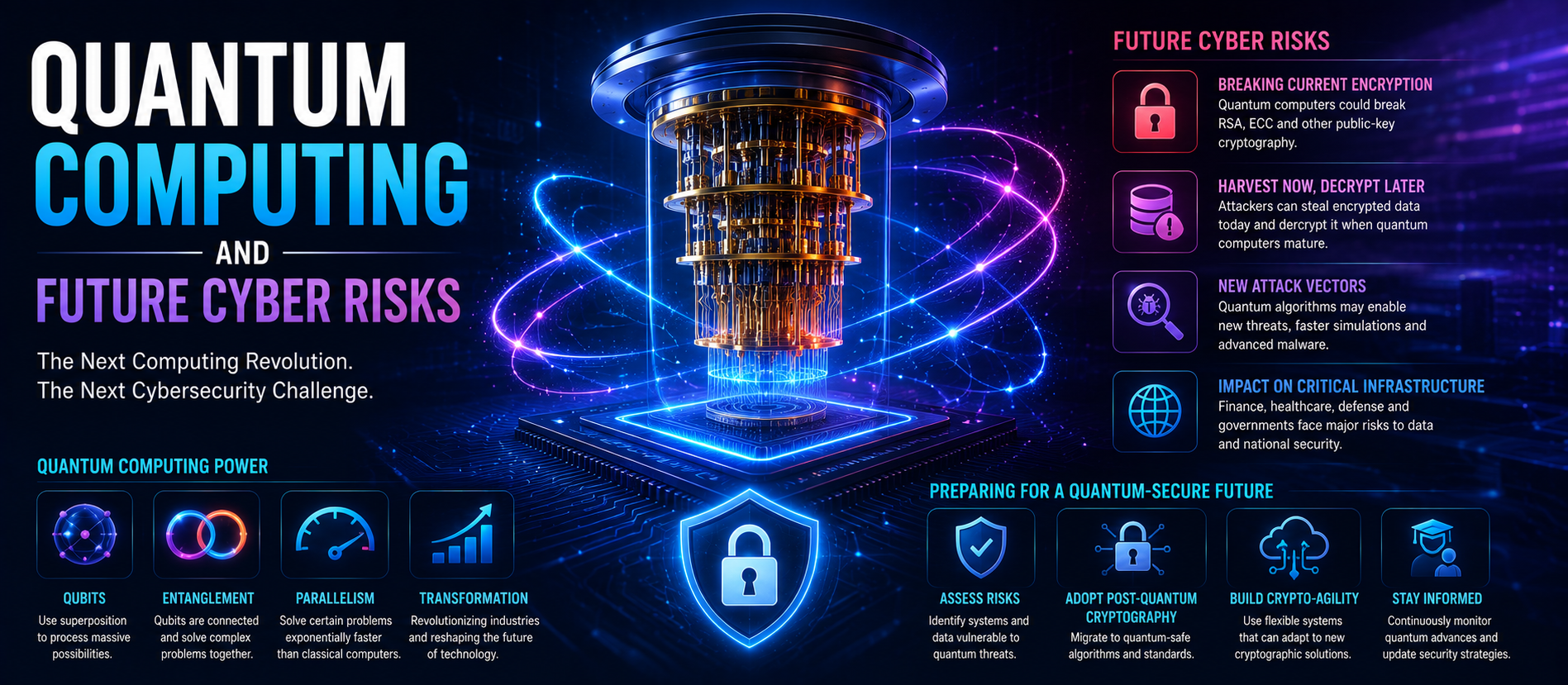
Unlike traditional computers that process information using bits (0 or 1), quantum computers use qubits, which can exist in multiple states simultaneously through superposition. Combined with entanglement and quantum interference, this enables certain complex calculations to be solved far more efficiently than with classical computers.
Why Quantum Computing Matters for Cyber Security
- Future quantum systems may weaken current public-key cryptography.
- Attackers could store encrypted data today and attempt to decrypt it later.
- Critical infrastructure and financial systems rely heavily on modern encryption.
- Governments and enterprises are preparing for post-quantum migration.
Potential Cyber Risks
Breaking Public-Key Encryption
Algorithms such as RSA and Elliptic Curve Cryptography may eventually become vulnerable to large-scale quantum computers.
Harvest Now, Decrypt Later
Threat actors may collect encrypted communications today with the expectation that future quantum capabilities could decrypt them.
Identity and Digital Signatures
Digital certificates, authentication systems, and code signing mechanisms may require quantum-resistant replacements.
Industries Most Affected
- Banking and Financial Services
- Healthcare
- Government and Defense
- Cloud Computing
- Telecommunications
- Critical Infrastructure
Preparing for the Post-Quantum Era
- Create an inventory of cryptographic assets.
- Monitor post-quantum cryptography standards.
- Implement crypto-agility.
- Protect sensitive long-term data.
- Review third-party vendor readiness.
- Strengthen identity and Zero Trust security.
Post-Quantum Cryptography
Post-Quantum Cryptography (PQC) refers to cryptographic algorithms designed to remain secure against attacks from both classical and quantum computers. Organizations should begin planning for migration as standards mature.
AI, Cloud, and Quantum Security
Artificial Intelligence will help automate cryptographic discovery, vulnerability analysis, and migration planning. Cloud providers are also expected to play a major role in delivering scalable post-quantum security services.
Business Best Practices
- Maintain strong encryption today.
- Use Multi-Factor Authentication (MFA).
- Adopt Zero Trust architecture.
- Perform regular risk assessments.
- Keep software updated.
- Develop long-term cryptographic migration plans.
SEO, AEO & GEO Best Practices
Publish authoritative content with structured headings, semantic keywords, practical examples, and FAQ sections to improve visibility across Google Search and AI-powered answer engines.
AEO & GEO Optimized FAQs
Will quantum computers break encryption?
Powerful future quantum computers may threaten some widely used public-key encryption algorithms, making post-quantum cryptography increasingly important.
What is post-quantum cryptography?
It is a new generation of cryptographic algorithms designed to resist attacks from both classical and quantum computers.
Should businesses prepare now?
Yes. Organizations should inventory cryptographic assets, monitor standards, and build migration plans to reduce future risk.
Is quantum computing a current threat?
Large-scale practical quantum attacks are not yet common, but preparation today helps protect long-term sensitive information.
Conclusion
Quantum computing represents both an extraordinary technological opportunity and a future cyber security challenge. Businesses that begin planning now by improving cryptographic agility, strengthening identity security, monitoring standards, and adopting post-quantum strategies will be better positioned for the next generation of digital security.
For more expert insights on Cyber Security, Cloud Security, SEO, AEO, GEO, AI Search Optimization, and Digital Transformation, visit Digiifrog at www.digiifrog.com.
Ready to Grow?
Talk to us about a strategy tailored to your brand — we will help you stand out in search, AI discovery and social.


Comments (0)
Log in to leave a comment.