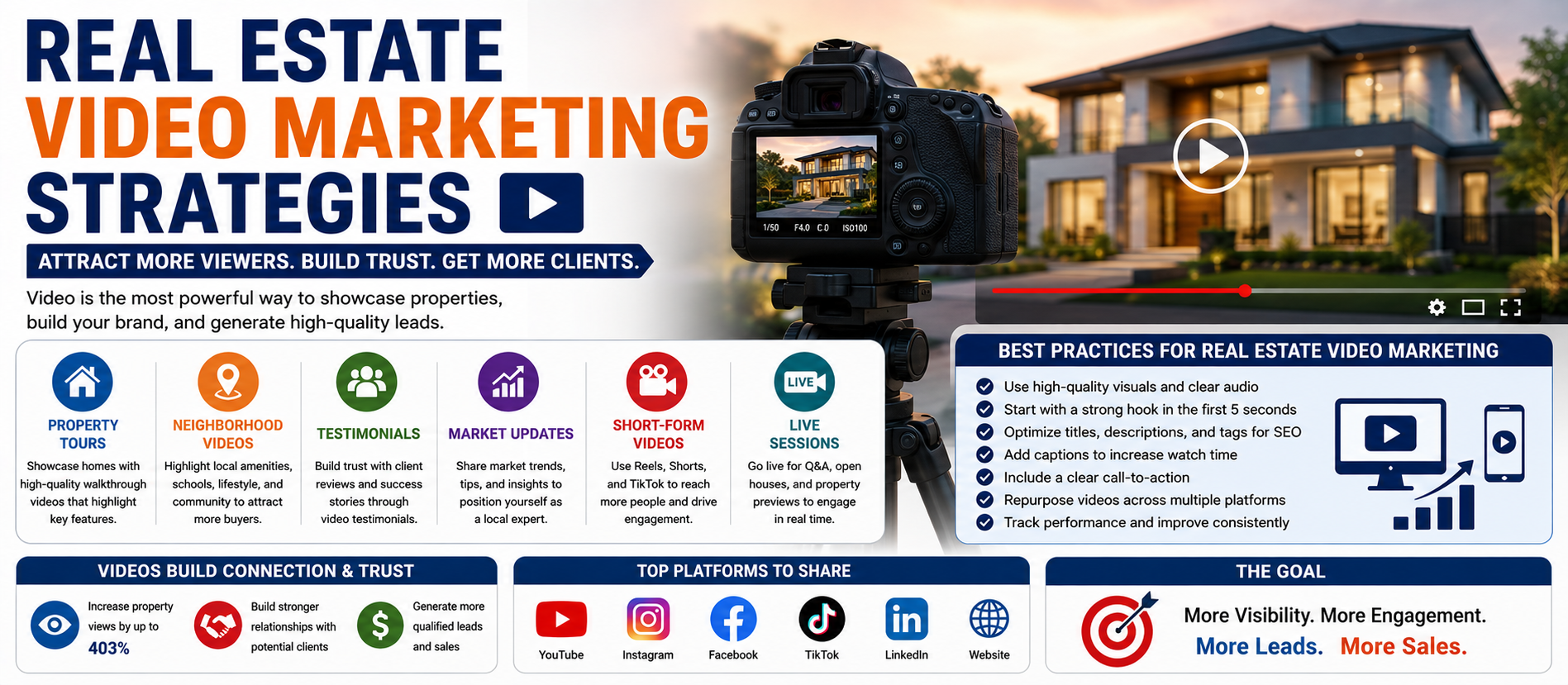
📋 Quick Summary
In this article:
What Is Real Estate Video Marketing?
Why Video Matters in Real Estate Marketing
1. Create a Video Marketing Goal
2. Know Your Target Audience
3. Use a Strong Hook
4. Make Property Walkthrough Videos
5. Create Short-Form Vertical Videos
6. Produce Neighborhood Guide Videos
7. Use Educational Real Estate Videos
8. Build a Seller-Lead Video Strategy
10. Use Market Update Videos
12. Optimize Video for Search
💡 Key Insight
Real estate video marketing strategies have become an essential part of modern property promotion. Buyers increasingly discover homes, neighborhoods, agents, and real estate brands online, where video can communicate visual details, atmosphere, location, and lifestyle more effectively than text alone. A strong video strategy can help agents attract attention, generate qualified leads, build trust, and keep listings visible across search engines and social platforms.
Video does not need to be expensive or cinematic to work. A useful property walkthrough, neighborhood guide, educational explainer, client testimonial, or short-form market update can often create more practical value than an over-produced video with little information. Recent industry and community examples also show that simple walkthroughs and consistent local content can perform strongly when they are focused on the right audience. citeturn0search0turn0reddit29
Google recommends making videos discoverable on the web, using descriptive information and appropriate structured data, providing high-quality thumbnails, and monitoring video performance in Search Console. citeturn0youtube26turn0search5
This guide explains how real estate professionals can create a repeatable video marketing system that supports listings, lead generation, branding, SEO, AEO, GEO, and AI Search visibility.
This WordPress-ready HTML article is prepared for Digiifrog (www.digiifrog.com).
What Is Real Estate Video Marketing?
Real estate video marketing is the use of video content to promote properties, real estate services, agents, neighborhoods, market insights, and client experiences. Videos can be published on property websites, social media, YouTube, email campaigns, landing pages, and other digital channels.
The goal is not simply to collect views. Effective video marketing should move viewers toward a useful next step such as viewing a listing, requesting information, booking a consultation, joining an open house, or contacting an agent.
Why Video Matters in Real Estate Marketing
Real estate is highly visual. Buyers want to understand layouts, finishes, natural light, outdoor spaces, neighborhood context, and the overall feeling of a property.
Video can also demonstrate local expertise through market explanations and neighborhood tours.
Some 2026 industry sources report substantially higher inquiry levels for listings using video, although exact performance varies by market, property, platform, and methodology. These figures should be treated as directional rather than guaranteed results. citeturn0search0turn0search3
1. Create a Video Marketing Goal
Start by deciding what the video is supposed to accomplish. Common goals include generating listing inquiries, attracting seller leads, building local awareness, educating buyers, promoting luxury properties, or strengthening an agent's personal brand.
Each goal needs a different content style. A listing video should showcase the property, while a seller-focused video should explain why an owner should choose your service.
2. Know Your Target Audience
Define the audience before creating the video. First-time buyers, luxury buyers, investors, renters, sellers, commercial clients, and relocation customers have different questions.
A neighborhood video for relocating families may focus on schools, commuting, parks, shopping, and community amenities. An investor video may focus on rental demand, property types, operating considerations, and local development.
3. Use a Strong Hook
The opening seconds should immediately tell viewers why the video is worth watching. Examples include a standout property feature, a useful market fact, a neighborhood question, or a clear promise.
Instead of starting with a long introduction, begin with the most interesting information. Then provide context and a clear next step.
4. Make Property Walkthrough Videos
⚠ Watch Out
A property walkthrough should move logically through the home and show the features buyers need to evaluate, including the exterior, major rooms, outdoor areas, parking, and notable upgrades. Avoid misleading angles or edits that make rooms appear materially larger than they are.
5. Create Short-Form Vertical Videos
Short vertical videos are useful for social platforms because they can introduce properties and educational topics quickly. One video can highlight a kitchen, a view, a renovation detail, a local business, or a common buyer mistake.
Short videos should be focused rather than trying to explain an entire property in a few seconds. Use one main idea per clip.
6. Produce Neighborhood Guide Videos
Neighborhood content can help agents become known as local experts. Show streets, parks, restaurants, shopping areas, transportation, community attractions, and other relevant features.
Local content also supports GEO by connecting the business with specific locations and search intent.
7. Use Educational Real Estate Videos
Educational videos can answer common questions such as how much buyers should budget for closing costs, how inspections work, what sellers should repair before listing, or how mortgage rates affect purchasing power.
Answer one question clearly per video. This makes the content easier to understand and easier to repurpose into articles, FAQs, social posts, and email campaigns.
8. Build a Seller-Lead Video Strategy
Listing videos attract buyers, but seller-focused content can create a different and often valuable lead source. Create videos about pricing mistakes, staging, photography, preparing a property, marketing timelines, and choosing an agent.
Use calls to action such as requesting a home valuation, booking a consultation, or downloading a seller checklist.
10. Use Market Update Videos
Regular market updates can keep an agent visible between listings. Discuss inventory, buyer demand, pricing trends, financing conditions, neighborhood activity, or other meaningful local information.
Keep claims current and explain the period and location being discussed. This is particularly important when publishing content that may be indexed by search engines and AI systems.
12. Optimize Video for Search
Video SEO begins with making the video accessible and understandable to search engines. Use a descriptive title, useful description, relevant page content, a strong thumbnail, and accurate supporting information.
Google's video guidance recommends making videos discoverable, using appropriate structured data, providing high-quality thumbnails, and monitoring indexing and performance. citeturn0youtube26turn0search5
Do not assume that uploading a video to a social platform automatically gives your website strong video-search visibility. Important videos can also be embedded or hosted on relevant website pages with supporting text.
14. Add Captions and Transcripts
Captions improve accessibility and help viewers who watch without sound. A transcript also gives search engines and AI systems additional textual context about the content.
Use accurate transcripts rather than automatically generated text without review, especially for names, addresses, prices, legal terms, and local place names.
19. Track Leads, Not Just Views
Track clicks, inquiries, consultation requests, property-page visits, showing requests, and qualified leads. A lower-view video that produces serious prospects can be more valuable than a viral video with no relevant leads.
22. Use Local SEO With Video
Combine video with location-specific website pages. A video titled around a neighborhood, city, property type, or buyer question can support a broader local-content strategy.
Include the location naturally in the title, description, page copy, transcript, and supporting content when relevant. Avoid keyword stuffing.
23. Optimize for AEO and AI Search
Answer Engine Optimization (AEO) means creating content that directly answers questions. Start videos with a concise answer, then explain the reasoning or details.
Generative Engine Optimization (GEO) and AI Search optimization benefit from clear, factual, well-structured content. Use descriptive headings, concise answers, local context, trustworthy sources, and consistent business information.
For example, instead of making a generic video called “Real Estate Tips,” create a focused video such as “How to Prepare a Home for Sale in [City]” and answer the question directly.
Calls to Action and Lead Tracking
Give each video one clear next step, such as scheduling a showing, requesting a valuation, or booking a consultation. Track clicks, inquiries, showing requests, and qualified leads rather than views alone.
26. Real Estate Video Marketing Checklist
- Define the target audience and goal.
- Write a strong opening hook.
- Use accurate property visuals.
- Record clean audio and stable footage.
- Add captions and a reviewed transcript.
- Create an optimized title and description.
- Use an accurate thumbnail.
- Add relevant website context.
- Use VideoObject structured data when appropriate.
- Include a clear call to action.
- Repurpose long videos into short clips.
- Track inquiries and qualified leads.
Frequently Asked Questions About Real Estate Video Marketing
What is the best type of real estate video?
There is no single best format. Property walkthroughs, neighborhood tours, educational videos, testimonials, market updates, and seller-focused videos can all work when matched to a specific audience and goal.
How long should a real estate video be?
The ideal length depends on the format. Short-form videos should focus on one idea, while detailed property tours can be longer when viewers need comprehensive information.
Do real estate videos help with SEO?
They can support search visibility when videos are discoverable, accurately described, properly embedded, supported by relevant page content, and technically optimized. Google recommends structured data, quality thumbnails, and other video SEO practices. citeturn0youtube26turn0search5
Should real estate agents use AI for videos?
AI can help with scripts, captions, editing, translation, and content workflows. It should be used carefully so that property visuals and claims remain accurate.
Conclusion
Real estate video marketing works best when it combines useful information, authentic property presentation, local expertise, search optimization, and measurable lead-generation goals. Agents do not need to create expensive cinematic productions for every listing. A consistent system of walkthroughs, short videos, neighborhood guides, educational content, testimonials, and market updates can create a strong digital presence.
The most important principle is to make every video useful to a defined audience. Optimize titles, descriptions, thumbnails, transcripts, structured data, and supporting web pages so search engines and AI systems can understand the content. Then connect each video to a meaningful business action and measure qualified leads rather than vanity metrics alone.
For real estate agencies, brokers, property managers, builders, and other businesses seeking modern websites, automated lead generation, content systems, SEO, AEO, GEO, and AI Search optimization, Digiifrog can help. Visit www.digiifrog.com.
Quick Answer: What Are the Best Real Estate Video Marketing Strategies?
The strongest real estate video marketing strategies include property walkthroughs, short-form vertical videos, neighborhood tours, educational buyer and seller content, client testimonials, market updates, optimized thumbnails and transcripts, local SEO, clear calls to action, content repurposing, and lead tracking. The best strategy is consistent, accurate, audience-focused, and connected to measurable business outcomes.
Important Note
Real estate advertising, disclosure, privacy, fair-housing, licensing, and property-marketing rules vary by jurisdiction. Verify local requirements before publishing claims, recording people, using property images, or creating AI-enhanced visuals. Marketing performance also varies by property, audience, platform, market, and execution.
Ready to Grow?
Talk to us about a strategy tailored to your brand — we will help you stand out in search, AI discovery and social.


Comments (0)
Log in to leave a comment.