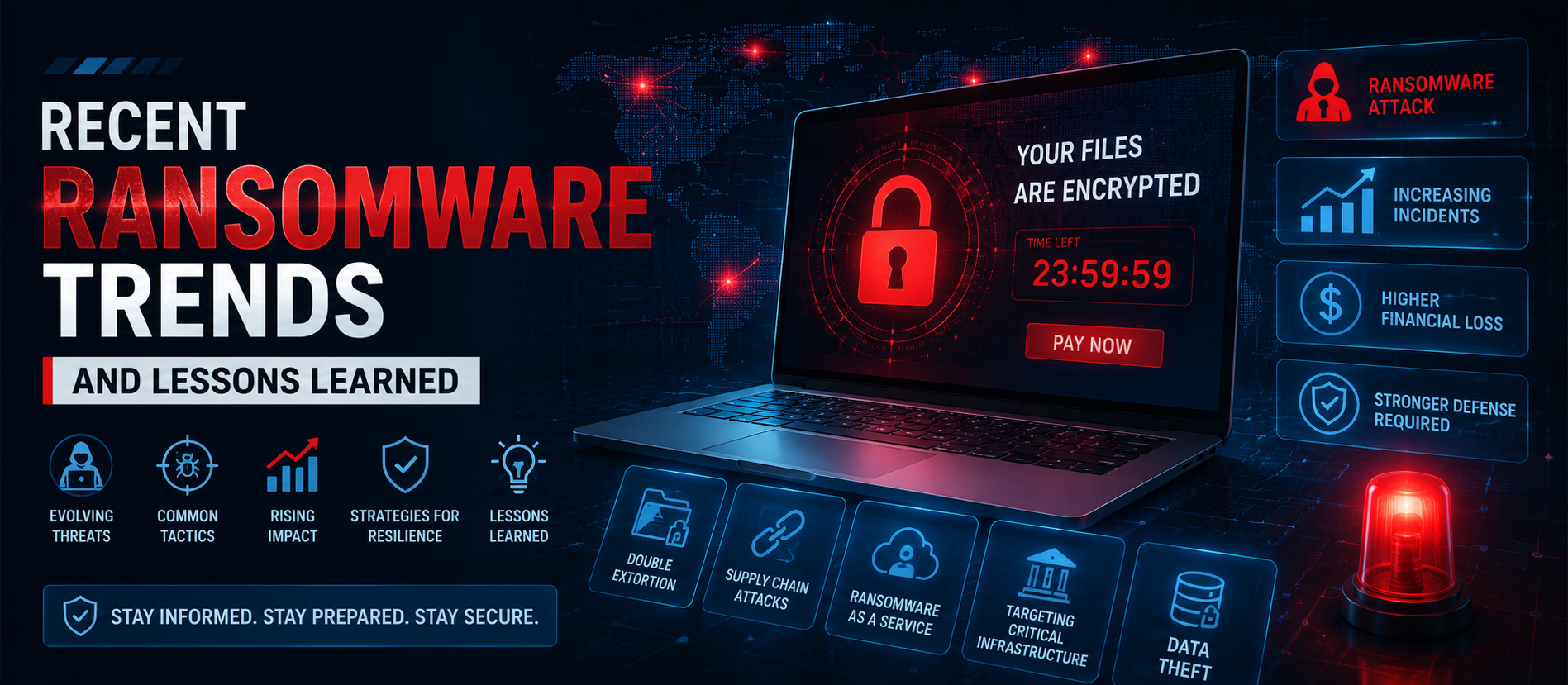
📋 Quick Summary
In this article:
Why Ransomware Remains a Major Threat in 2026
Recent Ransomware Trends in 2026
1. Double Extortion Attacks Continue to Rise
2. Triple Extortion Models
3. AI-Assisted Ransomware Campaigns
4. Targeting Critical Infrastructure
5. Supply Chain Ransomware Attacks
6. Cloud-Focused Ransomware
Most Common Ransomware Attack Vectors
Remote Desktop Protocol (RDP) Exploitation
Ransomware continues to be one of the most dangerous and costly cyber threats facing organizations worldwide in 2026. From multinational corporations and healthcare providers to small businesses and government agencies, cybercriminals are increasingly targeting organizations of every size. Modern ransomware attacks have evolved far beyond simple file encryption, becoming sophisticated multi-stage operations involving data theft, extortion, supply chain compromise, and AI-assisted attack techniques.
As digital transformation accelerates, organizations face growing pressure to strengthen their cyber defenses against ransomware. Understanding recent ransomware trends and the lessons learned from major incidents can help businesses improve resilience and reduce risk.
This comprehensive guide explores the latest ransomware developments, attack methods, emerging threats, defense strategies, and key lessons organizations should implement to protect themselves in 2026 and beyond.
What Is Ransomware?
Ransomware is a type of malicious software that prevents access to systems, files, or data until a ransom payment is made. Traditionally, ransomware encrypted files and demanded payment for decryption keys. However, modern ransomware groups have adopted more aggressive tactics, including data theft, public exposure threats, and business disruption.
Cybercriminals increasingly operate ransomware as a business model known as Ransomware-as-a-Service (RaaS), allowing affiliates to launch attacks using professionally developed malware platforms.
Why Ransomware Remains a Major Threat in 2026
Several factors contribute to ransomware's continued growth:
- Expanding digital infrastructure
- Increased remote work environments
- Growth of cloud services
- Weak password practices
- Unpatched vulnerabilities
- Complex supply chains
- Sophisticated phishing campaigns
- AI-powered attack automation
Cybercriminals are becoming more strategic, targeting organizations with valuable data and critical operations where downtime can be extremely costly.
Recent Ransomware Trends in 2026
1. Double Extortion Attacks Continue to Rise
Modern ransomware operators no longer rely solely on encryption. Attackers first steal sensitive data before encrypting systems. Victims face the threat of public exposure if they refuse to pay.
This approach significantly increases pressure on organizations and has become one of the most common ransomware tactics.
2. Triple Extortion Models
Some cybercriminal groups now employ triple extortion strategies. In addition to encrypting data and threatening publication, attackers may target customers, business partners, or employees associated with the victim organization.
3. AI-Assisted Ransomware Campaigns
Artificial Intelligence has transformed the cyber threat landscape. Attackers use AI to:
- Create convincing phishing emails
- Identify vulnerabilities faster
- Automate reconnaissance
- Generate malware variants
- Improve social engineering attacks
AI increases attack efficiency and scalability.
4. Targeting Critical Infrastructure
Healthcare systems, energy providers, transportation networks, and government services remain prime targets due to their operational importance.
Attackers understand that organizations responsible for critical services may be more likely to pay ransoms quickly.
5. Supply Chain Ransomware Attacks
Cybercriminals increasingly exploit trusted vendors and service providers to gain access to multiple organizations simultaneously.
Compromising a single supplier can create a cascading effect across numerous connected businesses.
6. Cloud-Focused Ransomware
As organizations migrate workloads to the cloud, ransomware operators have adapted their tactics to target cloud storage, SaaS platforms, and hybrid environments.
Most Common Ransomware Attack Vectors
Phishing Emails
Phishing remains the leading delivery method for ransomware. Employees may unknowingly click malicious links or download infected attachments.
Remote Desktop Protocol (RDP) Exploitation
Weakly secured remote access systems continue to provide entry points for attackers.
Software Vulnerabilities
Unpatched applications and operating systems create opportunities for exploitation.
Credential Theft
Stolen usernames and passwords allow attackers to gain legitimate access to corporate systems.
Third-Party Compromise
Vulnerabilities in vendors, contractors, or service providers can expose organizations to ransomware threats.
Industries Most Frequently Targeted
Although ransomware affects every sector, some industries face higher risks:
- Healthcare
- Financial Services
- Government Agencies
- Education
- Manufacturing
- Retail
- Transportation
- Energy and Utilities
Organizations operating critical services often become attractive targets due to the potential cost of downtime.
Financial Impact of Ransomware
The true cost of ransomware extends beyond ransom payments.
Organizations may experience:
- Business interruption
- Lost productivity
- Data recovery expenses
- Legal costs
- Regulatory penalties
- Customer loss
- Reputational damage
- Cyber insurance claims
For many organizations, recovery costs significantly exceed the actual ransom demand.
Key Lessons Learned from Recent Ransomware Incidents
Lesson 1: Backups Are Essential
Organizations with secure, offline backups recover significantly faster than those without effective backup strategies.
Best practices include:
- Regular backup schedules
- Offline backup storage
- Backup encryption
- Recovery testing
- Geographically separate backup locations
Lesson 2: Human Error Remains a Major Risk
Many successful attacks begin with employee mistakes.
Organizations must invest in:
- Security awareness training
- Phishing simulations
- Password education
- Incident reporting programs
Lesson 3: Patch Management Matters
Unpatched systems continue to be exploited by ransomware operators.
Timely updates reduce exposure to known vulnerabilities.
Lesson 4: Zero Trust Security Is Becoming Essential
Traditional perimeter-based security models are insufficient.
Zero Trust principles require continuous verification of users, devices, and applications.
Lesson 5: Incident Response Planning Saves Time
Organizations with documented response plans recover more efficiently during ransomware incidents.
How Artificial Intelligence Helps Defend Against Ransomware
AI-powered security solutions provide organizations with enhanced protection.
Capabilities include:
- Behavioral analytics
- Threat detection
- Anomaly monitoring
- Predictive threat intelligence
- Automated incident response
- Malware classification
AI can identify suspicious activity before ransomware fully executes.
Building a Ransomware Defense Strategy
Strong Authentication
Implement Multi-Factor Authentication (MFA) across all systems.
Network Segmentation
Limit lateral movement by separating critical systems.
Continuous Monitoring
Use Security Information and Event Management (SIEM) platforms to detect threats.
Endpoint Protection
Deploy advanced endpoint detection and response (EDR) solutions.
Employee Training
Create an ongoing security awareness culture.
Regular Risk Assessments
Identify vulnerabilities before attackers exploit them.
The Role of Cyber Insurance
Cyber insurance continues to evolve as ransomware threats increase.
Policies may provide coverage for:
- Incident response costs
- Legal expenses
- Business interruption losses
- Data recovery
- Public relations efforts
However, insurers increasingly require strong security controls before providing coverage.
Future Ransomware Predictions
Experts anticipate several emerging trends:
- More AI-driven attacks
- Cloud-native ransomware
- Targeted industry-specific campaigns
- Supply chain exploitation
- Advanced extortion techniques
- Increased regulatory oversight
Organizations must continuously adapt their security strategies to address these evolving threats.
Best Practices for Businesses in 2026
- Maintain secure backups
- Implement MFA everywhere possible
- Conduct regular security training
- Patch systems promptly
- Deploy EDR solutions
- Monitor network activity continuously
- Perform penetration testing
- Develop incident response plans
- Evaluate third-party risks
- Adopt Zero Trust architecture
A proactive security posture dramatically reduces ransomware risk.
AEO & GEO Optimized Frequently Asked Questions
What is ransomware?
Ransomware is malicious software that locks, encrypts, or steals data and demands payment from victims.
How do ransomware attacks start?
Most ransomware attacks begin through phishing emails, stolen credentials, software vulnerabilities, or compromised third-party vendors.
What is double extortion ransomware?
Double extortion involves stealing sensitive data before encryption and threatening public disclosure if payment is not made.
Can ransomware be prevented?
While no defense is perfect, strong cyber security practices significantly reduce the likelihood and impact of ransomware attacks.
How important are backups for ransomware protection?
Backups are one of the most effective recovery tools and should be maintained regularly and tested frequently.
Conclusion
Ransomware remains one of the most significant cyber security threats in 2026. Attackers continue to refine their tactics through AI-powered automation, double extortion strategies, cloud-focused attacks, and supply chain compromises.
Organizations must adopt a comprehensive cyber security strategy that combines employee awareness, advanced threat detection, Zero Trust principles, backup resilience, and proactive risk management.
💡 Key Insight
The lessons learned from recent ransomware incidents demonstrate that preparation, continuous monitoring, and security awareness are essential for protecting modern businesses.
For more expert insights on Cyber Security, Digital Transformation, AI Search Optimization, SEO, AEO, GEO, and emerging technology trends, visit Digiifrog at www.digiifrog.com.
Ready to Grow?
Talk to us about a strategy tailored to your brand — we will help you stand out in search, AI discovery and social.

Comments (0)
Log in to leave a comment.