📋 Quick Summary
In this article:
What Is Retail Property Investment?
Why Invest in Retail Property?
Single-Tenant Retail
Mixed-Use Retail
1. Location Should Be the First Investment Test
2. Analyze the Trade Area
3. Evaluate Foot Traffic and Vehicle Traffic
4. Review Tenant Quality
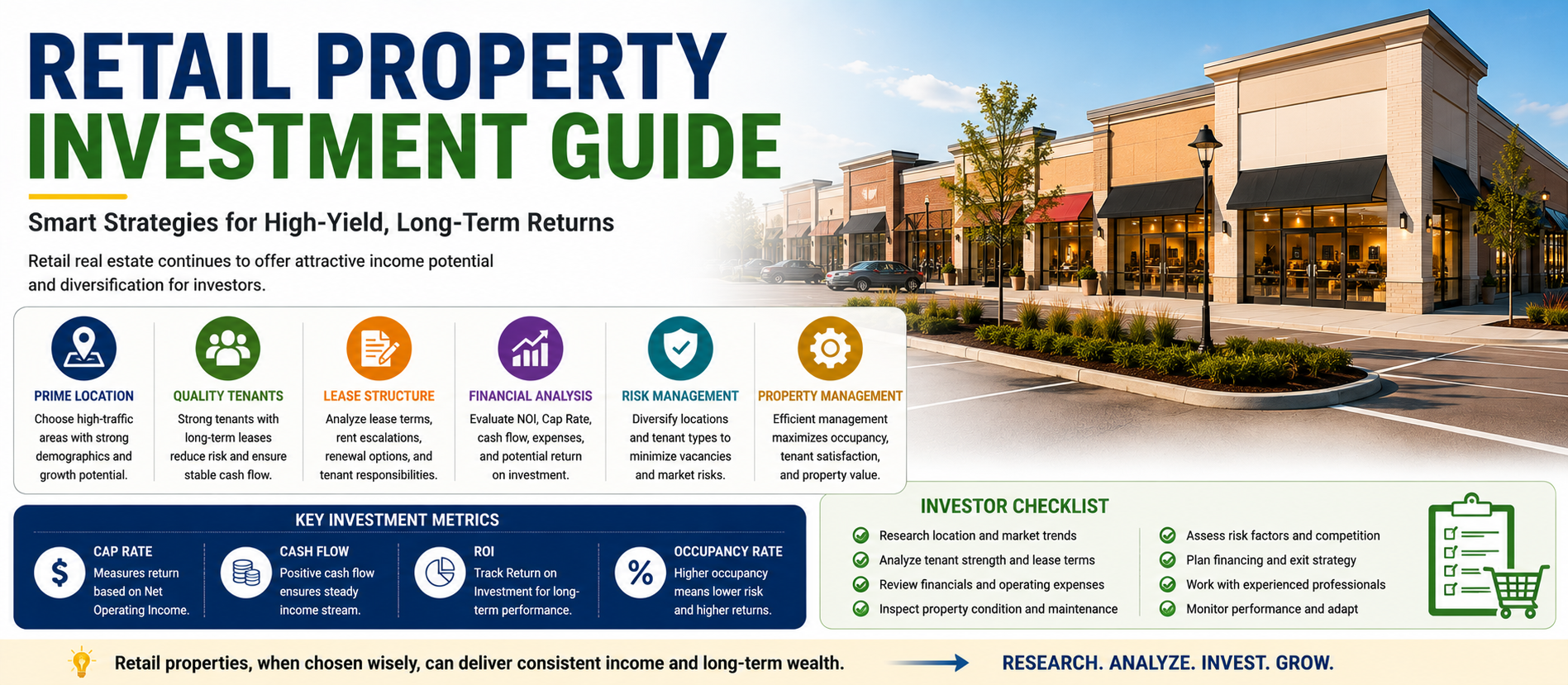
Retail property investment can be an attractive way to build long-term real estate income, diversify an investment portfolio, and potentially benefit from property appreciation. However, retail real estate is not simply about buying a building and collecting rent. Investors must evaluate location, customer demand, tenant quality, lease terms, operating expenses, financing, property condition, competition, and future market conditions.
A successful retail investment starts with disciplined research. A property with a strong-looking storefront may still be a poor investment if the rent is unsustainable, the major tenant is financially weak, the lease expires soon, or large capital expenses are approaching. Conversely, an ordinary-looking property in a strong trade area with reliable tenants and attractive lease economics may provide a more durable investment.
This WordPress-ready article is prepared for Digiifrog (www.digiifrog.com) with a focus on SEO, AEO, GEO, and AI Search optimization.
What Is Retail Property Investment?
Retail property investment involves purchasing commercial real estate used by retailers or consumer-facing businesses. Examples include shopping centers, strip centers, standalone stores, mixed-use developments, and single-tenant properties.
Returns may come from rental income, property appreciation, or both. Direct ownership also creates responsibilities for leasing, maintenance, financing, insurance, taxes, and management.
Why Invest in Retail Property?
Retail properties can generate recurring rental income when occupied by financially healthy tenants. Long leases and contractual rent increases may improve income visibility, while strong locations can support long-term value.
Risks include vacancy, tenant default, changing consumer behavior, e-commerce competition, rising expenses, property damage, financing risk, and market-value changes.
Types of Retail Properties
Neighborhood Shopping Centers
These centers serve nearby residents and commonly contain grocery, food, personal-service, convenience, and everyday-use businesses.
Strip Centers
Strip centers usually contain several smaller retail units with shared parking and visibility. Tenant mix and access are important.
Power Centers
Power centers generally contain larger retailers and attract customers from a wider trade area.
Single-Tenant Retail
A single tenant occupies the property under a lease that may assign some expenses to the tenant. The main risk is income concentration if that tenant leaves.
Mixed-Use Retail
Retail space may be combined with residential, office, hospitality, or entertainment uses, potentially creating multiple sources of customer traffic.
1. Location Should Be the First Investment Test
Location is critical in retail real estate because businesses depend on customers reaching the property. Analyze population, household income, employment, traffic, visibility, accessibility, parking, public transportation, surrounding businesses, and future development.
Do not evaluate the building separately from its trade area. A high-quality building in a weak location may struggle, while a flexible property in a strong commercial corridor may have better long-term potential.
2. Analyze the Trade Area
The trade area is the geographic region from which customers are likely to visit. Study population, income, employment, household growth, traffic, competing properties, and planned developments.
3. Evaluate Foot Traffic and Vehicle Traffic
Traffic is useful only when it supports the tenant's business model. High vehicle counts do not automatically create strong retail sales.
Study pedestrian activity, vehicle counts, parking utilization, access points, peak traffic periods, customer demographics, and whether shoppers can easily enter and exit the property.
4. Review Tenant Quality
💡 Key Insight
Tenants are one of the most important parts of a retail investment. A financially weak tenant can miss rent payments, request concessions, close, or leave before the expected investment period.
For significant tenants, review available financial information, business history, guaranties, operating performance, industry risks, and lease obligations. A famous brand is not automatically a strong tenant for every location.
5. Read Every Lease Carefully
The lease determines much of the property's economic performance. Review rent, expiration dates, renewal options, rent increases, operating expense responsibilities, tenant improvement obligations, assignment rights, termination clauses, security deposits, guaranties, and default provisions.
⚠ Watch Out
Never rely only on the seller's summary or rent roll. Compare the rent roll with the actual signed leases and amendments.
6. Watch Lease Expiration Risk
A property with several major leases expiring at the same time may face significant rollover risk. Losing a major tenant can create vacancy, lower income, tenant improvement costs, leasing commissions, and free-rent periods.
Create a lease-expiration schedule showing each tenant, occupied area, current rent, expiration date, options, and expected renewal probability.
7. Understand Co-Tenancy Clauses
Some retail leases contain co-tenancy provisions that can reduce rent or create termination rights if an important anchor tenant leaves or stops operating.
These provisions should be identified during due diligence because the departure of one major tenant can affect the economics of other leases.
8. Calculate Net Operating Income
Net operating income (NOI) is a central measure in commercial real estate. In simplified form, NOI equals property income minus operating expenses, before financing costs and certain other items.
For example:
- Annual rental and other income: $500,000
- Operating expenses: $150,000
- Estimated NOI: $350,000
Use actual recurring income and expenses whenever possible. Do not treat temporary income or one-time reimbursements as permanent revenue.
9. Understand the Cap Rate
The capitalization rate, or cap rate, is commonly calculated by dividing NOI by the property's purchase price or value.
If a property generates $350,000 of NOI and costs $5 million, the simplified cap rate is 7%.
Cap rate is useful for comparing properties, but it does not tell the entire investment story. A higher cap rate may reflect greater tenant, location, physical, lease, or market risk.
10. Evaluate Cash Flow After Financing
NOI is not the same as investor cash flow. Mortgage payments, capital expenditures, reserves, and other costs must be considered.
Investors should calculate debt service, cash flow before taxes, cash-on-cash return, and debt-service coverage. These measures can help determine whether the property can support its financing.
11. Understand Financing Risk
Debt can increase purchasing power but also increases risk. Higher interest rates can reduce cash flow, while a loan maturity can create refinancing risk.
Review the interest rate, fixed or floating structure, amortization period, maturity date, loan-to-value ratio, covenants, reserves, and possible refinancing requirements.
Do not assume that future financing will automatically be available at the same or a lower rate.
12. Inspect the Physical Property
Retail buildings can require significant capital investment. Inspect roofs, HVAC systems, electrical systems, plumbing, parking areas, paving, lighting, façades, signage, loading areas, and other major components.
A professional property-condition assessment can help identify immediate repairs and future replacement needs.
13. Budget for Capital Expenditures
Major building components eventually require replacement. Roofs, air-conditioning systems, parking lots, electrical equipment, and exterior systems can create substantial costs.
Do not assume that a property with positive current cash flow will remain equally profitable if major capital expenses are approaching. Include reasonable reserves in your investment model.
14. Perform Environmental Due Diligence
Environmental issues can create major financial and legal problems. Review previous property uses, especially where the site previously contained automotive, fuel, industrial, or chemical-related businesses.
Depending on the property and jurisdiction, a professional environmental assessment may be appropriate before closing.
15. Verify Zoning and Permitted Uses
Confirm that current and potential future uses are permitted. Review zoning, certificates of occupancy, parking requirements, signage rules, access rights, easements, and redevelopment restrictions.
A property with flexible permitted uses may be easier to re-lease if the existing tenant leaves.
22. Stress-Test Vacancy
Ask what happens if a major tenant leaves. Model several months of vacancy, reduced rental income, tenant improvements, leasing commissions, and potential changes in property value.
This is especially important for single-tenant properties where one tenant represents most or all of the rental income.
Retail Property Investment Checklist
- Analyze location, trade area, demographics, and traffic.
- Study tenant mix, tenant strength, leases, and expirations.
- Calculate realistic NOI and cap rate.
- Review financing, vacancy, and refinancing risk.
- Inspect property condition and capital needs.
- Complete environmental and zoning due diligence.
- Define a realistic exit strategy.
Frequently Asked Questions About Retail Property Investment
Is retail property a good investment?
It can be, when location, tenants, leases, price, financing, and cash flow justify the risks. There is no universally good retail property.
What is a retail property cap rate?
A cap rate is generally calculated by dividing net operating income by property value or purchase price. It helps compare operating income relative to price but does not measure every investment risk.
What should I check before buying?
Review location, demographics, tenants, leases, rent roll, property condition, environmental history, zoning, taxes, financing, capital needs, and competition.
Are long-term leases safer?
They can provide greater income visibility, but tenant credit, rent level, renewal options, guaranties, and property quality also matter.
What is the biggest risk in a single-tenant retail property?
Tenant concentration is a major risk. If the tenant leaves or fails financially, most or all rental income may disappear until a replacement tenant is found.
How important is location?
Location is extremely important because retail businesses often depend on demographics, visibility, access, traffic, parking, and nearby competition.
Can AI help analyze retail property?
Yes. AI can assist with document organization, lease analysis, market research, data comparison, and scenario modeling. Professional verification is still necessary for important investment decisions.
Conclusion
Retail property investment can provide rental income, diversification, and potential appreciation, but successful investing requires disciplined due diligence. The best opportunity is not necessarily the property with the highest advertised yield; it is the property where location, tenants, leases, income, expenses, financing, and exit strategy fit the risk.
Study the trade area, tenants, leases, NOI, cap rate, property condition, financing, environmental issues, and vacancy scenarios before committing capital.
For businesses seeking AI-powered websites, automated lead generation, SEO, AEO, GEO, and AI Search optimization, Digiifrog can help. Visit www.digiifrog.com.
Quick Answer: How Do You Start Investing in Retail Property?
Start by defining your investment goal, selecting a retail property type, studying the local trade area, analyzing tenant quality and leases, calculating realistic NOI and cap rate, evaluating financing, completing property and environmental due diligence, and stress-testing vacancy and refinancing risks. Never buy based only on a high advertised yield. Review the complete financial and legal picture and use qualified professionals when appropriate.
Ready to Grow?
Talk to us about a strategy tailored to your brand — we will help you stand out in search, AI discovery and social.

Comments (0)
Log in to leave a comment.