📋 Quick Summary
In this article:
The Software Industry Is Entering an AI-Native Era
Autonomous AI Agents Will Transform Business Software
Software Development Will Become Increasingly AI-Assisted
Low-Code and No-Code Platforms Will Expand
Cloud-Native Software Will Become the Default
Edge Computing Will Create a New Generation of Applications
Cybersecurity Software Will Become More Autonomous
Software Supply Chain Security Will Become a Major Priority
Quantum Computing Will Create New Software Markets
Post-Quantum Security Software Will Grow Rapidly
Spatial Computing Will Create New Software Experiences
Digital Twins Will Become More Common
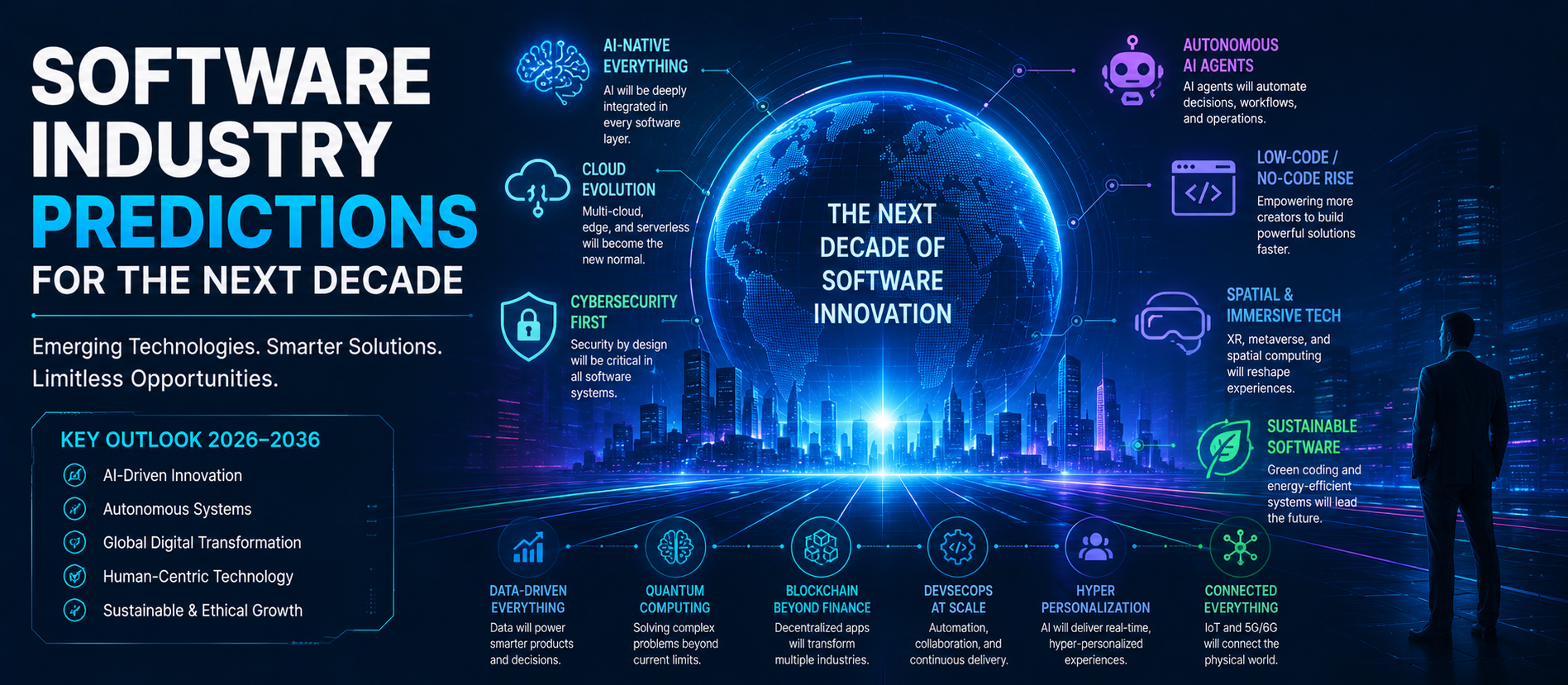
The global software industry is entering one of the most transformative periods in its history. Artificial Intelligence, cloud computing, quantum technologies, cybersecurity, automation, edge computing, spatial computing, and new software development models are changing how applications are created, distributed, secured, and monetized. During the next decade, software will become more intelligent, autonomous, personalized, and deeply integrated into almost every business process and aspect of daily life.
For companies, developers, investors, entrepreneurs, and technology professionals, understanding the future direction of the software industry is essential. Organizations that prepare early for emerging technologies can improve productivity, build new revenue streams, deliver better customer experiences, and create sustainable competitive advantages. Businesses that delay digital transformation may face higher costs, security risks, outdated systems, and increasing difficulty competing with AI-native organizations.
💡 Key Insight
This comprehensive WordPress-ready guide explores the most important software industry predictions for the next decade, including the rise of AI-native software, autonomous agents, cloud-native platforms, cybersecurity innovation, low-code development, quantum computing, sustainable software engineering, and the evolution of digital experiences. The article also explains how these changes will influence SEO, AEO, GEO, and AI Search optimization. Prepared for Digiifrog (www.digiifrog.com).
The Software Industry Is Entering an AI-Native Era
Artificial Intelligence will become a fundamental layer of modern software rather than an optional feature. Traditional applications are generally built around predefined interfaces, menus, workflows, and rules. AI-native software will increasingly understand natural language, analyze context, generate content, automate decisions, predict user needs, and perform multi-step tasks with limited human supervision.
Businesses will expect enterprise applications to include intelligent assistants, automated recommendations, predictive analytics, conversational interfaces, and generative capabilities. Software products without meaningful AI integration may struggle to compete in categories where intelligent automation delivers measurable productivity gains.
- AI-powered user interfaces
- Intelligent workflow automation
- Predictive business analytics
- Generative content and code creation
- Personalized software experiences
- Natural language application control
Autonomous AI Agents Will Transform Business Software
One of the most significant software trends of the next decade will be the development of autonomous AI agents. Unlike basic chatbots that answer questions, AI agents can plan tasks, access software tools, analyze information, coordinate workflows, and complete actions toward defined objectives.
Future organizations may deploy specialized agents for customer service, sales operations, marketing analysis, cybersecurity monitoring, financial reporting, software testing, procurement, and administrative work. Multi-agent systems could allow several intelligent software agents to collaborate on complex business processes.
Human oversight, security controls, permissions, auditing, and responsible AI governance will remain critical because greater autonomy also creates new operational risks.
Software Development Will Become Increasingly AI-Assisted
AI coding assistants are already helping developers generate code, explain unfamiliar repositories, create tests, identify defects, and write documentation. Over the next decade, software engineering workflows will become far more automated.
- AI-generated application prototypes
- Automated code reviews
- Intelligent debugging
- AI-generated unit and integration tests
- Automated software documentation
- Natural language software development
- AI-assisted system architecture
Developers will remain essential, but their roles will evolve. More time will be spent defining requirements, reviewing AI-generated outputs, designing architectures, solving complex problems, securing systems, and understanding user needs.
Low-Code and No-Code Platforms Will Expand
Demand for software continues to grow faster than many organizations can hire traditional development teams. Low-code and no-code platforms will help businesses close this gap by enabling employees, analysts, designers, and domain experts to create applications through visual interfaces and reusable components.
The next generation of low-code platforms will integrate generative AI. Users may describe an application in natural language, and software systems will generate workflows, interfaces, databases, integrations, and initial business logic automatically.
Professional developers will continue to handle complex architecture, security, performance, integrations, and advanced customization. However, citizen development will become an increasingly important part of enterprise digital transformation.
Cloud-Native Software Will Become the Default
Cloud computing has already transformed the software industry, but the next decade will bring deeper cloud-native adoption. Organizations will increasingly build applications using containers, microservices, serverless computing, managed databases, distributed systems, and cloud-based development platforms.
- Greater infrastructure scalability
- Faster application deployment
- Global software availability
- Improved disaster recovery
- Flexible consumption-based pricing
- Better support for remote development teams
Hybrid cloud and multi-cloud strategies will remain important for organizations that require flexibility, regulatory compliance, data sovereignty, and resilience.
Edge Computing Will Create a New Generation of Applications
Not every application can depend entirely on centralized cloud data centers. Autonomous vehicles, smart factories, robotics, healthcare devices, augmented reality, and industrial systems often require extremely low latency and real-time processing.
Edge computing moves software processing closer to users, machines, sensors, and connected devices. During the next decade, developers will increasingly build distributed applications that combine cloud infrastructure with edge computing.
Edge AI will allow intelligent applications to analyze information locally, improving response times, reducing bandwidth usage, and supporting privacy-sensitive use cases.
Cybersecurity Software Will Become More Autonomous
Cyber threats are becoming more sophisticated as attackers adopt automation and AI. Security teams face enormous volumes of alerts, vulnerabilities, endpoints, cloud workloads, and identities. Future cybersecurity software will increasingly use AI to detect unusual behavior, prioritize risks, investigate incidents, and automate response actions.
- AI-powered threat detection
- Autonomous incident response
- Continuous security validation
- Identity threat protection
- Cloud-native application security
- Software supply chain protection
- Post-quantum cryptography
Zero Trust security models will continue expanding because traditional network boundaries are no longer sufficient for distributed cloud environments and remote workforces.
Software Supply Chain Security Will Become a Major Priority
Modern applications depend on open-source packages, APIs, cloud services, third-party libraries, development tools, and automated deployment pipelines. This interconnected ecosystem creates significant security risks.
Organizations will increasingly adopt Software Bills of Materials (SBOMs), dependency monitoring, code signing, secure development frameworks, automated vulnerability scanning, and stronger vendor risk management.
Security will become more deeply integrated into the entire software development lifecycle rather than being treated as a final testing stage before release.
Quantum Computing Will Create New Software Markets
Quantum computing remains an emerging technology, but progress during the next decade may create significant opportunities for specialized software platforms, development tools, algorithms, simulation environments, and hybrid quantum-classical applications.
Potential areas of impact include materials science, pharmaceutical research, logistics optimization, financial modeling, cryptography, and complex scientific simulations.
Most businesses will not replace conventional computing systems with quantum computers. Instead, cloud platforms may provide access to quantum resources for specific computational problems.
Post-Quantum Security Software Will Grow Rapidly
Powerful quantum computers could eventually threaten widely used public-key cryptographic systems. Organizations with long-term security requirements will need to prepare for migration toward post-quantum cryptography.
Software vendors will develop tools for discovering cryptographic dependencies, managing certificates, testing new algorithms, monitoring migration progress, and protecting data against future quantum threats.
Spatial Computing Will Create New Software Experiences
Augmented Reality (AR), Virtual Reality (VR), Mixed Reality (MR), and spatial computing technologies will create new categories of applications. Instead of interacting exclusively with flat screens, users will increasingly work with three-dimensional interfaces and digital information integrated into physical environments.
- Immersive employee training
- Virtual product demonstrations
- Collaborative engineering environments
- Interactive education
- Healthcare visualization
- Remote maintenance assistance
Software developers will need new skills in 3D design, spatial interaction, real-time graphics, computer vision, and immersive user experience design.
Digital Twins Will Become More Common
Digital twins are virtual representations of physical assets, systems, facilities, products, or processes. They use real-world data to support monitoring, simulation, optimization, and predictive maintenance.
During the next decade, digital twin platforms will become increasingly important in manufacturing, energy, transportation, healthcare, smart cities, construction, and supply chain management.
AI-powered digital twins will help organizations simulate future scenarios, identify operational problems, optimize resource usage, and make better strategic decisions.
Industry-Specific Software Will Become More Intelligent
Generic enterprise platforms will remain important, but vertical software designed for specific industries will grow significantly. Specialized applications can incorporate industry terminology, regulations, workflows, data models, and AI capabilities that horizontal platforms may not provide.
- Healthcare software
- Legal technology platforms
- Financial services software
- Construction management systems
- Agricultural technology applications
- Manufacturing software
- Education technology platforms
Vertical AI solutions trained and designed around specialized workflows may create substantial business opportunities for software companies.
Enterprise Software Will Shift Toward Composable Architecture
Large monolithic applications can be difficult to customize and modernize. Composable architecture allows organizations to assemble business capabilities from modular services, APIs, microservices, and reusable components.
Businesses will increasingly select software based on interoperability, integration capabilities, data portability, and API availability. Platforms that create closed ecosystems without flexible integration options may become less attractive to enterprise customers.
APIs Will Remain the Foundation of Digital Ecosystems
APIs connect applications, cloud services, mobile apps, AI systems, payment platforms, data sources, and enterprise systems. As digital ecosystems become more interconnected, API management and security will become even more important.
Organizations will invest in API gateways, observability platforms, automated documentation, access management, developer portals, and intelligent API security tools.
Open-Source Software Will Continue to Drive Innovation
Open-source technologies already form the foundation of cloud computing, AI development, web infrastructure, databases, and software engineering. This influence will continue growing.
Businesses will need stronger strategies for open-source governance, security, licensing, maintenance, and contribution. Commercial companies will continue building products and services around open ecosystems while offering enterprise support, hosting, security, and management capabilities.
Software Pricing Models Will Continue to Evolve
Subscription-based Software-as-a-Service (SaaS) models will remain dominant, but customers will demand clearer value, flexible pricing, and measurable returns on software investments.
Usage-based pricing, consumption models, AI feature pricing, outcome-based contracts, and hybrid subscription structures will become more common.
Software vendors will need to carefully manage cloud infrastructure costs because AI workloads can be expensive to operate at scale.
Data Platforms Will Become More Intelligent
Organizations generate enormous volumes of structured and unstructured data. Future data software will use AI to improve data discovery, quality, governance, integration, analytics, and security.
- AI-powered data catalogs
- Automated data quality monitoring
- Natural language analytics
- Real-time data processing
- Semantic knowledge layers
- Intelligent data governance
Reliable, well-governed data will remain essential for successful AI implementation.
Natural Language Interfaces Will Change How People Use Software
Traditional graphical interfaces will not disappear, but natural language will become a major way users interact with applications. Instead of navigating multiple dashboards and menus, users may simply ask software to generate reports, analyze data, create workflows, update records, or explain complex information.
Multimodal interfaces combining text, voice, images, video, and gestures will create more flexible digital experiences.
Personalized Software Experiences Will Become Standard
AI enables applications to understand user behavior, preferences, roles, and goals. Future software will increasingly adapt interfaces, recommendations, workflows, and content to individual users.
Businesses will need to balance personalization with privacy, transparency, consent, and data protection requirements.
Privacy-Enhancing Technologies Will Gain Importance
Consumers, governments, and businesses are becoming more concerned about data privacy. Software companies will increasingly adopt privacy-enhancing technologies and privacy-by-design development practices.
- Data minimization
- Differential privacy
- Federated learning
- Confidential computing
- Advanced encryption
- Automated consent management
Sustainable Software Engineering Will Become a Business Priority
Data centers, AI models, cloud infrastructure, and software systems consume significant energy. Organizations will increasingly measure and optimize the environmental impact of digital operations.
Developers will focus on efficient code, optimized infrastructure, workload scheduling, sustainable cloud regions, hardware utilization, and carbon-aware computing.
Sustainable software practices can reduce costs while helping organizations meet environmental goals.
Software Observability Will Become More Intelligent
Modern distributed applications generate enormous amounts of logs, metrics, traces, events, and user experience data. Traditional monitoring systems can overwhelm engineering teams with alerts.
AI-powered observability platforms will identify anomalies, correlate incidents, analyze root causes, predict failures, and recommend remediation actions.
This trend will help organizations improve software reliability while reducing operational complexity.
DevSecOps and Platform Engineering Will Expand
Development teams are under pressure to release software faster without sacrificing security or reliability. DevSecOps integrates security into development and operations workflows, while platform engineering provides standardized internal platforms that simplify software delivery.
Internal developer platforms will help organizations provide reusable infrastructure, automated pipelines, security policies, observability, and self-service deployment capabilities.
Software Testing Will Become More Autonomous
AI will transform quality assurance by generating test cases, identifying high-risk application areas, maintaining automation scripts, analyzing failures, and simulating complex user behavior.
- Self-healing test automation
- AI-generated testing scenarios
- Predictive defect detection
- Visual regression analysis
- Continuous testing
Human testers will increasingly focus on exploratory testing, user experience, business risks, security, and complex edge cases.
Legacy Software Modernization Will Become Urgent
Many organizations still depend on aging systems that are expensive to maintain, difficult to integrate, and vulnerable to security risks. The rapid adoption of AI, cloud platforms, APIs, and modern data architectures will increase pressure to modernize legacy applications.
AI-assisted code analysis, automated documentation, application discovery, and migration tools will help organizations understand and transform older software systems.
Software Talent and Developer Roles Will Change
AI will automate parts of software development, but demand for skilled technology professionals will continue evolving rather than disappearing. Developers will need stronger knowledge of architecture, cybersecurity, data, AI systems, business strategy, product thinking, and responsible technology practices.
The ability to collaborate effectively with AI tools will become an important professional skill. Organizations will also invest more heavily in continuous technical education because software technologies are changing rapidly.
Responsible AI Governance Will Become Essential
As AI becomes embedded across enterprise applications, businesses will need frameworks for managing accuracy, security, bias, privacy, explainability, intellectual property, and regulatory compliance.
- AI model inventories
- Risk classification
- Human oversight
- Performance monitoring
- Security testing
- Data governance
- Audit documentation
Software companies that provide transparent, secure, and governable AI systems may gain greater trust from enterprise customers.
Search and Software Discovery Will Change
Users increasingly discover products, services, technical information, and software recommendations through AI assistants and generative search systems. This shift will change how software companies approach digital visibility.
Traditional search engine rankings will remain important, but organizations will also need to create content that can be understood, summarized, and referenced by AI systems.
How Future Software Trends Affect SEO
Search Engine Optimization (SEO) will continue evolving alongside AI-powered search experiences. Software companies must maintain strong technical performance, authoritative content, structured data, useful product information, and excellent user experiences.
- Fast website performance
- Mobile-friendly experiences
- Clear information architecture
- Original expert content
- Technical documentation
- Structured data implementation
How Future Software Trends Affect AEO
Answer Engine Optimization (AEO) focuses on making content easier for search engines and AI assistants to use when providing direct answers.
Software companies should publish clear definitions, comparison guides, FAQs, tutorials, product documentation, troubleshooting resources, and structured question-and-answer content.
How Future Software Trends Affect GEO
Generative Engine Optimization (GEO) focuses on improving the visibility and usefulness of content within generative AI experiences.
Organizations should create authoritative, accurate, well-structured, and context-rich information. Original research, expert insights, transparent authorship, credible references, and clearly explained concepts can help strengthen digital authority.
AI Search Optimization Will Become Part of Digital Strategy
AI Search optimization will require collaboration between SEO professionals, content creators, software developers, data teams, and brand experts. Businesses will need consistent entity information, high-quality knowledge resources, structured data, accessible websites, and trustworthy digital content.
Software platforms that help organizations manage these complex workflows will create new market opportunities.
How Businesses Should Prepare for the Next Decade
Organizations do not need to adopt every emerging technology immediately. Instead, they should build flexible strategies that allow experimentation while controlling costs and risks.
- Modernize critical software systems
- Build reliable data foundations
- Develop AI governance policies
- Strengthen cybersecurity
- Invest in employee training
- Adopt cloud-native architecture where appropriate
- Experiment with AI automation
- Improve API and integration capabilities
- Measure technology investments based on business outcomes
Opportunities for Software Startups
The next decade will create significant opportunities for startups that solve specialized problems with AI, automation, cybersecurity, vertical software, developer tools, data infrastructure, and industry-specific platforms.
Startups that combine deep domain expertise with modern technology may be able to compete effectively against larger software companies by delivering focused products and superior user experiences.
Opportunities for Established Software Companies
Established vendors can use existing customer relationships, industry knowledge, data, and distribution networks to build intelligent software products. However, they must modernize legacy systems, improve product development speed, strengthen AI capabilities, and respond to changing customer expectations.
Partnerships, acquisitions, platform ecosystems, and open APIs will remain important strategies for expanding capabilities.
Major Risks Facing the Software Industry
- AI-generated cybersecurity threats
- Data privacy violations
- Software supply chain attacks
- Regulatory uncertainty
- Cloud infrastructure concentration
- AI model reliability problems
- Technology talent shortages
- Rising computing costs
Successful organizations will need to balance innovation with security, governance, financial discipline, and customer trust.
Why Digiifrog Recommends Preparing for Future Software Trends
At Digiifrog, we believe businesses must understand emerging software technologies to remain competitive in the evolving digital economy. AI, cloud computing, automation, cybersecurity, data intelligence, and next-generation digital experiences will continue transforming industries worldwide.
Organizations that invest strategically in modern software, digital visibility, SEO, AEO, GEO, and AI Search optimization can improve productivity, strengthen customer engagement, create new opportunities, and build sustainable digital growth.
Website: www.digiifrog.com
Conclusion
The next decade of the software industry will be defined by intelligent automation, AI-native applications, autonomous agents, cloud-native infrastructure, stronger cybersecurity, new computing models, and increasingly personalized digital experiences. Software will become more capable of understanding user intent, completing complex tasks, optimizing business operations, and connecting physical and digital environments.
At the same time, organizations will face important challenges involving security, privacy, responsible AI, software reliability, sustainability, and workforce transformation. Technology alone will not guarantee success. Businesses must combine innovation with clear strategy, trusted data, skilled professionals, strong governance, and a commitment to delivering meaningful value.
Companies that begin preparing today will be better positioned to compete in the software economy of 2026–2036. By embracing responsible innovation and building flexible digital foundations, organizations can turn the next generation of software technologies into long-term business opportunities.
Ready to Grow?
Talk to us about a strategy tailored to your brand — we will help you stand out in search, AI discovery and social.
Comments (0)
Log in to leave a comment.