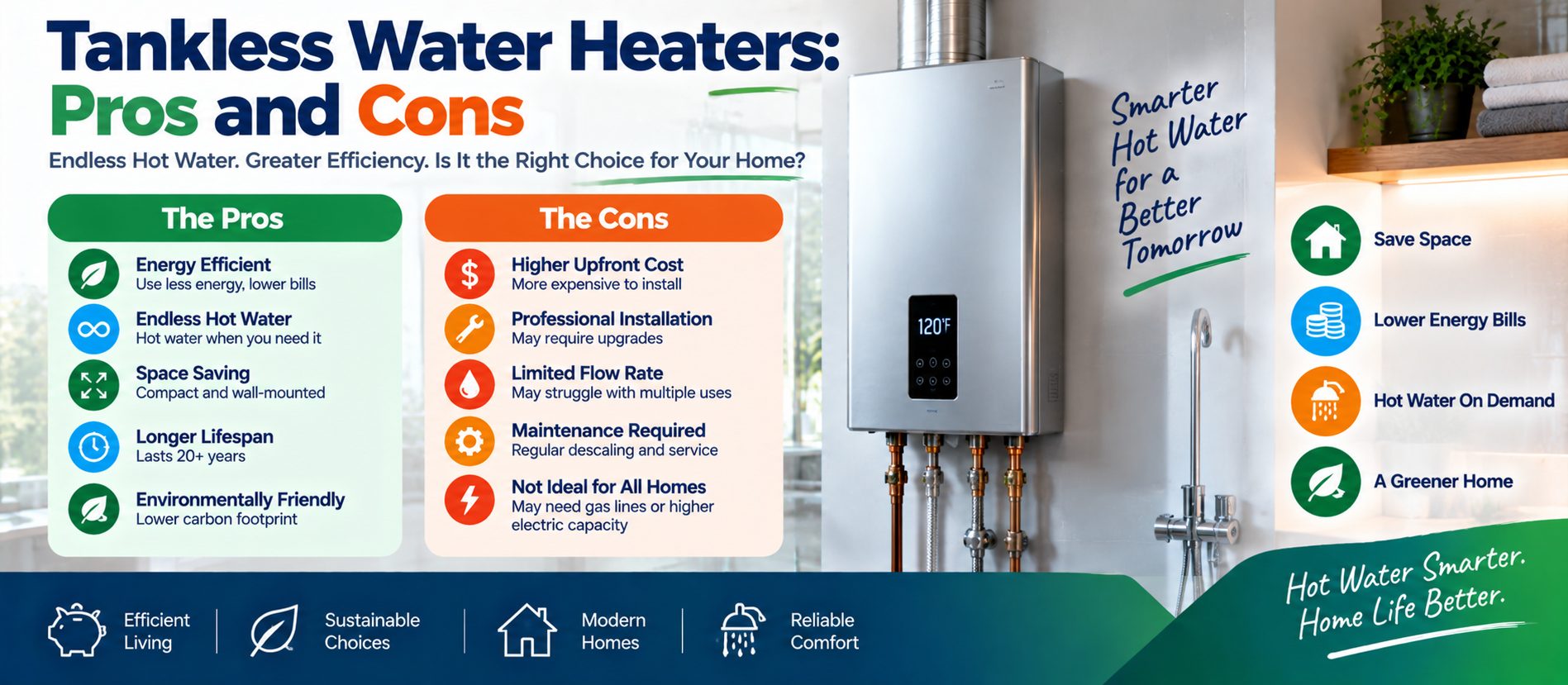
📋 Quick Summary
In this article:
Quick Answer: Are Tankless Water Heaters Worth It?
What Is a Tankless Water Heater?
How Does a Tankless Water Heater Work?
Pros of Tankless Water Heaters
1. Hot Water on Demand
2. Potential Energy Savings
3. Compact and Space-Saving Design
4. Potentially Long Service Life
5. No Large Storage Tank of Hot Water
6. Useful for Point-of-Use Applications
Cons of Tankless Water Heaters
1. Higher Upfront Cost
Tankless water heaters are a popular option for homeowners who want hot water on demand, improved energy efficiency, and a compact design. Unlike traditional water heaters that store heated water in a large tank, tankless systems heat water as it flows through the unit.
However, a tankless system is not automatically the right choice for every property. Purchase price, installation requirements, household demand, climate, water quality, and maintenance all matter.
This guide explains the pros and cons of tankless water heaters in simple language. It is designed to help homeowners compare tankless and traditional systems before making a decision.
Quick Answer: Are Tankless Water Heaters Worth It?
A tankless water heater can be worth it when a homeowner wants on-demand hot water, a space-saving system, and potential energy savings. The higher initial and installation cost may not make sense for every household. The best choice depends on hot-water demand, budget, energy source, existing infrastructure, and long-term plans.
What Is a Tankless Water Heater?
A tankless water heater heats water only when hot water is requested. When a faucet, shower, dishwasher, or another fixture calls for hot water, cold water flows into the unit. The system then uses gas burners or electric heating elements to raise the water temperature before sending it to the fixture.
A traditional storage water heater works differently. It stores a large quantity of water and keeps that water heated until someone uses it.
- Traditional tank heater: Stores a supply of heated water.
- Tankless water heater: Heats water as it moves through the system.
How Does a Tankless Water Heater Work?
When hot water is needed, the unit detects water flow and activates its heating system. Water moves through a heat exchanger or heating chamber and exits at the selected temperature, depending on the system and operating conditions.
When demand stops, the heating process stops. This can reduce the energy associated with continuously maintaining a tank of hot water.
However, every tankless unit has a maximum heating capacity. A system must be correctly sized to handle the expected flow rate and the temperature rise required in that home.
Pros of Tankless Water Heaters
1. Hot Water on Demand
The most well-known advantage is on-demand water heating. A tankless system does not depend on a limited tank of already heated water.
A properly sized unit can continue heating water while demand remains within its operating capacity. This can be useful for households that need hot water for extended periods.
It is important to understand that “endless hot water” does not mean unlimited flow. If several showers and appliances require hot water at the same time, an undersized unit may struggle to maintain the desired temperature and flow.
2. Potential Energy Savings
Traditional storage heaters can experience standby energy losses because stored water must remain warm. Tankless systems generally heat water when it is requested.
This may reduce energy use in some homes. Actual savings depend on:
- How much hot water the household uses.
- The energy source.
- The efficiency of the old system.
- The incoming water temperature.
- The selected tankless model.
- Installation quality.
- Maintenance practices.
Homeowners should compare expected operating costs rather than assuming that every tankless system will produce the same savings.
3. Compact and Space-Saving Design
Tankless water heaters are usually much smaller than storage tanks. Many units can be wall-mounted, freeing valuable floor space.
This can be helpful in:
- Small homes.
- Apartments.
- Utility rooms.
- Mechanical closets.
- Homes with limited storage space.
The installation location must still meet manufacturer clearance, ventilation, service-access, and local-code requirements.
4. Potentially Long Service Life
Many tankless systems are designed for long-term operation when properly installed and maintained. Some components may also be serviceable depending on the manufacturer and model.
Actual lifespan depends on water quality, usage, maintenance, installation conditions, and product design.
5. No Large Storage Tank of Hot Water
A traditional water heater stores a significant volume of water. If a storage tank fails, water damage can be substantial.
A tankless system does not hold a large reserve of heated water in the same way. This can reduce one type of tank-related failure risk.
However, tankless systems still have water connections and components that can leak. No plumbing system is completely free from water-damage risks.
6. Useful for Point-of-Use Applications
Smaller tankless units can sometimes be used near specific fixtures or remote areas of a property. This may be useful for an addition, distant bathroom, or other location where long pipe runs affect hot-water delivery.
The right approach depends on plumbing, electrical capacity, demand, and local requirements.
Cons of Tankless Water Heaters
1. Higher Upfront Cost
The purchase price of a tankless water heater can be higher than that of a conventional storage water heater.
The installation may also cost more if the property requires:
- Gas-line upgrades.
- New venting.
- Electrical service upgrades.
- Changes to water lines.
- New mounting or installation locations.
Total installed cost can vary greatly by property and system type.
2. Installation Can Be More Complex
Replacing a tank water heater with a tankless model is not always a simple replacement project.
Gas systems may need adequate fuel supply and approved venting. Electric whole-house systems can require significant electrical capacity.
Before purchasing equipment, homeowners should have the property evaluated by a qualified installer.
3. Limited Maximum Flow Capacity
A tankless heater can provide hot water continuously, but only up to its designed heating capacity.
High simultaneous demand from showers, dishwashers, washing machines, and faucets can create problems if the system is too small.
An undersized unit may lead to:
- Lower water temperature.
- Reduced hot-water flow.
- Difficulty serving several fixtures at once.
Correct sizing is one of the most important parts of a successful tankless installation.
4. Cold Weather Can Affect Performance
The temperature of incoming water changes how much heating work the system must perform.
In colder climates, incoming water can be much colder during parts of the year. The system may therefore deliver less hot-water flow at the same temperature setting.
Local water temperature conditions should be included in the sizing process.
5. Maintenance Is Still Required
Tankless water heaters are not maintenance-free. Manufacturers provide maintenance instructions that should be followed.
Hard water can contribute to mineral buildup and may increase the need for approved maintenance or descaling procedures.
Always follow the product manual and use qualified service professionals when needed.
6. Hot Water May Still Take Time to Reach the Faucet
A tankless unit can heat water quickly, but the hot water must still travel through the plumbing pipes.
If a bathroom or kitchen is far from the heater, there may still be a waiting period before hot water reaches the fixture.
This issue is related to plumbing distance and system design. Recirculation options may be available for some installations.
Tankless Water Heater Pros and Cons at a Glance
| AdvantagesDisadvantages | |
| Hot water on demand | Higher initial cost |
| Potential reduction in standby energy losses | Installation may require upgrades |
| Compact design | Limited maximum flow capacity |
| Potentially long service life | Cold incoming water can affect performance |
| No large storage tank | Regular maintenance is still needed |
| Can work for point-of-use applications | Hot water still travels through plumbing lines |
Gas vs. Electric Tankless Water Heaters
Gas Tankless Water Heaters
Gas-fired tankless systems can provide high heating capacity and may work well for larger household demand. However, they may require adequate gas supply, approved venting, combustion-related safety measures, and other installation considerations.
An existing gas connection does not automatically mean the home can support a specific tankless model without modifications.
Electric Tankless Water Heaters
Electric tankless systems do not use combustion venting. This may simplify certain installations. However, whole-house electric models can require substantial electrical capacity.
A qualified professional should evaluate electrical service and panel capacity before installation.
How to Choose the Right Size Tankless Water Heater
Tankless water heater sizing should consider both household demand and the temperature rise needed.
Important factors include:
- Number of bathrooms.
- Number of people in the home.
- Simultaneous shower and fixture use.
- Flow rate of showers and faucets.
- Dishwasher demand.
- Washing-machine demand.
- Incoming water temperature.
- Desired hot-water temperature.
A larger system is not always automatically better. The goal is to select equipment that meets realistic demand and can be safely installed.
Does One Tankless Water Heater Serve the Whole House?
Many homes can use one properly sized whole-house tankless system. Larger homes or households with high simultaneous demand may require a larger design, multiple units, or another configuration.
Multiple systems can be useful for:
- Large homes.
- Homes with remote bathrooms.
- Guest suites.
- Home additions.
- Properties with several high-demand areas.
Tankless Water Heater Maintenance Tips
Follow the Manufacturer's Schedule
Each model has specific maintenance requirements. The owner's manual should be the primary source for service intervals and approved procedures.
Consider Water Quality
Hard water can affect water-heating equipment. Depending on local water conditions and the system, approved maintenance may be needed to manage mineral deposits.
Arrange Professional Service When Appropriate
A qualified technician can inspect performance and relevant components. For gas-fired systems, professional attention to combustion-related equipment and venting can be especially important.
Do Not Ignore Warning Signs
Repeated error messages, unstable temperatures, unusual shutdowns, or changes in performance may indicate that the system needs inspection.
When Is a Tankless Water Heater a Good Choice?
A tankless water heater may be a good option when:
- You want to save installation space.
- You prefer on-demand heating.
- Your household demand can be matched to a properly sized unit.
- You are building a new home or completing a major renovation.
- The property can support the installation requirements.
- You are prepared to invest in correct installation and maintenance.
When Might a Traditional Tank Water Heater Be Better?
A conventional storage water heater may be a better fit when:
- Lower upfront cost is the main priority.
- The home cannot easily support necessary upgrades.
- Current hot-water demand is well served by a properly sized tank.
- A simple replacement project is preferred.
- The available installation budget is limited.
The best water heater is the one that matches the specific needs of the property.
Common Mistakes to Avoid
Buying Based Only on Price
The cheapest unit may not have the required capacity or may create higher installation costs. Compare the total project cost.
Ignoring Simultaneous Demand
Consider how many fixtures may use hot water at once. A system sized for one shower may not meet the needs of a busy family.
Assuming Installation Is Simple
Confirm fuel, electrical, plumbing, venting, and local requirements before purchasing a system.
Ignoring Water Quality
Water conditions can affect maintenance needs and long-term performance.
Skipping Professional Evaluation
A qualified installer can help determine appropriate capacity and identify infrastructure requirements before the project begins.
Tankless Water Heater Cost: What Should You Consider?
The cost of the equipment is only one part of the project. Homeowners should also consider:
- Professional installation.
- Gas or electrical upgrades.
- Venting materials where required.
- Plumbing modifications.
- Permits and inspections where required.
- Maintenance costs.
- Expected operating expenses.
A detailed assessment makes it easier to compare a tankless system with a conventional replacement.
Tankless Water Heaters and Energy Efficiency
Tankless systems can offer efficiency benefits because they generally do not maintain a large tank of hot water throughout the day.
Real-world results depend on the complete installation and household usage pattern.
When comparing systems, consider:
- Manufacturer efficiency information.
- Estimated annual energy use.
- Household hot-water demand.
- Local energy prices.
- Installation requirements.
Environmental Considerations
A more efficient water-heating system may reduce energy use under appropriate conditions. However, environmental impact depends on fuel source, equipment efficiency, household demand, and the wider energy system.
Homeowners interested in sustainability should evaluate the complete system rather than relying on one general claim about a particular technology.
SEO, AEO, GEO, and AI Search Optimization
This article uses direct answers and clear headings to help users and modern search systems understand tankless water heater pros and cons.
For SEO, key topics include tankless water heater pros and cons, are tankless water heaters worth it, tankless water heater benefits, and tankless vs traditional water heater.
For AEO, the article directly answers common questions such as:
- What are the advantages of a tankless water heater?
- What are the disadvantages of a tankless water heater?
- Do tankless water heaters save energy?
- How do you choose the right size tankless water heater?
For GEO and AI Search optimization, the content uses concise explanations, comparison sections, structured headings, practical decision factors, and clear answers that can be understood and summarized by AI-powered search tools.
Frequently Asked Questions
Do tankless water heaters provide endless hot water?
A properly sized tankless water heater can continue heating water while demand stays within its operating capacity. However, every unit has a maximum flow and heating capacity.
What is the biggest disadvantage of a tankless water heater?
For many homeowners, the main disadvantages are higher initial cost and potentially expensive installation upgrades.
Do tankless water heaters save money?
They may reduce energy use in some homes, but actual savings depend on usage, energy prices, the existing system, selected equipment, and installation conditions.
Can a tankless water heater run two showers at once?
It depends on the system capacity, incoming water temperature, shower flow rates, desired temperature, and other simultaneous demand. Proper sizing is essential.
How long does a tankless water heater last?
Service life varies by model, water quality, installation, use, and maintenance. Follow the manufacturer's guidance for the specific unit.
Do tankless water heaters require maintenance?
Yes. Maintenance requirements vary by model and local water conditions. Hard-water areas may require additional attention.
Is a tankless water heater better than a traditional water heater?
Neither system is universally better. Tankless systems offer on-demand heating and compact design, while traditional tanks may have lower upfront costs and simpler replacement requirements.
Final Thoughts: Should You Choose a Tankless Water Heater?
Tankless water heaters offer important advantages, including on-demand hot water, a compact design, and the potential for improved energy efficiency. They can be an excellent solution for the right home.
However, homeowners should also consider the disadvantages. Higher upfront costs, installation complexity, flow-rate limitations, cold-weather performance, water quality, and maintenance can all affect the overall value of the system.
The best decision begins with an accurate assessment of household needs. Consider the number of people in the home, simultaneous hot-water use, incoming water temperature, available fuel or electrical capacity, plumbing layout, and long-term budget.
⚠ Watch Out
Consulting a qualified water-heating professional before purchasing a system can help avoid common sizing and installation mistakes.
For more useful information about home services, home improvement, technology, SEO, AEO, GEO, and AI Search optimization, visit www.digiifrog.com.
Important Safety Note
Water-heating systems can involve electricity, gas, combustion equipment, hot water, plumbing, and other potential hazards. Installation, fuel connections, venting, electrical work, and major repairs should follow manufacturer instructions and applicable local requirements. Consult a qualified professional when evaluating, installing, or servicing a water-heating system.
Ready to Grow?
Talk to us about a strategy tailored to your brand — we will help you stand out in search, AI discovery and social.


Comments (0)
Log in to leave a comment.