📋 Quick Summary
In this article:
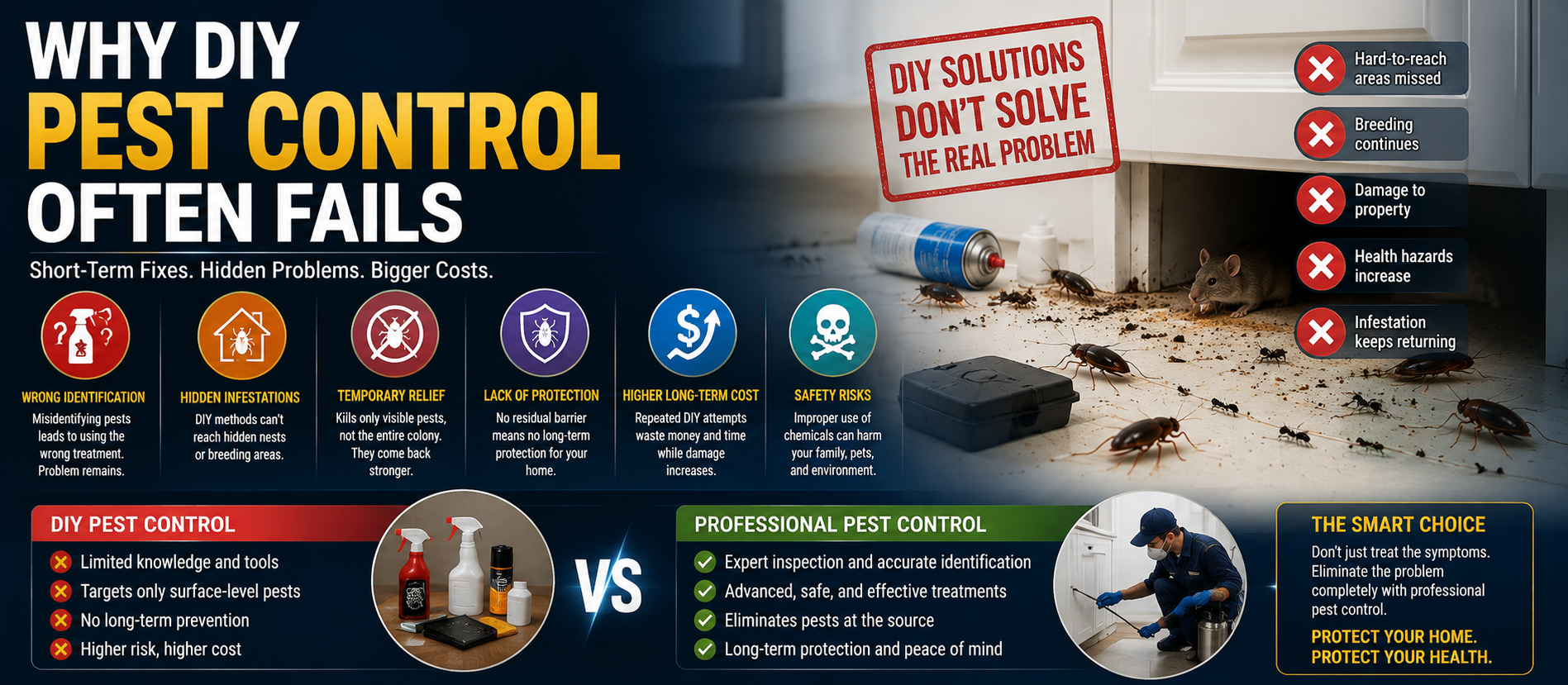
Why DIY Pest Control Often Fails
1. Homeowners May Misidentify the Pest
2. Visible Pests Are Often Only Part of the Problem
3. DIY Products May Not Match the Infestation
4. Incorrect Application Can Reduce Effectiveness
5. DIY Treatments Often Ignore Pest Entry Points
6. Food and Water Sources May Remain Available
7. Hidden Nesting and Breeding Areas Are Difficult to Find
8. DIY Pest Control Can Be Too Reactive
9. Recurring Infestations Need Root-Cause Analysis
10. Some Pests Require Specialized Knowledge
Discovering ants in the kitchen, cockroaches in a bathroom, termites near wooden structures, rodents in a garage, or other unwanted pests inside a property can be frustrating. The first reaction for many homeowners and small businesses is to purchase an over-the-counter product and attempt to solve the problem themselves. DIY pest control can sometimes help with minor, isolated issues, but it often fails when the infestation is established, hidden, recurring, or caused by conditions that have not been addressed.
Professional pest control companies approach the problem differently. They typically begin by identifying the pest, inspecting the property, determining contributing conditions, and developing a treatment and monitoring plan appropriate for the situation. Depending on the pest and location, professional services may combine sanitation advice, exclusion, habitat modification, traps, targeted treatments, monitoring, and follow-up visits.
This WordPress-ready HTML article is prepared for Digiifrog (www.digiifrog.com) with a strong focus on SEO, AEO, GEO, and AI Search optimization.
What Is DIY Pest Control?
DIY pest control refers to pest-management activities performed by homeowners, property managers, or business owners without hiring a professional pest-control provider. Common DIY approaches include traps, baits, commercially available insecticides, sanitation, sealing gaps, removing standing water, and other basic preventive measures.
Some DIY measures are useful for prevention and for limited pest activity. The problem occurs when a person assumes that treating visible pests automatically eliminates the underlying infestation.
- Spraying visible insects
- Using consumer traps
- Placing commercially available baits
- Cleaning food and waste areas
- Sealing obvious gaps
- Removing standing water
- Improving storage and sanitation
Why DIY Pest Control Often Fails
The most common reason DIY pest control fails is that the visible pest is only a symptom of a larger problem. A few ants may indicate a nearby colony. Repeated cockroach sightings may indicate hidden harborages. Rodent activity can point to an entry route that remains open. Termite evidence may indicate activity that requires a professional inspection.
Effective pest management usually requires understanding the entire situation rather than repeatedly treating the most visible symptom.
1. Homeowners May Misidentify the Pest
Different pests can look similar, especially when they are seen briefly or at a distance. Correct identification matters because different pests have different behaviors, nesting locations, food sources, and management requirements.
A product designed for one type of pest may be ineffective or inappropriate for another. Misidentification can therefore waste time and money while allowing the underlying problem to continue.
2. Visible Pests Are Often Only Part of the Problem
Many pests spend much of their time in hidden locations. Ant colonies may extend beyond the visible area. Cockroaches can hide in cracks, wall voids, appliances, and other protected spaces. Rodents can move through concealed areas of a structure.
Treating only the pests that are visible may provide temporary improvement without addressing the source.
3. DIY Products May Not Match the Infestation
Retail pest-control products are designed for consumer use, but selecting an appropriate product still requires understanding the pest, application area, label directions, and environmental conditions.
Using the wrong product can produce disappointing results and may create unnecessary exposure risks. Consumers should always follow the product label and applicable local requirements.
4. Incorrect Application Can Reduce Effectiveness
Even when a product is appropriate, improper application can reduce its effectiveness. Applying too little may fail to affect the target pest, while applying excessive amounts can create unnecessary risks without guaranteeing better results.
💡 Key Insight
Product labels provide important instructions about where, how, and how often a product may be used. Those directions should be followed carefully.
5. DIY Treatments Often Ignore Pest Entry Points
Pest management is not only about killing pests that are already inside. If pests can continue entering a property, the problem may return.
Common entry opportunities can include gaps around doors and windows, cracks in walls, openings around utility lines, damaged screens, roof or foundation openings, and other structural weaknesses.
Sealing appropriate entry points can be an important part of prevention.
6. Food and Water Sources May Remain Available
Pests are attracted to resources that help them survive. Food crumbs, uncovered waste, pet food, leaking plumbing, condensation, standing water, and poorly stored materials can contribute to pest activity.
If these conditions remain unchanged, treating the pests alone may not provide a lasting solution.
7. Hidden Nesting and Breeding Areas Are Difficult to Find
Some infestations persist because breeding or nesting areas are located in places that are difficult for homeowners to inspect. These can include wall voids, crawl spaces, attics, basements, utility areas, or inaccessible structural locations.
Professional inspections can help identify patterns and conditions that are easy to overlook during a quick visual check.
8. DIY Pest Control Can Be Too Reactive
Many homeowners only take action after seeing a pest. Effective pest management often works better as a combination of prevention, monitoring, and targeted response.
Regular inspection and preventive maintenance can help identify problems earlier and reduce the likelihood of a larger infestation.
9. Recurring Infestations Need Root-Cause Analysis
If pests repeatedly return after treatment, the key question should be why they are returning. Possible contributing factors include untreated harborages, structural entry points, moisture, food availability, neighboring infestations, or an incorrect treatment approach.
Repeating the same DIY treatment without investigating the cause can lead to repeated expense without solving the problem.
10. Some Pests Require Specialized Knowledge
Certain pest problems are particularly difficult to manage without professional experience. Termites, bed bugs, extensive rodent infestations, stinging insects in difficult locations, and persistent cockroach infestations may require specialized inspection and treatment strategies.
Professional pest technicians can evaluate the situation and recommend an approach based on the pest and property.
11. Termite Problems Can Be Especially Difficult to Detect
Termites can damage wood and other structural components while remaining difficult to observe directly. Visible signs may include damaged wood, discarded wings, mud tubes, or other indicators, but the absence of obvious signs does not necessarily prove that no activity exists.
Because termite management can involve structural considerations, homeowners who suspect termites should consider a professional inspection rather than relying only on surface treatment.
12. Bed Bugs Can Survive Poorly Planned Treatments
Bed bugs can hide in seams, cracks, furniture, bed frames, and other protected locations. They can also be difficult to eliminate with a single casual treatment.
Successful management may require detailed inspection, preparation, carefully selected treatments, monitoring, and follow-up. Repeatedly applying consumer products without a plan may not eliminate the infestation.
13. Rodents Require More Than Traps
Traps can catch individual rodents, but trapping alone may not solve the problem if additional animals can enter the structure.
Effective rodent management generally includes identifying entry points, reducing attractants, improving sanitation, using appropriate control measures, and monitoring for continued activity.
14. Cockroach Infestations Can Be Persistent
Cockroaches can hide in protected areas and reproduce quickly under favorable conditions. Seeing one or two cockroaches may therefore warrant closer inspection, particularly if sightings continue.
Sanitation, moisture management, exclusion, monitoring, and appropriately selected control measures can all play a role in managing cockroach activity.
15. Ant Control Is More Than Spraying Individual Ants
Spraying ants that are visible may provide temporary relief, but it may not address the colony. Depending on the species and circumstances, effective management can involve locating activity patterns, reducing food and moisture sources, sealing entry points, and using appropriate baiting or other control methods.
16. DIY Pest Control Can Waste Money
Repeated purchases of sprays, traps, baits, and other products can become expensive when the underlying problem is not resolved. A homeowner may spend money on several approaches and eventually still need professional service.
The total cost should therefore include not only product prices but also time, repeated applications, property disruption, and potential repair costs if the infestation causes damage.
17. Delayed Treatment Can Allow Infestations to Grow
Some pest populations can increase significantly when conditions are favorable. Delaying professional evaluation because a DIY treatment appears to provide temporary relief can allow the problem to become more difficult to manage.
Early action is particularly important when there is repeated activity, property damage, or evidence of nesting or breeding.
18. Pest Damage Can Continue Even When Pests Are Not Visible
Some pests cause damage in hidden areas. Termites can affect wood, rodents can damage insulation and wiring, and moisture-loving pests can indicate conditions that may also contribute to property deterioration.
When there are signs of structural damage or repeated pest activity, professional inspection can help determine the scope of the issue.
19. Professional Pest Control Starts With Inspection
A professional approach generally begins with inspection and identification. Technicians may examine interior and exterior areas, look for pest evidence, identify entry points, assess environmental conditions, and determine where activity is concentrated.
This diagnostic step helps make treatment more targeted instead of relying on guesswork.
20. Integrated Pest Management Is More Comprehensive
Integrated Pest Management (IPM) is an approach that combines monitoring, prevention, exclusion, sanitation, habitat modification, and appropriate control methods. The goal is to manage pests effectively while using interventions thoughtfully.
Depending on the situation, an IPM strategy may include:
- Inspection
- Pest identification
- Monitoring
- Sanitation improvements
- Moisture management
- Structural exclusion
- Trapping or baiting where appropriate
- Targeted treatment
- Follow-up inspections
21. Professional Services Can Provide Follow-Up Monitoring
One-time treatment does not always mean that the problem is permanently resolved. Follow-up visits or monitoring can help determine whether pest activity has decreased and whether additional measures are necessary.
Monitoring is especially valuable for recurring or difficult infestations.
22. Professional Pest Control Can Be More Targeted
Professionals can use inspection findings to focus attention on specific areas rather than treating an entire property unnecessarily. Targeted approaches can help make pest management more efficient.
The appropriate treatment depends on the pest, property, infestation level, local requirements, and product labels.
23. Safety Is an Important Consideration
Pest-control products can have safety considerations. Incorrect use, storage, mixing, or application can create unnecessary risks to people, pets, property, and the environment.
⚠ Watch Out
Professional technicians are trained to follow product labels and relevant safety procedures. Homeowners should never mix pesticides unless the label specifically permits it and should keep products away from children and pets as directed.
24. Professional Pest Companies Understand Local Pest Patterns
Pest activity varies by climate, geography, building type, season, and local environmental conditions. Local pest professionals may have practical experience with species and infestation patterns common in their service area.
This local knowledge can support more relevant inspections and preventive recommendations.
25. Preventive Pest Control Can Reduce Future Problems
Professional pest management can include preventive recommendations such as sealing gaps, improving drainage, reducing clutter, managing waste, correcting leaks, trimming vegetation near structures, and maintaining screens and doors.
Prevention is often more efficient than repeatedly responding to established infestations.
26. When DIY Pest Control May Be Reasonable
DIY measures are not always inappropriate. Minor, isolated pest activity can sometimes be managed through basic sanitation, exclusion, traps, or properly labeled consumer products.
DIY approaches may be reasonable when:
- The pest is correctly identified.
- The activity is limited.
- There is no evidence of structural damage.
- The homeowner can safely follow product instructions.
- The problem is monitored after the intervention.
If activity persists, increases, or involves a difficult-to-identify pest, professional evaluation becomes more appropriate.
27. Signs You Should Call a Professional Pest Control Company
- Repeated pest sightings
- Evidence of nesting or breeding
- Property or structural damage
- Rodent droppings or repeated activity
- Possible termite evidence
- Persistent bed bug signs
- Large or rapidly increasing infestations
- Pests returning after DIY treatment
- Uncertainty about pest identification
- Safety concerns involving pest-control products
28. How to Choose a Reliable Pest Control Company
Check Experience
Ask whether the company regularly handles the type of pest affecting your property.
Confirm Licensing and Insurance
Requirements vary by location and service. Verify that the provider has the credentials and insurance required in your area.
Ask About the Inspection
A reputable provider should be able to explain how the pest will be identified and how the property will be assessed.
Understand the Treatment Plan
Ask what methods are proposed, what preparation is required, and what follow-up is included.
Review Pricing
Request a clear explanation of service fees, follow-up visits, guarantees, and any additional charges.
29. Questions to Ask Before Hiring a Pest Control Company
- What pest do you believe is present?
- How will you inspect the property?
- What treatment approach do you recommend?
- Will you identify and address entry points?
- Are follow-up visits included?
- What preparation is required?
- What safety precautions should occupants follow?
- Are children and pets affected by the treatment requirements?
- Do you provide a written service plan?
- Are you licensed and insured where required?
- How do you monitor results?
30. Common DIY Pest Control Mistakes
Using Too Much Product
More product does not necessarily mean better results. Follow the product label exactly.
Treating Only Visible Pests
Visible pests may not represent the entire infestation.
Ignoring Moisture and Food Sources
Environmental conditions can continue attracting pests.
Failing to Seal Entry Points
New pests may continue entering the structure if openings remain.
Stopping After One Treatment
Some infestations require monitoring and repeated management steps.
31. Technology Is Changing Professional Pest Control
Modern pest-control companies increasingly use digital scheduling, customer management systems, inspection software, service reports, mapping tools, monitoring devices, and data analytics.
Technology can help technicians document findings, track service history, communicate recommendations, and identify recurring patterns.
32. Smart Pest Monitoring
Connected monitoring devices can provide information about pest activity in suitable commercial and residential applications. These systems may help identify activity earlier and allow service teams to respond based on monitoring data.
Smart monitoring is particularly useful when continuous observation is more practical than frequent manual inspection.
33. AI and Pest Management
Artificial intelligence can support pest-control businesses through image-assisted identification, service scheduling, customer communication, route planning, predictive analytics, and digital reporting.
AI-based identification should be treated as decision support rather than an unquestionable diagnosis. Professional inspection remains important when pest identification or treatment decisions have significant consequences.
34. Professional Pest Control and Property Value
Regular property maintenance can help preserve the condition and appearance of a building. Pest prevention is one component of broader property maintenance.
Addressing pest issues early may reduce the risk of damage becoming more extensive, although outcomes vary depending on the pest and property.
35. Pest Control for Businesses
Businesses have additional reasons to maintain effective pest management. Customers may react negatively to visible pests, and certain industries have strict sanitation or regulatory expectations.
Restaurants, food facilities, hotels, warehouses, healthcare environments, retail stores, offices, and property-management companies may require structured pest-management programs appropriate to their operations.
36. Pest Control for Restaurants and Food Businesses
Food businesses can be particularly attractive to pests because of food, moisture, waste, and storage conditions. A professional pest-management program can combine monitoring, sanitation recommendations, exclusion, documentation, and appropriate control methods.
Businesses should maintain cleaning and food-storage practices in addition to pest-control services.
37. SEO, AEO, GEO and AI Search for Pest Control Companies
Professional pest-control companies also need strong digital visibility. SEO helps pest-control businesses appear in traditional search results. AEO focuses on answering customer questions directly. GEO helps content become useful for generative search experiences, while AI Search optimization emphasizes structured, trustworthy, location-relevant information.
A pest-control website should clearly explain pest types, inspection services, treatment approaches, service areas, prevention advice, safety information, pricing factors, and frequently asked questions.
38. Future Trends in Pest Control Services
The pest-control industry is becoming increasingly data-driven. Smart monitoring, digital inspections, AI-assisted identification, automated scheduling, environmentally conscious products, and integrated pest-management strategies are likely to become more common.
These technologies can help pest-control companies improve service efficiency while maintaining the importance of trained technicians and property-specific assessment.
39. Key Pest Control Trends for 2026
- Integrated Pest Management
- Smart pest monitoring
- Digital inspection reports
- AI-assisted pest identification
- Data-driven service scheduling
- Preventive pest programs
- Environmentally responsible treatment options
- Targeted pest management
- Customer service automation
- Remote monitoring for selected applications
Frequently Asked Questions About DIY Pest Control
Why does DIY pest control often fail?
DIY pest control often fails because the pest may be misidentified, hidden nesting areas may be missed, entry points may remain open, food or moisture sources may continue attracting pests, and the treatment may not address the underlying infestation.
Is DIY pest control always ineffective?
No. Basic prevention, sanitation, exclusion, traps, and properly labeled consumer products can sometimes help with minor pest problems. More persistent or complex infestations may require professional assessment.
When should I call a professional pest control company?
Consider professional help when pests keep returning, the infestation is increasing, there is possible structural damage, the pest is difficult to identify, or DIY methods have not resolved the problem.
Why is pest identification important?
Different pests have different behaviors and management requirements. Correct identification helps determine an appropriate prevention and control strategy.
Can professional pest control prevent future infestations?
Professional services can include preventive recommendations such as exclusion, sanitation, moisture management, monitoring, and recurring inspections. No pest-control program can guarantee that pests will never return.
What is Integrated Pest Management?
Integrated Pest Management is a comprehensive approach that combines monitoring, prevention, sanitation, exclusion, habitat modification, and appropriate pest-control methods.
Is professional pest control safer than DIY treatment?
Professional technicians receive training and follow applicable product labels and safety procedures. However, every pest-control treatment has specific requirements, so customers should follow all preparation and re-entry instructions provided by the service provider.
Conclusion
DIY pest control often fails because treating visible pests is not the same as solving an infestation. Pest problems can involve hidden nesting areas, entry points, food and moisture sources, recurring breeding, structural conditions, and incorrect identification. Repeatedly applying consumer products without understanding the underlying cause can waste time and money.
Professional pest control takes a more comprehensive approach by combining inspection, identification, monitoring, prevention, exclusion, sanitation recommendations, and appropriate treatment. For difficult or recurring infestations, this structured process can provide a clearer path toward long-term pest management.
Homeowners can still play an important role through prevention. Keeping food sealed, reducing moisture, managing waste, removing standing water, maintaining screens, sealing appropriate openings, and keeping properties clean can reduce conditions that attract pests.
The best strategy is therefore not always DIY versus professional service. Minor problems may respond to sensible preventive measures, while persistent, complex, or potentially damaging infestations deserve professional evaluation. The right response depends on the pest, property, severity, and safety considerations.
For businesses looking to improve their digital presence, automate customer inquiries, build AI-powered websites, implement SEO, AEO, GEO, AI Search optimization, and develop modern technology solutions for home-service businesses, Digiifrog can help. Visit www.digiifrog.com to learn more.
Quick Answer: Why Does DIY Pest Control Often Fail?
DIY pest control often fails because visible pests may only be a symptom, infestations can be hidden, pests may be misidentified, entry points and food sources may remain, treatments may be applied incorrectly, and recurring problems may require inspection and follow-up. For minor problems, prevention and properly labeled consumer products may help, but persistent or complex infestations often benefit from professional pest inspection and integrated pest-management strategies.
Ready to Grow?
Talk to us about a strategy tailored to your brand — we will help you stand out in search, AI discovery and social.
Comments (0)
Log in to leave a comment.