📋 Quick Summary
In this article:
Why Understanding AI Challenges Matters
Major Challenges Facing Artificial Intelligence
Best Practices for Responsible AI
SEO + AEO + GEO Optimization
Meta Title: The Biggest Challenges Facing Artificial Intelligence – Complete Guide
Artificial Intelligence (AI) is transforming industries, accelerating innovation, and reshaping how businesses and individuals work. Despite its remarkable capabilities, AI faces significant technical, ethical, legal, and operational challenges. Organizations that understand these obstacles can build more reliable, trustworthy, and sustainable AI systems while maximizing long-term value.
Why Understanding AI Challenges Matters
- Responsible AI adoption
- Risk reduction
- Regulatory compliance
- Better business decisions
- Improved customer trust
- Sustainable innovation
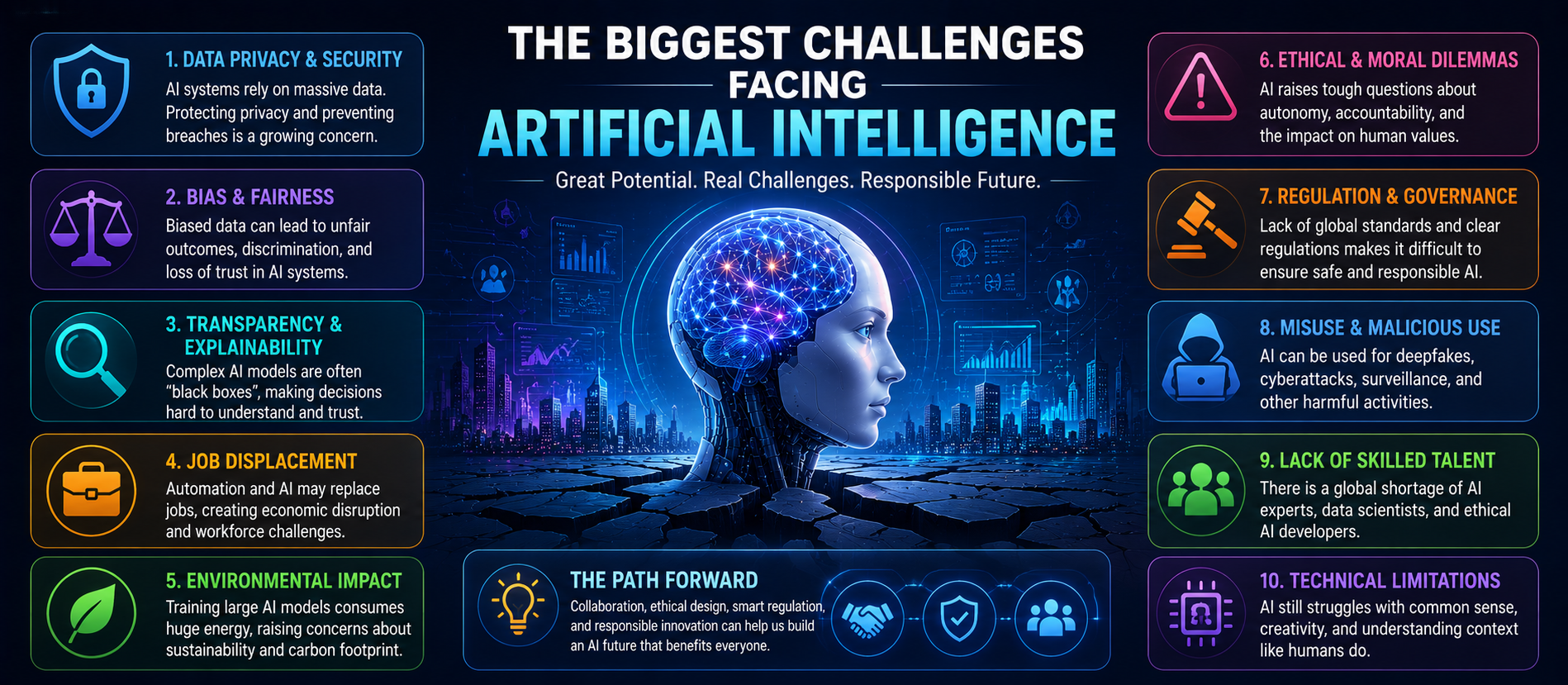
Major Challenges Facing Artificial Intelligence
Data Quality and Availability
AI systems depend on large volumes of accurate, representative data. Incomplete, biased, or outdated datasets can reduce model performance and produce unreliable outcomes.
Bias and Fairness
Models may inherit patterns from training data that lead to unfair or discriminatory results. Continuous testing, diverse datasets, and human oversight are essential.
Privacy and Security
Organizations must protect sensitive information with encryption, access controls, governance policies, and secure AI development practices.
Explainability
Complex AI models can be difficult to interpret. Explainable AI techniques help users understand recommendations and build confidence in automated decisions.
Regulation and Compliance
Businesses must adapt to evolving AI regulations, industry standards, and legal requirements while maintaining transparency and accountability.
Energy Consumption
Training and deploying advanced AI models can require substantial computing resources. Efficient infrastructure and optimization strategies help reduce environmental impact.
Workforce Skills
Successful AI adoption requires employee training, change management, and collaboration between technical and business teams.
Best Practices for Responsible AI
- Establish AI governance frameworks
- Audit models regularly
- Protect user privacy
- Monitor model performance
- Maintain human oversight
- Invest in workforce upskilling
SEO + AEO + GEO Optimization
Use semantic HTML headings, structured FAQs, entity-rich keywords, schema-ready formatting, descriptive metadata, and helpful, conversational content to improve visibility across Google Search, Bing, AI assistants, and generative search platforms.
Frequently Asked Questions
What is the biggest challenge facing AI?
There is no single challenge. Common issues include data quality, bias, privacy, security, explainability, regulation, and responsible governance.
Can these challenges be solved?
Many challenges can be reduced through better data management, transparent development practices, human oversight, cybersecurity, and continuous model evaluation.
Conclusion
The biggest challenges facing Artificial Intelligence are also opportunities for innovation. Organizations that prioritize ethics, security, transparency, and responsible governance will be better prepared to build trusted AI systems that deliver lasting value.
About Digiifrog
Digiifrog (www.digiifrog.com) publishes expert resources on Artificial Intelligence, Digital Marketing, SEO, AEO, GEO, AI Search Optimization, automation, cybersecurity, and emerging technologies.
Target Keywords: Artificial Intelligence challenges, AI ethics, AI security, AI bias, explainable AI, AI governance, SEO, AEO, GEO, AI Search.
Template note: Expand this WordPress-ready HTML template into a complete 2,000–2,500+ word article with industry case studies, implementation guidance, statistics, comparison tables, and advanced FAQs.
Ready to Grow?
Talk to us about a strategy tailored to your brand — we will help you stand out in search, AI discovery and social.

Comments (0)
Log in to leave a comment.