📋 Quick Summary
In this article:
What Is Biometric Authentication?
1. Why Biometrics Are Becoming More Important
2. Biometrics and Passkeys
3. Privacy-Preserving Authentication
4. More Accurate Facial Recognition
5. Liveness Detection and Presentation-Attack Resistance
6. Multimodal Biometrics
7. Behavioral Biometrics
8. Continuous and Risk-Based Authentication
12. The Biggest Security Challenge: Biometric Data Is Sensitive
13. Deepfakes and Synthetic Identity Threats
14. Biometrics Will Not Eliminate All Authentication Risks
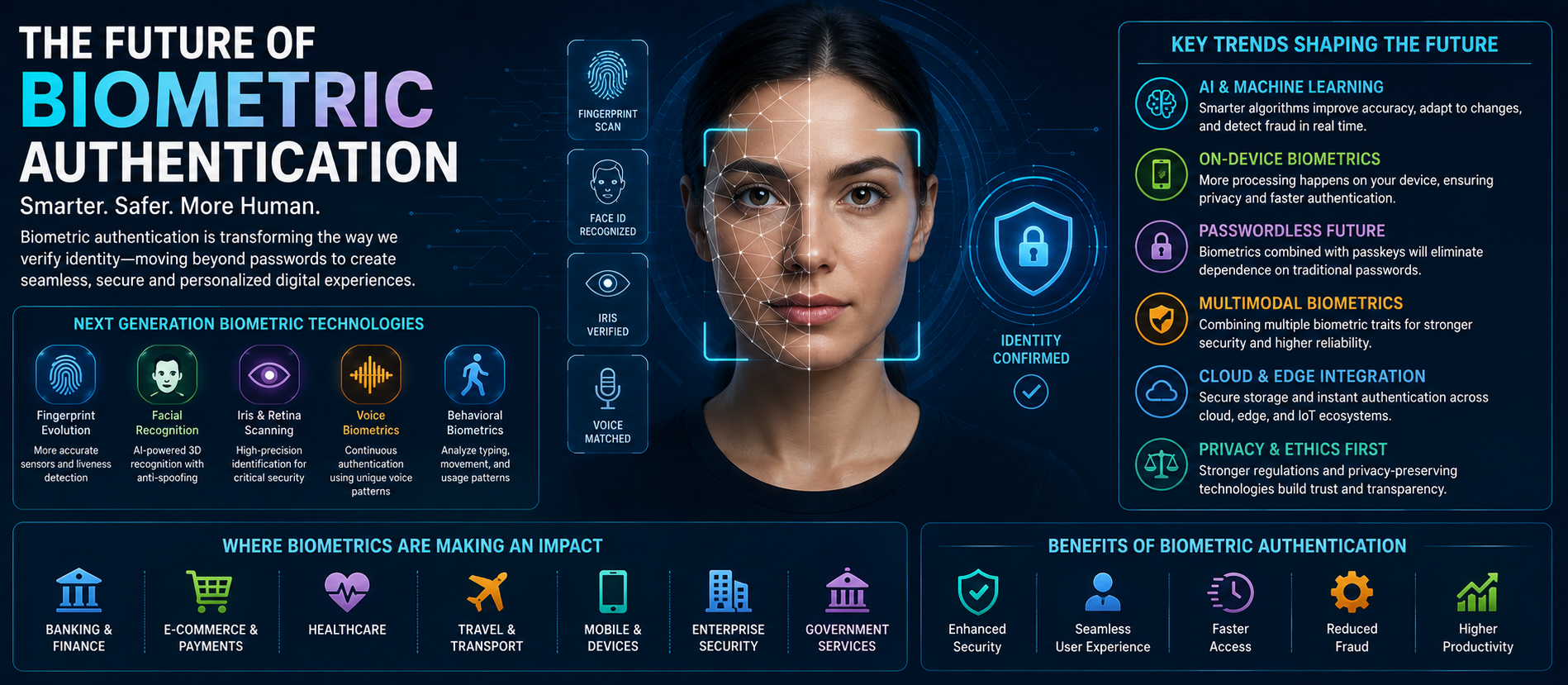
The future of biometric authentication is moving toward faster, more convenient, and increasingly privacy-conscious digital identity experiences. Fingerprints, facial recognition, iris recognition, voice recognition, and other biometric technologies are already used to unlock devices, approve transactions, access workplaces, and support identity verification.
Biometric authentication is also becoming closely connected with passwordless authentication and passkeys. FIDO standards allow users to approve a passkey sign-in using a device biometric, PIN, or pattern, while the cryptographic credential is used by the service. FIDO states that biometric information used with passkeys remains on the user's device rather than being sent to a remote server. citeturn0search0turn0search11
NIST's current Digital Identity Guidelines, SP 800-63-4, published in July 2025, provide updated guidance covering identity proofing, authentication, authenticators, federation, and related digital identity processes. citeturn0search1turn0search4
This WordPress-ready HTML article is prepared for Digiifrog (www.digiifrog.com) with SEO, AEO, GEO, and AI Search optimization.
What Is Biometric Authentication?
Biometric authentication verifies a person's identity using measurable biological or behavioral characteristics. Common examples include fingerprints, facial characteristics, iris patterns, voice characteristics, and behavioral signals.
Authentication asks whether a person attempting to access an account is the legitimate user associated with an identity or credential. This is different from identity proofing, which establishes or validates an identity during enrollment. NIST's SP 800-63-4 separates identity proofing, authentication, and federation into related but distinct areas. citeturn0search4turn0search5
1. Why Biometrics Are Becoming More Important
Passwords remain difficult to manage because people forget them, reuse them, choose weak credentials, or enter them into phishing pages. Biometrics can make authentication easier because users can verify themselves through a familiar device interaction.
💡 Key Insight
The most important future trend is not simply replacing every password with a fingerprint. It is combining biometrics with strong cryptographic authentication, device security, risk-based controls, and privacy protections.
2. Biometrics and Passkeys
Passkeys represent an important direction for biometric authentication. A passkey is a FIDO credential based on public-key cryptography. The user may unlock or approve the credential using a biometric, PIN, or device authentication method.
FIDO explains that passkeys are tied to an online service and designed to provide phishing-resistant authentication. The biometric itself is processed locally on the device; the service receives the result needed to complete authentication rather than the user's biometric image. citeturn0search0turn0search11
3. Privacy-Preserving Authentication
One of the biggest future developments will be reducing the need to centralize raw biometric information. Unlike passwords, biometric characteristics cannot simply be replaced if compromised. This makes secure storage and processing particularly important.
Device-local biometric processing combined with cryptographic credentials can reduce the need for organizations to maintain large centralized biometric databases. However, privacy depends on the complete system design, including enrollment, device security, recovery, data handling, and vendor practices.
4. More Accurate Facial Recognition
Facial recognition systems are likely to continue improving through better sensors, algorithms, liveness detection, and presentation-attack defenses. These improvements can help reduce false matches and unauthorized attempts.
However, accuracy should not be treated as the only measurement. Organizations should also evaluate demographic performance, accessibility, privacy, transparency, spoof resistance, and the consequences of false acceptance or false rejection.
5. Liveness Detection and Presentation-Attack Resistance
Attackers may attempt to fool biometric systems with photographs, recordings, masks, replicas, or other presentation techniques. Future biometric systems will increasingly use presentation attack detection (PAD), sensor capabilities, device security, and multiple signals to determine whether a biometric sample comes from a genuine user.
NIST's authentication guidance includes technical requirements around biometric use and presentation-attack resistance. Organizations should evaluate biometric systems against the threat model of the intended environment rather than relying on marketing claims. citeturn0search37turn0search1
6. Multimodal Biometrics
Future systems may combine more than one biometric signal, such as face and voice, or face and behavioral characteristics. Multimodal authentication can improve reliability in situations where one biometric is unavailable or produces an uncertain result.
However, collecting more biometric information can also increase privacy and security risks. The goal should be appropriate assurance with minimum necessary data, not maximum data collection.
7. Behavioral Biometrics
Behavioral biometrics analyze patterns such as typing rhythm, mouse movement, device interaction, walking patterns, or other behavioral characteristics. These signals can support continuous or risk-based authentication without requiring a user to repeatedly stop and provide a fingerprint or face scan.
Behavioral signals can be useful as an additional security layer, but they may change because of injury, stress, accessibility needs, device differences, or environmental factors. Systems should therefore include appropriate fallback mechanisms.
8. Continuous and Risk-Based Authentication
Future authentication is likely to become more adaptive. Instead of treating every login as identical, systems can evaluate device security, location, session behavior, account activity, and authentication strength.
A low-risk action may require minimal friction, while an unusual transaction or privileged administrative action may require stronger verification. This approach can improve both security and user experience when implemented carefully.
12. The Biggest Security Challenge: Biometric Data Is Sensitive
A compromised password can be replaced. A person's face or fingerprint cannot be changed in the same way. This makes biometric data protection a central issue for the future.
Organizations should minimize collection, protect templates, restrict access, encrypt sensitive information where appropriate, monitor systems, evaluate vendors, and establish clear deletion and retention policies.
13. Deepfakes and Synthetic Identity Threats
AI-generated images, video, and voice can create new challenges for biometric systems. An attacker may attempt to imitate a person's face or voice during identity verification or social-engineering attacks.
Future systems will therefore need stronger liveness detection, secure devices, cryptographic credentials, anti-spoofing techniques, transaction monitoring, and multiple independent signals.
14. Biometrics Will Not Eliminate All Authentication Risks
Biometrics solve some problems but introduce others. A stolen biometric template, compromised device, weak recovery process, or poor enrollment workflow can undermine an advanced system.
The strongest approach is layered authentication using secure devices, cryptographic credentials, biometrics, recovery controls, least privilege, and monitoring.
15. Accessibility and User Choice
Not every user can or wants to use a particular biometric method. Facial recognition may be difficult in certain environments, fingerprints may be unavailable for some users, and voice recognition may be affected by noise or speech differences.
⚠ Watch Out
Future systems should provide secure alternative authentication methods and avoid making accessibility an afterthought. Good authentication should be secure without unnecessarily excluding users.
17. The Role of FIDO and Passwordless Authentication
FIDO standards are likely to remain important in the future of authentication because they combine public-key cryptography with convenient local user verification. FIDO2 uses WebAuthn and CTAP, while passkeys provide a consumer-friendly way to use these capabilities. citeturn0search11
This model changes the security problem from protecting reusable passwords to protecting cryptographic credentials and the devices that authorize them. It can substantially reduce phishing and credential-reuse risks.
18. The Future: Biometrics as a Local Unlock Mechanism
A likely long-term model is for biometrics to remain a local user-verification mechanism rather than a universal identifier stored in centralized databases. The device verifies the biometric and authorizes a cryptographic credential, while the remote service verifies the cryptographic proof.
SEO, AEO, GEO and AI Search Optimization
SEO content about biometric authentication should target searches such as “future of biometric authentication,” “biometric authentication trends,” “biometric security,” “passwordless authentication,” “facial recognition authentication,” and “passkeys and biometrics.”
AEO should directly answer questions such as “What is the future of biometric authentication?”, “Are biometric authentication systems secure?”, and “How do passkeys use biometrics?”
GEO and AI Search optimization can be strengthened with clear definitions, current NIST and FIDO guidance, structured headings, practical examples, concise answers, privacy considerations, and FAQs.
Frequently Asked Questions About the Future of Biometric Authentication
What is the future of biometric authentication?
The future is likely to combine biometrics with phishing-resistant cryptographic authentication, passkeys, secure devices, risk-based controls, liveness detection, and privacy-preserving architectures.
Are biometric authentication systems secure?
They can provide strong authentication when properly designed, but security depends on enrollment, sensors, spoof resistance, device security, credential protection, recovery processes, and privacy controls.
Will biometrics replace passwords?
Biometrics are increasingly used to unlock or authorize passwordless credentials such as passkeys. The broader trend is toward replacing reusable passwords with cryptographic credentials, with biometrics serving as a convenient local verification method. citeturn0search0turn0search13
Is biometric data stored on a server?
It depends on the system. In passkey-based authentication, FIDO states that biometric processing remains on the user's device and the biometric itself is not sent to the remote service. Other biometric systems may use centralized or distributed templates, so their architecture and privacy practices must be evaluated separately. citeturn0search0
What are the biggest risks of biometrics?
Major concerns include privacy, biometric-data compromise, spoofing, deepfakes, inaccurate matching, accessibility, weak recovery procedures, excessive data collection, and insecure vendors or centralized storage.
Conclusion
The future of biometric authentication is not simply about better fingerprint scanners or facial-recognition cameras. It is about creating secure digital identity systems that combine biometrics, cryptography, secure devices, privacy, usability, and adaptive risk controls.
Passkeys and FIDO authentication demonstrate how biometrics can become a local verification step for cryptographic credentials rather than a secret that must be transmitted to every website. NIST's updated 2025 Digital Identity Guidelines also show the growing importance of modern authentication, identity proofing, authenticator management, and federation. citeturn0search0turn0search1turn0search14
For organizations, the best future strategy is not to adopt biometrics simply because they are popular. Instead, evaluate the business problem, required assurance level, privacy impact, accessibility needs, attack model, recovery process, and technology architecture before deployment.
For businesses seeking modern websites, cybersecurity content, automation, SEO, AEO, GEO, and AI Search optimization, Digiifrog can help. Visit www.digiifrog.com.
Quick Answer: What Is the Future of Biometric Authentication?
The future of biometric authentication will increasingly combine fingerprints, facial recognition, and other biometrics with passkeys, public-key cryptography, secure devices, liveness detection, risk-based authentication, and privacy-preserving design. Biometrics are likely to function primarily as a local way to unlock or authorize secure credentials rather than as passwords that are transmitted to remote servers.
Important Note
This article is general educational content, not legal, privacy, identity-assurance, or cybersecurity advice. Biometric deployments should be evaluated according to the organization's threat model, applicable regulations, accessibility requirements, data-handling practices, and technical architecture.
Ready to Grow?
Talk to us about a strategy tailored to your brand — we will help you stand out in search, AI discovery and social.

Comments (0)
Log in to leave a comment.