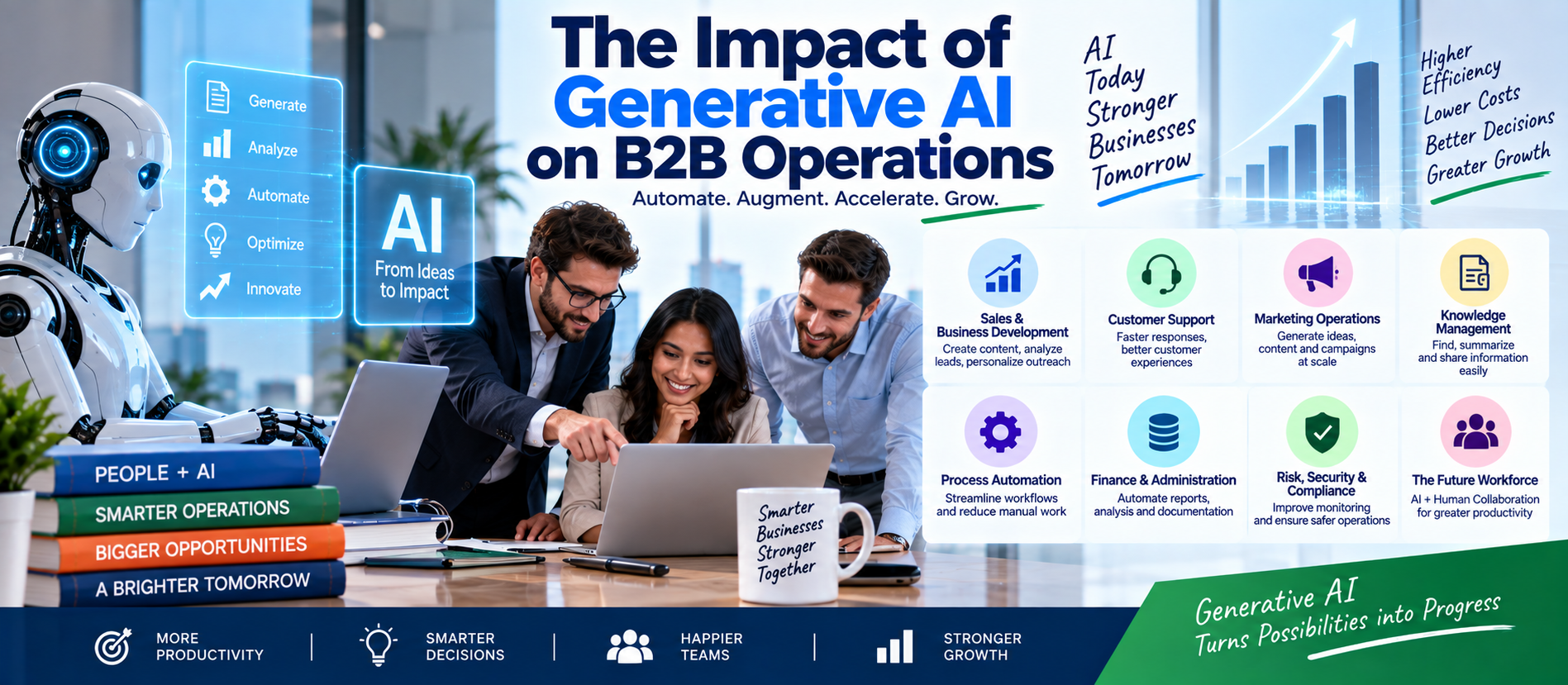
📋 Quick Summary
In this article:
Quick Answer: How Is Generative AI Transforming B2B Operations?
Why Generative AI Matters for B2B Businesses
1. Generative AI in B2B Sales Operations
2. Transforming Customer Support Operations
3. Generative AI for Marketing Operations
4. Knowledge Management and Enterprise Search
5. Improving Business Process Automation
6. Generative AI in Finance and Administrative Operations
7. AI-Assisted Procurement Operations
Generative AI is changing how B2B companies manage operations, serve customers, support employees, analyze information, and automate business workflows. Unlike traditional software that follows fixed rules, generative AI can create and summarize content, answer questions, organize information, and assist employees with complex tasks.
For B2B organizations, the biggest opportunity is not simply using AI to generate text. The real value comes from integrating generative AI into everyday operations. Businesses can use it to improve sales processes, customer support, marketing, knowledge management, finance, and internal workflows.
This guide explains the impact of generative AI on B2B operations, the main use cases, benefits, risks, and practical steps for successful adoption.
Quick Answer: How Is Generative AI Transforming B2B Operations?
Generative AI transforms B2B operations by helping teams automate repetitive work, analyze information faster, create business content, improve customer interactions, and support better decision-making.
Its greatest value usually comes when AI works alongside employees and existing business systems instead of operating as an isolated tool.
What Is Generative AI?
Generative AI refers to artificial intelligence systems that can create new outputs based on patterns learned from large amounts of information.
Depending on the system and use case, generative AI can produce:
- Written content.
- Summaries.
- Business reports.
- Software code.
- Images and visual concepts.
- Answers to questions.
- Structured information.
In B2B environments, generative AI is increasingly used as an assistant that helps employees complete work more efficiently.
Why Generative AI Matters for B2B Businesses
B2B operations often involve large amounts of information and repetitive processes. Teams manage customer data, proposals, contracts, product documentation, reports, support requests, and internal communication.
Generative AI can help reduce the time required to work with this information.
Common business goals include:
- Improving employee productivity.
- Reducing repetitive work.
- Speeding up information access.
- Improving customer response times.
- Supporting sales teams.
- Automating business workflows.
Generative AI does not automatically improve every process. Businesses need to select practical use cases and maintain appropriate human oversight.
1. Generative AI in B2B Sales Operations
Sales teams spend significant time researching prospects, preparing outreach, updating CRM records, and creating proposals.
Generative AI can support sales operations by helping with:
- Prospect research summaries.
- Personalized outreach drafts.
- Meeting summaries.
- Proposal preparation.
- Sales call analysis.
- CRM note generation.
This can reduce administrative work and give sales professionals more time to focus on customer relationships.
Important Consideration
AI-generated sales content should be reviewed before it is sent to prospects. Businesses should avoid inaccurate claims, generic messaging, or exposing confidential customer information.
2. Transforming Customer Support Operations
Customer support teams need fast access to accurate information.
Generative AI can assist support operations through:
- AI-powered knowledge search.
- Draft response suggestions.
- Support ticket summaries.
- Request classification.
- Self-service assistance.
- Agent support tools.
💡 Key Insight
An AI system can help an employee find relevant information quickly. However, human review remains important when responses involve sensitive issues, contracts, financial matters, or high-impact decisions.
3. Generative AI for Marketing Operations
B2B marketing teams create a large amount of content.
Generative AI can help create first drafts for:
- Blog articles.
- Email campaigns.
- Social media posts.
- Landing page copy.
- Product descriptions.
- Advertising concepts.
AI can speed up content production, but businesses should maintain brand consistency and review factual accuracy.
Strong marketing teams use AI to support creativity and productivity rather than publishing unreviewed output.
4. Knowledge Management and Enterprise Search
Many enterprises store important information across documents, databases, emails, and software platforms.
Employees may waste valuable time searching for the correct information.
Generative AI can improve knowledge management by helping employees:
- Search internal documents.
- Summarize long reports.
- Find policies and procedures.
- Understand technical documentation.
- Access organizational knowledge.
For B2B organizations, this can be one of the most valuable uses of AI.
Security Matters
Internal AI search systems should use appropriate access controls. Employees should only receive information they are authorized to access.
5. Improving Business Process Automation
Traditional automation works best when processes follow predictable rules.
Generative AI can support more flexible workflows by helping systems understand unstructured information.
For example, AI can assist with:
- Reading documents.
- Extracting important information.
- Summarizing requests.
- Classifying messages.
- Creating workflow drafts.
This creates opportunities for AI-powered business process automation.
However, businesses should not automate important decisions without appropriate controls.
6. Generative AI in Finance and Administrative Operations
Finance and administration teams handle large amounts of documents and communication.
AI can support tasks such as:
- Document summarization.
- Invoice information extraction.
- Report preparation.
- Policy search.
- Internal communication drafts.
Generative AI should support employees rather than replace required financial controls.
Organizations should validate important calculations and financial decisions independently.
7. AI-Assisted Procurement Operations
Procurement teams often review supplier information, contracts, requirements, and internal requests.
Generative AI can help summarize documents and organize information.
Possible applications include:
- Supplier document summaries.
- Request analysis.
- Contract information extraction.
- Internal procurement assistance.
Human procurement professionals should continue to manage strategic supplier decisions and negotiations.
8. Generative AI and B2B Data Analysis
Data is valuable only when employees can understand and use it.
Generative AI can make data easier to explore by helping users ask questions using natural language.
It can assist with:
- Report summaries.
- Trend explanations.
- Data exploration.
- Dashboard assistance.
- Business insight drafts.
Businesses should verify AI-generated interpretations against reliable data sources.
9. Improving Employee Productivity
One of the most immediate benefits of generative AI is employee assistance.
Employees can use AI to:
- Summarize meetings.
- Draft documents.
- Organize information.
- Create first drafts.
- Understand complex topics.
- Prepare presentations.
The result can be less time spent on routine work and more time available for higher-value tasks.
10. Generative AI for Software and IT Operations
Technology teams can use generative AI to support software development and IT operations.
Possible uses include:
- Code assistance.
- Documentation creation.
- Error explanation.
- Technical knowledge search.
- Support ticket summaries.
Developers and IT professionals should review AI-generated code and recommendations before production use.
Key Benefits of Generative AI in B2B Operations
Improved Productivity
AI can reduce time spent on repetitive writing, searching, and summarizing tasks.
Faster Access to Information
Employees can find and understand relevant information more quickly.
Better Customer Response
Support and sales teams can prepare responses faster with appropriate AI assistance.
Scalable Operations
AI can help organizations handle increasing workloads without increasing manual work at the same rate.
More Consistent Processes
AI-assisted workflows can help teams follow consistent templates and procedures.
Challenges and Risks of Generative AI
Generative AI also introduces important challenges.
1. Inaccurate Information
AI systems can produce incorrect or misleading information. Employees should verify important outputs.
2. Data Security
Businesses must understand how AI tools handle confidential data.
3. Privacy
Customer and employee information may require special protection.
4. Lack of Governance
Without clear rules, employees may use AI tools inconsistently or inappropriately.
5. Overdependence
AI should support human expertise. Critical thinking and professional judgment remain important.
How to Successfully Implement Generative AI in B2B Operations
Step 1: Identify High-Value Problems
Start with real operational challenges. Look for tasks that are repetitive, time-consuming, or information-heavy.
Step 2: Select a Practical Use Case
Choose a focused use case that can be tested and measured.
Step 3: Review Data Requirements
Identify what information the AI system will access and apply appropriate security controls.
Step 4: Create Governance Rules
Define acceptable uses, approval requirements, and data handling practices.
Step 5: Train Employees
Employees should understand how to use AI effectively and recognize its limitations.
Step 6: Measure Results
Track productivity, quality, response time, and other relevant outcomes.
Generative AI Governance for B2B Companies
AI governance provides a framework for responsible use.
A practical governance strategy may address:
- Approved AI tools.
- Data access rules.
- Human review requirements.
- Security controls.
- Output verification.
- Employee training.
The level of governance should reflect the risks associated with the AI use case.
Generative AI and the Future B2B Workforce
Generative AI is likely to change how employees work.
Many roles may increasingly involve working with AI systems. Employees may spend less time on repetitive tasks and more time on:
- Strategic thinking.
- Customer relationships.
- Problem solving.
- Creative work.
- Decision-making.
AI skills will become increasingly valuable across business functions.
AI Agents and B2B Operations
The next stage of business AI may involve more advanced AI agents that can assist with multi-step workflows.
For example, an AI system could support a process by:
- Receiving a request.
- Collecting relevant information.
- Preparing a summary.
- Routing the task to the correct employee.
Organizations should introduce these systems carefully and maintain human oversight for important actions.
How B2B Leaders Should Measure AI Success
AI adoption should be measured using business outcomes.
Useful metrics may include:
- Time saved per process.
- Employee productivity.
- Customer response time.
- Quality improvements.
- Process completion time.
- Cost efficiency.
The most important question is simple: Is generative AI solving a meaningful business problem?
SEO, AEO, GEO, and AI Search Optimization
Clear content structure helps users and modern search systems understand complex technology topics.
For SEO, relevant keywords include generative AI in B2B operations, impact of generative AI on business, B2B AI automation, and enterprise generative AI solutions.
For AEO, direct answers should address questions such as:
- How does generative AI affect B2B operations?
- What are the benefits of generative AI for businesses?
- How can B2B companies implement generative AI?
For GEO and AI Search optimization, structured headings, direct explanations, clear definitions, and practical examples make information easier for AI-powered search systems to interpret and summarize.
Frequently Asked Questions
How does generative AI help B2B companies?
Generative AI can help B2B companies improve productivity, summarize information, support customer service, automate workflows, and assist employees with content and knowledge tasks.
What are the best generative AI use cases for B2B operations?
Common use cases include sales assistance, customer support, knowledge management, marketing content, document processing, workflow automation, and employee productivity.
Can generative AI replace employees?
Generative AI is more commonly used to support employees and automate specific tasks. Human expertise remains important for judgment, relationships, strategy, and high-impact decisions.
What are the risks of using generative AI in business?
Key risks include inaccurate output, data security issues, privacy concerns, weak governance, and overdependence on AI-generated information.
How should a business start using generative AI?
Start with a practical business problem, test a focused use case, establish security and governance controls, train employees, and measure the results.
Conclusion
The impact of generative AI on B2B operations is growing because the technology can help businesses work with information faster and more efficiently.
Generative AI can support sales, customer service, marketing, finance, knowledge management, automation, and IT operations. However, successful adoption requires more than choosing an AI tool.
Businesses need clear goals, reliable data, security controls, employee training, and human oversight.
The strongest B2B organizations will focus on practical AI use cases that solve real problems and create measurable value.
For more insights into Generative AI, B2B operations, AI automation, digital transformation, SEO, AEO, GEO, and AI Search optimization, visit www.digiifrog.com.
Important Note
AI technologies and regulatory requirements continue to evolve. Businesses should review applicable privacy, security, legal, compliance, and industry requirements before deploying generative AI systems that handle sensitive information or support important business decisions.
Ready to Grow?
Talk to us about a strategy tailored to your brand — we will help you stand out in search, AI discovery and social.

Comments (0)
Log in to leave a comment.