📋 Quick Summary
In this article:
Quick Answer: What Is Supply Chain Risk Management?
Why Supply Chain Risk Management Matters
Common Types of Supply Chain Risk
Transportation and Logistics Risk
Climate and Environmental Risk
1. Map the Entire Supply Chain
2. Identify Critical Dependencies
Supply chains are no longer managed only for speed and cost. Modern businesses must also prepare for disruption.
A delayed shipment, failed supplier, cyberattack, trade restriction, extreme weather event, labor shortage, transportation problem, or sudden demand change can affect the entire business. A disruption at one point may spread to production, inventory, customer service, revenue, and reputation.
💡 Key Insight
This is why supply chain risk management strategies have become an important part of business planning.
A strong strategy does not attempt to predict every possible disruption. Instead, it helps a company understand its critical dependencies, identify major risks, reduce avoidable exposure, prepare response plans, and recover faster when disruption occurs.
Recent World Economic Forum research describes global value chains as operating in an era of structural volatility rather than temporary disruption. The report emphasizes resilience, optionality, distributed scale, and the ability to adapt as conditions change.
This guide explains practical supply chain risk management strategies in clear and direct language. It is structured for SEO, AEO, GEO, and AI Search Optimization.
Digiifrog creates clear, structured, and search-friendly content for businesses, technology companies, service providers, and digital growth strategies.
Quick Answer: What Is Supply Chain Risk Management?
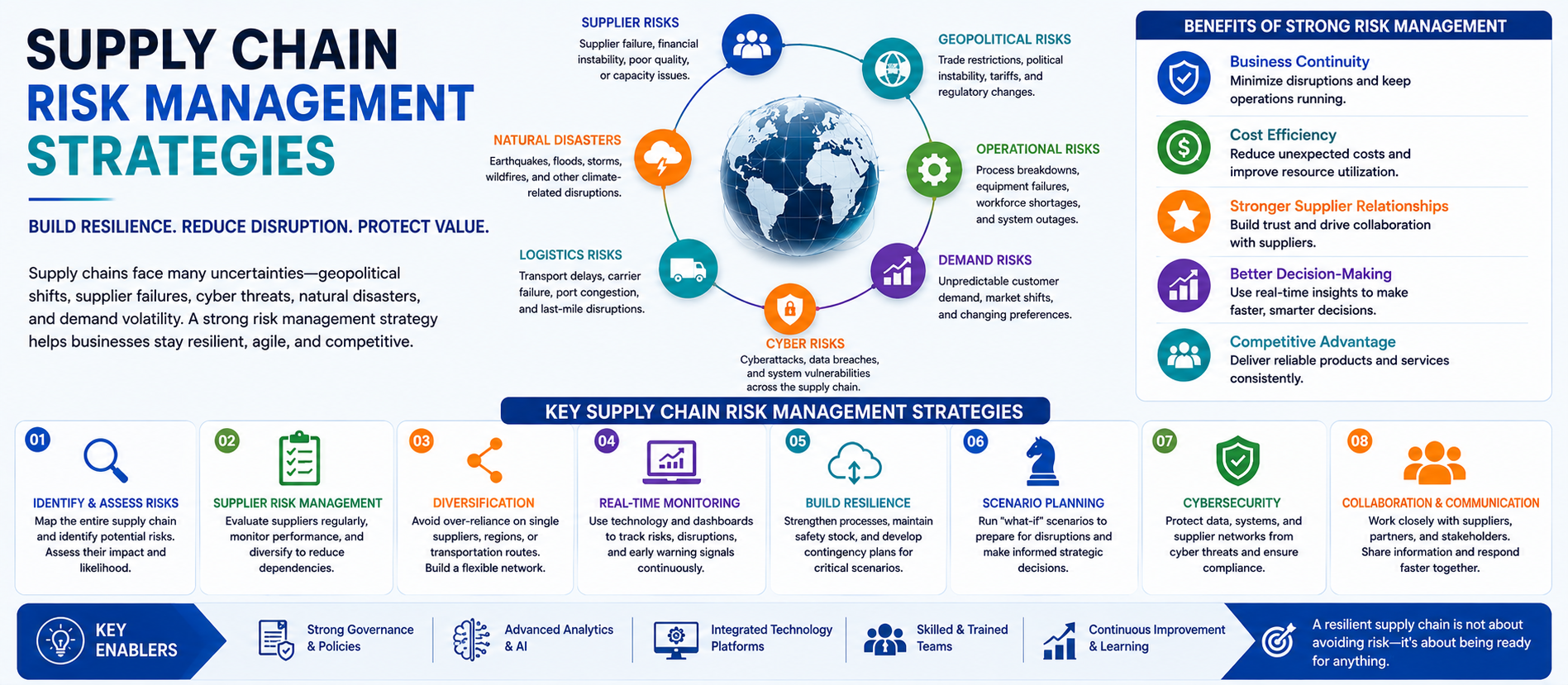
Supply chain risk management is the process of identifying, assessing, prioritizing, reducing, monitoring, and responding to risks that could disrupt suppliers, sourcing, manufacturing, transportation, technology, inventory, or delivery.
The best strategy combines visibility, supplier assessment, diversification, contingency planning, cybersecurity, data, financial analysis, and continuous monitoring.
Why Supply Chain Risk Management Matters
Modern supply chains are highly interconnected. A business may depend on suppliers, subcontractors, software providers, logistics companies, cloud platforms, manufacturers, ports, and financial partners.
This complexity creates hidden dependencies.
A company may know its direct supplier but have limited visibility into the supplier's own suppliers. This can create problems when a disruption occurs deeper in the network.
The World Economic Forum's 2026 Global Value Chains Outlook reports that persistent volatility is changing how companies think about supply chain design and resilience. Its findings emphasize that resilience is increasingly treated as a driver of growth rather than only a defensive risk-management activity.
The goal is not to eliminate all risk. That is impossible. The goal is to understand which risks matter most and build the ability to respond.
Common Types of Supply Chain Risk
Supplier Risk
A supplier may experience financial problems, quality failures, capacity shortages, labor disruption, or operational shutdowns.
Geopolitical Risk
Trade restrictions, tariffs, sanctions, political instability, and changing regulations can affect sourcing and transportation.
Transportation and Logistics Risk
Port congestion, route disruption, fuel issues, shipping delays, carrier failures, and infrastructure problems can delay delivery.
Climate and Environmental Risk
Floods, storms, droughts, heat, wildfires, and other environmental events can affect suppliers, facilities, transportation, and raw materials.
Cybersecurity Risk
Supply chains increasingly depend on connected software and digital service providers. A cyber incident at a third party can disrupt multiple organizations.
Demand Risk
Unexpected changes in customer demand can create shortages, excess inventory, or planning problems.
Financial Risk
Currency changes, commodity prices, supplier financial weakness, and rising transportation costs can affect supply chain performance.
1. Map the Entire Supply Chain
The first step in risk management is understanding what you depend on.
Create a supply chain map that identifies:
- Critical products and services.
- Direct suppliers.
- Important subcontractors where visibility is available.
- Manufacturing locations.
- Transportation routes.
- Warehouses and distribution points.
- Critical software and technology providers.
Do not assume that direct supplier visibility is enough. A critical dependency may exist several levels deeper in the supply network.
The World Economic Forum's 2026 cybersecurity research highlights limited visibility and third-party dependency risk as major supply chain concerns. It also notes that only a minority of surveyed organizations comprehensively map their supply chain ecosystems for deeper understanding of exposure and interdependencies.
2. Identify Critical Dependencies
Not every supplier or component deserves the same level of attention.
Identify dependencies that would create serious disruption if they failed.
Consider:
- Single-source suppliers.
- Unique raw materials.
- Specialized components.
- Critical software platforms.
- Key transportation routes.
- Suppliers with long replacement times.
Ask a simple question: If this supplier, system, route, or facility stopped operating tomorrow, how long could the business continue?
This helps prioritize risk management resources.
3. Build a Supply Chain Risk Register
A risk register provides a structured view of important threats.
Each risk can include:
- Risk description.
- Potential cause.
- Probability.
- Business impact.
- Early warning indicators.
- Risk owner.
- Mitigation actions.
- Contingency plan.
A simple risk score can combine likelihood and impact. However, businesses should also consider how quickly a disruption could occur and how difficult recovery would be.
4. Assess Suppliers Beyond Price
Low cost does not always mean low risk.
Supplier assessments should consider:
- Financial stability.
- Quality performance.
- Production capacity.
- Geographic exposure.
- Cybersecurity maturity.
- Business continuity planning.
- Regulatory compliance.
- Dependency on single facilities or customers.
NIST guidance on cybersecurity supply chain risk management emphasizes identifying, assessing, and mitigating risks associated with products and services throughout the supply chain.
5. Reduce Single Points of Failure
A single point of failure exists when one supplier, route, system, or location is essential and has no realistic backup.
Possible strategies include:
- Dual sourcing.
- Multi-sourcing.
- Alternative manufacturing locations.
- Backup logistics providers.
- Approved substitute materials.
- Secondary technology providers where practical.
Diversification has a cost. Managing several suppliers can increase complexity. The right goal is not maximum diversification. It is appropriate diversification for critical risks.
6. Balance Efficiency with Resilience
For many years, supply chains focused heavily on lean inventory and cost optimization.
Efficiency remains important, but excessive optimization can reduce the ability to absorb disruption.
The World Economic Forum's 2026 work argues for greater optionality and agility as uncertainty becomes more structural.
Businesses should ask:
- Where is efficiency creating fragility?
- Which inventory levels are too low for critical products?
- Where would a small backup capacity create significant protection?
- Which dependencies need alternatives?
7. Use Strategic Inventory Carefully
Inventory can provide a buffer against disruption.
However, holding more of everything can create unnecessary cost.
A better approach is to identify critical items based on:
- Replacement lead time.
- Supplier concentration.
- Demand variability.
- Customer importance.
- Availability of substitutes.
Strategic safety stock should focus on the items where shortages would cause the greatest damage.
8. Create Supplier Continuity Plans
Important suppliers should understand what happens during a disruption.
Continuity discussions may cover:
- Emergency contacts.
- Alternative production locations.
- Inventory availability.
- Priority allocation rules.
- Recovery time expectations.
- Communication procedures.
Continuity planning should be tested rather than stored and forgotten.
9. Strengthen Cyber Supply Chain Security
Supply chain risk is increasingly digital.
A business can have strong internal cybersecurity and still be affected by a weak supplier or service provider.
Useful controls include:
- Vendor security assessments.
- Security requirements in contracts.
- Access controls.
- Incident notification requirements.
- Third-party monitoring.
- Software and dependency visibility.
- Recovery testing.
NIST describes cybersecurity supply chain risk management as a coordinated approach for identifying, assessing, and mitigating risks across products and services.
10. Monitor External Risk Signals
Risk management should not depend only on annual supplier reviews.
Monitor relevant signals such as:
- Supplier financial changes.
- Regional instability.
- Weather alerts.
- Transportation disruptions.
- Cybersecurity incidents.
- Regulatory changes.
- Commodity price movements.
Early warning does not eliminate disruption, but it can give teams more time to respond.
11. Use Data and AI for Better Visibility
Data analytics and AI can help businesses identify patterns, forecast demand, monitor supplier information, and simulate possible disruptions.
Useful applications may include:
- Demand forecasting.
- Inventory optimization.
- Supplier risk scoring.
- Anomaly detection.
- Logistics monitoring.
- Scenario analysis.
However, technology alone does not create resilience. Recent analysis has warned that AI investments may improve individual functions without improving overall resilience when organizations continue to use disconnected systems and rigid processes.
The technology should support better decisions and redesigned workflows.
12. Develop Multiple Disruption Scenarios
Scenario planning helps teams prepare for uncertainty.
Possible scenarios include:
- A key supplier fails.
- A major port closes.
- A cyberattack affects a technology provider.
- Demand suddenly increases.
- A critical region experiences extreme weather.
- A trade rule changes unexpectedly.
For each scenario, ask:
- What happens first?
- Which customers are affected?
- How long can operations continue?
- What alternatives exist?
- Who makes decisions?
- How will stakeholders be informed?
13. Quantify Financial Exposure
Supply chain risk should be connected to financial impact.
Estimate potential effects on:
- Revenue.
- Operating costs.
- Cash flow.
- Working capital.
- Customer penalties.
- Insurance exposure.
World Economic Forum analysis published in 2026 argues that resilience should also consider whether a supply chain can withstand disruption without significant erosion of value, including higher costs, margin pressure, or financing strain.
14. Improve Contracts and Supplier Agreements
Contracts can clarify risk responsibilities.
Depending on the relationship, agreements may address:
- Service levels.
- Quality requirements.
- Cybersecurity expectations.
- Business continuity.
- Incident notification.
- Audit rights.
- Data protection.
- Alternative sourcing arrangements.
Contract requirements should be realistic and proportionate to the risk.
15. Create a Cross-Functional Risk Team
Supply chain risk is not only a procurement issue.
A strong program may involve:
- Procurement.
- Operations.
- Finance.
- IT.
- Cybersecurity.
- Legal and compliance.
- Business leadership.
Different teams see different parts of the risk.
16. Assign Clear Risk Ownership
Every critical risk should have a responsible owner.
The owner should understand:
- What the risk is.
- Which indicators should be monitored.
- What mitigation actions are planned.
- When escalation is required.
Shared responsibility is useful. Unclear responsibility is not.
17. Test the Response Plan
A plan that has never been tested may fail during a real crisis.
Use exercises such as:
- Tabletop simulations.
- Supplier disruption drills.
- Cyber incident exercises.
- Alternative logistics tests.
World Economic Forum cybersecurity research found that advanced resilience practices such as cyber incident simulation and recovery exercises remain less common than basic supplier assessments, highlighting an important gap between checking suppliers and testing real resilience.
18. Build Better Supplier Relationships
Suppliers can become important partners in risk management.
Regular communication can help both sides identify:
- Capacity problems.
- Material shortages.
- Technology changes.
- Financial concerns.
- Operational risks.
A purely transactional relationship may reduce the flow of early warning information.
19. Segment Risks Instead of Using One Response for Everything
Different risks require different strategies.
The OECD has highlighted the importance of distinguishing between more common business-as-usual disruptions and extreme disruptions that require broader preparedness and coordination.
For example:
- A routine delivery delay may require normal operational controls.
- A regional disaster may require emergency sourcing and cross-functional crisis management.
- A systemic cyber incident may require coordinated action across suppliers and technology partners.
20. Review and Update the Strategy Continuously
Supply chains change. New suppliers are added. Products change. Markets change. Technology dependencies grow.
Risk management should therefore be continuous.
Review the program when:
- A major supplier changes.
- A new product launches.
- The business enters a new market.
- A serious disruption occurs.
- Technology architecture changes.
- New regulations affect operations.
Supply Chain Risk Management Framework
| Stage Main Question Recommended Action | ||
| Map | What do we depend on? | Identify suppliers, systems, routes, facilities, and critical dependencies. |
| Assess | What can go wrong? | Evaluate likelihood, impact, speed, and recovery difficulty. |
| Prioritize | Which risks matter most? | Focus resources on critical exposure and single points of failure. |
| Mitigate | How can exposure be reduced? | Diversify, improve controls, and create alternatives. |
| Prepare | What happens during disruption? | Create continuity and response plans. |
| Monitor | What is changing? | Track supplier, cyber, logistics, climate, and market signals. |
| Test | Will the plan work? | Run simulations and recovery exercises. |
| Improve | What did we learn? | Update controls after exercises and real events. |
Common Supply Chain Risk Management Mistakes
Focusing Only on Direct Suppliers
Important dependencies may exist beyond the first tier.
Choosing Suppliers Only by Price
Low cost can hide financial, geographic, quality, or cybersecurity exposure.
Keeping No Alternative Options
Critical single-source dependencies can create major disruption.
Treating Risk Management as an Annual Exercise
Risk conditions can change quickly.
Ignoring Cybersecurity
Digital dependencies can create operational disruption even when physical suppliers are unaffected.
Collecting Data Without Taking Action
Visibility matters only when it improves decisions.
Testing Nothing
A continuity plan should be exercised before a real crisis.
SEO, AEO, GEO, and AI Search Optimization for Supply Chain Businesses
Supply chain companies, logistics providers, procurement consultants, manufacturers, and technology firms can improve visibility by publishing clear, useful answers to real business questions.
SEO supports visibility in traditional search engines.
AEO focuses on direct answers to questions such as:
- What is supply chain risk management?
- How can businesses reduce supplier risk?
- What are the biggest supply chain risks?
- How do companies build supply chain resilience?
GEO helps generative systems understand business expertise, services, products, locations, and industry context.
AI Search Optimization benefits from structured headings, direct answers, factual explanations, practical frameworks, updated information, and clear examples.
Frequently Asked Questions
What is the biggest supply chain risk?
The biggest risk depends on the business. Common high-impact risks include supplier concentration, geopolitical disruption, cyber incidents, climate events, transportation problems, and limited visibility into critical dependencies.
How can a company reduce supplier risk?
A company can assess supplier stability, monitor performance, diversify critical sourcing, improve contracts, create continuity plans, and maintain stronger visibility into important dependencies.
What is supply chain resilience?
Supply chain resilience is the ability to prepare for, absorb, respond to, recover from, and adapt after disruption.
Why is supply chain visibility important?
Visibility helps businesses identify dependencies, detect potential disruption, understand supplier exposure, and make faster decisions.
How does cybersecurity affect supply chains?
Cyberattacks can disrupt suppliers, software providers, logistics systems, and connected operations. A third-party incident can affect multiple organizations across the supply chain.
Can AI improve supply chain risk management?
AI can support forecasting, anomaly detection, monitoring, scenario analysis, and risk assessment. However, technology must be combined with reliable data, clear governance, and effective business processes.
Conclusion
Strong supply chain risk management strategies help businesses prepare for uncertainty without losing focus on growth and efficiency.
The most effective approach starts with visibility. Businesses need to understand their critical suppliers, systems, routes, and dependencies. They then need to assess exposure, reduce unnecessary concentration, prepare alternatives, strengthen cybersecurity, and test response plans.
⚠ Watch Out
Resilience does not mean avoiding every disruption. It means building the ability to respond and adapt when disruption happens.
As global volatility, climate pressure, cyber threats, and technology dependencies continue to shape business operations, supply chain risk management will remain a strategic capability rather than a narrow procurement task.
The businesses best prepared for disruption will be those that understand their dependencies, build practical alternatives, and continuously improve their ability to adapt.
Disclaimer: This article is for general educational and informational purposes only. Supply chain, cybersecurity, trade, contractual, regulatory, and financial risks vary by industry and location. Businesses should evaluate their own circumstances and consult appropriate professional advisers when making significant risk-management decisions.
Digiifrog
Website: www.digiifrog.com
Ready to Grow?
Talk to us about a strategy tailored to your brand — we will help you stand out in search, AI discovery and social.
Comments (0)
Log in to leave a comment.