📋 Quick Summary
In this article:
What Is Third-Party Vendor Security Management?
1. Why Third-Party Vendor Security Matters
2. Build a Complete Vendor Inventory
3. Classify Vendors by Risk
4. Perform Vendor Due Diligence Before Onboarding
5. Request Security Evidence
6. Review Vendor Access and Privileges
7. Protect Data Shared With Vendors
8. Include Cybersecurity Requirements in Contracts
10. Assess Software Supply Chain Security
11. Monitor Vendors After Onboarding
14. Manage Concentration and Single-Vendor Risk
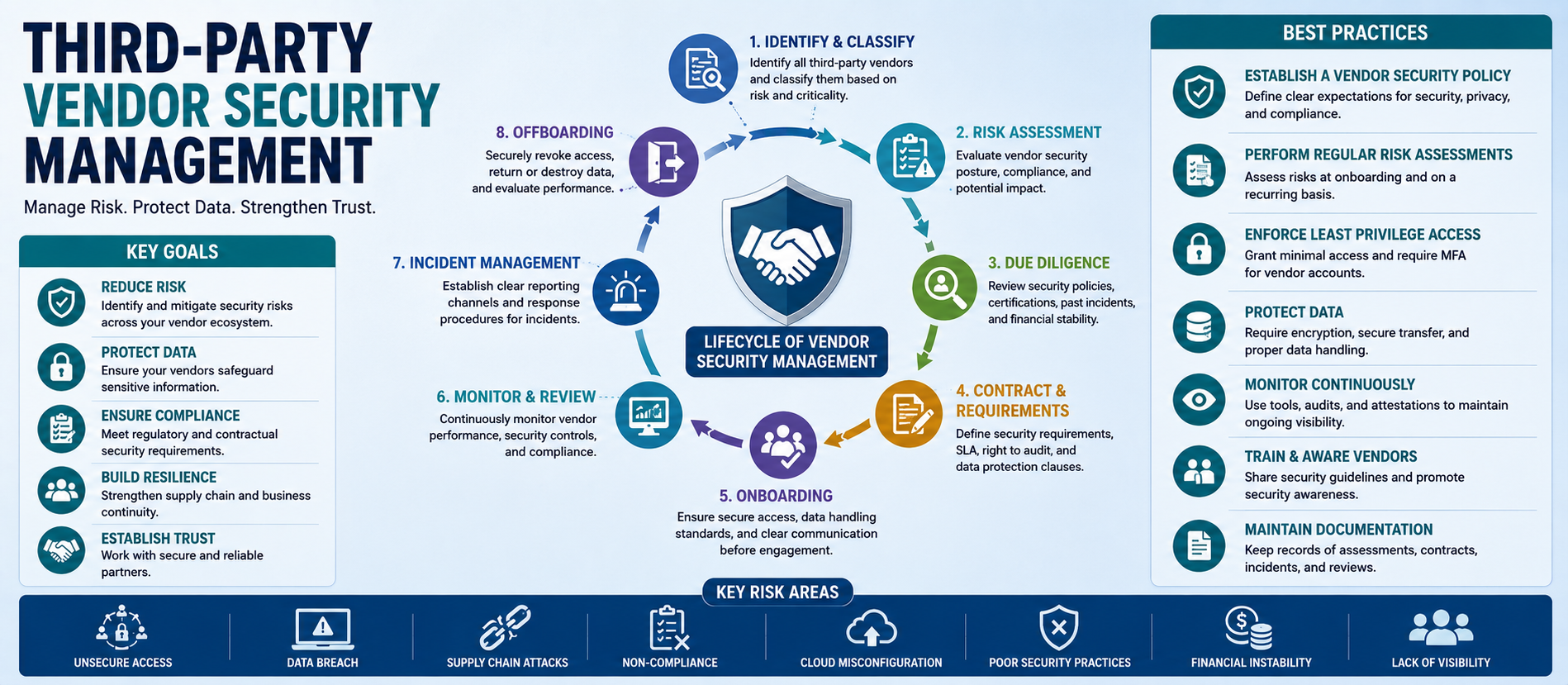
Third-party vendor security management is the process of identifying, assessing, monitoring, and reducing cybersecurity risks created by suppliers, contractors, cloud providers, software vendors, managed service providers, and other external partners. Modern businesses depend on vendors for technology, payment processing, customer support, hosting, analytics, software development, logistics, and many other functions. That dependency can create security risk beyond the organization's direct control.
NIST's Cybersecurity Supply Chain Risk Management guidance recommends identifying, assessing, and mitigating cybersecurity risks throughout the supply chain and integrating supplier risk into broader organizational risk management. In July 2026, NIST also released SP 1326, a Due Diligence Assessment Quick-Start Guide covering supplier considerations such as provenance, resilience, foundational cyber practices, supply-chain tiers, and foreign ownership, control, or influence. citeturn0search0turn0search8
CISA's 2025 Vendor Supply Chain Risk Management Template similarly provides standardized questions intended to improve visibility into vendor risk and support informed decisions when comparing providers. citeturn0search24
This WordPress-ready HTML article is prepared for Digiifrog (www.digiifrog.com) with SEO, AEO, GEO, and AI Search optimization.
What Is Third-Party Vendor Security Management?
Third-party vendor security management is a structured program for understanding how external organizations can affect the confidentiality, integrity, availability, privacy, resilience, and security of a company's systems and information.
It is broader than a one-time vendor questionnaire. Effective management continues from vendor selection and due diligence through contracting, onboarding, monitoring, incident response, renewal, and termination.
1. Why Third-Party Vendor Security Matters
A vendor may have privileged access to business systems, process sensitive information, host applications, provide software updates, or connect directly to internal infrastructure. A weakness at the vendor can therefore create consequences for the customer.
💡 Key Insight
CISA notes that increasing dependency on suppliers and other third parties makes understanding and managing those relationships important for secure, reliable, and resilient operations. citeturn0search25
Vendor risk can include data exposure, compromised software, outages, insecure remote access, weak authentication, poor incident response, regulatory problems, and supply-chain attacks.
2. Build a Complete Vendor Inventory
You cannot manage vendor risk if you do not know which vendors exist. Create a central inventory covering technology providers, SaaS applications, contractors, consultants, payment processors, cloud services, managed security providers, software suppliers, and other external entities with meaningful access or dependency.
Useful fields include vendor, service, business owner, data accessed, system connections, locations, contract dates, risk rating, assessment status, renewal date, and incident contacts.
3. Classify Vendors by Risk
Not every vendor requires the same level of scrutiny. A supplier that only provides office stationery should not receive the same assessment as a cloud provider hosting customer records.
Risk classification can consider data sensitivity, system access, business criticality, connectivity, regulatory impact, concentration risk, geographic exposure, and the potential impact of vendor failure.
A simple model might classify suppliers as low, medium, high, or critical risk. High-risk vendors should generally receive deeper due diligence and more frequent reviews.
4. Perform Vendor Due Diligence Before Onboarding
Due diligence should happen before a vendor receives meaningful access to systems or sensitive information. NIST's new SP 1326 describes due diligence as researching relevant information about a supplier or product so organizations can make informed acquisition and risk decisions. citeturn0search8
Assessment topics can include security governance, access control, vulnerability management, encryption, incident response, business continuity, privacy, subcontractors, software development, data handling, and previous security incidents.
5. Request Security Evidence
Vendor claims should be supported by appropriate evidence. Depending on risk, organizations may request security certifications, independent audit reports, penetration-test summaries, vulnerability-management information, security policies, business-continuity documentation, incident-response procedures, or completed security questionnaires.
Evaluate evidence for scope and relevance; a certification for one service does not necessarily cover every vendor environment.
6. Review Vendor Access and Privileges
External access should follow the principle of least privilege. Vendors should receive only the access required to perform their contracted service.
Use named accounts, strong authentication, MFA, time-limited access, privileged-access controls, logging, and regular access reviews. Remove vendor access when no longer required.
7. Protect Data Shared With Vendors
Before sending information to a third party, determine exactly what data is necessary. Data minimization reduces exposure if the vendor suffers an incident.
Contracts and technical controls should address encryption, data retention, deletion, backups, access restrictions, approved locations, subcontractors, and restrictions on secondary use where appropriate.
8. Include Cybersecurity Requirements in Contracts
Security requirements should not be left to informal conversations. Contracts should clearly define relevant responsibilities and expectations.
Depending on risk, contract provisions may cover security controls, confidentiality, data protection, breach notification, incident cooperation, audit rights, subcontractor requirements, vulnerability disclosure, business continuity, data return or deletion, and termination assistance.
CISA's small-business supply-chain guidance recommends supplier qualification criteria, service-level agreements, regular supplier audits, and ongoing performance monitoring. citeturn0search26
10. Assess Software Supply Chain Security
Software vendors can introduce risks through vulnerable dependencies, insecure development practices, compromised build environments, malicious components, or weak update mechanisms. NIST identifies software and services acquired through the supply chain as important cybersecurity risk considerations. citeturn0search9
For important software suppliers, organizations can evaluate secure development practices, vulnerability disclosure, software provenance, update processes, code-signing practices, dependency management, and security testing.
11. Monitor Vendors After Onboarding
Vendor risk changes over time. A supplier can change ownership, infrastructure, subcontractors, products, security controls, or geographic operations after the initial assessment.
Continuous or periodic monitoring can include security ratings, vulnerability notifications, threat intelligence, compliance evidence, incident disclosures, contract performance, and changes to critical services.
14. Manage Concentration and Single-Vendor Risk
Depending heavily on one provider can create a single point of failure. If the provider experiences a major outage or security incident, multiple business functions may be affected simultaneously.
CISA recommends identifying single points of failure and considering alternate suppliers when possible. citeturn0search26
15. Conduct Periodic Vendor Reviews
A vendor assessment should not automatically remain valid forever. Review frequency should reflect risk. Critical suppliers may require annual or more frequent review, while low-risk vendors may need a lighter process.
Trigger reviews after major changes such as new data access, significant incidents, mergers, new subcontractors, major product changes, or changes in regulatory requirements.
17. Common Third-Party Security Mistakes
- Failing to maintain a complete vendor inventory.
- Using the same assessment for every supplier.
- Trusting vendor claims without reviewing evidence.
- Giving vendors excessive system access.
- Ignoring subcontractors and fourth parties.
- Leaving cybersecurity requirements out of contracts.
- Performing due diligence only once.
- Failing to monitor critical vendors.
- Ignoring concentration and single-provider risk.
- Failing to remove vendor access after termination.
18. Practical Third-Party Vendor Security Checklist
- Maintain a current vendor inventory.
- Classify suppliers by cybersecurity and business risk.
- Perform risk-based due diligence before onboarding.
- Review relevant security evidence and audit reports.
- Limit vendor access using least privilege and MFA.
- Define data-protection requirements.
- Include security and incident clauses in contracts.
- Understand important subcontractors and supply-chain tiers.
- Monitor critical vendors after onboarding.
- Maintain vendor incident-response contacts.
- Evaluate business continuity and concentration risks.
- Review suppliers periodically and after major changes.
- Remove access and recover data during offboarding.
SEO, AEO, GEO and AI Search Optimization
SEO content about vendor security should target searches such as “third-party vendor security management,” “vendor risk management,” “third-party cybersecurity risk,” “supplier security assessment,” and “vendor security checklist.”
AEO should directly answer questions such as “What is third-party vendor security management?”, “How do companies assess vendor cybersecurity risk?”, and “What should be included in a vendor security assessment?”
GEO and AI Search optimization can be strengthened with clear definitions, risk-based processes, practical checklists, NIST and CISA references, structured headings, concise answers, and real-world vendor-management scenarios.
Frequently Asked Questions About Third-Party Vendor Security
What is third-party vendor security management?
It is the process of identifying, assessing, contracting with, monitoring, and managing cybersecurity risks created by external suppliers and service providers.
Why is third-party vendor risk important?
Vendors may have access to systems, sensitive data, software, or critical business services. A weakness at a supplier can therefore affect the customer's security, operations, compliance, and reputation.
How often should vendors be assessed?
Assessment frequency should be risk-based. Critical suppliers generally require more frequent review than low-risk providers, with additional assessments after major incidents, ownership changes, new access, or significant service changes.
What should a vendor security assessment include?
It can cover governance, identity and access management, encryption, vulnerability management, secure development, incident response, privacy, business continuity, subcontractors, data handling, and relevant security evidence.
Does a vendor's security certification guarantee safety?
No. Certifications and audit reports can provide useful assurance, but organizations should verify their scope, date, applicable services, exceptions, and relevance to the actual risk.
Conclusion
Third-party vendor security management is an essential part of modern cybersecurity because an organization's risk does not stop at its own network boundary. Suppliers, cloud providers, software vendors, contractors, and service partners can have direct or indirect access to important systems and information.
A mature program combines vendor inventory, risk classification, due diligence, evidence review, secure contracts, least-privilege access, data protection, subcontractor oversight, continuous monitoring, incident planning, resilience assessment, periodic reviews, and secure offboarding.
NIST identifies SP 800-161 Rev. 1 as foundational C-SCRM guidance, while its July 2026 SP 1326 provides a focused due-diligence approach for ICT suppliers. CISA's vendor SCRM resources likewise emphasize consistent assessment, transparency, supplier qualification, contracts, audits, and ongoing monitoring. citeturn0search3turn0search8turn0search24turn0search26
For businesses seeking modern websites, cybersecurity content, automation, SEO, AEO, GEO, and AI Search optimization, Digiifrog can help. Visit www.digiifrog.com.
Quick Answer: How Do You Manage Third-Party Vendor Security?
Manage third-party vendor security by maintaining a complete vendor inventory, classifying suppliers by risk, performing due diligence before onboarding, reviewing security evidence, limiting vendor access, protecting shared data, adding cybersecurity requirements to contracts, monitoring critical suppliers, managing subcontractors, preparing for vendor incidents, evaluating business continuity, reviewing vendors periodically, and securely removing access when relationships end.
Important Note
This article is educational content and is not a substitute for professional cybersecurity, legal, procurement, audit, or compliance advice. Vendor requirements should be tailored to the organization's systems, data, industry, contracts, regulatory obligations, business criticality, and risk tolerance.
Ready to Grow?
Talk to us about a strategy tailored to your brand — we will help you stand out in search, AI discovery and social.

Comments (0)
Log in to leave a comment.