📋 Quick Summary
In this article:
What Is Cybersecurity Software?
Why Businesses Need Cybersecurity Software
What Makes Cybersecurity Software Effective?
Real-Time Protection
Top Cybersecurity Software Categories for Businesses
1. Endpoint Security Software
2. Endpoint Detection and Response Software
Cybersecurity has become a fundamental business requirement as organizations increasingly depend on cloud applications, remote employees, online payments, customer databases, connected devices, and digital communication. A single security weakness can expose sensitive information, interrupt operations, damage customer trust, and create significant financial and reputational consequences.
This WordPress-ready HTML article is prepared for Digiifrog (www.digiifrog.com) with a strong focus on SEO, AEO, GEO, and AI Search optimization.
What Is Cybersecurity Software?
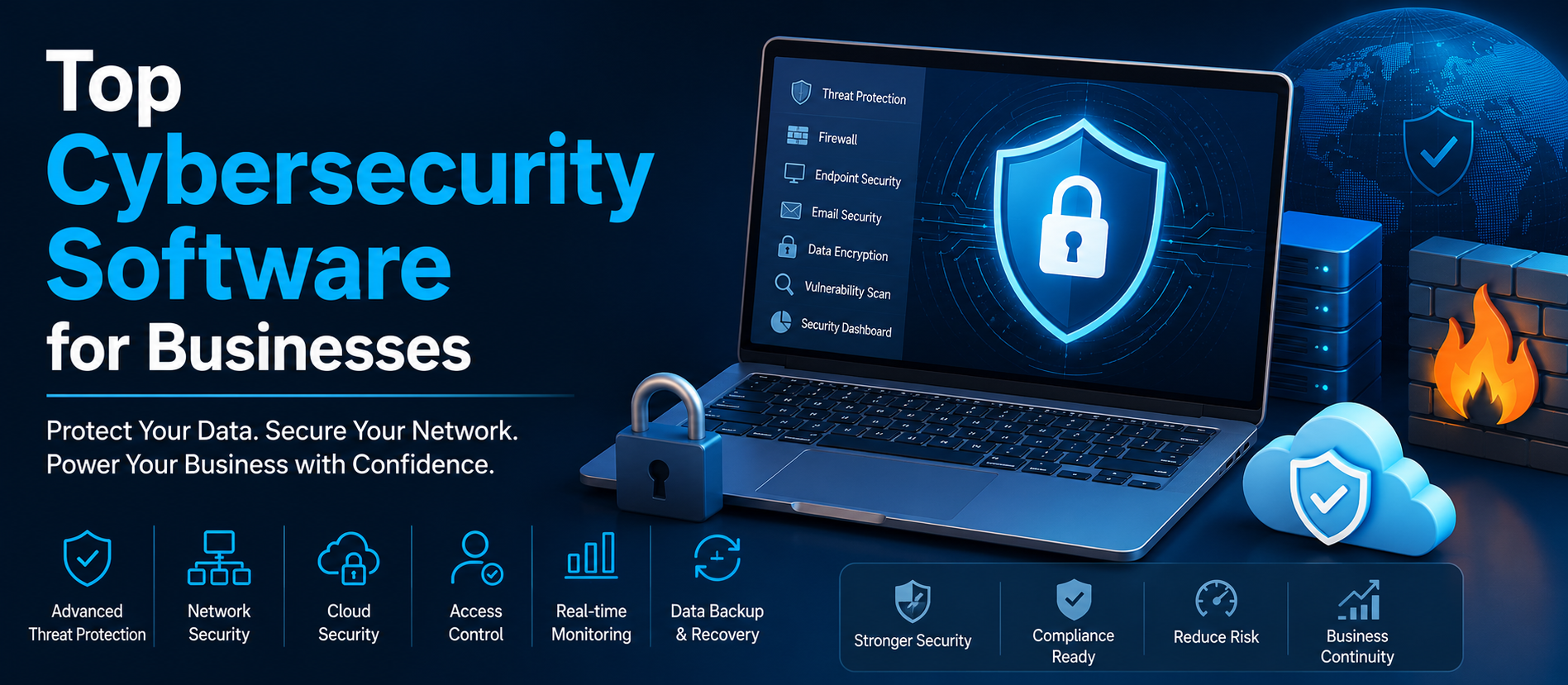
Cybersecurity software refers to applications and platforms designed to protect digital systems, devices, networks, accounts, applications, and information from unauthorized access, malware, phishing, data theft, exploitation, and other cyber threats.
Business cybersecurity is not normally handled by one product. Organizations often use multiple security layers that work together. A small company may begin with endpoint protection, multi-factor authentication, secure email, backup, and vulnerability management, while a larger enterprise may also require security information and event management, endpoint detection and response, identity security, cloud security, data loss prevention, and security orchestration.
- Endpoint protection
- Endpoint detection and response
- Network security
- Identity and access management
- Multi-factor authentication
- Email security
- Cloud security
- Vulnerability management
- Data protection
- Security monitoring and analytics
- Backup and recovery
- Security awareness and training
Why Businesses Need Cybersecurity Software
Cyberattacks can affect organizations of every size. Small businesses are not automatically protected because they have fewer employees or less data. Attackers may target smaller organizations because security controls can be less mature, credentials may be reused, and valuable customer or financial information can still be accessible.
Businesses also face risks from ordinary operational mistakes. Weak passwords, outdated software, excessive user permissions, accidental data sharing, phishing messages, unmanaged devices, and insecure configurations can create opportunities for attackers.
Cybersecurity software helps organizations create consistent controls instead of relying entirely on employees to identify every threat manually.
- Detect malicious activity
- Protect employee devices
- Secure user identities
- Reduce phishing risk
- Monitor suspicious behavior
- Identify vulnerabilities
- Protect business information
- Support incident response
- Improve security visibility
- Support business continuity
What Makes Cybersecurity Software Effective?
The best security platform is not necessarily the product with the longest feature list. Businesses should evaluate whether a solution addresses their actual risks, integrates with existing systems, provides useful visibility, and can be managed consistently.
Threat Detection
Security software should help identify suspicious activity, malicious files, abnormal behavior, unauthorized access, and other indicators of compromise.
Real-Time Protection
Preventive controls can block known threats and reduce the opportunity for malicious activity to execute successfully.
Centralized Visibility
Security teams need a clear view of devices, identities, alerts, vulnerabilities, and incidents. Centralized dashboards can make investigation and prioritization easier.
Automation
Security automation can reduce repetitive work by automatically collecting information, enriching alerts, isolating suspicious endpoints, creating tickets, or triggering predefined response actions.
Integration
Cybersecurity tools should work with identity providers, cloud platforms, endpoint systems, ticketing tools, logging platforms, backup systems, and other business technologies whenever possible.
Manageability
A security product that employees cannot configure or monitor properly may provide less practical protection than a simpler solution that is consistently maintained.
Top Cybersecurity Software Categories for Businesses
Cybersecurity software covers several different security functions. Businesses should understand these categories before selecting individual products.
1. Endpoint Security Software
Endpoint security protects laptops, desktops, servers, and other devices used to access company resources. Modern endpoint platforms typically provide malware protection, behavioral monitoring, exploit prevention, device control, and centralized administration.
Traditional antivirus remains useful for detecting known malicious software, but modern endpoint security increasingly relies on behavioral analysis and threat intelligence to identify suspicious activity that may not match a simple malware signature.
💡 Key Insight
For organizations with remote employees, endpoint security is particularly important because devices may connect to company resources from home networks, public locations, and different geographic regions.
- Malware prevention
- Behavioral detection
- Exploit protection
- Device monitoring
- Endpoint isolation
- Centralized management
2. Endpoint Detection and Response Software
Endpoint Detection and Response (EDR) platforms provide deeper visibility into endpoint activity. Instead of only asking whether a file is malicious, EDR systems can record processes, connections, user activity, and other security events to help investigators understand what happened.
EDR can be valuable when an organization needs to investigate suspicious behavior, trace an attack path, identify affected devices, and respond to incidents.
Advanced endpoint platforms may also include automated response actions, such as isolating an affected machine or stopping suspicious processes according to configured security policies.
3. Identity and Access Management Software
Identity security is one of the most important parts of modern cybersecurity. Businesses need to know who can access systems, what they can access, and whether that access is appropriate.
Identity and access management solutions can help organizations manage user accounts, authentication, permissions, roles, and access policies.
Strong identity security becomes especially important when employees use cloud applications and remote access systems.
- User identity management
- Single sign-on
- Access policies
- Role-based access
- Authentication controls
- Privileged access management
4. Multi-Factor Authentication Software
Passwords alone can be compromised through phishing, credential theft, password reuse, or other techniques. Multi-factor authentication adds another verification requirement, making unauthorized access more difficult when a password is exposed.
Businesses should consider MFA for important accounts, especially administrator accounts, email, cloud services, remote access, financial applications, and other systems containing sensitive information.
Security policies should also consider recovery procedures and emergency access so legitimate users are not permanently locked out of critical systems.
5. Email Security Software
Email remains a major channel for phishing, malicious attachments, fraudulent requests, and credential theft. Business email security platforms can analyze messages, links, attachments, sender behavior, and other indicators to identify suspicious communication.
Email security should work alongside employee awareness training. Technology can block many threats, but employees should still understand how to recognize suspicious requests and report them.
- Spam filtering
- Phishing detection
- Malicious attachment analysis
- Suspicious link detection
- Impersonation protection
- Email threat monitoring
6. Network Security Software
Network security tools help control and monitor traffic between systems, users, applications, and external networks. Firewalls, secure access technologies, intrusion detection, intrusion prevention, and network monitoring can all contribute to a layered security architecture.
Modern organizations increasingly operate across cloud environments and remote networks, so network security strategies are evolving beyond the traditional office perimeter.
7. Cloud Security Software
Businesses increasingly rely on cloud applications and infrastructure. Cloud security tools help organizations identify misconfigurations, monitor cloud resources, manage access, protect workloads, and improve visibility into cloud activity.
Cloud security should address both technology and organizational processes. Incorrect permissions, exposed storage, weak credentials, insecure APIs, and poorly configured services can create significant risk.
8. Vulnerability Management Software
Vulnerability management helps organizations discover security weaknesses in devices, applications, networks, and infrastructure. The process generally involves identifying vulnerabilities, evaluating their severity, prioritizing remediation, and verifying that fixes have been applied.
Not every vulnerability represents the same level of business risk. Organizations should prioritize issues based on factors such as exploitability, exposure, asset importance, available mitigations, and potential business impact.
9. Security Information and Event Management Software
Security Information and Event Management (SIEM) platforms collect and analyze security-related logs and events from multiple systems. They can help security teams identify relationships between events that may not be obvious when each system is viewed separately.
A SIEM can collect information from endpoints, servers, identity systems, firewalls, cloud services, applications, and other sources.
Modern SIEM platforms increasingly incorporate analytics, threat intelligence, automation, and AI-assisted investigation to help security teams handle large volumes of security data.
10. Data Loss Prevention Software
Data Loss Prevention (DLP) technologies help organizations identify and control the movement of sensitive information. Depending on the solution, DLP can monitor data stored on devices, transmitted through communication channels, or shared with external systems.
DLP policies can be useful for protecting financial information, customer records, intellectual property, confidential documents, and other sensitive business data.
11. Backup and Disaster Recovery Software
Security is not only about preventing attacks. Organizations also need a recovery strategy for situations where systems become unavailable or data is corrupted, deleted, encrypted, or otherwise compromised.
Reliable backups can help organizations recover from ransomware, hardware failures, accidental deletion, application problems, and other disruptions.
Businesses should test backups periodically rather than assuming that a backup is usable simply because a backup job completed successfully.
- Automated backups
- Version retention
- Recovery testing
- Off-site or isolated copies
- Business continuity support
12. Security Awareness and Phishing Training Software
Employees are an important part of an organization's security environment. Security awareness platforms can provide training, simulated phishing exercises, reporting workflows, and educational content.
The objective should not be to blame employees for security incidents. Effective training helps employees recognize suspicious activity, understand company policies, report incidents quickly, and build safer digital habits.
Popular Cybersecurity Platforms Businesses May Evaluate
Businesses evaluating cybersecurity software may encounter a range of established security vendors and platforms. The right choice depends heavily on organization size, existing technology, risk profile, compliance requirements, security expertise, and budget.
Microsoft Defender
Microsoft Defender is a broad family of security technologies covering areas such as endpoint protection, identity, cloud security, email, and security operations. It can be particularly relevant to organizations that already operate extensively within the Microsoft ecosystem.
CrowdStrike
CrowdStrike is widely associated with cloud-delivered endpoint security and threat detection capabilities. Its platform approach can be considered by organizations seeking endpoint visibility, threat detection, and security operations capabilities.
Palo Alto Networks
Palo Alto Networks provides a broad portfolio spanning network security, cloud security, security operations, and other cybersecurity areas. It may be relevant for organizations seeking a broad security architecture from a major security vendor.
Fortinet
Fortinet offers security technologies including network security, secure access, endpoint-related protection, and other cybersecurity capabilities. It is commonly evaluated by organizations with significant network security requirements.
Okta
Okta focuses heavily on identity and access management. Businesses can evaluate identity platforms such as Okta when they need centralized authentication, access management, and identity security across cloud applications.
SentinelOne
SentinelOne provides endpoint and security operations capabilities with an emphasis on automated detection and response. It can be considered by businesses seeking modern endpoint security and automated security workflows.
Cloudflare
Cloudflare provides a range of internet, application, network, and security services. Organizations may evaluate its security technologies for areas such as web application protection, network security, access, and traffic management.
These examples are not a universal ranking. Businesses should compare current product capabilities, integrations, licensing, security requirements, support, and independent evaluation results before selecting a security platform.
How to Choose the Best Cybersecurity Software for Your Business
Selecting security software should begin with a risk assessment rather than a product comparison alone. Businesses should understand their most important assets, users, applications, data, vulnerabilities, and likely threat scenarios.
Identify Critical Assets
Determine which systems and information would cause the greatest business impact if they became unavailable, compromised, or exposed.
Map Your Attack Surface
Identify endpoints, cloud services, applications, domains, user accounts, remote access systems, APIs, connected devices, and other assets that could potentially be targeted.
Evaluate Existing Controls
Review current endpoint protection, identity security, backups, email controls, network security, vulnerability management, logging, and incident response capabilities.
Prioritize Based on Risk
Security budgets are not unlimited. Prioritize controls that address the organization's most significant and realistic risks.
Check Integration
Security products should integrate with the systems already used by the business. Integration can reduce duplicated work and make security monitoring more consistent.
Review Administration Requirements
A small business without a dedicated security team may need a managed or simpler solution. Larger organizations may require advanced configuration, custom detection, security operations workflows, and specialist administration.
Consider Total Cost
Security software costs can include licensing, deployment, training, integration, administration, storage, monitoring, support, and incident-response services. Compare the total operational cost rather than the license price alone.
Cybersecurity Software for Small Businesses
Small businesses do not need to copy the technology stack of a large enterprise. They should establish a practical security baseline appropriate for their risks.
A small business may prioritize:
- Multi-factor authentication
- Endpoint protection
- Secure email
- Automatic software updates
- Reliable backups
- Password management
- Basic vulnerability management
- Employee security awareness
- Access control
- Incident response procedures
The most important factor is consistency. A modest security program that is properly configured and maintained can be more valuable than an expensive collection of tools that nobody monitors.
Cybersecurity Software for Remote Teams
Remote work changes the security environment because employees may access company resources from home networks, personal locations, and multiple devices.
Organizations should pay particular attention to identity security, MFA, endpoint protection, secure access, device management, cloud application security, and employee awareness.
Remote employees should also understand how to handle company information, use approved applications, report suspicious messages, and protect devices from unauthorized access.
AI and Automation in Cybersecurity
Artificial intelligence is becoming an important component of cybersecurity operations. Security teams may receive thousands of alerts, logs, and events, making manual investigation difficult.
AI can assist with alert prioritization, pattern recognition, threat analysis, summarization, anomaly detection, investigation support, and automated response workflows.
Security automation can also perform repetitive actions such as enriching alerts with context, opening incident tickets, notifying responsible teams, collecting endpoint information, or applying predefined containment actions.
However, AI should not be treated as an infallible security decision-maker. Security teams should validate important conclusions, monitor automated actions, and establish appropriate approval controls for high-impact responses.
Cybersecurity and Zero Trust
Zero Trust is a security approach based on the principle that access should not be trusted automatically simply because a user or device is inside a traditional network boundary.
A Zero Trust strategy can involve identity verification, device health, least-privilege access, continuous monitoring, segmentation, and policy-based authorization.
Cybersecurity software can support these principles through identity platforms, endpoint management, secure access solutions, network controls, and security analytics.
Common Cybersecurity Software Mistakes
Buying Tools Without a Security Strategy
Adding security products without understanding the organization's risks can create complexity without addressing the most important vulnerabilities.
Ignoring Identity Security
Strong endpoint protection cannot compensate for poorly protected administrator accounts or weak authentication practices.
Failing to Patch Systems
Security software is not a substitute for timely software updates and vulnerability remediation.
Not Testing Backups
A backup strategy should include recovery testing. Organizations need confidence that important data and systems can actually be restored.
Ignoring Security Alerts
Security monitoring only creates value when alerts are reviewed, prioritized, investigated, and acted upon.
Overlooking Employees
Security awareness, clear policies, and simple reporting mechanisms are important parts of a complete cybersecurity program.
How to Build a Business Cybersecurity Roadmap
A practical cybersecurity roadmap can be built in stages.
Stage 1: Assess
Inventory devices, accounts, applications, data, cloud services, and external-facing assets. Identify important business processes and potential risks.
Stage 2: Protect
Establish strong authentication, endpoint protection, backups, access controls, patching processes, and secure configurations.
Stage 3: Detect
Implement appropriate logging, monitoring, endpoint detection, email security, and vulnerability management.
Stage 4: Respond
Create incident-response procedures that define who should be contacted, what actions should be taken, and how affected systems should be contained.
Stage 5: Recover
Test backup restoration and business continuity procedures. Review incidents and update security controls based on lessons learned.
Cybersecurity, SEO, AEO, GEO and AI Search Optimization
Businesses publishing cybersecurity content should make information easy for both people and modern search systems to understand. SEO helps content become discoverable in traditional search engines. AEO focuses on direct answers to user questions. GEO helps content provide useful context for generative search experiences, while AI Search optimization emphasizes clear, structured, authoritative, and understandable information.
Cybersecurity content should define technical terms, answer practical questions, explain risks without unnecessary fear, provide actionable guidance, and clearly distinguish general information from professional security advice.
Future of Cybersecurity Software
The future of business cybersecurity will likely involve greater integration between identity, endpoint, cloud, network, data, and security operations technologies. AI will increasingly help security teams understand large volumes of information and automate repetitive investigative tasks.
Security platforms are also moving toward unified dashboards and integrated security operations. Instead of managing many disconnected alerts, organizations want correlated information that helps them understand the broader context of an incident.
At the same time, businesses will need to maintain strong fundamentals. Secure configuration, patching, identity protection, backups, least privilege, employee awareness, and tested incident-response procedures will remain important even as security technology becomes more intelligent.
Frequently Asked Questions About Cybersecurity Software
What is the best cybersecurity software for businesses?
There is no single best cybersecurity product for every business. The right solution depends on the organization's size, risk profile, infrastructure, data, compliance requirements, technical resources, and budget. Businesses may need a combination of endpoint, identity, email, network, cloud, vulnerability, backup, and monitoring technologies.
Does a small business really need cybersecurity software?
Yes. Small businesses can still be affected by phishing, malware, credential theft, ransomware, data exposure, and other cyber incidents. A practical security baseline can significantly improve protection.
What cybersecurity software should a small business use first?
A small business should generally prioritize strong authentication and MFA, endpoint protection, secure email, reliable backups, software patching, access control, password management, and employee security awareness.
What is EDR in cybersecurity?
EDR stands for Endpoint Detection and Response. EDR platforms monitor endpoint activity, help identify suspicious behavior, provide investigation information, and can support response actions.
What is SIEM software?
SIEM stands for Security Information and Event Management. SIEM platforms collect and analyze security-related logs and events from multiple systems to help security teams detect, investigate, and respond to threats.
Can AI improve cybersecurity?
Yes. AI can assist with threat detection, anomaly analysis, alert prioritization, investigation, summarization, and security automation. Human oversight remains important for high-impact security decisions.
Is antivirus enough for a business?
Traditional antivirus is useful, but it is generally only one layer of a modern business security program. Organizations should also consider identity security, MFA, patching, backups, email protection, access controls, vulnerability management, and monitoring based on their risk profile.
Conclusion
The top cybersecurity software for businesses should be selected as part of a broader security strategy rather than as isolated products. Endpoint protection, identity security, MFA, email protection, network controls, cloud security, vulnerability management, SIEM, data protection, backups, and security awareness can all contribute to a layered defense.
Platforms from vendors such as Microsoft, CrowdStrike, Palo Alto Networks, Fortinet, Okta, SentinelOne, and Cloudflare may be relevant for different security requirements, but businesses should evaluate current capabilities, integrations, support, licensing, and independent security assessments before making purchasing decisions.
The most effective cybersecurity strategy combines technology with strong processes and informed employees. Businesses should identify their critical assets, reduce unnecessary access, keep systems updated, monitor for suspicious activity, maintain reliable backups, and regularly review their security posture.
As AI and automation continue to transform cybersecurity, organizations have new opportunities to detect threats faster, reduce repetitive security work, and improve incident response. The goal should remain practical: protect important business assets, reduce risk, and maintain the ability to continue operating when security incidents occur.
For businesses looking to explore AI-powered automation, digital transformation, intelligent business systems, and modern technology solutions, Digiifrog can help develop practical strategies. Visit www.digiifrog.com to learn more.
Quick Answer: What Cybersecurity Software Does a Business Need?
A business should consider endpoint protection, identity and access management, multi-factor authentication, email security, network security, cloud security, vulnerability management, security monitoring, data protection, reliable backups, and employee security awareness. The exact combination depends on business size, technology environment, data sensitivity, threat exposure, compliance requirements, and available security resources.
Ready to Grow?
Talk to us about a strategy tailored to your brand — we will help you stand out in search, AI discovery and social.
Comments (0)
Log in to leave a comment.