📋 Quick Summary
In this article:
What Is Cybercrime Prosecution?
What Types of Cybercrime Can Lead to Prosecution?
The Main Legal Framework for Cybercrime in India
1. Information Technology Act, 2000
2. Bharatiya Nyaya Sanhita, 2023
3. Bharatiya Nagarik Suraksha Sanhita, 2023
4. Bharatiya Sakshya Adhiniyam, 2023
Step 1: Reporting the Cybercrime
Report Quickly When Money Is Involved
Step 2: Registration and Initial Investigation
Step 3: Preserving Digital Evidence
Focus Keyword: Understanding Cybercrime Prosecution
Cybercrime can affect individuals, businesses, banks, government systems and critical digital infrastructure. A cyber offence may involve online financial fraud, identity theft, hacking, impersonation, privacy violations, ransomware, cyberstalking, illegal content or other crimes committed through computers, mobile devices and digital networks.
💡 Key Insight
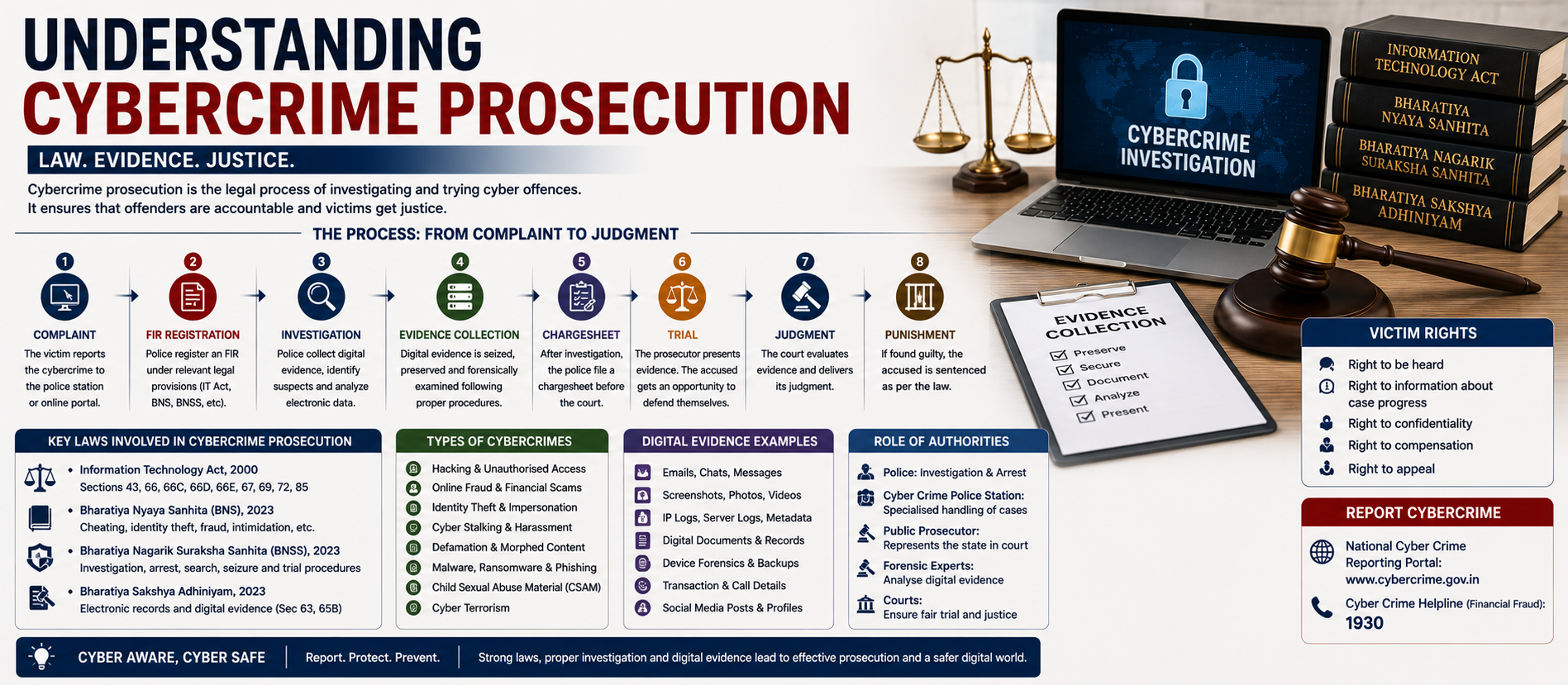
Understanding cybercrime prosecution is important because reporting a crime is only the beginning. A cyber case may move through several stages: complaint, registration, investigation, collection of digital evidence, identification of suspects, filing of charges, court proceedings and, finally, judgment.
This India-focused guide explains the process in simple language. It discusses the Information Technology Act, 2000, relevant criminal law, investigation procedure, electronic evidence, prosecution and practical steps for victims.
Digiifrog creates clear, useful and search-friendly content through SEO, AEO, GEO and AI Search Optimization.
What Is Cybercrime Prosecution?
Cybercrime prosecution is the legal process through which an alleged cyber offender is investigated, charged and prosecuted before a competent court.
A prosecution usually requires more than a victim's allegation. Investigators and prosecutors must connect the available evidence to the alleged offence and prove the case according to the applicable legal standard.
A typical cybercrime case may involve:
- A victim or organization reporting an incident.
- Police or another competent authority examining the complaint.
- Registration of a case where legally appropriate.
- Collection and preservation of digital evidence.
- Identification and tracing of suspects.
- Analysis of devices, accounts, logs and transactions.
- Application of relevant provisions of the IT Act and other criminal laws.
- Submission of a police report or other legally required charging document.
- Court proceedings, evidence and arguments.
- A judgment based on the facts and applicable law.
What Types of Cybercrime Can Lead to Prosecution?
Cybercrime is a broad term. Different offences may be prosecuted under different laws depending on what actually happened.
Common Examples Include:
- Online financial fraud
- Identity theft
- Cheating by online impersonation
- Unauthorized access to computer systems
- Data theft or unlawful interference with computer resources
- Privacy violations
- Cyberstalking and online harassment
- Publishing prohibited or unlawful electronic content
- Ransomware and extortion-related activity
- Social-media impersonation
- Child sexual abuse material and related offences
- Cyber terrorism and attacks on protected systems
The label “cybercrime” does not automatically determine the legal section. Investigators and courts examine the facts and apply the provisions that match the alleged conduct.
The Main Legal Framework for Cybercrime in India
Cybercrime cases can involve more than one law.
1. Information Technology Act, 2000
The Information Technology Act, 2000 contains important provisions dealing with computer-related offences and electronic activity.
Examples include:
- Section 66: Computer-related offences connected with acts referred to in Section 43 when done dishonestly or fraudulently.
- Section 66C: Identity theft involving fraudulent or dishonest use of another person's electronic signature, password or unique identification feature.
- Section 66D: Cheating by personation using a communication device or computer resource.
- Section 66E: Violation of privacy in specified circumstances.
- Section 66F: Cyber terrorism.
- Sections 67, 67A and 67B: Certain offences involving prohibited electronic content.
- Section 67C: Preservation and retention of information by intermediaries in the circumstances covered by the law.
- Sections 72 and 72A: Provisions concerning confidentiality, privacy and disclosure in the situations covered by those sections.
Section 66A of the IT Act is omitted and should not be treated as a current offence provision.
2. Bharatiya Nyaya Sanhita, 2023
Cybercrime may also involve general criminal offences, depending on the facts. For example, online conduct may amount to cheating, theft, extortion, criminal intimidation, forgery or other offences under the applicable criminal law.
One digital act can therefore trigger both a specific cyber-law provision and another criminal-law provision where the facts satisfy the legal requirements.
3. Bharatiya Nagarik Suraksha Sanhita, 2023
The Bharatiya Nagarik Suraksha Sanhita, 2023 provides the procedural framework for criminal investigation, inquiry and trial. It also contains provisions relevant to offences involving electronic communications and questions about the place of trial.
4. Bharatiya Sakshya Adhiniyam, 2023
Digital evidence is central to cybercrime prosecution. The Bharatiya Sakshya Adhiniyam, 2023 recognizes electronic and digital records and contains provisions regarding their proof and admissibility.
Section 63 specifically addresses the admissibility of electronic records and the conditions and certification requirements that may apply.
Step 1: Reporting the Cybercrime
Cybercrime prosecution usually begins when an incident is reported or otherwise comes to the attention of law-enforcement authorities.
In India, victims can use the National Cyber Crime Reporting Portal for reporting cybercrime. The Ministry of Home Affairs states that the national reporting system facilitates reporting of all types of cybercrime, with special focus on cybercrime against women and children.
For online financial fraud, the national cybercrime helpline is 1930.
Report Quickly When Money Is Involved
Speed matters in financial cyber fraud. A quick report may help law-enforcement and financial institutions act on available information. However, reporting does not guarantee recovery of money.
Keep the following details ready where available:
- Transaction ID.
- Date and time of the transaction.
- Amount involved.
- Bank, wallet or payment-app details.
- UPI ID or merchant details.
- Phone numbers or email addresses used by the suspected fraudster.
- Screenshots and messages.
- Website or social-media URLs.
Step 2: Registration and Initial Investigation
After a complaint is received, the competent authorities assess the available information and take action according to the applicable law and procedure.
Depending on the nature of the offence, this may involve registration of a criminal case, preliminary examination where permitted, or another legally appropriate step.
The investigation may focus on questions such as:
- What exactly happened?
- When did the incident begin?
- Which devices or accounts were used?
- Who received money or controlled the relevant account?
- What IP addresses, logs or transaction records exist?
- Are there additional victims?
- Does the evidence indicate one or more suspects?
In India, police and public order are primarily State subjects, and State and Union Territory law-enforcement agencies play the main role in the prevention, detection, investigation and prosecution of crimes, including cyber fraud.
Step 3: Preserving Digital Evidence
Digital evidence can disappear quickly. A message may be deleted, an account may be closed, a log may be overwritten or a device may be altered.
That is why evidence preservation is a critical part of cybercrime investigation.
Digital Evidence May Include:
- Emails.
- Chat messages.
- SMS records.
- Social-media posts.
- Website records.
- Call records.
- Bank and payment transactions.
- Server logs.
- IP address information.
- Device data.
- Photographs and videos.
- Metadata.
- Cloud-storage records.
Victims should avoid altering original evidence unnecessarily. Take screenshots and preserve original files where possible. Do not fabricate, edit or manipulate evidence.
Step 4: Digital Forensics and Technical Investigation
Cybercrime cases often require technical analysis.
Digital forensic work may examine devices, storage media, logs and other records to understand what happened. Depending on the legal authority and facts, investigators may seek data from service providers, platforms, banks, intermediaries or other entities.
Technical questions may include:
- Which account accessed a system?
- When was the access made?
- Was a particular device connected to the activity?
- Was data copied, altered or deleted?
- Did multiple accounts or devices communicate with each other?
- Can transaction records help trace the movement of funds?
Technical evidence alone may not always identify the final human actor. Investigators often need to connect technical indicators with other evidence.
Step 5: Identifying the Suspect
Finding the person behind an online account can be difficult.
A cybercriminal may use false identities, multiple devices, proxy services, stolen accounts or infrastructure located in another jurisdiction.
Investigators may combine:
- Account information.
- Device information.
- IP and network records.
- Bank and payment trails.
- Mobile connections.
- Witness statements.
- Recovered communications.
- Digital forensic findings.
The goal is not simply to show that an online account existed. The prosecution must establish facts that legally connect the accused to the alleged conduct.
Step 6: Applying the Correct Legal Charges
After investigation, authorities may examine which statutory provisions apply.
For example:
- Using another person's password or unique identification feature may raise identity theft issues under Section 66C of the IT Act.
- Using a computer resource or communication device to cheat by impersonating another person may involve Section 66D.
- Unauthorized and dishonest or fraudulent computer-related conduct may involve Section 66 in the circumstances covered by the Act.
- Online fraud may also involve provisions relating to cheating under the applicable criminal law.
- Some privacy or unlawful-content cases may involve other specific provisions of the IT Act or criminal law.
Charges depend on evidence and facts. The same cyber incident may involve several possible offences.
Step 7: The Role of the Prosecutor
The prosecutor plays an important role after the investigation reaches the court stage.
The prosecution generally presents the case before the court, relying on admissible evidence and applicable law. The prosecutor must prove the allegations according to the legal standard required in criminal proceedings.
A prosecution may rely on:
- Witness testimony.
- Digital evidence.
- Forensic reports.
- Bank records.
- Telecom records.
- Platform or intermediary records.
- Expert evidence.
- Documents seized or lawfully obtained during investigation.
The accused has legal rights and the opportunity to defend against the allegations according to the applicable procedure.
Electronic Evidence in Cybercrime Cases
Electronic evidence can be powerful, but it must be handled carefully.
The Bharatiya Sakshya Adhiniyam, 2023 contains provisions on electronic and digital records. Section 63 provides for admissibility of qualifying electronic records and describes conditions and certificate requirements associated with computer output.
Important Questions About Digital Evidence
- Where did the data come from?
- How was it collected?
- Was it preserved properly?
- Was the evidence altered?
- Can its source and integrity be established?
- Are the required legal conditions and certifications satisfied?
A screenshot can be useful, but the evidentiary value of any particular record depends on the facts, the source, the applicable law and the requirements for proving the record.
Chain of Custody
Chain of custody refers to documenting how evidence is handled from collection through examination and presentation.
For digital evidence, a proper record may help establish:
- Who collected the device or data.
- When it was collected.
- How it was stored.
- Who accessed it.
- What forensic process was used.
- How the evidence was transferred or preserved.
A weak evidence trail can create questions about authenticity and reliability.
Step 8: Filing the Police Report or Charge Sheet
After completing the investigation required at that stage, the investigating agency may submit the appropriate report to the competent court according to the criminal procedure framework.
The court then deals with the matter according to the applicable legal process. The exact path can depend on the offences, evidence, jurisdiction and procedural requirements.
It is important to understand that filing a charge sheet or other report is not the same as a conviction. The prosecution must still prove the case before the court.
Step 9: Court Proceedings and Trial
At the court stage, the process may involve several steps depending on the offence and procedural law.
Possible stages can include:
- Cognizance or consideration by the court.
- Appearance of the accused.
- Consideration of charges.
- Framing of charges where applicable.
- Prosecution evidence.
- Cross-examination.
- Defence evidence, if any.
- Final arguments.
- Judgment.
The exact sequence may vary depending on the type of court and applicable procedure.
What Must the Prosecution Prove?
In a criminal case, the prosecution must establish the legally required elements of the alleged offence using admissible evidence and the standard applicable to criminal proceedings.
In cybercrime cases, this may involve proving both:
- The digital event: for example, unauthorized access, impersonation or fraudulent communication.
- The connection to the accused: evidence linking the alleged act to the person charged.
Technical evidence can show that an account or device performed an action. Additional evidence may be needed to establish who controlled or used that account or device at the relevant time.
Victim Rights and the Role of the Complainant
The victim or complainant can play an important role by preserving evidence, providing accurate information and cooperating with lawful investigative requests.
A victim should:
- Keep the complaint acknowledgement or reference number.
- Preserve original evidence.
- Provide accurate timelines.
- Report additional losses or related incidents promptly.
- Keep records of communications with authorities and financial institutions.
- Avoid contacting or threatening the suspected offender directly.
Victims should not assume that an online report automatically means a final criminal case has already been established. Investigation and prosecution follow legal procedures.
Cybercrime Against Women and Children
The National Cyber Crime Reporting Portal provides reporting facilities for cybercrime and gives special focus to crimes against women and children.
Some forms of online sexual exploitation or child sexual abuse material may involve serious offences under the IT Act and other applicable laws. Such incidents should be reported promptly through appropriate official channels.
Do not download, forward or redistribute illegal sexual content as a way of “collecting evidence.” Preserve only what is necessary and follow lawful reporting guidance.
Cross-Border Cybercrime
Cybercrime often crosses geographical borders. A victim may be in India, a payment account may be elsewhere, a platform may be headquartered in another country and the suspect may operate from a different jurisdiction.
Cross-border investigation can therefore require:
- Cooperation between law-enforcement agencies.
- Requests for information from foreign service providers.
- International legal assistance.
- Coordination under applicable treaties or legal arrangements.
These cases can take longer because evidence and suspects may be outside the immediate jurisdiction of local investigators.
Why Cybercrime Prosecution Can Be Difficult
Cybercrime cases create unique challenges.
1. Anonymity
Offenders may hide behind false accounts, stolen identities or technical infrastructure.
2. Speed
Money can move through multiple accounts quickly. Digital evidence can also disappear.
3. Jurisdiction
Different parts of the offence may occur in different States or countries.
4. Technical Complexity
Investigators, lawyers and courts may need to understand logs, networks, encryption, devices and forensic methods.
5. Evidence Integrity
Digital evidence must be collected and presented in a manner that satisfies legal requirements.
6. Attribution
Showing that a device or account was involved is not always the same as proving who committed the offence.
What Should You Do Immediately After Becoming a Victim?
- Stop further loss. Contact your bank or payment provider where relevant.
- Report financial cyber fraud immediately. Use the official 1930 helpline and the National Cyber Crime Reporting Portal as appropriate.
- Preserve evidence. Save messages, URLs, transaction records and screenshots.
- Change compromised passwords.
- Enable multi-factor authentication.
- Do not destroy or alter relevant devices or files.
- Record a timeline. Note dates, times, amounts and communications.
- Report the matter to the appropriate authorities.
Common Mistakes That Can Harm a Cybercrime Case
Deleting Messages
Do not delete important chats, emails or transaction notices before preserving them.
Waiting Too Long
Delay can make it harder to trace funds and preserve digital records.
Editing Evidence
Do not manipulate screenshots or alter original files.
Using Unofficial Reporting Channels
Verify that you are using the real government portal or official contact method.
Posting Sensitive Evidence Publicly
Publicly sharing personal information or illegal content may create additional risks.
Assuming Every Online Dispute Is Cybercrime
Some online disputes are civil or contractual matters rather than criminal offences. The facts determine the legal route.
The Role of I4C and the National Cybercrime Reporting System
The Ministry of Home Affairs describes the Indian Cyber Crime Coordination Centre (I4C) as an important part of India's cybercrime coordination ecosystem.
The I4C framework includes components such as the National Cybercrime Threat Analytics Unit, the National Cybercrime Reporting Portal, joint investigation support and cybercrime training and research initiatives.
These systems support the wider response to cybercrime, while investigation and prosecution of individual criminal cases remain primarily connected to the competent law-enforcement and judicial processes.
SEO, AEO, GEO and AI Search Optimization for Cybercrime Content
People increasingly ask direct questions through search engines and AI systems.
- How is cybercrime prosecuted in India?
- What happens after I report cyber fraud?
- What evidence is needed in a cybercrime case?
- Can screenshots be used as evidence?
- What is the difference between cybercrime investigation and prosecution?
SEO helps useful legal and cybersecurity content become discoverable.
AEO focuses on answering questions directly and clearly.
GEO helps structure information for generative search experiences.
AI Search Optimization emphasizes clear language, logical headings, useful context and direct answers.
For legal content, clarity is especially important. Complex laws should be explained in simple language without making unsupported promises about legal outcomes.
How Digiifrog Supports Modern Cyber and Legal Content
Digiifrog helps businesses and publishers create structured, readable and search-friendly content.
- SEO Content Strategy
- AEO and Answer-Focused Content
- GEO and Generative Search Optimization
- AI Search Optimization
- Cybersecurity and Legal Content Development
- Digital Branding Strategy
Frequently Asked Questions
What is cybercrime prosecution?
Cybercrime prosecution is the legal process through which an alleged cyber offender is investigated, charged and prosecuted before a competent court using the applicable criminal procedure and evidence rules.
Where can I report cybercrime in India?
You can use the National Cyber Crime Reporting Portal for reporting cybercrime. For online financial cyber fraud, the official national helpline is 1930.
What laws are used to prosecute cybercrime?
Depending on the facts, cybercrime may involve the Information Technology Act, 2000, the Bharatiya Nyaya Sanhita, 2023 and other applicable laws. Investigation and trial procedure are governed by the relevant procedural framework, including the Bharatiya Nagarik Suraksha Sanhita, 2023.
Can electronic records be used as evidence?
Yes. The Bharatiya Sakshya Adhiniyam, 2023 contains provisions relating to electronic and digital records. Their admissibility and proof depend on the statutory requirements and facts of the case.
Can a screenshot alone prove a cybercrime?
A screenshot can be useful evidence, but whether it is sufficient depends on authenticity, source, context and other evidence. A complete investigation may require original records, device data, logs, witness evidence or other supporting material.
What should I do if I lose money in an online fraud?
Act immediately. Contact the relevant bank or payment provider, report the incident through the official 1930 cybercrime helpline and use the National Cyber Crime Reporting Portal as appropriate. Preserve transaction records and other evidence.
Does filing a cybercrime complaint guarantee that the money will be recovered?
No. A report can trigger investigation and protective action, but recovery depends on the facts, timing, movement of funds, available evidence and the outcome of the legal and financial processes.
Conclusion
Understanding cybercrime prosecution helps victims and businesses understand that a cyber case is a process, not a single event.
The process may begin with a complaint, but successful prosecution can require careful investigation, reliable digital evidence, proper legal charges and proof before a competent court.
For victims, the most important actions are to report quickly, preserve evidence, protect affected accounts and use official channels. For organizations, strong incident response, evidence preservation and cooperation with lawful investigations can be critical.
India's cybercrime framework continues to develop as technology changes. Always check current official laws, reporting procedures and legal requirements before making decisions about a specific incident.
Legal Disclaimer: This article is for general educational and informational purposes only. It is not legal advice and does not determine whether a specific act is a criminal offence. Cybercrime cases depend on the facts, applicable laws, evidence, jurisdiction and current procedural requirements. Consult a qualified legal professional for advice about a specific matter.
Digiifrog
Website: www.digiifrog.com
Ready to Grow?
Talk to us about a strategy tailored to your brand — we will help you stand out in search, AI discovery and social.

Comments (0)
Log in to leave a comment.