📋 Quick Summary
In this article:
What Is an Insurance Settlement?
How the Insurance Settlement Process Works
Step 1: Report the Claim Promptly
Step 2: Review Your Insurance Policy
Step 3: Document the Loss
Step 4: The Adjuster Investigates the Claim
Step 5: Coverage Is Determined
Step 6: Damage or Loss Is Valued
Step 7: Deductibles Are Applied
Step 8: Policy Limits and Sublimits Are Considered
Step 9: The Settlement Offer Is Explained
Actual Cash Value vs. Replacement Cost
Introduction
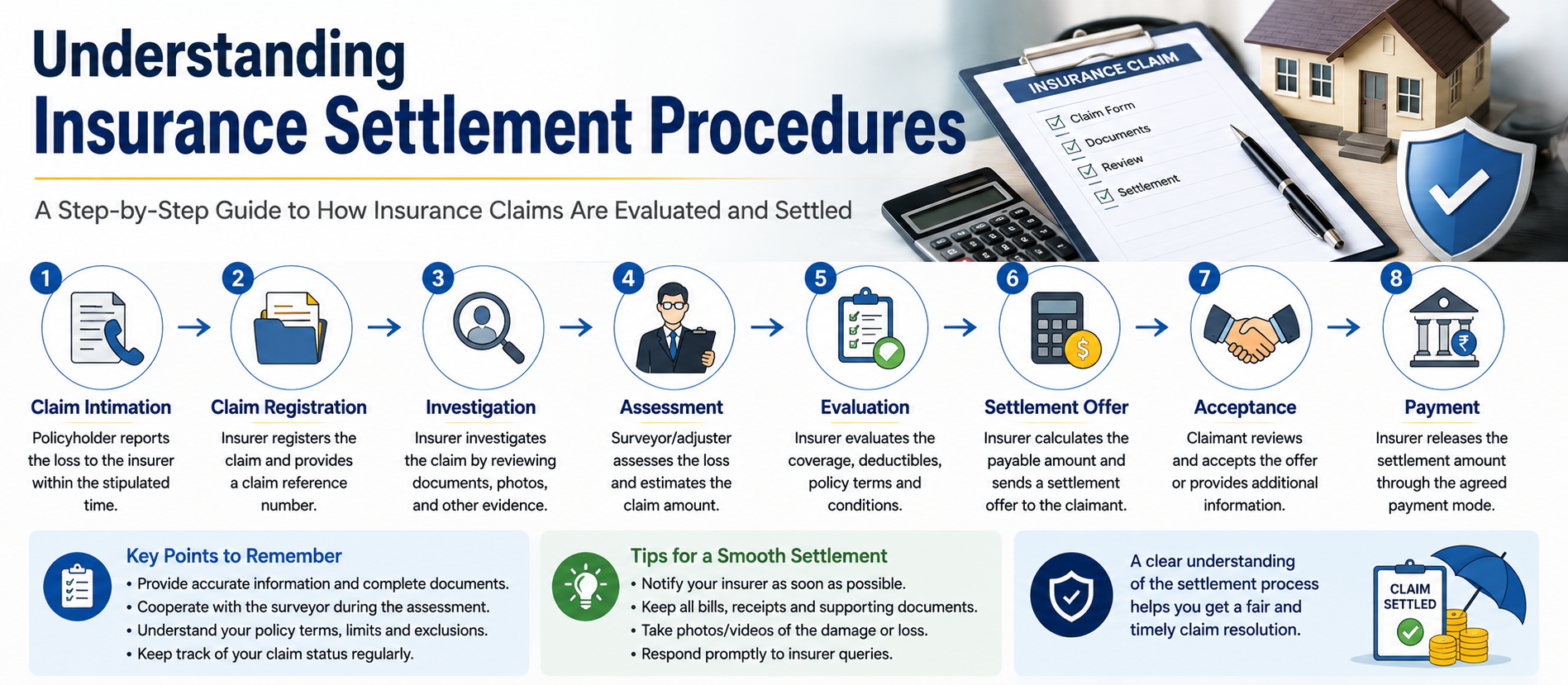
Understanding how an insurance settlement works can make a stressful claim much easier to manage. Whether the claim involves a vehicle, home, business property, health expense, or another insured loss, the settlement process usually involves several stages: reporting the loss, reviewing the policy, investigating the circumstances, assessing the damage or financial loss, applying deductibles and limits, calculating the amount payable, communicating the decision, and issuing payment.
An insurance settlement is not simply a number chosen by an insurer. It is generally based on the policy contract, the facts of the loss, applicable coverage, valuation rules, deductibles, limits, exclusions, and supporting documentation. The exact process varies by insurance type, country, state, insurer, and policy wording.
⚠ Watch Out
The National Association of Insurance Commissioners (NAIC) explains that adjusters may review the policy, assess damage, apply deductibles and coverage limits, and provide estimates or calculations. NAIC also advises policyholders to keep records, request written explanations, and avoid rushing into a settlement they do not understand. citeturn0search0turn0search1
This WordPress-ready guide from Digiifrog explains insurance settlement procedures in simple language. It is optimized for SEO, AEO, GEO, and AI Search Optimization.
Website: www.digiifrog.com
What Is an Insurance Settlement?
An insurance settlement is the payment or agreed resolution of a covered claim. Depending on the type of insurance, the settlement may pay for repairing or replacing damaged property, reimbursing eligible expenses, compensating for covered losses, or providing another benefit defined by the policy.
A settlement can sometimes involve more than one payment. For example, a property claim may include separate payments for structural damage, personal property, temporary living expenses, or additional covered costs. NAIC notes that major homeowners claims may involve several payments rather than one single transaction. citeturn0search0
How the Insurance Settlement Process Works
Although procedures vary, a typical claim follows a sequence similar to this:
- Loss occurs.
- Policyholder protects people and property from further harm.
- Claim is reported.
- Insurer assigns a claim number and adjuster.
- Coverage is reviewed.
- Evidence and documents are collected.
- Damage or financial loss is assessed.
- Deductibles, limits, exclusions, and valuation rules are applied.
- Insurer communicates the claim decision or settlement calculation.
- Payment is issued if the claim is covered.
- Additional documentation or supplemental payments may follow.
- Disputes can be escalated through applicable policy or regulatory procedures.
Step 1: Report the Claim Promptly
After a covered event, notify your insurer or agent as soon as reasonably possible. Your policy may contain specific notification requirements. Prompt reporting also gives the insurer an opportunity to inspect the damage and begin its investigation.
Provide accurate information about when, where, and how the loss occurred. Keep the claim number and contact details for the claims representative handling your file.
Step 2: Review Your Insurance Policy
The policy is the foundation of the settlement process. Review the declarations page, coverage sections, exclusions, conditions, endorsements, deductibles, limits, and valuation provisions.
NAIC advises consumers to understand what their policy covers, what is excluded, and what deductibles apply. citeturn0search1
Step 3: Document the Loss
Strong documentation can make the settlement process more efficient. Photograph or video damaged property before cleanup when it is safe to do so. Prepare an inventory of damaged or missing items and collect receipts, invoices, estimates, reports, and other supporting evidence.
For property claims, NAIC recommends documenting losses before removing debris or damaged belongings where possible and preserving damaged items for inspection. Policyholders should also take reasonable temporary measures to prevent additional damage. citeturn0search3turn0search4
Step 4: The Adjuster Investigates the Claim
An insurance adjuster evaluates the circumstances of the loss and the amount of damage or financial exposure. The adjuster may inspect property, review photographs, interview people, examine receipts and estimates, review police or incident reports, and compare the facts with the policy.
The adjuster may be employed by the insurer or may be an independent adjuster working on the insurer's behalf. In some situations, a policyholder may hire a public adjuster to assist with a property claim. NAIC notes that public adjusters charge fees for their services. citeturn0search3
Step 5: Coverage Is Determined
Before calculating the final amount, the insurer determines whether the loss is covered. This involves comparing the facts with the policy's insuring agreement, exclusions, conditions, definitions, and endorsements.
A claim can be partially covered, fully covered, or denied depending on the circumstances. If a portion is denied, ask the insurer to identify the relevant policy language and provide the decision in writing.
Step 6: Damage or Loss Is Valued
Once coverage is established, the insurer evaluates the financial value of the covered loss. The valuation method depends on the policy and type of claim.
For property insurance, common valuation approaches include actual cash value and replacement cost. Actual cash value generally reflects depreciation, while replacement cost coverage may pay the cost to repair or replace covered property with similar materials, subject to the policy's requirements and limits.
For an auto claim, valuation may involve repair estimates or, when the vehicle is considered a total loss, an assessment of its market value under the applicable policy and local rules.
Step 7: Deductibles Are Applied
A deductible is the amount the policyholder is responsible for on a covered claim before the insurer pays according to the policy.
For example, if a covered property loss is valued at $10,000 and the applicable deductible is $1,000, the insurer may pay $9,000, assuming there are no other policy limits, exclusions, or adjustments affecting the calculation.
Some policies can contain different deductibles for different risks, so check the applicable section rather than assuming one deductible applies to every claim.
Step 8: Policy Limits and Sublimits Are Considered
A policy limit is the maximum amount the insurer may pay for a covered category of loss. Sublimits can impose lower limits on specific types of property or expenses.
For example, a policy may cover personal property generally but impose a special limit on jewelry, collectibles, electronics, or certain business property. Settlement calculations must account for these limits.
Step 9: The Settlement Offer Is Explained
After evaluating the claim, the insurer may provide a settlement calculation, estimate, explanation of benefits, or other payment determination. Review the document carefully rather than focusing only on the final number.
Look for:
- Total estimated loss.
- Covered amount.
- Excluded amounts.
- Depreciation where applicable.
- Deductible.
- Policy limits and sublimits.
- Previous payments.
- Remaining amount payable.
- Additional documentation required.
NAIC recommends asking the adjuster for an itemized explanation of the settlement offer when necessary. citeturn0search1
Actual Cash Value vs. Replacement Cost
Actual Cash Value
Actual cash value generally accounts for depreciation. A newer item may therefore receive a higher valuation than an older item of the same type.
Replacement Cost
Replacement cost coverage is designed to provide the amount needed to repair or replace covered property with similar kind and quality, subject to the policy's requirements, limits, and conditions.
Some policies initially pay actual cash value and release additional replacement-cost amounts after the policyholder completes eligible repairs or replacement. The exact procedure varies, so read the policy carefully.
Why a Settlement May Be Paid in Multiple Stages
Large claims can require multiple payments. A property claim may begin with an emergency advance, followed by payments for structural repairs, contents, and additional living expenses. NAIC notes that homeowners may receive several payments for different components of a major claim. citeturn0search0
Do not assume that the first payment is necessarily the final payment. Ask whether additional covered amounts may become payable after repairs, replacement, or submission of further documentation.
What Is a Supplemental Claim?
A supplemental claim or supplement may arise when additional covered damage or expenses are identified after the initial estimate. This can happen during vehicle repairs, building demolition, restoration, or replacement work.
Keep documentation of newly discovered damage and ask the insurer or repair professional how supplemental estimates should be submitted. Never assume that additional costs will automatically be approved.
What If You Disagree With the Settlement?
You do not have to treat an unclear settlement calculation as the end of the discussion. Start by identifying exactly what you disagree with. It may be a missing item, incorrect measurement, depreciation, repair estimate, valuation, deductible, policy interpretation, or exclusion.
Contact the insurer and provide evidence supporting your position. NAIC advises consumers who disagree with an auto or homeowners settlement to discuss the differences with the insurer and request written explanations. citeturn0search0turn0search2
Appraisal and Arbitration
Some insurance policies contain an appraisal clause for disputes about the amount of a property loss. An appraisal process is generally designed to resolve disagreements about the value or cost of the loss rather than determine whether the policy provides coverage. NAIC explains that appraisal and arbitration can be alternatives to court in certain disputes, but the availability and rules depend on the policy and applicable law. citeturn0search26
Read your policy before starting an appraisal process because it may contain specific procedures, deadlines, and cost-sharing requirements.
When Should You Seek Professional Help?
Professional advice may be appropriate when a claim is unusually large, complex, disputed, partially denied, or involves significant legal or financial consequences. Depending on the situation, this could involve an insurance professional, public adjuster, attorney, accountant, engineer, contractor, or other specialist.
Understand the fees and role of anyone you hire. Professional assistance does not guarantee a larger settlement, and the right choice depends on the complexity of the claim.
Insurance Settlement Procedures by Claim Type
Auto Insurance
Auto settlements may involve repair estimates, parts, labor, rental transportation, diminished-value questions where applicable, or total-loss valuation. If the vehicle is considered a total loss, carefully review how its value was determined.
Homeowners Insurance
Home claims can involve the structure, personal property, additional living expenses, debris removal, temporary repairs, and other covered components. Large claims may result in multiple payments.
Health Insurance
Health claim processing is different from property settlement. The insurer may evaluate medical eligibility, network rules, deductibles, copayments, coinsurance, exclusions, preauthorization requirements, and the allowed amount. In India, current industry discussions are also focusing on greater transparency and faster claim processing, including broader digital health-claims infrastructure. citeturn0news23turn0news24
Life Insurance
Life insurance claims generally require proof of death and policy-related documentation. The insurer verifies the policy, beneficiary information, exclusions, and other contractual requirements before payment.
Commercial Insurance
Commercial claims may involve buildings, equipment, inventory, business income, extra expenses, liability, and specialized coverage. Business interruption calculations can require detailed financial records.
How to Prepare for a Fair Settlement
- Read your policy before a loss occurs.
- Report claims promptly.
- Document damage thoroughly.
- Keep receipts and invoices.
- Maintain a property or asset inventory.
- Request itemized estimates.
- Keep a claim communication log.
- Ask for unclear decisions in writing.
- Compare repair estimates carefully.
- Understand depreciation and valuation.
- Check deductibles and policy limits.
- Do not rush into an agreement you do not understand.
Common Insurance Settlement Mistakes
- Accepting the first offer without reviewing the calculation.
- Failing to read the policy exclusions.
- Not documenting damage before cleanup.
- Throwing away damaged property before inspection.
- Making permanent repairs before the insurer has an opportunity to inspect when inspection is required.
- Ignoring depreciation or valuation adjustments.
- Forgetting policy deductibles.
- Failing to submit supporting documents.
- Relying only on verbal explanations.
- Missing claim or dispute deadlines.
Insurance Settlement Checklist
- Claim number recorded.
- Policy documents saved.
- Photos and videos completed.
- Damage inventory prepared.
- Receipts and invoices collected.
- Adjuster's contact details recorded.
- Coverage decision requested.
- Settlement calculation reviewed.
- Deductible confirmed.
- Policy limits checked.
- Depreciation understood.
- Payment schedule confirmed.
- Dispute options reviewed if necessary.
Frequently Asked Questions
What is an insurance settlement?
An insurance settlement is the payment or agreed resolution of a covered claim based on the policy, facts of the loss, valuation, limits, deductibles, and applicable conditions.
How is an insurance settlement calculated?
The insurer generally reviews coverage, investigates the loss, calculates eligible damage or expenses, applies valuation rules, deductibles, limits, exclusions, and prior payments, and then determines the amount payable.
Do I have to accept the first insurance settlement offer?
Not necessarily. If you believe the offer is incorrect or incomplete, ask for an explanation and provide supporting evidence. Your rights depend on the policy and applicable law.
What should I do if my insurance settlement is too low?
Identify the specific differences, request an itemized explanation, provide estimates or documentation supporting your position, and use the policy's dispute procedures if the issue cannot be resolved.
What is an insurance adjuster?
An adjuster investigates the claim, assesses the loss, reviews policy provisions, and helps determine the amount payable under the insurance contract.
What is depreciation in an insurance settlement?
Depreciation is an adjustment that reflects factors such as age and condition when actual cash value is used. Replacement-cost policies may handle depreciation differently.
Can an insurance settlement be paid in installments?
Yes. Large or complex claims may involve multiple payments for different components of the loss, depending on the policy and claim circumstances.
What is an appraisal clause?
An appraisal clause can provide a process for resolving certain disputes about the amount of a property loss. It generally does not decide whether an excluded loss is covered.
How can I protect myself during the settlement process?
💡 Key Insight
Keep detailed records, document the loss, save receipts and estimates, request important decisions in writing, understand your policy, and avoid agreeing to unclear terms.
Conclusion
Understanding insurance settlement procedures helps policyholders approach claims with greater confidence and organization. The process normally involves reporting the loss, documenting damage, reviewing coverage, investigating the claim, valuing the loss, applying deductibles and limits, reviewing the settlement calculation, and receiving payment.
The settlement process is strongest when the policyholder keeps accurate records and asks specific questions. If a settlement appears incomplete or incorrect, identify the exact issue and provide evidence rather than relying on a general disagreement. Request written explanations and review the policy's dispute procedures, including appraisal or other available mechanisms, where appropriate.
Insurance policies and claim laws differ substantially across jurisdictions and product types. When a claim is significant or disputed, professional advice can be valuable.
Digiifrog
Website: www.digiifrog.com
Insurance settlement procedures, deadlines, valuation methods, dispute rights, deductibles, and regulatory requirements vary by country, state, insurer, policy, and claim type. This article is educational and is not personalized insurance, legal, or financial advice. Always review your policy and obtain professional guidance when appropriate.
Ready to Grow?
Talk to us about a strategy tailored to your brand — we will help you stand out in search, AI discovery and social.


Comments (0)
Log in to leave a comment.