📋 Quick Summary
In this article:
Common features of value investing
Common features of growth investing
Value Investing vs. Growth Investing: The Main Differences
How Valuation Works in Each Strategy
Price-to-earnings ratio (P/E)
Price-to-book ratio (P/B)
Price-to-sales ratio (P/S)
Simple Example: Value Stock vs. Growth Stock
Potential Benefits of Value Investing
Learn how value and growth investors evaluate companies, compare their risks, understand valuation, and decide which investing approach may fit their goals.
Investors use different methods to decide which stocks to buy. Some look for companies that appear undervalued compared with their business fundamentals. Others focus on companies they believe can grow sales and profits faster than the market. These approaches are commonly known as value investing and growth investing.
Both strategies can help investors build a long-term portfolio, but neither guarantees a profit. A company can look cheap and still perform poorly. A company with strong growth can also be a disappointing investment if its share price already assumes too much future success.
Understanding the difference can help you ask better questions before investing. Rather than choosing a stock because it is popular or because its price has fallen, you can examine the business, its valuation, its future prospects, and the risks involved.
In this Digiifrog guide, we explain value investing vs. growth investing in clear language. You will learn how each approach works, which measures investors often review, how the strategies compare, and how to think about your own investing process. Examples use simple numbers for education, not as recommendations to buy or sell any security.
What Is Value Investing?
Value investing is an approach that looks for investments trading at a price below an estimate of their underlying business value. Investors try to understand what a company may be worth based on its earnings, cash flow, assets, debt, competitive position, and future prospects. They then compare that estimate with the current market price.
The central idea is that market prices do not always reflect the full value of a business. Investors may become overly pessimistic about a company, an industry, or the economy. If the business remains financially sound, its share price may eventually recover. A value investor looks for a gap between the price paid and the value they believe the business can deliver.
However, a low share price alone does not make a stock a value investment. A company may be cheap because its products are losing demand, its debt is too high, or its business model is becoming outdated. Investors must decide whether the market has overreacted or whether the lower price reflects real problems.
Common features of value investing
- Comparing the share price with earnings, cash flow, assets, or other measures of business value.
- Looking for a possible margin of safety between the price paid and estimated value.
- Reviewing the company’s balance sheet, debt, profits, and ability to generate cash.
- Considering whether the business can remain competitive over time.
- Being willing to wait while the market reassesses the company.
Value investors often seek to avoid paying too much for a business. They may favour companies with established operations, reliable cash generation, or valuations that appear low compared with their fundamentals. But value investing does not require buying only large or mature companies. A company in any sector can be a value candidate if its price is low relative to a reasonable estimate of its worth.
What Is Growth Investing?
Growth investing focuses on companies that may increase revenue, earnings, cash flow, or market share faster than many other businesses. Investors look for evidence that a company has opportunities to expand. These opportunities may come from a new product, a growing market, a strong brand, new technology, or an ability to reach more customers.
Growth companies may reinvest much of their earnings into research, product development, hiring, infrastructure, or expansion. As a result, some may pay little or no dividend. Investors may expect future business growth to increase the company’s value over time.
The main challenge is deciding how much future growth is realistic and how much of it is already reflected in the share price. A company can grow quickly and still be a poor investment if it was purchased at an excessive valuation. Competition, changing customer needs, higher costs, or weaker demand can also reduce expected growth.
Common features of growth investing
- Looking for businesses with strong potential to expand revenue or earnings.
- Reviewing customer demand, market size, innovation, and competitive advantages.
- Assessing whether growth can continue and whether it can become profitable.
- Accepting that current valuations may reflect expectations about future performance.
- Monitoring business progress to see whether the original growth case remains credible.
Growth investing is not simply buying technology stocks or companies with rising share prices. Growth opportunities can exist in healthcare, consumer products, manufacturing, financial services, industrial businesses, and many other sectors. The key question is whether the company can sustain attractive growth and whether the price offers a reasonable balance between opportunity and risk.
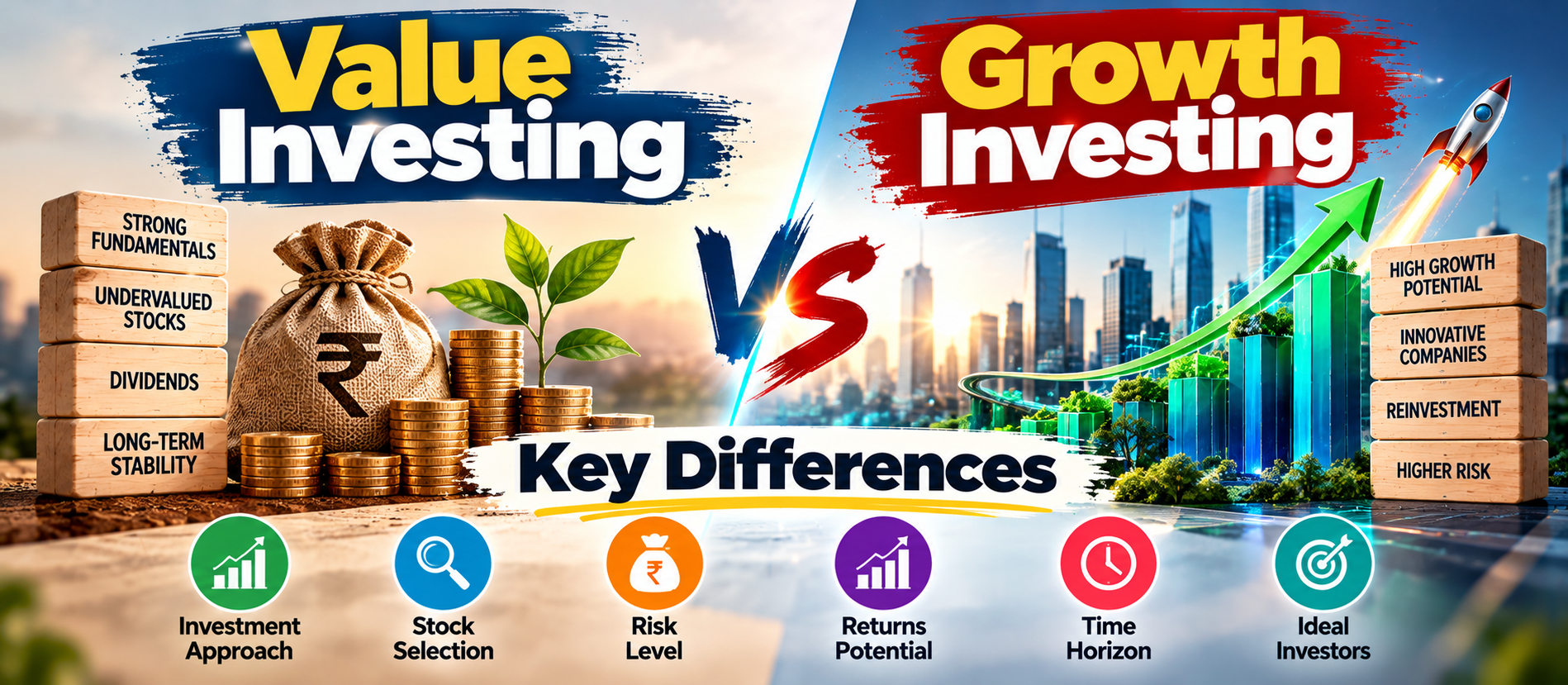
Value Investing vs. Growth Investing: The Main Differences
| FactorValue investingGrowth investing | ||
| Main focus | Price compared with estimated business value | Potential for faster future business growth |
| Core question | Is the stock priced below a reasonable estimate of its worth? | Can the company grow enough to justify its current price? |
| Valuation | Often seeks lower valuation measures relative to fundamentals | May accept higher valuation measures if growth expectations are credible |
| Business profile | May include mature, overlooked, or temporarily unpopular companies | May include expanding businesses with strong growth opportunities |
| Dividends | Some value companies pay regular dividends, but not all do | Some growth companies reinvest earnings and pay little or no dividend |
| Common risk | The business may be cheap for a valid reason | Growth may disappoint or the price may be too high |
| Potential challenge | Waiting for the market to recognise value | Meeting demanding expectations embedded in the price |
| Time horizon | Often requires patience while value is realised | Often requires patience while growth develops |
These are broad tendencies, not fixed rules. Some companies can be both value and growth investments. A business may be growing quickly while still trading at a reasonable price. Another may have a low valuation but weak growth prospects. Investors should examine the individual company rather than rely only on a category label.
How Valuation Works in Each Strategy
Valuation means estimating what an investment may be worth. It is not an exact science. Investors use financial statements, industry comparisons, assumptions about future performance, and measures of risk. Different analysts may reach different estimates because they use different assumptions.
Price-to-earnings ratio (P/E)
The price-to-earnings ratio compares a company’s share price with its earnings per share. A lower P/E may suggest that investors are paying less for each unit of current earnings. But it can also reflect concerns about falling profits, debt, competition, or uncertain prospects.
A higher P/E may reflect expectations of faster future growth. It can also indicate that investors have become too optimistic. P/E ratios are most useful when considered alongside earnings quality, growth prospects, industry conditions, debt, and the company’s own history. They can be difficult to interpret when earnings are negative or unusually high or low.
Price-to-book ratio (P/B)
The price-to-book ratio compares a company’s market value with the accounting value of its net assets. Some value investors review this measure when analysing asset-heavy businesses, such as certain financial or industrial companies. However, book value may not capture the full worth of a company whose most important assets are brand strength, software, intellectual property, or customer relationships.
Price-to-sales ratio (P/S)
The price-to-sales ratio compares market value with revenue. It may be useful when a company has low or negative earnings but generates meaningful sales. However, revenue does not automatically create profit. Investors should also examine operating costs, margins, cash flow, debt, and the company’s path toward sustainable profitability.
Cash flow and profitability
Cash flow helps show whether a company generates money from its operations. A business can report accounting profits while still facing cash-flow pressure. Investors may review operating cash flow, free cash flow, profit margins, capital spending, and working-capital needs.
For a value investor, cash flow can help test whether a low valuation is supported by the business. For a growth investor, it can help show whether expansion is becoming financially sustainable. In both cases, no single measure should replace a broader review of the company.
Simple Example: Value Stock vs. Growth Stock
Imagine two fictional companies, Company A and Company B. They operate in different industries, so the numbers below are simplified and should not be used as a direct comparison of real businesses.
Company A is an established business. It earns steady profits but has limited expected growth. Investors have become pessimistic about its industry, and its share price has fallen. Its valuation appears low compared with its recent earnings. A value investor may investigate whether the company can maintain its profits and whether the market has overestimated the risks.
Company B sells a product in a growing market. Its sales are rising quickly, and it is investing heavily to expand. Its share price reflects expectations that revenue and profits will increase significantly over the next several years. A growth investor may examine the size of the market, customer retention, competition, costs, and whether the company can meet those expectations.
Company A is not automatically the better investment because it is cheaper. Its profits could decline further. Company B is not automatically better because its sales are growing. Its future results may fall short of what the share price already assumes.
The key question for both companies is the relationship between price, business quality, and future performance. A good business can be a poor investment at the wrong price. A struggling business can remain a poor investment even when its valuation looks low.
Potential Benefits of Value Investing
1. Focus on price discipline
Value investing encourages investors to ask whether the price offers enough room for uncertainty. Paying less relative to a careful estimate of business value may provide a margin of safety, although it cannot eliminate the chance of loss.
2. Attention to financial strength
Many value strategies involve reviewing debt, cash flow, profitability, and assets. This can encourage a closer look at the company’s financial condition rather than relying only on a popular story about its future.
3. Opportunities in overlooked areas
Some companies receive less attention or become unpopular during difficult periods. Research may uncover businesses whose prospects are better than market sentiment suggests. However, investors must separate temporary pessimism from long-term decline.
4. Possible income from dividends
Some value-oriented companies distribute part of their earnings to shareholders. Dividends can be one part of an investment return, but they are not guaranteed. A high dividend yield may signal risk if the payout is not supported by cash flow.
Risks and Limitations of Value Investing
Value traps
A value trap is a stock that appears cheap but continues to perform poorly because the business has deeper problems. Falling demand, weak management, excessive debt, or a lasting loss of competitiveness can prevent a recovery. A low valuation is a reason to investigate, not proof of a bargain.
Long waiting periods
The market may take a long time to recognise an improvement, if it happens at all. An investor can be correct about a company’s underlying value but still experience years of weak returns while waiting.
Uncertain estimates of fair value
Business value depends on future assumptions. If an investor overestimates future cash flow or underestimates risk, the stock may not be as cheap as it appears. A margin of safety can help, but it cannot compensate for every mistaken assumption.
Sector and economic risks
Some sectors may face long periods of structural change. Companies in these sectors may trade at low valuations for good reasons. Investors need to understand how regulation, technology, customer preferences, and competition may affect the business.
Potential Benefits of Growth Investing
1. Exposure to expanding businesses
Growth investing can provide exposure to companies serving larger markets, developing new products, or increasing their customer base. If the business executes well, growth may increase its earnings and value over time.
2. Focus on future opportunities
Growth investors often examine innovation, customer demand, market size, and competitive advantages. This can help identify businesses that are changing how a product or service is delivered.
3. Potential for compounding business value
A company that reinvests capital effectively may expand its earnings power over time. If the company can maintain strong returns on new investments, its business value may grow. The outcome depends on execution, competition, costs, and the price investors pay.
4. Clear milestones for monitoring progress
Growth companies often have measurable goals, such as customer growth, revenue expansion, product launches, or improving profit margins. Investors can monitor these indicators to check whether the original investment case remains realistic.
Risks and Limitations of Growth Investing
High expectations
When a stock trades at a high valuation, investors may expect strong growth for many years. Even if the company continues to grow, its share price can fall if results are weaker than expected. The difference between good business performance and good investment performance is important.
Competition and disruption
A fast-growing market attracts competitors. New products, regulation, changing customer preferences, or lower-cost alternatives can weaken a company’s position. Growth is not guaranteed to continue at the same rate.
Profitability and cash-flow pressure
Expansion can require large spending on staff, marketing, equipment, technology, or new markets. If costs rise faster than revenue, the company may struggle to become profitable. Investors should examine whether growth is creating economic value or simply increasing sales at high cost.
Share-price volatility
Stocks with high growth expectations can react sharply when interest rates, economic conditions, or investor sentiment change. A company may remain operationally sound while its valuation declines. Investors should be prepared for uncertainty and avoid investing money they need soon.
Which Strategy Is Better: Value or Growth?
Neither strategy is always better. Performance can vary across market cycles, sectors, interest-rate environments, and economic conditions. A strategy that performs well for one period may lag in another. It is risky to choose an approach only because it has recently delivered strong returns.
Value investing may appeal to investors who enjoy analysing financial statements, estimating business value, and waiting for market prices to reflect that value. Growth investing may appeal to investors who focus on expanding markets, innovation, and future earnings potential. Both require research, patience, risk management, and attention to valuation.
Your choice should also reflect your wider financial plan. Consider your investment time horizon, ability to tolerate losses, need for liquidity, existing portfolio, and financial goals. You do not need to choose one strategy for every investment. Some investors hold a diversified core portfolio and use smaller allocations for specific value or growth ideas, depending on their plan and risk capacity.
For many beginners, a diversified fund may be a simpler starting point than trying to select individual value or growth stocks. Funds vary in cost, holdings, and risk, so review their investment objectives and underlying assets. A fund focused on one style or sector may still be concentrated and may not suit every investor.
Can You Combine Value and Growth Investing?
Yes. Value and growth are not mutually exclusive categories. Some companies have attractive growth prospects and still trade at a reasonable price. Some established businesses can improve their earnings while also appearing undervalued. Investors may use both approaches to broaden the range of companies they consider.
⚠ Watch Out
A combined approach still needs clear rules. Decide how much of the portfolio will follow each strategy, what evidence you will use to evaluate companies, and how you will manage concentration. Avoid adding a stock simply because it has been labelled both “value” and “growth.” Examine the actual business and its valuation.
Be aware that owning both a value fund and a growth fund does not guarantee balanced exposure. The funds may overlap, and both can lose value in a broad market decline. Review holdings, fees, sector exposure, and how the investments fit into your full portfolio.
A Practical Checklist Before Buying a Value or Growth Stock
- Understand the business: Know what the company sells, who its customers are, and how it earns money.
- Read the financial statements: Review revenue, profit margins, cash flow, debt, and other relevant measures.
- Check the valuation: Compare the share price with earnings, cash flow, assets, and realistic future assumptions.
- Understand the competitive position: Consider competitors, customer loyalty, pricing power, and potential disruption.
- Test the investment case: Ask what could go wrong and what evidence would prove your original view incorrect.
- Review the risks: Consider business, sector, market, liquidity, and concentration risks.
- Check costs and taxes: Understand transaction costs, fund expenses, and applicable tax rules.
- Protect diversification: Avoid letting one stock or one sector dominate your financial future.
- Set a review plan: Decide which business results or changes would lead you to reassess the investment.
- Keep your time horizon in mind: Do not use money needed for near-term essentials for risky stock selection.
Common Mistakes Investors Should Avoid
Buying a stock only because its price has fallen
A lower price may create an opportunity, but it may also reflect worsening business conditions. Review the reason for the decline before deciding that the stock is cheap.
Assuming a fast-growing company is automatically a good investment
Growth is valuable only when the company can turn it into sustainable economic results. Compare growth expectations with the price you would pay.
Using one valuation ratio in isolation
A low P/E or P/S ratio does not explain the full business. Consider profitability, debt, cash flow, industry conditions, and the company’s future prospects.
Ignoring diversification
Even careful research can be wrong. Spreading investments across companies and sectors can reduce the damage caused by one poor outcome, though it cannot eliminate market risk.
Reacting to short-term market noise
Daily headlines can encourage emotional decisions. Review important company information, but judge it against your original investment thesis and long-term goals.
Frequently Asked Questions
What is the main difference between value investing and growth investing?
Value investing looks for stocks priced below an estimate of their underlying business value. Growth investing looks for companies that may increase revenue or earnings faster than many other businesses. Both approaches require careful valuation and risk assessment.
Is value investing safer than growth investing?
Not automatically. A low-priced stock may face serious business problems, while a growth stock may be vulnerable to high expectations and price volatility. Risk depends on the company, its financial position, valuation, industry, and the investor’s circumstances.
Do growth stocks always have high P/E ratios?
No. Growth stocks often trade at higher valuation multiples when investors expect rapid future growth, but this is not a universal rule. Some growing companies may trade at modest valuations, and some expensive stocks may not deliver the growth investors expect.
Do value stocks always pay dividends?
No. Some value stocks pay dividends, while others reinvest earnings or do not generate enough cash to support a payout. Dividend payments can change or stop, so investors should assess the company’s financial ability to sustain them.
Can a stock be both a value stock and a growth stock?
Yes. A company may have strong growth prospects and still trade at a reasonable price relative to its expected business performance. The labels are useful ways to describe investment approaches, but they are not strict categories.
Which approach is suitable for beginners?
That depends on the person’s goals, time horizon, risk tolerance, and willingness to research individual companies. Beginners who do not want to select stocks may consider learning about diversified funds before adopting a focused value or growth strategy. No approach guarantees returns.
Should I switch strategies when market conditions change?
A change in business fundamentals or personal goals may justify a review. Switching only because one strategy has recently outperformed can lead to buying high and selling low. Use a clear plan and consider costs, taxes, and portfolio diversification before making changes.
Final Thoughts: Focus on Business Value, Not Labels
Value investing and growth investing offer two useful ways to evaluate stocks. Value investors focus on the price paid relative to estimated business worth. Growth investors focus on a company’s ability to expand its business and future earnings. Both approaches can identify opportunities, and both can lead to losses when assumptions are wrong.
Before investing, understand the company, examine its financial health, consider its competitive position, and ask whether the price is reasonable. Keep valuation and business quality in the same conversation. A strong company can disappoint if expectations are too high, and a cheap company can remain cheap if its problems persist.
Build your decisions around your own financial goals and risk capacity. Diversify, monitor your investments, and avoid relying on a single ratio or market trend. The most useful strategy is one you understand, can afford to follow, and can maintain with discipline over time.
Explore more personal finance and investing insights at Digiifrog.
Further Reading
- Investor.gov: Introduction to Investing
- Investor.gov: Stocks — FAQs
- Investor.gov: Asset Allocation and Diversification
Ready to Grow?
Talk to us about a strategy tailored to your brand — we will help you stand out in search, AI discovery and social.

Comments (0)
Log in to leave a comment.