📋 Quick Summary
In this article:
Key Objectives of Workforce Planning
Why Workforce Planning Matters for Sustainable Growth
Align Workforce Planning with Business Strategy
Questions Leaders Should Consider
Forecast Future Talent Requirements
Invest in Employee Development
Benefits of Employee Development
In today's rapidly evolving business landscape, organizations face unprecedented challenges and opportunities. Technological advancements, changing workforce demographics, remote work trends, artificial intelligence, economic uncertainty, and shifting customer expectations are transforming how businesses operate. To remain competitive and achieve long-term success, organizations must adopt effective workforce planning strategies that align talent management with business objectives.
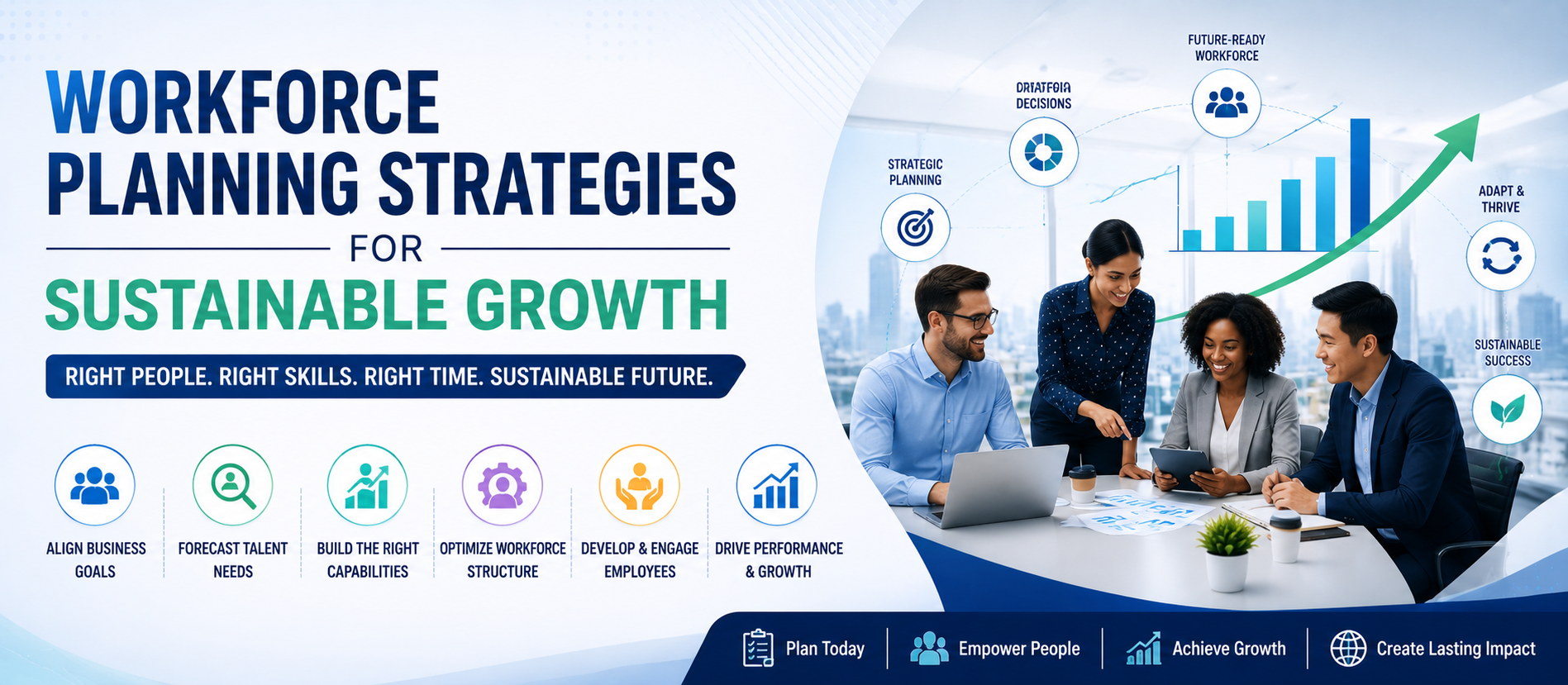
Workforce planning is a strategic process that ensures an organization has the right people, with the right skills, in the right roles, at the right time. Effective workforce planning helps businesses anticipate future talent needs, address skill gaps, improve productivity, reduce labor costs, and support sustainable growth.
This comprehensive guide explores workforce planning strategies, best practices, emerging trends, and how modern businesses can leverage SEO, AEO, GEO, and AI-driven technologies to build a future-ready workforce.
What Is Workforce Planning?
Workforce planning is the process of analyzing current workforce capabilities, forecasting future talent requirements, and developing strategies to bridge the gap between existing and future workforce needs.
Key Objectives of Workforce Planning
- Align workforce with business goals
- Identify skill shortages
- Improve workforce productivity
- Reduce recruitment risks
- Support business expansion
- Optimize labor costs
- Enhance organizational agility
Organizations that invest in workforce planning are better prepared to adapt to changing market conditions and maintain sustainable growth.
Why Workforce Planning Matters for Sustainable Growth
Sustainable growth requires more than increasing revenue. Businesses must develop the human capital needed to support long-term expansion while maintaining efficiency and profitability.
Without proper workforce planning, organizations may experience:
- Talent shortages
- High turnover rates
- Skills mismatches
- Increased recruitment costs
- Reduced productivity
- Operational inefficiencies
Strategic workforce planning helps businesses proactively address these challenges.
Align Workforce Planning with Business Strategy
Successful workforce planning begins with understanding organizational goals.
Questions Leaders Should Consider
- What are our growth objectives?
- Which markets are we entering?
- What technologies will impact operations?
- What skills will be required in the future?
- How will customer expectations evolve?
Aligning workforce plans with business strategy ensures talent investments support organizational success.
Conduct Workforce Analysis
The first step in workforce planning is understanding the current workforce.
Key Areas to Analyze
- Employee demographics
- Skill inventories
- Performance metrics
- Productivity levels
- Turnover rates
- Leadership capabilities
Comprehensive workforce analysis provides insights into strengths, weaknesses, and future needs.
Forecast Future Talent Requirements
Workforce forecasting helps organizations anticipate future staffing needs.
Factors influencing workforce demand include:
- Business growth plans
- Technological advancements
- Market expansion
- Industry trends
- Regulatory changes
- Customer demand fluctuations
Accurate forecasting enables proactive workforce management.
Identify Skills Gaps
As industries evolve, organizations must continually assess skill requirements.
Common Emerging Skills
- Artificial Intelligence
- Data Analytics
- Cybersecurity
- Cloud Computing
- Digital Marketing
- Project Management
- Leadership Development
Identifying skills gaps helps businesses develop targeted training and recruitment strategies.
Invest in Employee Development
Upskilling and reskilling employees are critical workforce planning strategies.
Benefits of Employee Development
- Improved productivity
- Higher engagement
- Better retention
- Enhanced innovation
- Greater adaptability
Organizations that prioritize learning and development create a more resilient workforce.
Build a Strong Talent Pipeline
Talent acquisition should be proactive rather than reactive.
Strategies for Building Talent Pipelines
- Employer branding
- University partnerships
- Internship programs
- Employee referrals
- Professional networking
- Talent communities
A strong pipeline reduces recruitment delays and improves hiring outcomes.
Leverage Workforce Analytics
Data-driven workforce planning improves decision-making and forecasting accuracy.
Key Metrics to Monitor
- Employee turnover
- Time-to-hire
- Training effectiveness
- Employee engagement
- Productivity rates
- Retention rates
Workforce analytics provide actionable insights for HR leaders and executives.
Embrace Flexible Workforce Models
The traditional workforce model is evolving rapidly.
Organizations increasingly rely on:
- Remote employees
- Hybrid workforces
- Freelancers
- Contract workers
- Outsourcing partners
- Gig workers
Flexible workforce models improve scalability and adaptability.
Succession Planning for Leadership Continuity
Leadership transitions can significantly impact organizational stability.
Succession planning ensures critical leadership positions can be filled quickly when necessary.
Succession Planning Benefits
- Leadership continuity
- Reduced business disruption
- Improved employee confidence
- Knowledge retention
Promote Employee Engagement and Retention
Retaining talented employees is often more cost-effective than replacing them.
Retention Strategies
- Career development opportunities
- Competitive compensation
- Recognition programs
- Flexible work arrangements
- Positive workplace culture
Engaged employees contribute significantly to sustainable business growth.
Use Artificial Intelligence in Workforce Planning
AI is transforming workforce management through predictive analytics and automation.
AI Applications
- Workforce forecasting
- Recruitment automation
- Skill gap analysis
- Performance evaluation
- Employee engagement monitoring
AI enables organizations to make faster and more informed workforce decisions.
Diversity, Equity and Inclusion (DEI)
Modern workforce planning should incorporate diversity and inclusion objectives.
Diverse teams often demonstrate:
- Greater innovation
- Improved decision-making
- Stronger collaboration
- Enhanced problem-solving capabilities
DEI initiatives contribute to organizational resilience and growth.
SEO, AEO, GEO and AI Search Considerations
Workforce planning increasingly intersects with digital transformation initiatives.
SEO Talent Needs
Organizations require SEO professionals who understand evolving search algorithms and digital visibility strategies.
AEO Expertise
Answer Engine Optimization requires specialists who can create content that directly answers user queries.
GEO Skills
Generative Engine Optimization focuses on improving visibility within AI-generated search experiences.
AI Search Readiness
As AI-driven search continues to grow, businesses need workforce capabilities that support AI content strategies and digital innovation.
Technology and Workforce Transformation
Emerging technologies are reshaping workforce requirements across industries.
Technology Trends Impacting Workforce Planning
- Artificial Intelligence
- Machine Learning
- Cloud Computing
- Automation
- Robotic Process Automation
- Data Analytics
Organizations must continuously adapt workforce strategies to remain competitive.
Common Workforce Planning Challenges
- Rapid technological change
- Skills shortages
- Talent competition
- Economic uncertainty
- Changing employee expectations
- Remote workforce management
Proactive planning helps organizations overcome these challenges effectively.
Future Trends in Workforce Planning
The future of workforce planning will be driven by AI, predictive analytics, workforce automation, skills-based hiring, and continuous learning models.
Organizations that embrace these trends will be better positioned to achieve sustainable growth and competitive advantage.
Best Practices for Workforce Planning Success
- Align workforce planning with business objectives
- Use workforce analytics
- Invest in employee development
- Promote workforce flexibility
- Leverage AI-driven insights
- Prioritize employee engagement
- Build leadership pipelines
These practices help create a resilient and future-ready workforce.
Conclusion
Workforce planning is a critical component of sustainable business growth. Organizations that proactively assess talent needs, develop employee capabilities, leverage technology, and align workforce strategies with business goals are better equipped to thrive in competitive markets.
💡 Key Insight
As technology and workforce expectations continue to evolve, effective workforce planning will become even more important for organizational success.
At Digiifrog, we help businesses achieve sustainable growth through SEO, AEO, GEO, AI Search Optimization, digital transformation, workforce innovation, and business strategy consulting.
Website: www.digiifrog.com
Contact: Connect with Digiifrog to accelerate your growth journey.
Ready to Grow?
Talk to us about a strategy tailored to your brand — we will help you stand out in search, AI discovery and social.

Comments (0)
Log in to leave a comment.