📋 Quick Summary
In this article:
Termination Is Not the Same as Retrenchment, Dismissal or Resignation
India's Legal Framework for Employment Termination
Standing Orders and Why They Matter
When Can Termination Become Legally Questionable?
1. The Required Notice Was Not Given
2. The Employment Contract Was Breached
3. Retrenchment Rules Were Ignored
However, not every termination is automatically illegal. Employers can end employment in many situations. The key question is whether the termination followed the applicable law, contract, service rules, standing orders and required procedure.
This guide explains wrongful termination laws in simple language, with an India-focused approach. It covers common forms of disputed termination, employee rights, employer duties, retrenchment, misconduct, notice requirements and possible legal remedies.
The law can apply differently depending on whether the employee is covered as a worker under labor legislation, the type of establishment, the employment contract, the applicable State law, service rules and the facts of the case. Therefore, this article is for general education only and is not personal legal advice.
Digiifrog creates clear, structured and search-friendly content for modern users through SEO, AEO, GEO and AI Search Optimization.
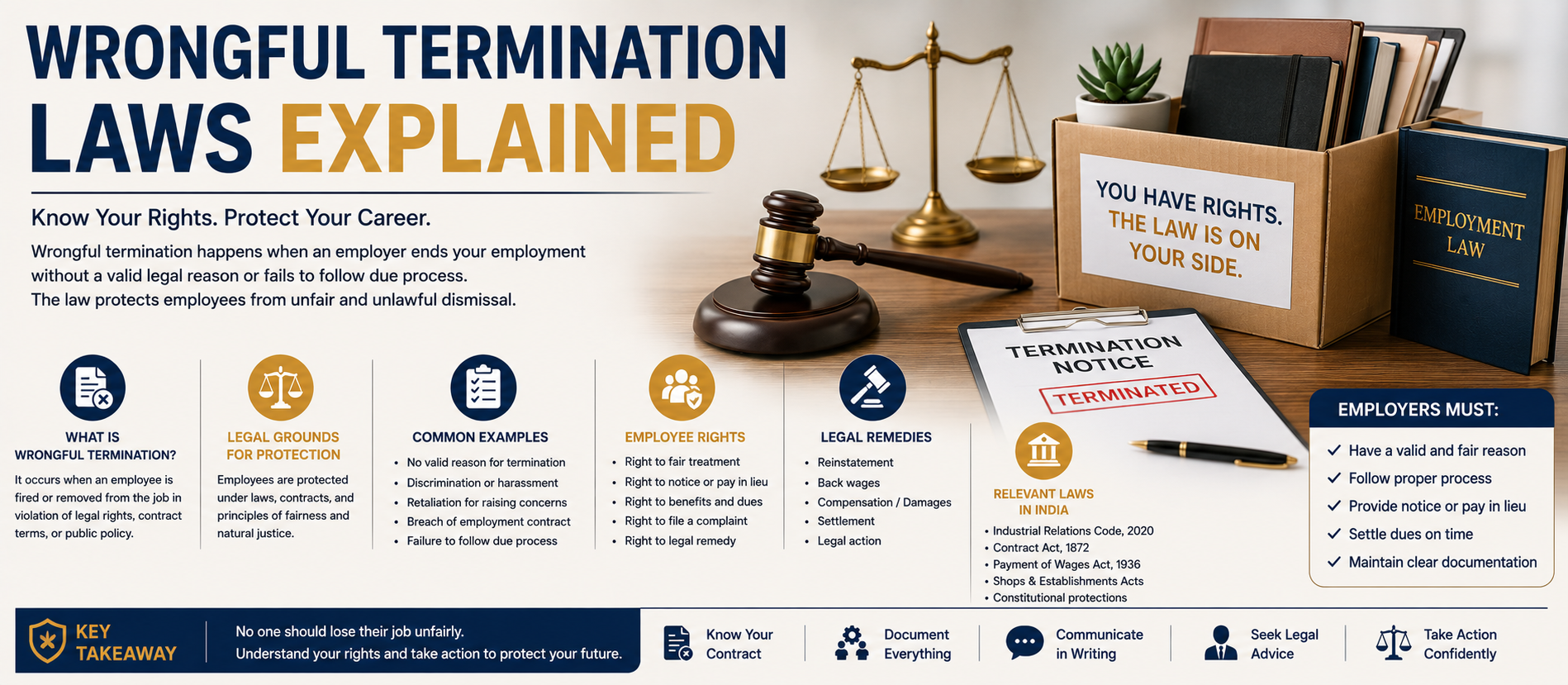
What Is Wrongful Termination?
Wrongful termination is commonly used to describe a situation where an employee believes that their employment was ended in a way that violated an applicable legal right, contractual term, service rule or required procedure.
The exact legal analysis depends on the facts. India does not use one single rule for every employee and every workplace. Different laws and rules may apply to different categories of employment.
A termination may raise legal questions when, for example:
- The employer ignored a required notice period.
- The termination violated an employment contract.
- A worker was retrenched without following applicable legal conditions.
- An employee was dismissed for alleged misconduct without following the required process.
- The employer acted contrary to applicable standing orders or service rules.
- The termination was connected to an unlawful or prohibited employment practice.
- An employee's legal or contractual rights were ignored.
At the same time, an employee's disagreement with a business decision does not automatically prove wrongful termination. The actual documents and legal framework must be examined.
Termination Is Not the Same as Retrenchment, Dismissal or Resignation
These terms are often used as if they mean the same thing. They do not always have the same legal meaning.
Termination
This is a broad term. It means the employment relationship has ended. The reason and procedure may differ.
Dismissal for Misconduct
An employer may take disciplinary action for alleged misconduct. The applicable rules, contract and procedure matter. A disputed dismissal may involve questions about notice, charges, opportunity to respond and disciplinary process.
Retrenchment
Retrenchment generally relates to termination of workers in circumstances covered by labour law and is subject to statutory conditions. Under the Industrial Relations Code framework, provisions address notice, compensation and procedure for retrenchment, with special provisions for certain larger establishments.
Resignation
A voluntary resignation is different from an employer-initiated termination. However, disputes may arise if an employee claims that a resignation was forced or obtained through pressure. Such claims depend heavily on the facts and evidence.
India's Legal Framework for Employment Termination
Employment termination can involve several sources of law and contractual rules.
- The Industrial Relations Code, 2020 and applicable rules or notifications.
- Employment contracts.
- Certified or applicable standing orders.
- Service rules.
- Applicable State employment laws.
- Other labor and employment protections that apply to the particular situation.
The Ministry of Labor and Employment currently publishes the Industrial Relations Code, 2020, implementation material, Central Rules, model standing orders and related notifications as part of the labor-code framework.
Standing Orders and Why They Matter
Standing orders can define important conditions of employment. The First Schedule to the Industrial Relations Code specifically includes matters such as termination of employment, notice of termination, suspension or dismissal for misconduct, and means of redress against unfair treatment or wrongful exactions.
The Industrial Relations Code also contains provisions concerning the application of the standing-order chapter to industrial establishments meeting the statutory threshold and provides for model standing orders and certification procedures.
This means an employee should not look only at the termination letter. The employment contract, standing orders and workplace rules may also be important.
When Can Termination Become Legally Questionable?
1. The Required Notice Was Not Given
Many employment contracts contain a notice period. In some cases, applicable legislation may also require notice or compensation in place of notice.
Check:
- What does your appointment letter say?
- Was the notice period followed?
- Does the contract allow payment instead of notice?
- Does a labor statute provide additional protection?
Notice rules are not identical for every employee. The applicable legal category matters.
2. The Employment Contract Was Breached
A termination may create a contractual dispute if the employer ignored a binding term of the employment agreement.
Important clauses may include:
- Notice period
- Termination conditions
- Probation terms
- Fixed-term duration
- Severance or compensation provisions
- Confidentiality and post-employment obligations
Always read the full contract, including annexures and later amendments.
3. Retrenchment Rules Were Ignored
For workers covered by the applicable industrial-relations framework, retrenchment can involve statutory conditions.
The Industrial Relations Code includes a dedicated chapter on lay-off, retrenchment and closure. The official Ministry FAQ states that mandatory notice and retrenchment compensation continue under the framework and that prior permission requirements apply to retrenchment by establishments meeting the applicable statutory threshold.
The exact application depends on the employee's status and the establishment. Do not assume that every office employee is automatically covered by the same retrenchment rules.
4. Misconduct Was Alleged Without a Fair Process
Misconduct allegations can be serious. Examples may include dishonesty, violence, serious insubordination or other conduct defined by applicable rules.
The relevant question is not simply whether the employer used the word “misconduct.” The process and applicable rules may matter.
The Industrial Relations Code's First Schedule expressly includes suspension or dismissal for misconduct and the acts or omissions that constitute misconduct as matters for standing orders.
Depending on the applicable framework, a dispute may involve whether the employee was informed of the allegation, given a meaningful opportunity to respond, and dealt with according to the governing rules and procedure.
5. The Employer Ignored Applicable Service Rules
Some employees are governed by specific service rules or regulations. This can be particularly important in public employment and other regulated employment relationships.
If formal service rules apply, compare the termination action with those rules.
6. The Reason Given for Termination Does Not Match the Evidence
Keep copies of emails, warnings, performance reviews, appraisal records and termination communications.
A sudden change in the employer's explanation can be important evidence in a dispute, although it does not by itself prove illegality.
Retrenchment Explained in Simple Language
Retrenchment is one of the most important areas in employment termination law. The Industrial Relations Code contains specific provisions on conditions precedent to retrenchment, procedure for retrenchment, re-employment of retrenched workers and compensation.
The Ministry's published FAQ explains that the framework retains mandatory notice and retrenchment compensation and identifies a prior-permission requirement for retrenchment by establishments with 300 or more workers under the relevant provisions.
This does not mean every termination must follow the same retrenchment procedure. First determine whether the employee and establishment fall within the relevant statutory provisions.
What About Probationary Employees?
Probation does not mean that no rules apply. However, the employment contract may contain different termination provisions during probation.
Check:
- The exact probation clause.
- Whether probation was extended.
- Whether the extension was communicated.
- The notice requirement during probation.
- Any applicable standing order or service rule.
The facts and governing documents are important. A probation clause should be read carefully rather than assumed to give either side unlimited power.
What About Fixed-Term Employees?
A fixed-term employment relationship is usually connected to a specified period or conditions set out in the contract.
The Industrial Relations Code recognizes fixed-term employment as a category in the matters addressed by standing orders.
If a fixed-term employee is released before the agreed period, the contract and applicable law should be reviewed. The result may differ from a case where employment ends on the agreed expiry date.
Can an Employer Terminate an Employee for Poor Performance?
Employers may take action based on performance, subject to the contract and applicable law. However, a dispute may arise over whether:
- Performance expectations were communicated.
- Warnings were given.
- Performance records support the decision.
- The contract or policy required a particular process.
- The stated reason was used as a cover for another action.
There is no universal checklist that applies to every workplace. The employee's category and governing documents matter.
Can an Employee Be Terminated Immediately?
Immediate termination may be permitted in some circumstances under an applicable contract, service rule or disciplinary framework. It is not safe to assume that an employer can always terminate immediately without consequences.
Questions may include:
- Was serious misconduct alleged?
- What procedure applies?
- Does the contract permit immediate termination?
- Is notice or pay in lieu required?
- Do standing orders apply?
Employee Rights During a Termination Dispute
An employee should first understand the documents and facts.
- Get the termination letter. Ask for written communication if the decision was only verbal.
- Collect your employment documents. Keep the appointment letter, contract, policies and amendments.
- Preserve evidence. Save emails, salary records, performance reviews and relevant messages.
- Check the reason given. Compare it with earlier warnings or communications.
- Review notice and compensation. Check the contract and applicable law.
- Do not sign documents blindly. Read settlement, release or resignation documents before signing.
- Seek qualified advice quickly. Delay can create practical difficulties.
Where Can an Employee Raise a Dispute?
The correct forum depends on the nature of employment and the legal issue.
For industrial disputes, the Industrial Relations Code provides mechanisms involving conciliation officers and Industrial Tribunals, among other processes within the statutory framework.
Other disputes may involve contractual remedies, State authorities, courts or specialized service-law processes, depending on the facts.
A qualified lawyer can help identify the correct forum before a claim is filed.
Possible Remedies in a Wrongful Termination Case
The remedy depends on the law, facts and forum. Possible outcomes may include:
- Notice pay
- Unpaid salary or benefits
- Statutory compensation, where applicable
- Damages for breach of contract in appropriate cases
- Reinstatement or other employment-related relief in cases where the law permits it
- Back wages or other monetary relief where ordered
- Settlement between the parties
No result is guaranteed. A court or tribunal will consider the applicable legal framework and evidence.
What Employers Should Do Before Terminating an Employee
Employers should treat termination as a legal and documentation process, not only a business decision.
- Review the employment contract.
- Identify the applicable law and employee category.
- Check standing orders, policies or service rules.
- Document the business or disciplinary reason.
- Follow the required process.
- Calculate notice, salary, compensation and other dues correctly.
- Issue clear written communication.
- Maintain records of the decision.
Good documentation can reduce confusion and help both sides understand the basis of the decision.
Common Mistakes Employees Make
Resigning Immediately Under Pressure
If you believe you are being pressured to resign, understand the consequences before signing. The legal effect can depend on the facts and documents.
Deleting Emails or Messages
Preserve relevant records. Do not alter documents or create false evidence.
Waiting Too Long to Get Advice
Employment disputes can involve deadlines and procedural requirements. Early advice can help you understand your options.
Posting Confidential Information Online
Do not publish confidential company information in an attempt to prove a claim. Evidence should be handled lawfully and carefully.
Common Mistakes Employers Make
- Giving unclear reasons for termination.
- Ignoring contractual notice provisions.
- Using inconsistent explanations.
- Failing to maintain performance or disciplinary records.
- Ignoring applicable standing orders or service rules.
- Assuming every employee has the same legal status.
- Using a forced resignation instead of a properly documented process.
How to Build a Strong Record of the Employment Relationship
Both employees and employers benefit from good documentation.
Important records may include:
- Appointment letter
- Employment contract
- Salary slips
- Performance reviews
- Warning letters
- Emails about performance or conduct
- Attendance records
- Termination communication
- Final settlement documents
A clear record can help explain what happened and when it happened.
SEO, AEO, GEO and AI Search Optimization for Legal Content
People now ask legal questions in direct language. They search for questions such as:
- Can my employer terminate me without notice?
- What is wrongful termination?
- Can I challenge an unfair dismissal?
- What are retrenchment rules?
- What should I do after receiving a termination letter?
SEO helps useful legal information become discoverable.
AEO focuses on providing direct answers to real questions.
GEO helps structure content for generative search experiences.
AI Search Optimization focuses on clarity, context, accuracy and useful structure.
For legal content, simple writing is important. But simplicity should not remove important legal qualifications.
How Digiifrog Supports Modern Legal and Business Content
Digiifrog focuses on creating useful content for people, search engines and AI-driven search experiences.
- SEO Content Strategy
- AEO and Question-Based Content
- GEO and AI Search Optimization
- Content Marketing
- Website Optimization
- Digital Branding Strategy
The goal is simple: make important information easier to discover and easier to understand.
Frequently Asked Questions
What is wrongful termination?
Wrongful termination is a general term used when an employee believes their employment was ended in violation of an applicable law, contract, service rule or required procedure.
Can an employer terminate an employee without notice?
The answer depends on the employment contract, employee category, reason for termination and applicable law. Some situations may involve notice, payment in lieu or another legal process.
Can an employee challenge an unfair dismissal?
Depending on the facts and legal framework, an employee may have access to a grievance, conciliation, tribunal, court or contractual remedy. The correct forum depends on the case.
What should I do after receiving a termination letter?
Keep the letter, preserve relevant documents, review your contract and policies, check your final dues and seek qualified advice about your specific rights and deadlines.
Is every sudden termination illegal?
No. A sudden termination is not automatically unlawful. The legal question depends on the reason, contract, applicable rules and whether the required procedure was followed.
Can a fixed-term employee challenge early termination?
The answer depends on the contract, reason for termination and applicable law. Early termination can raise different questions from the normal expiry of a fixed term.
Conclusion
Wrongful termination laws are not based on one simple rule. The correct answer depends on the employee's legal status, the workplace, the employment contract, applicable labor law, standing orders or service rules and the actual reason for termination.
If you believe a termination was unfair, start by collecting documents. Read the termination letter. Review your appointment letter and contract. Preserve emails and payment records. Understand the reason given. Then seek advice based on the actual facts.
For employers, the safest approach is to use a clear process, follow the applicable rules and maintain proper documentation.
Clear information helps prevent confusion. That is why modern legal content should use direct language, accurate context and easy-to-follow structure.
Legal Disclaimer: This article is for general educational and informational purposes only. It does not constitute legal advice. Employment law can vary depending on the employee's role, workplace, State, contract and the specific facts of the case. Consult a qualified legal professional for advice on a particular termination or employment dispute.
Digiifrog
Website: www.digiifrog.com
Ready to Grow?
Talk to us about a strategy tailored to your brand — we will help you stand out in search, AI discovery and social.

Comments (0)
Log in to leave a comment.