📋 Quick Summary
In this article:
Why Year-End Tax Planning Matters
1. Review Your Total Income
2. Check Your Tax Withholding
Retirement and Investment Review
5. Evaluate Capital Gains and Losses
6. Review Charitable Giving
7. Gather Receipts and Tax Documents
10. Estimate Your Tax Bill or Refund
11. Review Estimated Tax Payments
13. Check Your Filing Status and Dependents
15. Check for Tax Law Changes
17. Avoid Last-Minute Tax Mistakes
A year-end tax planning checklist can help individuals and families review income, deductions, credits, retirement contributions, investments, charitable giving, and tax withholding before the calendar year closes. Good tax planning is not about finding a last-minute trick. It is about understanding what happened during the year, identifying legitimate opportunities, keeping proper records, and avoiding surprises when the tax return is prepared.
💡 Key Insight
For U.S. taxpayers, year-end planning is especially important because many tax decisions depend on actions taken before December 31. Some retirement contributions, however, may have different deadlines. The IRS also changes tax thresholds and contribution limits periodically, so taxpayers should use the rules that apply to the specific tax year.
For tax year 2026, the IRS says the standard deduction is $16,100 for single filers, $32,200 for married couples filing jointly, and $24,150 for heads of household. The 2026 federal marginal tax rates remain 10%, 12%, 22%, 24%, 32%, 35%, and 37%. citeturn0search0turn0search4
This WordPress-ready HTML article is prepared for Digiifrog (www.digiifrog.com) with SEO, AEO, GEO, and AI Search optimization.
Why Year-End Tax Planning Matters
Waiting until tax-filing season can limit your options. By December, you may still be able to adjust withholding, make eligible retirement contributions through payroll, realize gains or losses in taxable investments, make charitable gifts, organize deductible expenses, or prepare for a change in income.
Year-end planning also helps identify missing documents and potential tax payments before deadlines become urgent.
1. Review Your Total Income
Start by estimating your total income for the year. Include wages, bonuses, freelance income, business income, interest, dividends, investment gains, rental income, retirement distributions, and other taxable sources.
Changes in income can affect tax brackets, credits, deductions, estimated payments, and eligibility for certain benefits. A year with unusually high income may require different planning from a year with lower income.
2. Check Your Tax Withholding
Employees and people receiving certain other income should review whether enough tax has been paid during the year. The IRS notes that federal income taxes generally operate on a pay-as-you-go system and provides a Tax Withholding Estimator for taxpayers who need to evaluate their withholding. citeturn0search9turn0search14
If your income, marital status, dependents, deductions, or other financial circumstances changed, your withholding may need attention. An updated Form W-4 can change future paycheck withholding.
Retirement and Investment Review
Review workplace retirement contributions, eligible IRA opportunities, and taxable investment gains or losses. Check the current IRS limits and deadlines before making additional contributions. For taxable investments, consider gains, losses, fees, diversification, and the wash-sale rules rather than making a sale solely for a tax benefit. citeturn0search10turn0search15
5. Evaluate Capital Gains and Losses
If you have investments in a taxable account, review realized and unrealized gains and losses. Selling an investment can create a taxable capital gain or loss, so year-end portfolio decisions should consider both investment objectives and tax consequences.
Tax-loss harvesting can sometimes help offset capital gains, but it should not be used simply to create a tax deduction if selling would damage a sound investment strategy. Consider the wash-sale rules and the investment implications before acting.
6. Review Charitable Giving
If charitable donations are part of your financial plan, make sure qualifying gifts are completed and documented properly. The IRS says taxpayers should keep records of contributions and verify that organizations qualify for deductible donations.
For tax year 2026, the IRS says taxpayers who do not itemize may be able to deduct up to $1,000 of qualifying cash contributions, or $2,000 for married couples filing jointly, subject to the applicable rules. citeturn0search6
7. Gather Receipts and Tax Documents
Organize documents before the new year begins. The IRS recommends keeping records for items such as retirement contributions, charitable donations, mortgage and property-tax information where relevant, healthcare expenses, education expenses, and self-employment income and expenses. citeturn0search12
Also collect W-2s, 1099s, brokerage statements, bank statements, estimated-tax payment records, and digital-asset transaction information when applicable.
10. Estimate Your Tax Bill or Refund
A refund is not necessarily a sign that you paid less tax. It generally means more tax was paid during the year than was ultimately owed. Conversely, a balance due can occur when withholding or estimated payments were insufficient.
⚠ Watch Out
Estimate your likely tax liability before year-end so you can plan your cash flow and avoid an unpleasant surprise.
11. Review Estimated Tax Payments
Self-employed individuals, investors, retirees, and others with income that is not fully subject to withholding may need estimated tax payments. Compare year-to-date payments with expected taxable income and applicable safe-harbor requirements.
The IRS provides Publication 505 and other resources for taxpayers who need to calculate withholding and estimated taxes. citeturn0search2
13. Check Your Filing Status and Dependents
Review whether your expected filing status and dependent information are correct. Changes in marriage, divorce, household composition, or support arrangements can affect filing requirements and eligibility for certain tax benefits.
15. Check for Tax Law Changes
Tax rules can change from one year to the next. For 2026, the IRS has published inflation-adjusted tax brackets, deductions, and other provisions, including changes resulting from recent legislation. citeturn0search0turn0search3
Use current IRS guidance when making year-end decisions rather than relying on an older checklist or social-media post.
17. Avoid Last-Minute Tax Mistakes
- Do not make a financial decision solely because someone says it will “save taxes.”
- Do not claim deductions without supporting records.
- Do not ignore income from side jobs, investments, or digital assets.
- Do not assume every retirement contribution has the same deadline.
- Do not overlook estimated-tax obligations.
- Do not wait until filing season to discover missing documents.
- Do not rely on outdated tax brackets or contribution limits.
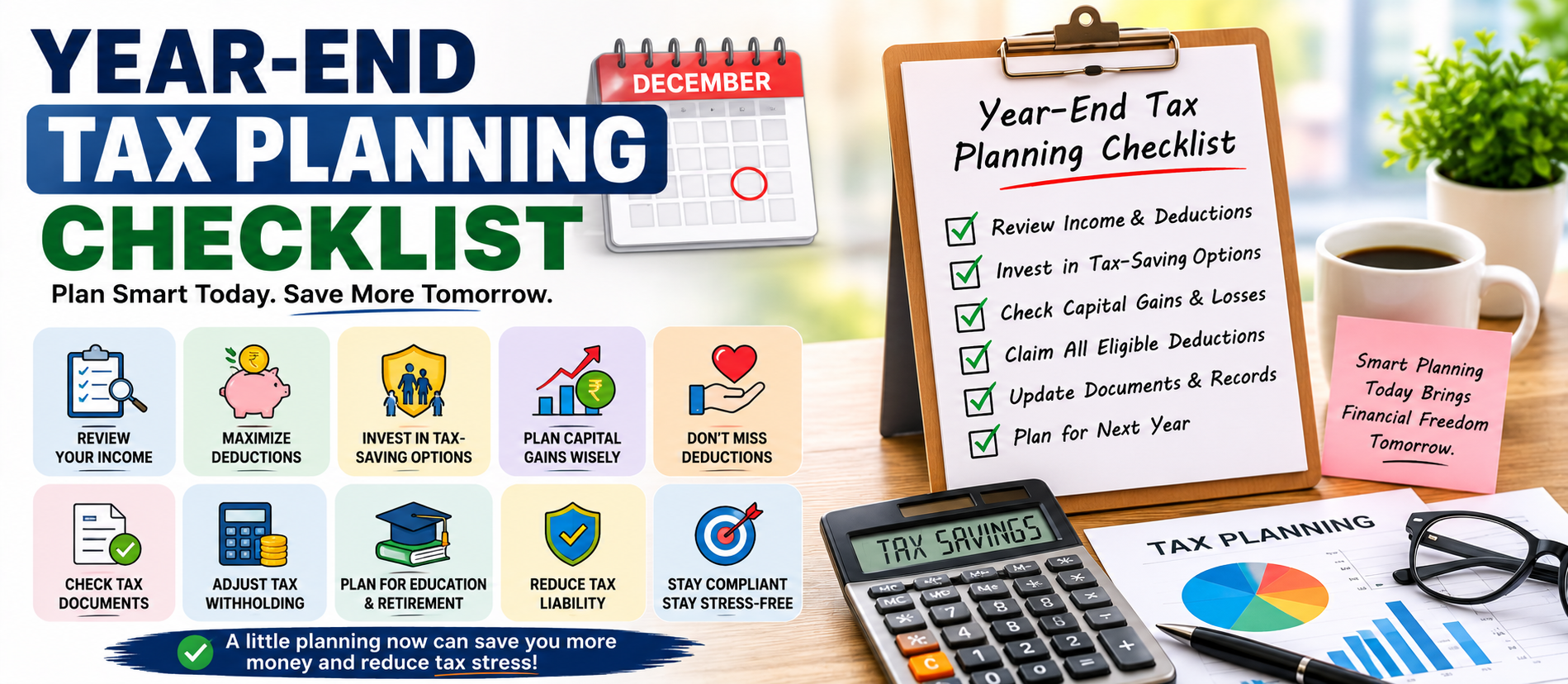
Year-End Tax Planning Checklist
- Estimate total annual income.
- Review federal and state tax withholding.
- Check retirement-plan contributions.
- Review IRA contribution opportunities.
- Evaluate taxable investment gains and losses.
- Complete planned charitable gifts and keep receipts.
- Gather W-2s, 1099s, brokerage statements, and other records.
- Estimate your likely tax bill or refund.
- Review estimated tax payments if applicable.
- Organize business income and expense records.
- Confirm filing status and dependent information.
- Check current tax-law changes.
- Consult a qualified tax professional when your situation is complex.
SEO, AEO, GEO and AI Search Optimization
SEO content about year-end tax planning should target searches such as “year-end tax planning checklist,” “tax planning before December 31,” “retirement contribution tax planning,” and “how to reduce taxable income.”
AEO should answer direct questions such as “What should I do before the tax year ends?”, “How can I check my tax withholding?”, and “What tax documents should I gather?”
GEO and AI Search optimization can be improved with country-specific tax information, current official sources, concise answers, structured headings, practical checklists, FAQs, and clear distinctions between general education and personalized tax advice.
Frequently Asked Questions About Year-End Tax Planning
What should I do before the tax year ends?
Review income, withholding, retirement contributions, investments, charitable giving, tax documents, estimated payments, and major life changes. Focus on actions that must be completed before the relevant deadline.
Should I increase my retirement contributions at year-end?
It may make sense if you have available cash flow and the contribution fits your retirement and tax strategy. Workplace-plan contribution deadlines and limits should be checked before acting. The IRS publishes current limits and rules each year. citeturn0search10
How can I avoid an unexpected tax bill?
Estimate your annual income and tax liability, review withholding, make required estimated payments when applicable, and account for investment or self-employment income that may not have tax withheld.
When should I consult a tax professional?
Professional guidance can be especially useful when you have a business, substantial investments, complex retirement accounts, major life changes, international income, significant charitable giving, or other situations where tax rules are difficult to apply.
Conclusion
A year-end tax planning checklist can help you enter the new tax year organized, prepared, and less likely to face avoidable surprises. The key is to review income, withholding, retirement savings, investments, charitable contributions, deductions, credits, records, and major life changes before deadlines pass.
For 2026, the IRS has published updated tax brackets and standard deductions, along with updated retirement contribution rules. citeturn0search0turn0search10 Because tax law can change, always verify current rules with the IRS or a qualified tax professional before making a significant tax decision.
For finance websites, tax-planning platforms, businesses, and service providers seeking modern websites, content marketing, automated lead generation, SEO, AEO, GEO, and AI Search optimization, Digiifrog can help. Visit www.digiifrog.com.
Quick Answer: What Is a Year-End Tax Planning Checklist?
A year-end tax planning checklist is a review of income, tax withholding, retirement contributions, investments, charitable giving, deductions, credits, estimated payments, and tax records before the tax year closes. For 2026, taxpayers should also check current IRS tax brackets, standard deductions, retirement limits, and recently changed tax provisions before taking action.
Important Note
This article focuses primarily on U.S. federal individual tax planning and uses 2026 IRS information. State, local, business, and international tax rules may differ. Tax laws can change, and eligibility for deductions, credits, and contributions depends on individual circumstances. This article is educational content, not personalized tax, financial, investment, or legal advice.
Ready to Grow?
Talk to us about a strategy tailored to your brand — we will help you stand out in search, AI discovery and social.
Comments (0)
Log in to leave a comment.