📋 Quick Summary
In this article:
Quick Answer: How Does AI Help Renewable Energy?
What Is Artificial Intelligence in the Energy Sector?
1. AI in Solar Energy
AI and Solar Site Optimization
2. AI in Wind Energy
Introduction
Artificial Intelligence is becoming an important part of the global transition toward cleaner energy. Renewable energy sources such as solar power, wind power, hydropower, and other low-carbon technologies are expanding. At the same time, energy systems are becoming more complex.
Renewable energy production can change with sunlight, weather, wind speed, demand, and other conditions. Managing these changes requires accurate data, fast analysis, and better decision-making.
This is where Artificial Intelligence can help.
AI can analyze large amounts of energy data, identify patterns, predict future conditions, improve equipment performance, support smart grids, and help energy companies make faster decisions.
💡 Key Insight
💡 Key Insight
The combination of AI and renewable energy does not mean that machines solve every energy problem automatically. Engineers, operators, policymakers, and energy experts remain essential. However, AI can provide useful tools for managing increasingly complex energy systems.
This guide explains AI and Renewable Energy Innovations in simple and clear language. It covers how AI is changing solar and wind energy, smart grids, energy storage, forecasting, predictive maintenance, energy efficiency, and the future of clean energy technology.
Quick Answer: How Does AI Help Renewable Energy?
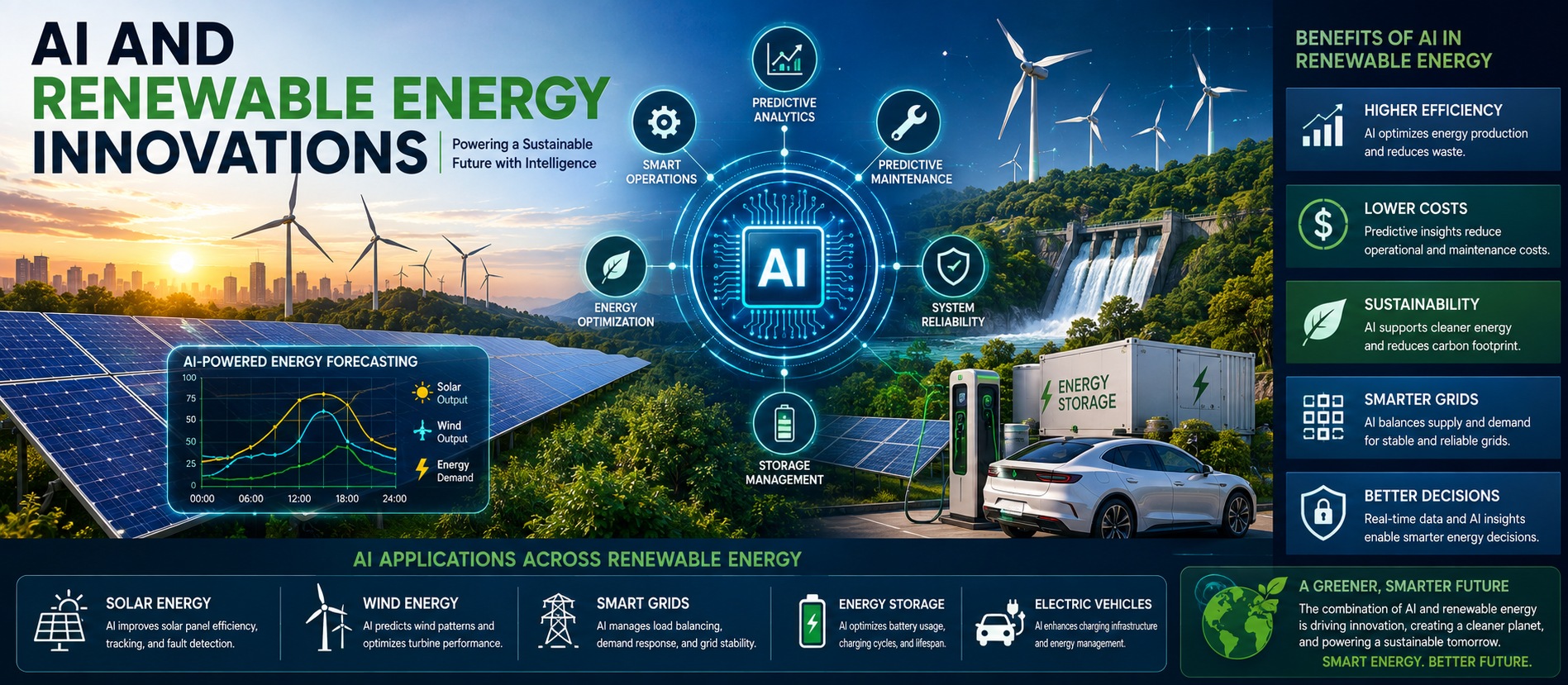
AI helps renewable energy systems by analyzing large amounts of data and identifying useful patterns. It can improve energy forecasting, optimize solar and wind operations, support smart grids, predict equipment maintenance needs, manage energy storage, and improve overall efficiency.
What Is Artificial Intelligence in the Energy Sector?
Artificial Intelligence refers to computer systems that can analyze information, identify patterns, make predictions, and support decisions.
In the energy sector, AI can process information from many sources, including:
- Weather forecasts
- Solar radiation data
- Wind speed measurements
- Energy demand records
- Smart meters
- Grid sensors
- Battery systems
- Power generation equipment
Traditional software can follow fixed rules. AI can also identify patterns in large datasets and make predictions based on historical and current information.
For example, an AI system may analyze historical electricity demand, weather conditions, time of day, and recent energy usage. It can then help forecast future demand.
Better forecasts can help energy operators prepare for changes in supply and demand.
Why Renewable Energy Needs AI
Renewable energy is essential for reducing dependence on fossil fuels. However, some renewable energy sources are variable.
Solar power production changes based on sunlight, cloud cover, time of day, and seasonal conditions. Wind power depends on wind speed and weather patterns.
Energy demand also changes throughout the day.
This creates a balancing challenge.
Energy systems must match electricity supply and demand while maintaining stability and reliability.
AI can help by:
- Forecasting renewable energy production
- Predicting electricity demand
- Optimizing equipment performance
- Managing battery storage
- Detecting unusual equipment behavior
- Supporting faster grid decisions
- Reducing energy waste
AI is therefore becoming an important supporting technology for modern energy systems.
1. AI in Solar Energy
Solar power is one of the most widely used forms of renewable energy. Solar panels convert sunlight into electricity, but energy production changes throughout the day.
AI can help solar energy systems operate more effectively.
Solar Power Forecasting
One major application is solar energy forecasting.
AI models can analyze:
- Historical solar production
- Weather information
- Cloud conditions
- Seasonal patterns
- Time of day
The system can use these patterns to estimate future solar energy production.
Accurate forecasting can help grid operators plan how to balance available electricity.
Solar Panel Monitoring
Large solar facilities may contain thousands of panels.
Monitoring every panel manually can be difficult.
AI can analyze performance data and help identify unusual patterns that may indicate:
- Reduced output
- Possible equipment issues
- Unexpected performance differences
- Potential maintenance needs
Human technicians can then investigate the issue.
AI and Solar Site Optimization
AI and advanced analytics can also support planning and operations.
Data can help developers understand local weather patterns, expected production, equipment performance, and other operational factors.
However, solar projects still require professional engineering, environmental review, site analysis, and compliance with local regulations.
2. AI in Wind Energy
Wind energy is another major area where AI can provide value.
Wind turbines operate in changing environmental conditions. Their performance can depend on wind speed, wind direction, temperature, equipment condition, and other factors.
Wind Power Forecasting
AI can analyze weather data and historical turbine performance to support wind power forecasting.
Better forecasting can help operators estimate how much electricity may be available from a wind farm.
Predictive Maintenance for Wind Turbines
Wind turbines contain important mechanical and electrical components.
Sensors can collect information about vibration, temperature, speed, and other operating conditions.
AI can analyze this data and identify unusual patterns.
If a pattern suggests that a component may need attention, maintenance teams can investigate before a serious failure occurs.
This approach is commonly called predictive maintenance.
Improving Turbine Performance
AI and analytics can also help operators understand how turbines perform under different conditions.
The goal is to improve operational efficiency while maintaining safety and equipment reliability.
3. AI and Smart Grids
A smart grid uses digital technologies, sensors, communication systems, and advanced software to improve how electricity is managed.
Traditional power systems were designed around large, centralized power plants. Modern energy systems are becoming more decentralized.
Electricity may now come from:
- Large solar farms
- Rooftop solar systems
- Wind farms
- Battery storage systems
- Other distributed energy resources
This creates more data and more operational complexity.
AI can help smart grids analyze information from connected devices and support decisions.
Demand Forecasting
AI can help estimate future electricity demand using factors such as:
- Historical consumption
- Time of day
- Weather conditions
- Seasonal trends
Forecasts can help grid operators prepare for expected changes.
Grid Monitoring
Connected sensors can provide information about parts of the electricity network.
AI can help analyze this information and identify unusual conditions that may require human attention.
Managing Distributed Energy
As more homes and businesses produce electricity through solar systems and other technologies, managing energy flows becomes more complex.
AI can support analysis and coordination across distributed energy resources.
4. AI and Energy Storage
Energy storage is an important part of the renewable energy transition.
Batteries can store electricity for use when production or demand changes.
For example, a battery system may store excess electricity generated during periods of strong solar production and release energy later when it is needed.
AI can support battery management by analyzing:
- Energy demand
- Renewable energy forecasts
- Battery condition
- Charging and discharge patterns
The goal is to support better decisions about when energy should be stored or used.
Battery Health Monitoring
Battery systems can also generate operational data.
AI and analytics may help identify patterns related to battery performance and condition.
This can support maintenance planning and long-term asset management.
5. AI for Energy Demand Forecasting
Electricity demand changes constantly.
Demand can increase or decrease because of:
- Weather
- Business activity
- Time of day
- Seasonal changes
- Consumer behavior
AI can analyze historical and current information to create demand forecasts.
Better forecasting may help energy providers:
- Prepare for peak demand
- Manage available energy resources
- Reduce unnecessary waste
- Improve planning
No forecast is perfect. Weather and human behavior can change unexpectedly. AI forecasting should therefore be used as part of a broader energy management process.
6. Predictive Maintenance in Renewable Energy
Renewable energy equipment requires regular maintenance.
Solar systems, wind turbines, batteries, inverters, and other equipment can experience wear or unexpected problems.
Traditional maintenance may follow a fixed schedule or begin after equipment fails.
Predictive maintenance uses data to identify possible problems earlier.
A typical process may include:
- Sensors collect equipment data.
- The information is stored and processed.
- AI analyzes historical and current patterns.
- The system identifies unusual behavior.
- Maintenance teams review the information.
- Technicians decide whether action is needed.
This can help organizations reduce unexpected downtime when implemented correctly.
7. AI and Energy Efficiency
Renewable energy is only one part of a sustainable energy strategy.
Using energy more efficiently is also important.
AI can support energy efficiency in:
- Commercial buildings
- Factories
- Data centers
- Homes
- Transportation systems
Connected devices can collect information about energy use. AI can then identify consumption patterns and possible opportunities for improvement.
Smart Buildings
AI-enabled building systems may analyze information from occupancy sensors, temperature sensors, lighting systems, and energy meters.
The system can support decisions about heating, cooling, lighting, and other building operations.
The goal is to maintain comfort and operational requirements while reducing unnecessary energy use.
8. AI in Hydropower
Hydropower remains an important renewable energy source in many regions.
AI and data analytics can support hydropower operations by analyzing equipment performance, water-related data, weather information, and electricity demand.
Potential uses include:
- Equipment monitoring
- Maintenance planning
- Operational forecasting
- Efficiency analysis
Hydropower management also involves environmental, safety, engineering, and regulatory considerations that require expert oversight.
9. AI and Renewable Energy Forecasting
Forecasting is one of the most valuable applications of AI in clean energy.
Energy companies need to estimate how much electricity renewable sources may produce.
AI models can combine different data sources to identify useful relationships.
For example, an AI system may examine weather patterns, historical production, current sensor data, and seasonal trends.
The resulting forecast can help operators plan for expected changes in energy availability.
Better forecasting supports a more flexible and responsive energy system.
10. AI for Climate and Energy Data Analysis
The energy transition involves large and complex datasets.
AI can help researchers and organizations process information from:
- Weather systems
- Satellite observations
- Energy infrastructure
- Electricity markets
- Environmental monitoring systems
AI can make it easier to identify patterns and generate useful insights.
However, important scientific and policy decisions should rely on reliable evidence, transparent methods, and qualified human expertise.
11. AI and Electric Vehicles
Electric vehicles are becoming increasingly connected to the wider energy ecosystem.
AI can support areas such as:
- Charging demand forecasting
- Route and energy optimization
- Battery performance analysis
- Charging infrastructure planning
As electric vehicle adoption grows, managing charging demand may become increasingly important for electricity networks.
AI can help operators understand demand patterns and plan energy resources more effectively.
12. AI and Renewable Energy Trading
Energy markets can involve changing prices, demand, weather conditions, and available generation.
AI and advanced analytics can help organizations process large amounts of market and operational information.
Possible uses include:
- Demand analysis
- Generation forecasting
- Risk analysis
- Operational planning
Energy market decisions involve financial and regulatory risks. AI output should not be treated as guaranteed financial advice.
Benefits of AI and Renewable Energy Innovations
1. Improved Forecasting
AI can help estimate future renewable energy production and electricity demand.
2. Better Energy Efficiency
AI can identify patterns in energy use and support more efficient operations.
3. Reduced Equipment Downtime
Predictive maintenance can help maintenance teams investigate potential problems earlier.
4. Smarter Energy Storage
AI can support decisions about battery charging and energy use.
5. Faster Data Analysis
Energy systems generate large amounts of information. AI can process this data more quickly than manual analysis.
6. Support for Smart Grids
AI can help manage increasingly complex networks with distributed energy resources.
7. Better Resource Planning
Data-driven insights can help organizations plan operations more effectively.
Challenges of Using AI in Renewable Energy
AI offers important opportunities, but it also creates challenges.
Data Quality
AI systems depend on reliable data.
Incorrect, incomplete, or inconsistent information can reduce the quality of predictions and recommendations.
Cybersecurity
Modern energy systems increasingly use connected devices and digital platforms.
This creates cybersecurity risks that must be managed carefully.
Cost and Infrastructure
AI systems may require sensors, data platforms, computing resources, skilled professionals, and ongoing maintenance.
Skills and Training
Energy organizations may need professionals with knowledge of engineering, data science, software, cybersecurity, and energy operations.
Model Reliability
AI predictions can be wrong. Models may perform differently when conditions change.
Human oversight and continuous evaluation are important.
Cybersecurity in AI-Powered Energy Systems
Energy infrastructure is critical infrastructure in many countries.
AI and connected systems should therefore be designed with strong cybersecurity practices.
Important measures may include:
- Strong authentication
- Access controls
- Regular software updates
- Network monitoring
- System segmentation
- Secure data handling
- Incident response planning
Security should be considered from the beginning of a project.
How Businesses Can Start Using AI for Renewable Energy
Businesses should start with a clear problem instead of adopting AI simply because it is popular.
Step 1: Identify the Energy Challenge
Examples may include high energy costs, equipment downtime, poor forecasting, or inefficient operations.
Step 2: Review Available Data
Determine what information is already available and whether additional sensors or data systems are needed.
Step 3: Choose the Right AI Use Case
Possible starting points include energy forecasting, predictive maintenance, building energy optimization, or battery management.
Step 4: Run a Pilot Project
Start with a focused project before expanding across the organization.
Step 5: Measure Results
Track meaningful outcomes such as energy savings, reduced downtime, improved forecasting, or faster operational decisions.
Step 6: Scale Carefully
Expand only after the organization understands the technical, financial, and operational results.
The Role of Edge AI in Renewable Energy
Not every energy system can send all data to a distant cloud platform.
Edge AI processes information close to where it is generated.
For example, an AI-enabled device near a renewable energy facility may analyze sensor data locally.
Potential benefits include:
- Faster response times
- Reduced network traffic
- Lower latency
- Continued operation during limited connectivity
Many modern systems may use a combination of edge computing and cloud computing.
The Future of AI and Renewable Energy
AI is likely to become increasingly important as energy systems become more digital and decentralized.
Future developments may include:
- More accurate renewable energy forecasting
- Advanced battery management
- Smarter distributed energy networks
- Improved predictive maintenance
- Greater use of edge AI
- AI-powered building energy management
- Better integration of electric vehicles and power systems
- More advanced energy simulations
The future will depend on technology, investment, regulation, infrastructure, cybersecurity, and public policy.
AI and the Transition to a Smarter Energy System
The energy system of the future may include millions of connected devices.
Homes may generate solar power. Businesses may use battery storage. Electric vehicles may add new electricity demand. Wind and solar farms may produce energy based on changing weather conditions.
Managing this complex environment requires better information and faster analysis.
AI can help energy organizations understand what is happening and prepare for what may happen next.
Its greatest value may come from supporting people and systems rather than replacing them.
SEO, AEO, GEO, and AI Search Optimization for Renewable Energy Content
The way people search for information is changing.
Traditional search engines remain important, but many users now ask AI-powered search tools direct questions.
For this reason, renewable energy content should be clear, structured, and easy to understand.
- SEO: Search Engine Optimization
- AEO: Answer Engine Optimization
- GEO: Generative Engine Optimization
- AI Search Optimization: Creating content that is clear and useful for AI-assisted discovery
Strong content should include direct answers, clear headings, useful explanations, practical examples, and relevant questions.
Simple language can improve readability for both human readers and AI systems.
❓ Frequently Asked Questions
How is AI used in renewable energy?▾
AI is used in renewable energy for forecasting, equipment monitoring, predictive maintenance, energy storage management, smart grid operations, and energy efficiency analysis.
Can AI improve solar energy production?▾
AI can help improve solar operations by forecasting solar output, analyzing equipment performance, and identifying unusual patterns that may require maintenance.
How does AI help wind energy?▾
AI can analyze weather and turbine data to support power forecasting, performance analysis, and predictive maintenance.
What is AI predictive maintenance in renewable energy?▾
AI predictive maintenance uses sensor and equipment data to identify patterns that may indicate a possible future maintenance need. Human maintenance teams then investigate and decide what action is required.
Can AI help manage renewable energy storage?▾
Yes. AI can analyze energy demand, renewable production forecasts, and battery conditions to support decisions about charging, storing, and using energy.
What is the role of AI in smart grids?▾
AI can help smart grids forecast demand, analyze sensor data, monitor changing conditions, and support the management of distributed energy resources.
What are the risks of AI in energy systems?▾
Important risks include poor data quality, cybersecurity threats, unreliable predictions, high implementation costs, and over-reliance on automated recommendations.
Will AI make renewable energy more efficient?▾
AI can support greater efficiency by improving forecasting, monitoring equipment, reducing unnecessary energy use, and helping operators make more informed decisions. Results depend on the quality of the technology and how it is implemented.
AI Search and Featured Snippet Summary▾
Question: How does AI improve renewable energy? Direct Answer: AI improves renewable energy by analyzing weather, sensor, equipment, and energy demand data. It can forecast solar and wind production, predict maintenance needs, optimize energy storage, support smart grids, and improve overall energy efficiency.
Key Takeaways
- AI is becoming an important technology in the renewable energy sector.
- AI can analyze large amounts of energy and weather data.
- Solar energy systems can use AI for forecasting and equipment monitoring.
- Wind energy can benefit from AI forecasting and predictive maintenance.
- Smart grids can use AI to support demand forecasting and grid monitoring.
- AI can help manage batteries and other energy storage systems.
- Predictive maintenance can help identify unusual equipment behavior earlier.
- AI can improve energy efficiency in buildings, factories, and other systems.
- Cybersecurity and reliable data are essential for AI-powered energy systems.
- Businesses should begin with clear use cases and measurable goals.
- The future of clean energy will increasingly combine renewable power, digital systems, connected devices, and AI.
Conclusion
AI and renewable energy innovations are creating new opportunities for a smarter and more flexible energy system.
Renewable energy technologies generate valuable data from weather systems, sensors, equipment, batteries, and electricity networks. AI can help transform this information into useful forecasts, insights, and operational support.
AI can improve solar and wind forecasting, support predictive maintenance, optimize energy storage, improve efficiency, and help manage increasingly complex smart grids.
However, technology alone is not enough.
Successful AI adoption requires reliable data, skilled professionals, cybersecurity, responsible governance, strong infrastructure, and clear business goals.
The future of renewable energy will depend on innovation across many areas. AI is not the only solution, but it can become an important tool for helping people manage cleaner, smarter, and more resilient energy systems.
About Digiifrog
Digiifrog creates clear, useful, and search-optimized content for modern SEO, AEO, GEO, and AI Search environments. Visit www.digiifrog.com for more content about Artificial Intelligence, renewable energy, technology, digital innovation, and online growth.
Disclaimer
This article is for educational and informational purposes only. Energy technologies, AI systems, regulations, market conditions, and technical capabilities can change over time. Businesses and organizations should consult qualified engineers, energy professionals, cybersecurity experts, and relevant legal or regulatory authorities before implementing AI-powered energy systems.
Ready to Grow?
Talk to us about a strategy tailored to your brand — we will help you stand out in search, AI discovery and social.
Comments (0)
Log in to leave a comment.