📋 Quick Summary
In this article:
What Is AI-Powered Threat Detection?
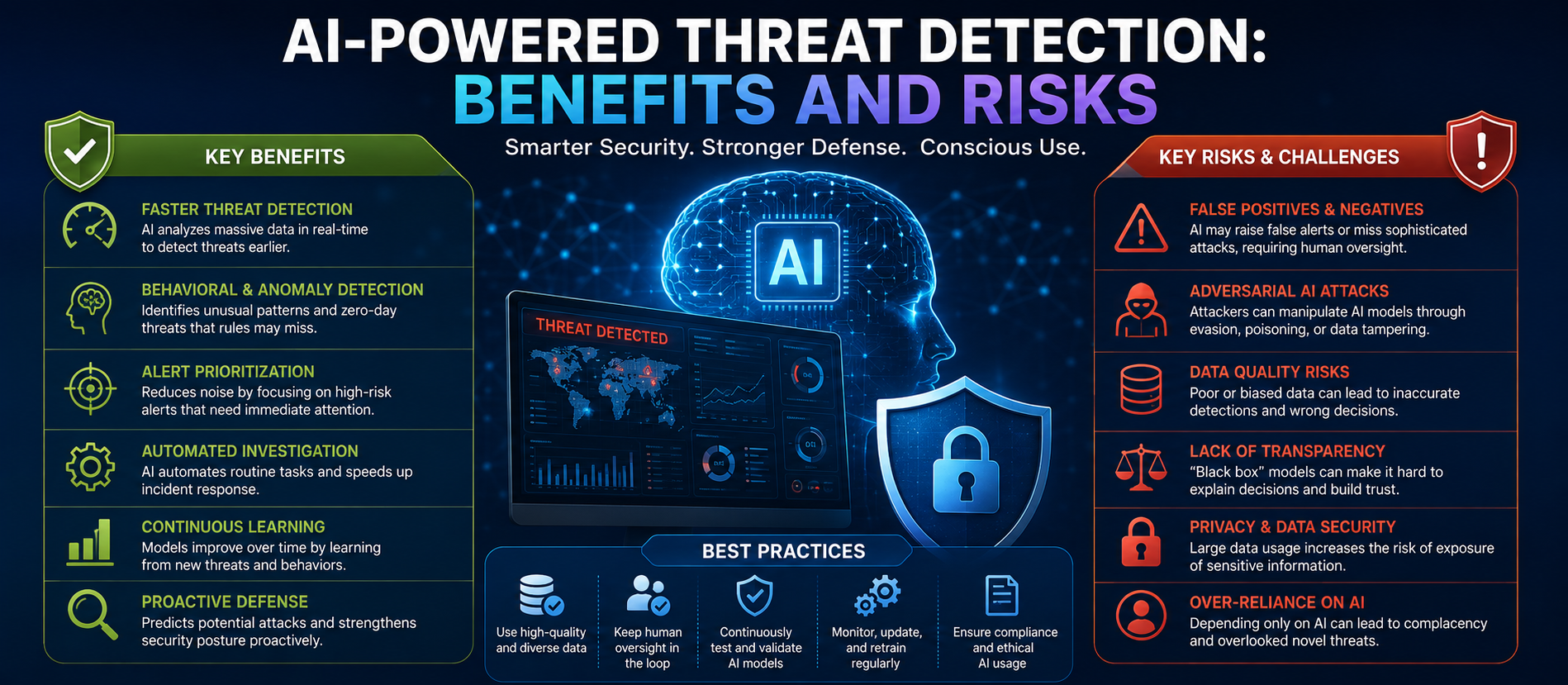
1. Faster Analysis of Security Data
2. Behavioral and Anomaly Detection
3. Better Alert Prioritization
4. Faster Threat Investigation
5. Continuous Monitoring
6. Improved Vulnerability Detection
7. Predictive and Proactive Security
8. Reduced Manual Work
9. False Positives and False Negatives
10. AI Models Can Be Attacked
11. Data Quality Determines Detection Quality
AI-powered threat detection is changing how organizations identify suspicious activity, investigate security alerts, and respond to cyber threats. Traditional security tools often depend on signatures, rules, and predefined indicators. Artificial intelligence and machine learning can add behavioral analysis, pattern recognition, anomaly detection, and large-scale data analysis to the defensive toolkit.
AI can analyze large volumes of logs, endpoint activity, authentication records, and threat intelligence. NIST notes that it can improve cybersecurity data analysis and anomaly detection while also introducing new risks. citeturn1search8turn1search0
AI is not a replacement for security professionals. Models can produce false positives, miss attacks, depend on data quality, and become targets for manipulation. NIST documents threats such as evasion and poisoning and notes that defenses are not foolproof. citeturn1search14turn1search18
This WordPress-ready HTML article is prepared for Digiifrog (www.digiifrog.com) with SEO, AEO, GEO, and AI Search optimization.
What Is AI-Powered Threat Detection?
AI-powered threat detection uses machine-learning models, statistical techniques, behavioral analytics, automation, or related AI capabilities to identify activity that may indicate a cyber threat. Instead of looking only for known signatures, AI systems can analyze relationships and patterns across large datasets.
A security platform may examine login behavior, network traffic, endpoint processes, email activity, file changes, cloud events, and other signals. The system can then assign a risk score, generate an alert, or help prioritize an investigation.
1. Faster Analysis of Security Data
Modern organizations generate huge quantities of security telemetry. Humans cannot manually examine every event. AI can process large datasets rapidly and identify patterns that deserve investigation.
This can reduce the time between an unusual event occurring and a security team becoming aware of it. Faster analysis is particularly valuable when attackers move quickly after gaining initial access.
2. Behavioral and Anomaly Detection
💡 Key Insight
One important benefit of AI is the ability to identify deviations from expected behavior. For example, an account that normally logs in from one region during business hours might suddenly access sensitive systems from an unusual location and download a large volume of data.
An anomaly does not automatically mean an attack. It is a signal for investigation. This distinction is important because unusual activity can have legitimate explanations such as travel, new projects, system migrations, or administrative work.
3. Better Alert Prioritization
Security operations centers can face thousands of alerts. AI can help correlate events and prioritize alerts based on context, severity, asset importance, and behavioral patterns.
Better prioritization can reduce alert fatigue and help analysts focus attention on incidents with greater potential impact. NIST has also noted that AI-driven threat hunting can improve detection rates while potentially increasing false positives, showing why human review remains important. citeturn1search0
4. Faster Threat Investigation
AI can help analysts summarize related events, connect indicators across systems, search historical telemetry, and identify possible attack paths. This can reduce repetitive investigation work.
AI-assisted investigation is especially useful when security teams have limited staff and need to make better use of existing expertise.
5. Continuous Monitoring
Automated systems can analyze security events continuously rather than waiting for a person to review a report. This supports monitoring across endpoints, cloud services, applications, networks, and identity systems.
Continuous monitoring does not eliminate the need for people. It creates a mechanism for surfacing events that require human judgment.
6. Improved Vulnerability Detection
AI can assist with identifying patterns associated with vulnerabilities, misconfigurations, suspicious code, or exposed assets. CISA has stated that the current best use of AI for vulnerability detection is to supplement and enhance existing tools rather than replace them. citeturn1search17
7. Predictive and Proactive Security
Traditional security often focuses on known indicators and current events. AI can also support proactive analysis by identifying trends, unusual behavior, and relationships that may indicate emerging risks.
Prediction should be treated as risk estimation rather than certainty. A model can identify that an event resembles previous malicious activity, but it cannot guarantee that an attack will occur.
8. Reduced Manual Work
AI can automate repetitive tasks such as event classification, enrichment, summarization, correlation, and initial triage. This can allow analysts to spend more time on complex investigations, incident response, architecture, and strategic improvements.
9. False Positives and False Negatives
One of the biggest risks is inaccurate detection. A false positive occurs when legitimate activity is flagged as malicious. Too many false positives can overwhelm analysts and cause important alerts to be ignored.
A false negative occurs when malicious activity is not detected. False negatives can be more dangerous because they may allow an attacker to continue operating unnoticed.
Measure detection accuracy, coverage, investigation time, and business impact rather than simply counting alerts.
10. AI Models Can Be Attacked
AI systems introduce an additional attack surface. NIST's adversarial machine-learning guidance describes attacks that can manipulate AI behavior, including evasion and poisoning. citeturn1search14turn1search18
⚠ Watch Out
In a poisoning scenario, an attacker may attempt to influence training or reference data so that a model learns misleading patterns. In an evasion scenario, an attacker may manipulate inputs to avoid detection.
11. Data Quality Determines Detection Quality
AI security systems depend heavily on data. Incomplete logs, inconsistent formats, missing context, incorrect labels, or outdated threat intelligence can reduce detection quality.
Organizations should therefore invest in reliable telemetry, time synchronization, log retention, data validation, asset inventories, and clear data-governance practices before expecting AI to solve detection problems.
12. Explainability Matters
Security analysts need to understand why an AI system generated a high-risk alert. A completely opaque prediction can be difficult to validate, investigate, or defend during an audit.
Explainability does not require every model to reveal every internal calculation. It means providing useful evidence such as contributing events, unusual behaviors, affected assets, confidence indicators, and relevant context.
13. Privacy and Sensitive Data Risks
Threat-detection platforms may process employee identities, communications metadata, endpoint information, customer data, source code, and other sensitive material. Sending such data to external AI services can create privacy, confidentiality, regulatory, and contractual concerns.
CISA highlights data security and integrity risks across the AI lifecycle, while NIST recommends managing AI risks systematically across design, development, use, and evaluation. citeturn1search1turn1search2
14. AI Can Increase Attacker Capabilities
Defenders are not the only users of AI. Attackers can also use AI to improve phishing, social engineering, reconnaissance, content generation, and other malicious activities.
This creates an arms-race effect in which organizations must improve defensive capabilities while also securing the AI systems they deploy. NIST's emerging Cyber AI Profile work specifically addresses securing AI systems, defending against AI-enabled attacks, and using AI for cyber defense. citeturn1search10turn1search12
15. Human Oversight Should Remain Central
AI should generally support security professionals rather than automatically making every high-impact decision. Analysts can validate alerts, investigate context, approve containment actions, and challenge incorrect model conclusions.
Human oversight is especially important when automation could disable systems, lock accounts, isolate critical infrastructure, or affect customers.
16. How to Implement AI Threat Detection Responsibly
- Define the security problem before selecting an AI tool.
- Identify the data sources the system needs.
- Validate data quality and logging coverage.
- Start with high-value use cases such as alert triage or anomaly detection.
- Measure false positives and false negatives.
- Keep human review for high-impact actions.
- Protect models, training data, APIs, and credentials.
- Test for adversarial manipulation.
- Review privacy and regulatory requirements.
- Continuously evaluate performance after deployment.
SEO, AEO, GEO and AI Search Optimization
SEO content on AI-powered threat detection should target searches such as “AI threat detection,” “AI cybersecurity benefits,” “AI threat detection risks,” “machine learning cybersecurity,” and “AI-powered SOC.”
AEO should directly answer questions such as “How does AI detect cyber threats?”, “What are the benefits of AI threat detection?”, and “What are the risks of using AI in cybersecurity?”
GEO and AI Search optimization can be strengthened through clear definitions, current cybersecurity guidance, structured headings, practical examples, concise answers, FAQs, and transparent discussion of AI limitations.
Frequently Asked Questions About AI-Powered Threat Detection
What is AI-powered threat detection?
It is the use of AI, machine learning, behavioral analytics, and related techniques to analyze security data and identify activity that may indicate cyber threats.
What are the main benefits of AI threat detection?
Key benefits include faster analysis, anomaly detection, alert prioritization, continuous monitoring, investigation assistance, automation, and support for vulnerability detection.
What are the main risks?
Important risks include false positives, false negatives, poor data quality, model manipulation, privacy concerns, explainability challenges, model drift, and over-reliance on automated decisions.
Can AI replace cybersecurity analysts?
AI can automate and accelerate many repetitive tasks, but it should not be treated as a complete replacement for human expertise. Human judgment remains important for complex investigations, risk decisions, and high-impact response actions. citeturn1search8turn1search17
Conclusion
AI-powered threat detection can make cybersecurity operations faster, more scalable, and more context-aware, but it also introduces new risks that organizations must actively manage. AI can help analyze massive datasets, identify anomalies, prioritize alerts, assist investigations, and automate repetitive security tasks. At the same time, false positives, false negatives, data-quality problems, adversarial manipulation, privacy concerns, and over-automation can reduce its value.
The most effective approach is to combine AI with strong security fundamentals, reliable telemetry, skilled analysts, clear governance, continuous testing, and human oversight. NIST's current AI cybersecurity work emphasizes all three dimensions: securing AI systems, defending against AI-enabled attacks, and using AI to improve cyber defense. citeturn1search10turn1search12
For businesses seeking modern websites, cybersecurity content, automation, SEO, AEO, GEO, and AI Search optimization, Digiifrog can help. Visit www.digiifrog.com.
Quick Answer: What Are the Benefits and Risks of AI-Powered Threat Detection?
AI-powered threat detection can improve cybersecurity by analyzing large volumes of data, identifying unusual behavior, prioritizing alerts, supporting investigations, and automating repetitive work. Its risks include false positives and negatives, poor training data, model manipulation, privacy concerns, lack of explainability, model drift, and excessive dependence on automation. The strongest approach combines AI with established security controls and human oversight.
Important Note
This article is educational content and is not a substitute for a professional cybersecurity assessment. AI security tools should be evaluated according to the organization's threat environment, data sensitivity, regulatory obligations, technology architecture, and risk tolerance.
Ready to Grow?
Talk to us about a strategy tailored to your brand — we will help you stand out in search, AI discovery and social.

Comments (0)
Log in to leave a comment.