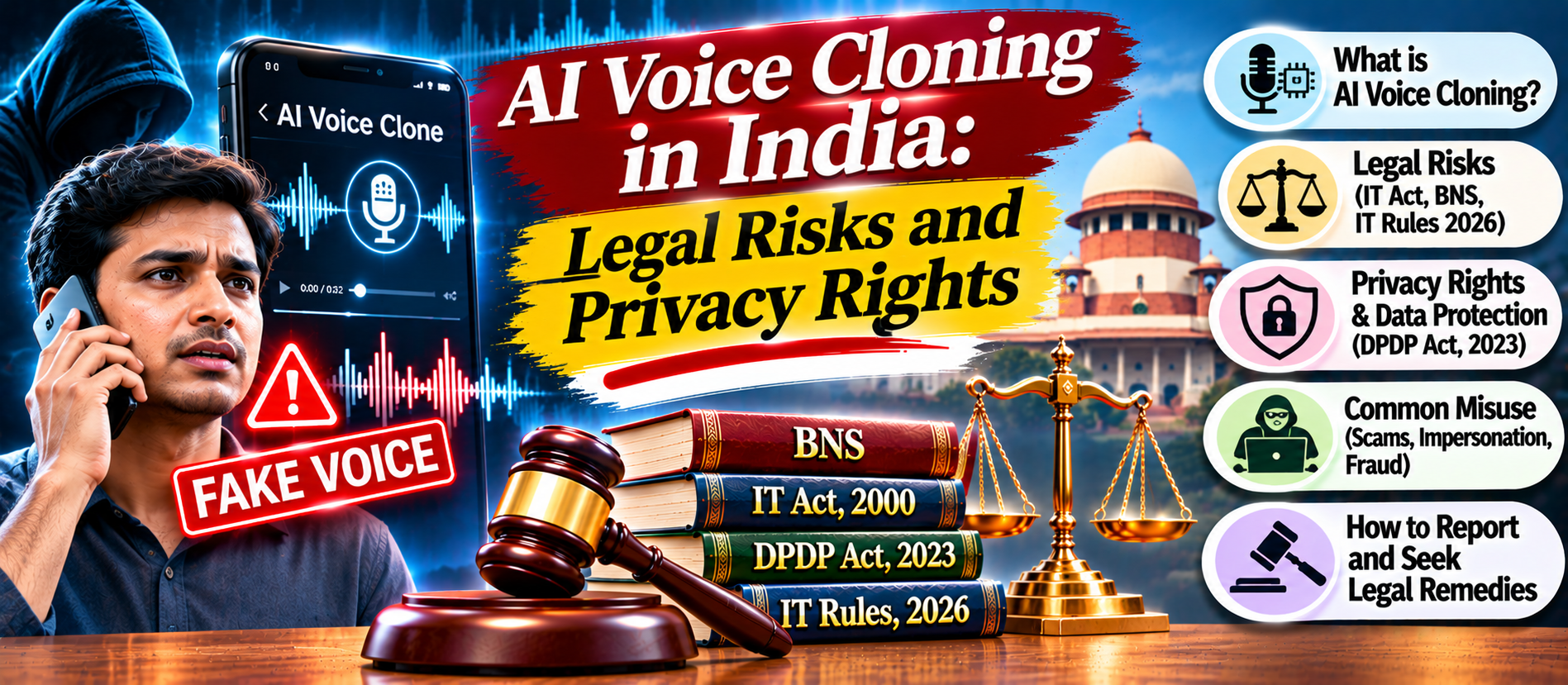
📋 Quick Summary
In this article:
1. Introduction
2. What Is AI Voice Cloning?
2.1 Voice data and identity
2.2 Voice cloning is not always easy to detect
3. Legitimate Uses and Harmful Misuse
3.1 Legitimate uses
3.2 Harmful uses
4. Is AI Voice Cloning Illegal in India?
5. Information Technology Act, 2000: Important Legal Provisions
5.1 Section 66C — Identity theft
5.2 Section 66D — Cheating by personation using a computer resource
Digiifrog | Legal Awareness — www.digiifrog.com
Understand how voice cloning works, when its misuse may break the law, and what individuals and businesses can do to protect themselves.
Table of Contents
- Introduction
- What is AI voice cloning?
- Legitimate uses and harmful misuse
- Is AI voice cloning illegal in India?
- Information Technology Act provisions
- Bharatiya Nyaya Sanhita provisions
- 2026 IT Rules and synthetic audio
- Privacy and personal data rights
- Consent and use of a person's voice
- Risks for businesses and employees
- How to preserve evidence
- How to report voice-cloning misuse
- Practical prevention measures
- Action checklist
- Frequently asked questions
- Conclusion
1. Introduction
Artificial intelligence can now copy a person's voice from a short audio sample. The generated voice may sound very similar to the original speaker. It may copy their accent, tone, pauses and speaking style. This technology is known as AI voice cloning.
Voice cloning can support useful work. It can help people with speech disabilities, create voiceovers, localize educational content and restore a person's voice in some medical situations. It can also help businesses produce audio content more efficiently.
⚠ Watch Out
The same technology can be misused. A fraudster may copy a family member's voice and ask for emergency money. Someone may create a fake recording of a manager approving a payment. A cloned voice may be used to make a public figure appear to support a product or make a statement that they never made.
These incidents raise questions about identity, privacy, consent, reputation and financial security. They also create legal questions. Is copying a voice itself an offence? Can a victim file a police complaint? Which Indian laws may apply? Can a platform be asked to remove the audio? What evidence should be preserved?
India does not currently have one separate, all-purpose criminal offence called “AI voice cloning”. The legal result depends on what the person did with the cloned voice. Fraud, cheating by personation, identity theft, defamation, threats, privacy violations and certain forms of unlawful publication may attract different legal provisions.
The Information Technology (Intermediary Guidelines and Digital Media Ethics Code) Rules, 2021 were amended in 2026 to address synthetically generated information. The amended definition can cover realistic synthetic audio, including voice clones, when the legal conditions are met.
This article explains the legal framework in clear language. It also gives practical steps for individuals, families, employees and businesses.
Legal information note: This article is for general education. It is not legal advice. The correct legal route depends on the facts, evidence, location and current law. Consult a qualified Indian advocate for advice about a specific incident.
2. What Is AI Voice Cloning?
AI voice cloning is the use of software or machine-learning systems to create speech that sounds like a particular person. The system may be trained or prompted using recordings of that person's voice. It can then generate new words that the person never actually spoke.
A voice clone may be used to create:
- A phone call that sounds like a family member asking for urgent money.
- A voice note that appears to come from a company director.
- A fake recording in which a teacher, doctor or public official appears to make a statement.
- A fabricated endorsement in which a celebrity appears to recommend a product.
- A synthetic voice message used to threaten, harass or blackmail someone.
- A fake customer-service call designed to obtain passwords, one-time passwords or banking information.
Voice cloning is different from ordinary text-to-speech. Basic text-to-speech may use a generic computer voice. Voice cloning attempts to reproduce the sound of a specific person.
2.1 Voice data and identity
A person's voice can help identify them. A familiar voice may carry personal, professional and emotional significance. A recording may also reveal information about a person's conversations, relationships, health or activities.
However, not every voice recording is automatically a biometric identifier under every law. The legal classification depends on the context, the way the recording is processed and the applicable statutory definition. A voice sample may be personal data when it relates to an identifiable individual. It may also be used as an authentication feature in a particular system.
2.2 Voice cloning is not always easy to detect
A synthetic voice may contain unusual pauses, pronunciation or background noise. But modern systems can produce convincing results. A listener should not rely only on whether the voice “sounds real”. Confirm important requests through a separate, trusted channel.
3. Legitimate Uses and Harmful Misuse
The technology itself is not automatically unlawful. Its purpose, consent, disclosure and consequences matter.
3.1 Legitimate uses
- Accessibility: A person who has lost the ability to speak may use a synthetic version of their own voice.
- Education: A publisher may create licensed narration for lessons and learning material.
- Entertainment: A production company may use a synthetic voice with appropriate rights and consent.
- Translation and localization: A speaker may authorize a voice model to produce translated versions of their own content.
- Customer support: A company may use a disclosed synthetic voice for automated assistance.
3.2 Harmful uses
- Financial fraud: A caller imitates a relative or senior employee to obtain money.
- False statements: A fake recording attributes damaging words to an identifiable person.
- Impersonation: A person uses a cloned voice to pretend to be someone else.
- Blackmail: A synthetic recording is used to threaten exposure or demand payment.
- False endorsement: A person appears to recommend a product or service without permission.
- Harassment: A cloned voice is used to send repeated abusive or intimidating calls.
- Manipulation: A fake audio clip is circulated to mislead voters, customers, employees or the public.
The legal analysis should focus on the conduct and its effect. A person who creates a clearly disclosed fictional voice for a lawful project is in a different position from a person who uses a clone to deceive a bank or damage someone's reputation.
4. Is AI Voice Cloning Illegal in India?
There is no single Indian law that makes every act of voice cloning illegal. A person may have a lawful reason to create a synthetic voice, especially where they use their own voice or have valid permission.
Misuse may become unlawful when it involves deception, impersonation, unauthorized use of identity credentials, publication of defamatory material, threats, extortion, privacy violations or prohibited content.
For example:
- Creating a voice model of yourself for your own accessibility needs is not the same as cloning another person's voice to steal money.
- Using a licensed actor's voice under a clear contract is not the same as using a person's voice without permission to advertise a product.
- A fictional audio drama that is clearly presented as fiction is not the same as publishing a fake recording as genuine evidence.
💡 Key Insight
Consent is important, but it is not the only legal issue. A person may have consented to a voice recording but not to the use of that recording to create a voice model, imitate them in new statements or use the output for commercial advertising. The scope of permission should be examined.
Similarly, a person cannot make fraud or defamation lawful simply by adding a small “AI-generated” label if the overall conduct still violates another law.
5. Information Technology Act, 2000: Important Legal Provisions
The Information Technology Act, 2000 (IT Act) contains provisions that may apply when a cloned voice is used through a computer resource or communication device. The exact section depends on the facts. The use of AI alone does not prove that an offence has occurred.
5.1 Section 66C — Identity theft
Section 66C deals with fraudulent or dishonest use of another person's electronic signature, password or other unique identification feature. It may apply where a voice-cloning operation forms part of the misuse of a protected digital identity feature.
A cloned voice by itself does not automatically satisfy Section 66C. Investigators must establish the statutory elements, including the relevant identification feature and fraudulent or dishonest use.
The punishment may extend to three years' imprisonment and a fine of up to ₹1 lakh.
5.2 Section 66D — Cheating by personation using a computer resource
Section 66D may be especially relevant to voice-cloning fraud. It applies where a person cheats by pretending to be someone else through a communication device or computer resource.
For example, a fraudster may clone a business owner's voice and call an employee. The caller may order an urgent transfer to a new bank account. If the caller deceives the employee and obtains money through personation, Section 66D may be considered along with other applicable offences.
The punishment under Section 66D may extend to three years' imprisonment and a fine of up to ₹1 lakh. The prosecution must prove cheating by personation and the other required elements.
5.3 Section 66E — Violation of privacy
Section 66E addresses intentional or knowing capture, publication or transmission of an image of a person's private area without consent, in circumstances that violate privacy. It is a specific provision about images of a defined private area.
It should not be described as a general offence covering every unauthorized voice recording or voice clone. Other privacy, criminal or civil principles may be relevant depending on the facts.
5.4 Sections 67, 67A and 67B
These sections address specified categories of obscene, sexually explicit or child-related material in electronic form. They may become relevant where synthetic audio is part of a wider prohibited electronic publication, or where audio accompanies unlawful visual material. The statutory definitions and elements must be checked carefully. A voice recording that is merely embarrassing or offensive does not automatically fall within these provisions.
5.5 Section 43 and Section 66
Section 43 provides for compensation in relation to specified unauthorized acts involving computer systems and data. Section 66 may apply where an act referred to in Section 43 is done dishonestly or fraudulently. These provisions may be relevant if an incident also involves unauthorized access, data extraction or interference with a computer resource.
5.6 Section 72 and confidentiality
Section 72 addresses breach of confidentiality and privacy by a person who has secured access to electronic records, books, registers, correspondence, information, documents or other material under powers conferred by the IT Act and then discloses it without consent, subject to the section's conditions. It is not a general offence for every person who shares a private recording. Other laws or contractual duties may apply to other forms of disclosure.
5.7 Section 66A is not a valid offence
The Supreme Court struck down Section 66A of the IT Act in Shreya Singhal v. Union of India (2015). It must not be used as a valid charge merely because a voice message is offensive or upsetting.
6. Bharatiya Nyaya Sanhita, 2026: Criminal Liability
The Bharatiya Nyaya Sanhita, 2023 (BNS) replaced the Indian Penal Code for offences committed on or after 1 July 2024, subject to applicable transition rules. Several BNS provisions may be relevant to the misuse of cloned voices.
6.1 Cheating
The BNS provisions on cheating may apply when a person deceives another and dishonestly induces them to deliver property, retain property or do or omit something that causes or is likely to cause legally recognized harm. A cloned voice used to obtain money or property may form part of such conduct.
The exact charge depends on the method of deception, the result and the statutory ingredients. The IT Act Section 66D may also be relevant where cheating is carried out by personation using a computer resource or communication device.
6.2 Criminal intimidation
Section 351 of the BNS deals with criminal intimidation. A cloned voice may be used to threaten injury to a person, reputation or property, or to someone in whom the person is interested. If the statutory requirements are met, criminal intimidation provisions may apply.
6.3 Defamation
Section 356 of the BNS deals with defamation. It covers specified imputations made or published with the intention or knowledge required by the section. A synthetic voice recording that falsely attributes a damaging statement to an identifiable person may be examined under this provision.
Section 356(2) provides punishment that may extend to simple imprisonment for two years, or a fine, or both, or community service. The section also contains exceptions, including certain statements made in good faith and matters of public interest. The facts and statutory conditions must be examined.
6.4 Extortion and related offences
If a person uses a cloned voice to threaten someone and demand money or property, provisions relating to extortion may be relevant. Other offences may apply if the incident involves stalking, harassment, forgery, cheating or organized fraud. A lawyer or investigator should identify the provisions supported by evidence rather than adding unrelated sections.
7. 2026 IT Rules: Synthetic Audio and Voice Cloning
The Information Technology (Intermediary Guidelines and Digital Media Ethics Code) Rules, 2021 were amended by the Information Technology (Intermediary Guidelines and Digital Media Ethics Code) Amendment Rules, 2026. The amendment was notified through Gazette Notification G.S.R. 120(E), dated 10 February 2026, and came into force on 20 February 2026.
The amendment introduced the concept of “synthetically generated information” (SGI). The definition covers audio, visual or audio-visual information that is artificially or algorithmically created, generated, modified or altered using a computer resource so that it appears real, authentic or true and portrays an individual or event in a way that is, or is likely to be perceived as, indistinguishable from a natural person or real-world event.
MeitY's explanatory FAQs specifically identify voice cloning as an example that may fall within SGI when it meets the definition. This is important because the Rules are not limited to manipulated photographs or videos. Realistic synthetic audio can also be covered.
7.1 Routine editing is not automatically SGI
The Rules contain exclusions for specified routine or good-faith activities. These include editing, formatting, enhancement, technical correction, color adjustment, noise reduction, transcription or compression that does not materially alter, distort or misrepresent the substance, context or meaning of the underlying content.
Using software to remove background noise from a genuine recording is not automatically the same as generating a fake statement in another person's voice. The substance and effect of the processing matter.
7.2 Duties of intermediaries
The amended Rules strengthen intermediary due diligence. Depending on the type of intermediary and the applicable rule, obligations include reasonable technical measures to prevent unlawful SGI, clear labelling and traceable identifiers or metadata for permissible synthetic content, and action against prohibited material.
Significant social media intermediaries have additional duties under the amended framework. These include measures relating to user declarations and technical verification for certain synthetic content. The detailed obligations depend on the intermediary's legal category and the relevant rule.
7.3 What can a victim ask a platform to do?
A victim can report a synthetic voice recording that impersonates them, misleads users, violates privacy or is otherwise unlawful. The complaint should identify the exact post, URL, account and harm. The victim can ask the platform to review the content, disable access or remove it where required by law, and preserve relevant records.
The Rules do not mean that every disputed audio clip must be removed automatically. The platform must assess the complaint under the applicable law and process. A court or competent authority may also issue directions in an appropriate case.
8. Privacy Rights and Personal Data Protection in India
Voice cloning raises privacy concerns because a voice recording may be linked to an identifiable person. A voice sample may reveal more than the sound of speech. It may contain names, relationships, locations, health details, work information or private conversations.
8.1 Constitutional privacy
In Justice K.S. Puttaswamy (Retd.) v. Union of India (2017), the Supreme Court recognized privacy as a fundamental right under the Constitution. Privacy includes important interests in personal autonomy, dignity and control over personal information, subject to the constitutional framework and lawful restrictions.
This recognition is relevant to debates about unauthorized collection and use of voice recordings. It does not create an automatic criminal offence for every voice clone. The specific legal remedy depends on the facts and applicable statutes.
8.2 Digital Personal Data Protection Act, 2026
The Digital Personal Data Protection Act, 2023 (DPDP Act) creates a framework for processing digital personal data. A voice recording or voice sample may be personal data when it relates to an identifiable individual. A business that collects and processes voice samples to create or operate voice models may therefore need to consider data protection requirements.
Important commencement point as at November 2026: The DPDP Act was brought into force in phases through Gazette Notification G.S.R. 843(E), dated 13 November 2025. Several institutional and enabling provisions commenced immediately. Some provisions, including core processing duties and individual rights in Sections 3 to 17, are scheduled to commence 18 months after publication, on 13 May 2027. Other provisions have separate commencement dates. The Act should not be described as if every substantive duty is already operative in November 2026.
The DPDP Rules, 2025 also have phased commencement. Rules 1, 2 and 17 to 21 commenced on publication; Rule 4 is scheduled after one year; and Rules 3, 5 to 16, 22 and 23 are scheduled after 18 months. Check the exact provision and commencement notification before relying on a particular obligation.
8.3 What should organizations prepare for?
Organizations that collect voice samples should identify why they need the data, how long they will retain it, who can access it and whether it will be used to train or generate a voice model. They should explain the proposed use in clear language and design appropriate safeguards.
Where consent is the relevant legal basis, it should be meaningful and tied to a clearly explained purpose. A general permission to record a meeting may not necessarily amount to permission to create a reusable voice clone for advertising or synthetic conversations.
Because the main DPDP processing provisions have phased commencement, organizations should distinguish between duties already in force and duties that are scheduled to commence later. They should also comply with other laws and contractual obligations that apply now.
8.4 IT Act Section 43A during the transition
Section 43A of the IT Act concerns compensation for failure to protect sensitive personal data or information by a body corporate, where its statutory conditions are met. The DPDP Act's Section 44(2), which provides for omission of Section 43A, is scheduled to commence 18 months after 13 November 2025. Therefore, as at November 2026, Section 43A has not yet been omitted under that commencement schedule. Its application depends on the facts and the rules governing sensitive personal data.
9. Consent: Who Can Use a Person's Voice?
Consent is a central practical issue in voice cloning. A voice actor, employee, customer, public speaker or content creator may agree to one use of a recording but not another.
Before using a person's voice to create a synthetic model, a responsible organization should explain:
- What voice recordings will be collected.
- Whether the recordings will be used to train or fine-tune a voice model.
- What kinds of speech the model may generate.
- Whether the generated voice will be used in advertising, films, games, customer support or other contexts.
- Whether the model or voice outputs may be shared with third parties.
- How long the source recordings and model will be retained.
- Whether the person can withdraw permission or request deletion, where applicable.
- What happens to existing outputs after permission ends.
A written agreement should define the scope of use, payment, territory, duration, attribution, disclosure and restrictions. It should also deal with sensitive uses, political content, endorsements and statements that could harm the speaker's reputation.
For commercial projects, a vague clause such as “the company may use the recording for any purpose” can create uncertainty. A clear contract is better for both the speaker and the organization.
Consent does not excuse fraud, unlawful threats or other prohibited conduct. Nor should an organization assume that a voice sample found online is free for unrestricted cloning. Public availability is not the same as permission for every new use.
10. AI Voice Cloning Risks for Businesses and Employees
Businesses face a growing risk from synthetic voice fraud. Attackers may study public interviews, webinars, podcasts and social media videos to collect voice samples. They may then imitate a senior employee, supplier or customer.
10.1 Fake payment instructions
An employee may receive a call that sounds like the managing director. The caller may claim that a confidential transaction must be completed immediately. The employee may be told not to contact anyone because the payment is urgent.
Businesses should never approve a major payment based only on a voice call. Use a second channel and an established approval workflow.
10.2 Fake customer and supplier calls
A cloned voice may be used to impersonate a customer, vendor or bank representative. Staff should verify account changes, refunds and sensitive requests using contact details already on file, not a number supplied during the suspicious call.
10.3 False statements attributed to executives
A fabricated recording may damage a company's reputation, affect share or customer confidence, or create internal conflict. The company should preserve the source material, notify its legal and security teams and issue a factual response after verification.
10.4 Employee voice and workplace policies
Employers should explain whether meetings or calls are recorded and whether recordings may be used for transcription, training or synthetic voice generation. Employees should know who can access the material and how to raise a concern.
10.5 A practical corporate control framework
- Require two-person approval for high-value or unusual payments.
- Use a callback to a verified number for bank-account changes.
- Set a verbal challenge phrase for exceptional internal requests, while keeping it confidential and updating it securely.
- Train employees to recognize urgency, secrecy and unusual payment instructions.
- Keep a clear incident-response contact list.
- Limit access to voice recordings and model-training datasets.
- Use contracts that define permitted voice-model use.
- Keep logs of access, generation and distribution where technically and legally appropriate.
11. How to Preserve Evidence of AI Voice Cloning
Evidence can disappear. A social media post may be deleted. A messaging account may be closed. A caller may change a number or profile. Preserve information as soon as possible, but do not put yourself at risk.
11.1 Keep the original audio
If you receive an audio file, save the original file in the format received. Do not trim, filter, convert or enhance the only copy. If you need to create a shorter clip for explanation, keep it as a separate working copy.
11.2 Record where it came from
Write down the platform, account name, profile link, telephone number, message ID, URL, date and time. If the audio arrived through a messaging app, preserve the relevant chat and sender details. Do not rely only on a forwarded copy with no context.
11.3 Preserve the surrounding conversation
Keep messages before and after the audio. The surrounding conversation may show the purpose of the call, the request made, the threat or the financial demand. Preserve emails, call logs, SMS messages and payment details where relevant.
11.4 Keep a clear incident timeline
Record when you received the audio, when you realized it might be fake, who you contacted, when you reported it and what action followed. Separate what you personally observed from what someone else told you.
11.5 Do not circulate the audio unnecessarily
Do not upload the recording repeatedly or share it in public groups to ask whether it is genuine. This may increase its reach and cause further harm. Share it only with the platform, police, lawyer or qualified forensic expert through an appropriate channel.
11.6 Consider digital forensic analysis
A qualified examiner may review file metadata, encoding, compression, editing traces, source devices and other technical indicators. The examiner may calculate a cryptographic hash, such as SHA-256, to help show that the collected file has not changed.
A hash does not prove that the audio is genuine. It only helps verify that a particular file remains unchanged after collection. An AI detection tool may provide a useful lead, but its result should not be treated as final proof. Detection systems can produce false positives and false negatives.
12. Electronic Evidence under the Bharatiya Sakshya Adhiniyam, 2026
The Bharatiya Sakshya Adhiniyam, 2023 (BSA) governs evidence in many Indian proceedings from 1 July 2024. Sections 61 to 63 address electronic and digital records.
Section 61 recognizes electronic or digital records, subject to the Act. Section 62 provides that the contents of electronic records may be proved in accordance with Section 63. Section 63 sets conditions for specified computer outputs and includes a certificate framework. The certificate identifies the electronic record, explains how it was produced and provides relevant device particulars, in the manner required by the section and its Schedule.
A downloaded voice note, exported chat, call recording or audio file may need to be presented in a legally compliant way. The correct procedure depends on how the record was created, stored and produced. Do not assume that a screenshot or a copied audio file will automatically be admissible in every case.
Ask your advocate or investigating officer how to preserve the original device, export the relevant record and obtain the required certificate. If a platform holds important account or call data, prompt legal steps may be needed to request preservation through the proper process.
Maintain a record of who collected the file, when it was collected, from which device or account, and where it was stored. This helps establish the chain of custody and reduces questions about alteration.
13. How to Report AI Voice-Cloning Misuse in India
13.1 National Cyber Crime Reporting Portal
The Government's National Cyber Crime Reporting Portal is available at https://cybercrime.gov.in/. It accepts reports about cybercrime, including online impersonation and financial fraud. Select the category that best matches the incident and provide accurate details.
If money has been transferred because of a voice-cloning scam, contact your bank immediately and call the national cyber financial fraud helpline at 1930 as soon as possible. Prompt reporting may help authorities and banks take steps to trace or hold funds, but recovery is not guaranteed.
13.2 Local police or cybercrime police station
Submit a clear written complaint. Explain how the voice was used, what the caller said, whether money or information was requested, and what loss or harm occurred. Attach the original audio where safe, the phone number, call logs, messages and transaction details.
Ask for an acknowledgement or complaint reference. If the facts disclose a cognizable offence, the police may register an FIR in accordance with the Bharatiya Nagarik Suraksha Sanhita, 2026. The classification depends on the offence alleged and the facts.
13.3 Report the content to the platform
Use the platform's current reporting and grievance process. Report the audio as impersonation, synthetic media, fraud, harassment, privacy violation or another relevant category. Include the exact URL or post ID and request review and preservation of relevant records.
13.4 Notify the bank or payment provider
If the scam involved a bank transfer, card, UPI or wallet, contact the relevant bank or payment provider immediately through its official channel. Ask for a complaint number and provide transaction identifiers. Do not call a number given by the suspected fraudster.
13.5 Seek legal advice
A lawyer can assess whether the facts support allegations under the IT Act, BNS or other laws. The lawyer can also advise on a legal notice, civil injunction, compensation claim or urgent court application where appropriate.
14. How to Protect Your Voice and Reduce the Risk
No single measure can prevent every voice-cloning attempt. A combination of verification, privacy controls and staff awareness can reduce risk.
14.1 For individuals and families
- Be careful about posting long, clean voice recordings publicly if you do not need to.
- Use privacy settings to limit who can access personal videos and audio.
- Agree on a family verification method for emergency money requests.
- Call the person back using a saved number rather than the number that contacted you.
- Do not share OTPs, passwords, PINs or banking details over an unexpected call.
- Pause when a caller creates urgency, demands secrecy or asks for an unusual transfer.
- Tell family members that a familiar voice is not proof of identity.
14.2 For businesses
- Use dual approval for high-value payments and sensitive account changes.
- Verify unusual instructions through a separate, trusted channel.
- Train staff with realistic examples of synthetic voice scams.
- Use role-based access to recordings and voice-model systems.
- Document the purpose and permitted scope of voice data processing.
- Review vendor contracts and security controls before sharing voice samples.
- Prepare an incident-response process for fake executive or customer calls.
14.3 For creators and developers
- Use voice samples only with appropriate rights and permission.
- Explain when a synthetic voice is being used, especially where listeners could be misled.
- Do not generate deceptive statements or false endorsements in another person's voice.
- Protect source recordings, model files and access credentials.
- Keep records of permissions, intended uses and model access.
- Review the current IT Rules and other applicable laws before deploying a voice-generation service in India.
15. Immediate Action Checklist
- Stop the conversation if a caller makes an unusual demand.
- Do not transfer money or disclose OTPs based only on a familiar voice.
- Verify the request through a separate trusted contact method.
- Preserve the original audio, messages, call logs and account details.
- Record the date, time, telephone number, platform and transaction details.
- Contact your bank and call 1930 promptly if money is involved.
- Report the incident at cybercrime.gov.in or to the appropriate police authority.
- Report synthetic audio to the relevant platform and retain the complaint reference.
- Ask an advocate to assess the IT Act, BNS, privacy and civil-law options.
- Preserve electronic records in a manner that supports BSA requirements.
- Avoid forwarding or publicly reposting the suspicious audio.
16. Frequently Asked Questions (FAQs)
Q1. Is AI voice cloning legal in India?
Voice cloning is not automatically illegal. It may be lawful when used for a legitimate purpose with appropriate rights and consent. It may attract legal consequences when used for fraud, impersonation, defamation, threats, privacy violations or other unlawful conduct.
Q2. Is there a specific Indian law against AI voice cloning?
India does not currently have one separate criminal offence that covers every form of voice cloning. Depending on the facts, the IT Act, BNS, IT Rules and other legal principles may apply.
Q3. Can someone be arrested for using my voice in an AI scam?
Police action depends on the facts and the offences disclosed. A voice clone used to cheat by personation may raise issues under IT Act Section 66D and relevant BNS provisions. Investigators must establish the legal ingredients and evidence.
Q4. What is Section 66D of the IT Act?
Section 66D punishes cheating by personation using a communication device or computer resource. It may be relevant when a person uses a cloned voice to pretend to be someone else and cheat a victim.
Q5. Can a cloned voice recording amount to defamation?
It may amount to defamation if it communicates a harmful imputation about an identifiable person and the legal requirements of BNS Section 356 are met. Context, publication, intention or knowledge and applicable exceptions matter.
Q6. Do the 2026 IT Rules cover AI-generated voice?
Yes. The 2026 amendment introduced a definition of synthetically generated information that can include realistic synthetic audio and voice cloning when it meets the specified threshold. MeitY's FAQs expressly discuss voice cloning as an example.
Q7. Can I stop a company from cloning my voice?
You may have legal options depending on the source recording, consent, contract, purpose and harm. You can raise the issue with the company, platform or relevant authority and seek legal advice about privacy, data protection, contractual or civil remedies.
Q8. Is my voice personal data?
A voice recording may be personal data when it relates to an identifiable person. Whether it is also treated as biometric or sensitive information depends on the applicable law and the way it is processed. The DPDP Act's substantive processing provisions have phased commencement.
Q9. Are the DPDP Act's main duties already in force in November 2026?
No. The Act has phased commencement. Under the 13 November 2025 notification, several core provisions are scheduled to commence 18 months after publication, on 13 May 2027. Other provisions have different dates. Check the Gazette notification for the exact section.
Q10. What if a fraudster uses my parent's voice to ask for money?
Do not transfer money based only on the call. Contact your parent using a saved number or another trusted method. If money has been sent, contact the bank immediately and call 1930. Preserve the call details and report the incident.
Q11. Can an AI detector prove that an audio file is fake?
Not by itself. Detection tools can make mistakes. A qualified forensic examiner may assess the file and its technical context. The result should be considered with other evidence.
Q12. Are voice samples found online free to use?
No. Public availability does not automatically grant unrestricted permission to clone or commercially exploit a person's voice. Copyright, contract, privacy, publicity and other legal issues may arise depending on the material and use.
Q13. What evidence should I keep?
Keep the original audio, source URL, account details, telephone number, call logs, messages, timestamps, transaction records and a written timeline. Avoid editing the only copy.
Q14. Can I report an AI voice scam at cybercrime.gov.in?
Yes. The National Cyber Crime Reporting Portal accepts cybercrime reports. If money is involved, contact your bank and call 1930 promptly as well.
Q15. Can a business use an employee's voice for an AI assistant?
It should define the purpose, scope, duration, access, compensation and withdrawal arrangements clearly. The organization should obtain appropriate permissions and review applicable data protection, employment, contract and IT Rules obligations.
Q16. Does a disclaimer make every voice clone lawful?
No. A disclosure may help avoid misleading listeners, but it does not legalize fraud, threats, defamation, privacy violations or other prohibited conduct.
Q17. What if a fake voice recording is being used to blackmail me?
Preserve the threats and account details. Do not circulate the recording or make a payment without seeking help. Report the incident to the police or cybercrime authorities and consult an advocate promptly.
Q18. Can I claim compensation for misuse of my voice?
A civil remedy may be available depending on the facts and recognized legal grounds. A lawyer can assess the applicable claim, evidence of harm, responsible parties and appropriate relief.
17. Conclusion
AI voice cloning can support accessibility, creativity and business services. It can also create serious risks when someone uses a familiar voice to deceive, threaten, impersonate or damage another person's reputation.
In India, the legal response depends on the conduct. IT Act Section 66D may be relevant to cheating by personation. Section 66C may apply where the misuse involves a unique identification feature. BNS provisions may apply to cheating, criminal intimidation, defamation or extortion. The 2026 IT Rules also recognize realistic synthetic audio within the framework for synthetically generated information.
Privacy and personal data protection are important, but the DPDP Act has a phased commencement schedule. As at November 2026, several core processing provisions are scheduled to commence on 13 May 2027. Readers and organizations should check the effective date of each provision before relying on it.
If a cloned voice is used against you, preserve the original audio and surrounding records. Verify urgent requests through a separate channel. Report financial fraud quickly. Seek legal advice before taking formal action.
Technology can imitate a voice. It should not be allowed to take away a person's identity, dignity or security.
Publishing note: Verify the latest statutory text, Gazette notifications and platform grievance procedures before publication. Add the actual publication date and a periodic legal-review date to the live page.
Legal Disclaimer: This article is for general educational and informational purposes only. It is not legal advice and does not create a lawyer-client relationship. Laws, commencement dates and platform procedures may change. The applicability of a provision depends on the facts, evidence and jurisdiction. Digiifrog does not guarantee any legal outcome. Consult a qualified Indian advocate for advice on a specific matter.
Ready to Grow?
Talk to us about a strategy tailored to your brand — we will help you stand out in search, AI discovery and social.

Comments (0)
Log in to leave a comment.