📋 Quick Summary
In this article:
Why Air Conditioner Maintenance Matters in Summer
1. Replace or Clean the Air Filter
2. Keep the Outdoor Condenser Area Clear
3. Clean the Area Around the Outdoor Unit
4. Check Indoor Airflow
5. Keep Supply and Return Vents Open
6. Inspect the Condensate Drain
7. Check for Unusual Water Leaks
8. Inspect the Thermostat
9. Use a Reasonable Summer Temperature Setting
10. Avoid Constant Thermostat Adjustments
11. Listen for Unusual AC Noises
💡 Key Insight
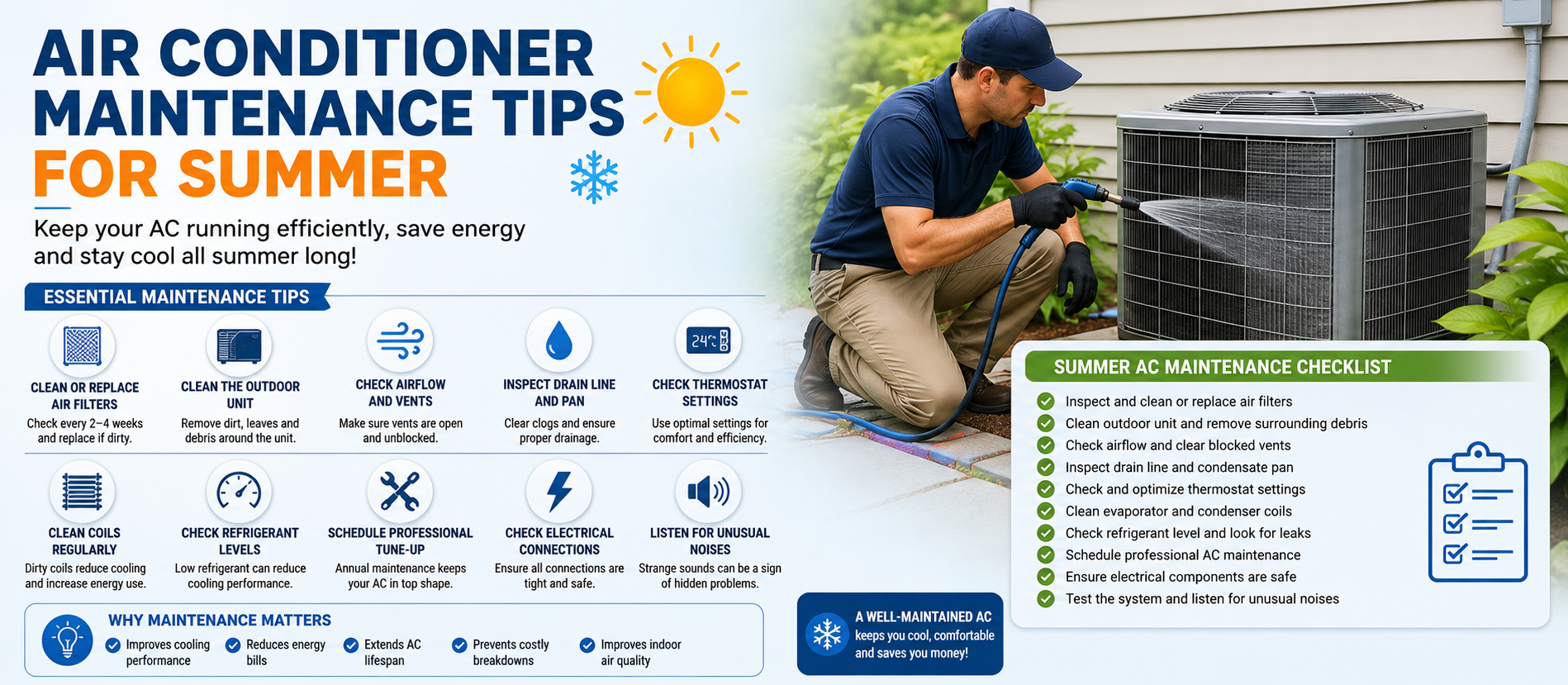
Summer heat can place a major demand on residential and commercial air conditioning systems. An air conditioner that worked well during cooler months may struggle when outdoor temperatures rise and the system operates for long periods. Regular maintenance can help keep an AC system operating efficiently, improve indoor comfort, reduce avoidable breakdowns, and support the expected service life of important components.
Air conditioner maintenance tips for summer are useful for homeowners, landlords, property managers, offices, retail stores, and other businesses that depend on reliable cooling. Simple tasks such as replacing or cleaning the appropriate air filter, keeping outdoor equipment clear, checking airflow, inspecting drainage, and scheduling professional service can make a meaningful difference. However, air conditioning systems contain electrical components, refrigerant, moving parts, and pressurized equipment, so technical repairs should be handled by a qualified HVAC professional.
Summer maintenance is not simply about making an AC unit blow colder air. A properly maintained system should deliver appropriate airflow, remove heat and humidity effectively, operate without unusual noises or odors, and cycle according to the conditions of the building. Preventive maintenance can also help identify small issues before they become expensive emergency repairs.
This WordPress-ready HTML article is prepared for Digiifrog (www.digiifrog.com) with a strong focus on SEO, AEO, GEO, and AI Search optimization.
Why Air Conditioner Maintenance Matters in Summer
Air conditioners often work hardest during summer. Longer operating hours mean more airflow through filters, more condensation, more movement of mechanical components, and greater demand on the compressor and outdoor condenser. If maintenance has been neglected, restricted airflow, dirty components, blocked drainage, or other problems can become more noticeable.
Regular maintenance can help with:
- More consistent indoor cooling
- Better airflow
- Reduced strain on the system
- Improved operating efficiency
- Early identification of mechanical problems
- Better humidity management
- Reduced risk of unexpected breakdowns
- Long-term equipment care
1. Replace or Clean the Air Filter
The air filter is one of the simplest parts of an AC system to maintain, but it can have a significant effect on airflow. A dirty or clogged filter can restrict the amount of air moving through the system and may cause the equipment to work harder.
Filter requirements vary by system and filter type. Some filters are disposable and should be replaced, while others are designed to be cleaned according to manufacturer instructions. Check the equipment manual or consult an HVAC professional if you are unsure which filter is appropriate.
Homes with pets, renovation dust, smoke, or higher occupancy may require more frequent filter attention than homes with lower particle loads.
2. Keep the Outdoor Condenser Area Clear
The outdoor condenser needs sufficient airflow to release heat. Leaves, grass clippings, branches, boxes, furniture, and other objects can restrict airflow around the unit.
Keep the area around the outdoor unit reasonably clear and avoid storing items directly against it. Vegetation should also be managed so that it does not block airflow or make professional servicing difficult.
Turn off the appropriate power before performing any maintenance that requires access to the equipment, and never open electrical compartments unless you are qualified to do so.
3. Clean the Area Around the Outdoor Unit
Dust and organic debris can accumulate around outdoor equipment. Gently removing loose debris from the surrounding area can help keep the condenser environment cleaner.
Do not bend condenser fins, spray electrical components, or use aggressive cleaning methods that could damage the equipment. Detailed coil cleaning is often best left to a trained HVAC technician.
4. Check Indoor Airflow
Strong and consistent airflow is an important part of effective cooling. Weak airflow from supply registers can result from a dirty filter, blocked ductwork, closed dampers, blower problems, frozen coils, or other issues.
Make sure supply and return vents are not blocked by furniture, curtains, boxes, or other objects. If airflow remains weak after basic checks, professional diagnosis may be necessary.
5. Keep Supply and Return Vents Open
Closing a large number of vents can change airflow throughout the system. While homeowners may occasionally adjust registers for comfort, the system should be operated according to its design.
Keep major return-air openings unobstructed because the system needs adequate air movement to operate correctly.
6. Inspect the Condensate Drain
Air conditioners remove moisture from indoor air as part of the cooling process. That moisture collects as condensate and is normally directed through a drain system.
A blocked condensate drain can cause water to back up and may result in leaks, water damage, unpleasant odors, or system shutdowns where protective devices are installed.
If you notice water around the indoor air handler, ceiling, wall, or drain pan, switch off the system if appropriate and contact an HVAC professional. Do not ignore recurring water leaks.
7. Check for Unusual Water Leaks
Small amounts of condensation can be normal in an air conditioning system, but unexplained water accumulation is not something to dismiss. A leak may be related to a blocked drain, damaged drain pan, frozen coil, condensate pump issue, or another problem.
Water near electrical components can create additional safety concerns. Professional evaluation is recommended when leakage is persistent or significant.
8. Inspect the Thermostat
A thermostat controls when the air conditioning system operates. Check that the thermostat is displaying the expected temperature and operating mode.
If the thermostat uses batteries, replace them according to the manufacturer's instructions when necessary. Smart thermostats should also have appropriate connectivity and configuration if remote scheduling or monitoring features are being used.
9. Use a Reasonable Summer Temperature Setting
Setting the thermostat extremely low does not necessarily cool a building faster. The system can only remove heat at the rate allowed by its capacity and operating conditions.
A reasonable temperature setting can balance comfort and energy use. Individual preferences, outdoor conditions, insulation, occupancy, and equipment efficiency all affect the appropriate setting.
10. Avoid Constant Thermostat Adjustments
Frequent large temperature changes can make comfort management more difficult. A consistent schedule can help the system operate predictably.
Programmable and smart thermostats can automatically adjust temperatures based on occupancy and time of day, which may help reduce unnecessary cooling during periods when a property is unoccupied.
11. Listen for Unusual AC Noises
Air conditioners produce normal operating sounds, but new or unusual noises can indicate a problem. Rattling, grinding, squealing, buzzing, banging, or repeated clicking should be investigated when the sound is persistent or significantly different from normal operation.
Different noises can originate from fans, motors, electrical components, ductwork, loose panels, or other parts. Avoid attempting to diagnose internal components without appropriate training.
12. Pay Attention to Unusual Odors
Persistent musty, burning, chemical-like, or otherwise unusual odors coming from an AC system can indicate different problems. Musty odors may be associated with moisture or biological growth in certain areas, while burning odors can indicate overheating electrical or mechanical components.
If you smell burning or notice smoke, shut down the system when safe and seek professional assistance. If there is an immediate fire hazard, leave the area and contact emergency services.
13. Keep the Evaporator Coil Clean
The indoor evaporator coil is responsible for absorbing heat from indoor air. Dirt accumulating on the coil can interfere with heat transfer and airflow.
Because accessing the evaporator coil can involve removing panels and working near electrical and refrigerant components, detailed coil cleaning should generally be performed by a qualified HVAC technician.
14. Maintain the Condenser Coil
The outdoor condenser coil releases heat absorbed from the building. Dirt and debris on the coil can reduce heat transfer and place additional strain on the system.
Professional seasonal maintenance can include inspecting and cleaning the condenser coil using appropriate equipment and procedures.
15. Check the Refrigerant System Professionally
Refrigerant is essential to the cooling process. A system that is low on refrigerant may not cool properly, but low refrigerant is generally a sign of a leak or another issue rather than something that should simply be topped off repeatedly.
Refrigerant handling requires specialized equipment and knowledge, and regulations may apply. If the system shows signs of low refrigerant or poor cooling, contact a qualified HVAC technician.
16. Watch for Ice on the AC Unit
Ice or frost on refrigerant lines, the indoor coil, or other AC components can indicate restricted airflow, refrigerant-related problems, or other operating issues.
Do not assume that adding refrigerant is the solution. The underlying cause needs to be identified. A professional can inspect airflow, refrigerant conditions, coil temperature, and other relevant factors.
17. Inspect Ductwork for Airflow Problems
Ductwork distributes conditioned air throughout the building. Damaged, disconnected, poorly insulated, or leaking ducts can reduce cooling performance and create uneven temperatures.
Accessible ducts can be visually inspected for obvious damage. Detailed duct testing and repair should be handled by an HVAC professional.
18. Reduce Heat Gain Around the Home
Air conditioner performance is influenced by the amount of heat entering a building. Window coverings, insulation, shading, weatherization, and appropriate building maintenance can reduce heat gain.
Closing blinds or curtains during periods of strong sunlight can reduce direct solar heat entering rooms. Exterior shading from suitable landscaping can also help in some properties.
19. Keep Doors and Windows Closed While Cooling
Open doors and windows allow outdoor heat and humidity to enter. When the AC is operating, keeping the building envelope reasonably closed helps the system maintain the desired indoor conditions.
Weatherstripping and properly functioning door seals can also help reduce unwanted air leakage.
20. Manage Indoor Humidity
Air conditioning removes both heat and some moisture from indoor air. High indoor humidity can make a space feel warmer and may contribute to comfort problems.
If humidity remains unusually high even while the AC is running, the system may be oversized, underperforming, or affected by another issue. A qualified HVAC professional can assess the situation.
21. Schedule Professional AC Maintenance Before Peak Summer
Professional preventive maintenance is one of the most useful summer preparation steps. Scheduling service before the hottest part of the season can give a technician an opportunity to identify worn components, airflow problems, electrical issues, drainage problems, and other concerns.
Maintenance procedures vary by system, but may include inspection, cleaning, electrical testing, airflow evaluation, condensate-drain checks, refrigerant-system assessment, and examination of mechanical components.
22. What a Professional HVAC Tune-Up May Include
- Thermostat operation check
- Air filter assessment
- Electrical connection inspection
- Blower and fan inspection
- Condenser coil inspection and cleaning
- Evaporator coil assessment
- Condensate drain inspection
- Refrigerant-system evaluation
- Airflow assessment
- Safety-control inspection
- General system performance testing
The exact service depends on the equipment type and manufacturer's recommendations.
23. Check Electrical Connections Professionally
Air conditioning systems use electrical components that must operate reliably under significant loads. Loose connections, worn components, damaged wiring, or abnormal electrical readings can create performance and safety problems.
Electrical inspection and repairs should be performed by an appropriately qualified HVAC or electrical professional.
24. Do Not Ignore Short Cycling
Short cycling occurs when an air conditioner starts and stops more frequently than expected instead of completing appropriate operating cycles. Possible causes include thermostat problems, restricted airflow, equipment sizing, refrigerant issues, or other faults.
Repeated short cycling can reduce comfort and may place additional stress on components. Professional diagnosis is recommended.
25. Check for Uneven Cooling
If one room is consistently much warmer than another, the cause may involve ductwork, insulation, solar heat gain, airflow balance, thermostat location, equipment capacity, or another building condition.
Do not automatically assume that the AC unit needs replacement. A professional assessment can determine whether the issue is related to the equipment or the building.
26. Keep the Indoor Unit Accessible
Indoor air handlers and other equipment need adequate access for inspection and service. Avoid storing boxes or household items around the unit in a way that blocks service access or airflow.
Maintaining a clean equipment area also makes it easier to identify leaks or unusual conditions.
27. Clean Around Return-Air Areas
Return-air grilles can collect dust over time. Keeping the surrounding area clean and ensuring that furniture does not block airflow can help the system circulate air properly.
If a return grille is unusually dirty despite normal filter maintenance, discuss the issue with an HVAC professional.
28. Use Ceiling Fans to Improve Comfort
Ceiling fans do not replace air conditioning, but they can improve perceived comfort by increasing air movement across the skin. This may allow occupants to maintain comfort at a somewhat higher thermostat setting in appropriate conditions.
Turn fans off in unoccupied rooms because fans generally cool people rather than the room itself.
29. Maintain Outdoor Drainage
The area around outdoor HVAC equipment should not remain unnecessarily wet or obstructed. Proper site drainage can help protect equipment and surrounding property.
If standing water repeatedly forms around the system, investigate the drainage issue rather than assuming it is normal AC operation.
30. Protect the AC During Landscaping
Lawn mowing, trimming, gardening, and landscaping can send grass, dirt, leaves, and debris toward outdoor equipment. Keep landscaping activities away from the condenser and avoid damaging fins or panels.
Vegetation should be maintained at an appropriate distance to preserve airflow and service access.
31. Know When DIY Maintenance Is Appropriate
Some basic maintenance tasks are suitable for homeowners when performed according to manufacturer instructions. These can include checking or replacing the filter, keeping vents clear, removing loose debris from around the outdoor unit, and checking the thermostat.
Tasks involving refrigerant, electrical compartments, sealed components, internal wiring, or major mechanical parts should be left to qualified professionals.
32. Signs You Need an HVAC Professional
- The AC does not cool the property adequately.
- The system repeatedly trips a breaker.
- There is ice or frost on the equipment.
- Water is leaking from the indoor unit.
- There is a burning smell.
- The system makes new or loud unusual noises.
- The AC repeatedly short cycles.
- Cooling is uneven across rooms.
- The system requires frequent refrigerant service.
- The unit will not start.
33. How to Improve AC Efficiency in Summer
Efficiency is influenced by equipment condition, building design, thermostat settings, insulation, ductwork, outdoor temperature, and occupant behavior.
- Maintain clean filters.
- Keep outdoor equipment unobstructed.
- Use appropriate thermostat settings.
- Reduce direct solar heat gain.
- Seal obvious air leaks where practical.
- Maintain insulation and ductwork.
- Schedule preventive HVAC service.
- Avoid unnecessary cooling of unoccupied spaces.
34. Air Conditioner Maintenance for Businesses
Commercial properties often depend on air conditioning for employee comfort, customer experience, equipment protection, and operational continuity. A failed commercial AC system can disrupt business activity and create uncomfortable indoor conditions.
Businesses should establish preventive maintenance schedules based on equipment type, occupancy, operating hours, manufacturer recommendations, and site conditions.
35. Air Conditioner Maintenance for Rental Properties
Landlords and property managers should maintain clear procedures for reporting AC problems. Tenants should be encouraged to report unusual noises, water leaks, poor cooling, repeated shutdowns, or other problems promptly.
Maintenance responsibilities vary according to lease agreements and local laws, so property owners and managers should follow applicable requirements.
36. How to Choose a Reliable HVAC Company
Check Qualifications
Confirm that the HVAC company has appropriately qualified technicians for the type of equipment being serviced.
Ask About Experience
Experience with your specific system type can be valuable, particularly for older, complex, or specialized equipment.
Request a Written Service Description
Ask what maintenance tasks are included and whether replacement parts or additional repairs cost extra.
Check Reviews and References
Customer feedback can provide insight into reliability, communication, punctuality, and workmanship.
Ask About Emergency Service
If summer cooling is essential to your property, understand whether the company offers emergency or after-hours service.
37. Questions to Ask Before Hiring an HVAC Professional
- What maintenance does my AC system require?
- What problems did you identify during inspection?
- Is the system operating within normal performance ranges?
- Does the filter need replacement?
- Is the condensate drain clear?
- Are the coils clean?
- Are there any electrical concerns?
- Is the refrigerant system operating properly?
- Are any components showing signs of wear?
- What maintenance should be performed before the next cooling season?
38. Common Summer AC Maintenance Mistakes
Ignoring the Filter
A dirty filter can restrict airflow and reduce system performance.
Blocking the Outdoor Unit
Plants, storage items, and debris can restrict airflow.
Ignoring Water Leaks
Repeated condensate leaks can cause property damage and may indicate a system problem.
Adding Refrigerant Without Diagnosis
Low refrigerant can indicate a leak or another problem that needs investigation.
Waiting for a Breakdown
Preventive service before peak summer demand can help identify issues earlier.
Attempting Unsafe Electrical Repairs
Electrical and refrigerant work should be performed by appropriately qualified professionals.
39. Smart Thermostats and AC Maintenance
Smart thermostats can provide scheduling, remote control, occupancy-based adjustments, temperature history, and other features. These tools can help property owners understand cooling patterns and avoid unnecessary operation.
However, a smart thermostat cannot repair an aging compressor, blocked drain, dirty coil, refrigerant leak, or electrical fault. Technology should complement physical maintenance rather than replace it.
40. AI and Predictive HVAC Maintenance
Artificial intelligence and connected building systems are increasingly being used to analyze equipment performance, detect unusual operating patterns, predict potential failures, and optimize maintenance scheduling.
Predictive systems may use temperature data, runtime information, energy consumption, vibration measurements, or other signals. These tools can help maintenance teams identify unusual behavior earlier, although professional inspection remains important.
41. Energy Monitoring for Air Conditioning
Energy-monitoring technology can help property owners understand how much electricity cooling equipment consumes. Unexpected changes in energy use can sometimes indicate changes in operating conditions or equipment performance.
Energy consumption is influenced by outdoor weather, building occupancy, thermostat settings, equipment size, insulation, and many other factors, so energy data should be interpreted in context.
42. Air Conditioner Maintenance, SEO, AEO, GEO and AI Search
HVAC companies also need strong digital visibility to attract customers searching for summer cooling services. SEO helps HVAC businesses appear in traditional search results. AEO focuses on directly answering customer questions. GEO helps content become useful in generative search experiences, while AI Search optimization emphasizes structured, trustworthy, location-relevant information.
An HVAC website should clearly explain maintenance services, AC repair, emergency service, installation, service areas, common symptoms, maintenance schedules, pricing factors, and frequently asked questions.
Useful content can answer questions such as how often an AC filter should be changed, why an air conditioner freezes, why an AC leaks water, how to prepare an air conditioner for summer, and when professional HVAC maintenance is necessary.
43. Future Trends in Air Conditioner Maintenance
The HVAC industry is becoming increasingly connected through smart thermostats, sensors, remote monitoring, predictive analytics, variable-speed equipment, heat pumps, energy-management platforms, and automated maintenance alerts.
These technologies can improve visibility into equipment performance and help property owners make better maintenance decisions. However, physical inspection and qualified technical service remain essential for mechanical, electrical, and refrigerant-related work.
44. Key HVAC Trends for 2026
- Smart thermostat integration
- Predictive HVAC maintenance
- Remote equipment monitoring
- Energy management systems
- High-efficiency cooling equipment
- Variable-speed technology
- Heat pump adoption
- Connected HVAC diagnostics
- Digital service reports
- Preventive maintenance programs
Frequently Asked Questions About Air Conditioner Maintenance
How often should an air conditioner be maintained?
Maintenance frequency depends on the equipment, usage, environment, manufacturer recommendations, and property conditions. Many systems benefit from professional preventive service before the main cooling season.
How often should an AC filter be changed?
There is no single interval for every system. Filter type, household conditions, pets, dust levels, occupancy, and equipment requirements affect replacement frequency. Follow the manufacturer's guidance and inspect the filter regularly.
Why is my air conditioner not cooling properly?
Possible causes include restricted airflow, dirty coils, thermostat problems, refrigerant issues, ductwork problems, equipment faults, or excessive heat load. A qualified HVAC technician can diagnose the actual cause.
Why is my AC leaking water?
A blocked condensate drain, damaged drain pan, frozen coil, condensate pump problem, or another issue may cause water leakage. Persistent leaks should be professionally evaluated.
Why does an air conditioner freeze up?
Ice can form because of restricted airflow, refrigerant-related issues, or other operating problems. The cause should be diagnosed rather than assuming that refrigerant needs to be added.
Should I service my AC before summer?
Scheduling preventive maintenance before peak summer demand can help identify problems before the system is required to operate for long periods.
Can I clean my AC myself?
Homeowners can perform basic tasks such as filter maintenance and keeping the outdoor area clear when following manufacturer instructions. Internal electrical, refrigerant, and major mechanical work should be handled by qualified professionals.
Do smart thermostats improve AC efficiency?
Smart thermostats can help manage schedules and reduce unnecessary cooling, but actual energy savings depend on building conditions, equipment, settings, and occupant behavior.
Conclusion
Air conditioner maintenance is one of the best ways to prepare a property for summer cooling demand. Simple tasks such as maintaining the appropriate air filter, keeping vents clear, protecting the outdoor condenser area, monitoring drainage, and paying attention to unusual sounds or odors can help identify problems early.
Professional HVAC maintenance adds another level of protection by allowing trained technicians to inspect electrical components, coils, airflow, condensate systems, refrigerant-related conditions, and other parts that are not appropriate for casual DIY servicing.
Property owners should not ignore warning signs such as poor cooling, repeated short cycling, ice formation, water leaks, burning odors, unusual noises, or frequent system shutdowns. Early diagnosis can help prevent a minor problem from becoming a major summer breakdown.
As HVAC technology becomes smarter, connected monitoring, predictive maintenance, energy analytics, and intelligent thermostats are creating new opportunities for more efficient building management. Nevertheless, technology works best when combined with regular physical inspection and professional maintenance.
For businesses looking to improve their digital presence, automate customer inquiries, build AI-powered websites, implement SEO, AEO, GEO, AI Search optimization, and develop modern technology solutions for HVAC and home-service companies, Digiifrog can help. Visit www.digiifrog.com to learn more.
Quick Answer: What Are the Best Air Conditioner Maintenance Tips for Summer?
The most important summer AC maintenance tips are to check or replace the air filter, keep indoor vents and outdoor equipment clear, inspect condensate drainage, monitor cooling performance, watch for unusual noises and odors, reduce unnecessary heat gain, use sensible thermostat settings, and schedule professional HVAC maintenance before peak summer demand. Homeowners should avoid refrigerant handling, electrical repairs, and major internal servicing unless they are appropriately qualified.
Ready to Grow?
Talk to us about a strategy tailored to your brand — we will help you stand out in search, AI discovery and social.


Comments (0)
Log in to leave a comment.