📋 Quick Summary
In this article:
What Is Task Management Software?
Why Businesses Use Task Management Software
How We Compare Task Management Software
Best Task Management Software Compared
1. Asana
2. ClickUp
3. monday.com
4. Trello
5. Notion
6. Microsoft Planner
7. Jira
Introduction
Task management software helps teams turn plans into clear, trackable work. Instead of depending on scattered notes, spreadsheets, chat messages, and email threads, a team can create tasks, assign owners, set deadlines, track progress, and keep project information in one place.
The market has many options. Some tools focus on simple task lists. Others combine tasks with documents, planning, automation, reporting, time tracking, and AI. There is no single system for every business.
This guide compares major task management platforms by their core capabilities and typical use cases. It focuses on practical differences rather than declaring one universal winner. Your team's workflow, size, budget, existing software, and required level of control should determine the final choice.
What Is Task Management Software?
Task management software is a digital system for planning, assigning, organizing, and monitoring work. A task normally includes a title, owner, due date, priority, status, description, checklist, comments, or attachments.
Modern platforms often go beyond individual tasks. They can connect tasks to projects, goals, calendars, documents, forms, workflows, dependencies, and reports. Some also provide AI features that summarize work, create subtasks, generate updates, or help users find information.
Why Businesses Use Task Management Software
- Clear ownership: Every task can have a responsible person or team.
- Better deadlines: Due dates and reminders make upcoming work visible.
- Less follow-up: Status updates and notifications reduce repeated questions.
- Centralized information: Files, comments, checklists, and instructions can stay with the task.
- Better prioritization: Teams can separate urgent work from lower-priority tasks.
- Workflow visibility: Managers can see what is planned, active, blocked, or completed.
- Automation: Rules can move tasks, assign work, send alerts, or trigger other actions.
How We Compare Task Management Software
A useful comparison should look beyond feature counts. Consider these areas:
- Task creation and assignment
- Subtasks and dependencies
- List, board, calendar, timeline, and Gantt views
- Collaboration and communication
- Automation
- AI capabilities
- Integrations
- Reporting and dashboards
- Mobile access
- User permissions and administration
- Ease of adoption
- Pricing and plan limits
Current 2026 product documentation shows meaningful differences. For example, Asana supports custom fields, rules, forms, timeline planning, integrations, and AI-powered workflows. Microsoft Planner combines tasks, plans, projects, templates, lists, boards, timelines, and Copilot features within Microsoft 365.
Best Task Management Software Compared
| SoftwareTypical StrengthUseful ForKey Consideration | |||
| Asana | Structured work management | Marketing, operations, cross-functional teams | Strong structure may require process discipline |
| ClickUp | Broad all-in-one workspace | Teams wanting tasks, docs, goals, dashboards, and automation | Large feature set can require setup and training |
| monday.com | Visual workflows | Operations, marketing, sales, project teams | Plan limits and pricing should be checked for team size |
| Trello | Simple Kanban boards | Small teams and straightforward workflows | Complex projects may need additional structure |
| Notion | Docs plus databases and tasks | Content, research, startups, knowledge teams | Task systems may need careful workspace design |
| Microsoft Planner | Microsoft 365 integration | Organizations using Microsoft 365 | Best fit depends on the existing Microsoft environment |
| Jira | Agile and issue tracking | Software and engineering teams | Can feel complex for simple business tasks |
| Todoist | Fast personal task capture | Individuals and lightweight team work | Less focused on large enterprise project structures |
The comparison above is descriptive, not a universal ranking. Product plans and features change, so businesses should verify current limits before purchasing. A June 2026 market review also found that different tools serve different lanes, including structured operations, visual teams, simple Kanban, documentation-heavy work, personal task capture, and engineering workflows.
1. Asana
Asana is designed around structured work management. Teams can create tasks, subtasks, dependencies, custom fields, forms, rules, and multiple project views. Its timeline features can help teams visualize schedules and relationships between work items.
Asana can be useful when a business has repeatable processes. Marketing campaigns, content production, client onboarding, product launches, and internal operations can all be organized into workflows.
Its AI capabilities add another layer. Current Asana documentation describes AI-powered work management and natural-language workflow creation.
2. ClickUp
ClickUp takes an all-in-one approach. Its feature set includes tasks, subtasks, dependencies, goals, milestones, multiple views, docs, time tracking, dashboards, automations, and AI features.
Its broad scope can reduce the need for separate work-management tools. The trade-off is complexity. Teams should decide which features they actually need instead of configuring every available option.
Current ClickUp documentation lists AI capabilities such as AI search, AI notetaking, automated task updates, AI-generated summaries, workflow automation, and AI agents. citeturn0search7
3. monday.com
monday.com uses visual boards and workflow structures to help teams manage projects and operational processes. Its visual approach can be useful for teams that want to see status, ownership, deadlines, and workload at a glance.
It can support marketing calendars, sales processes, content workflows, project delivery, and other business operations. Before choosing a plan, review seat requirements, automation limits, integrations, and reporting needs.
4. Trello
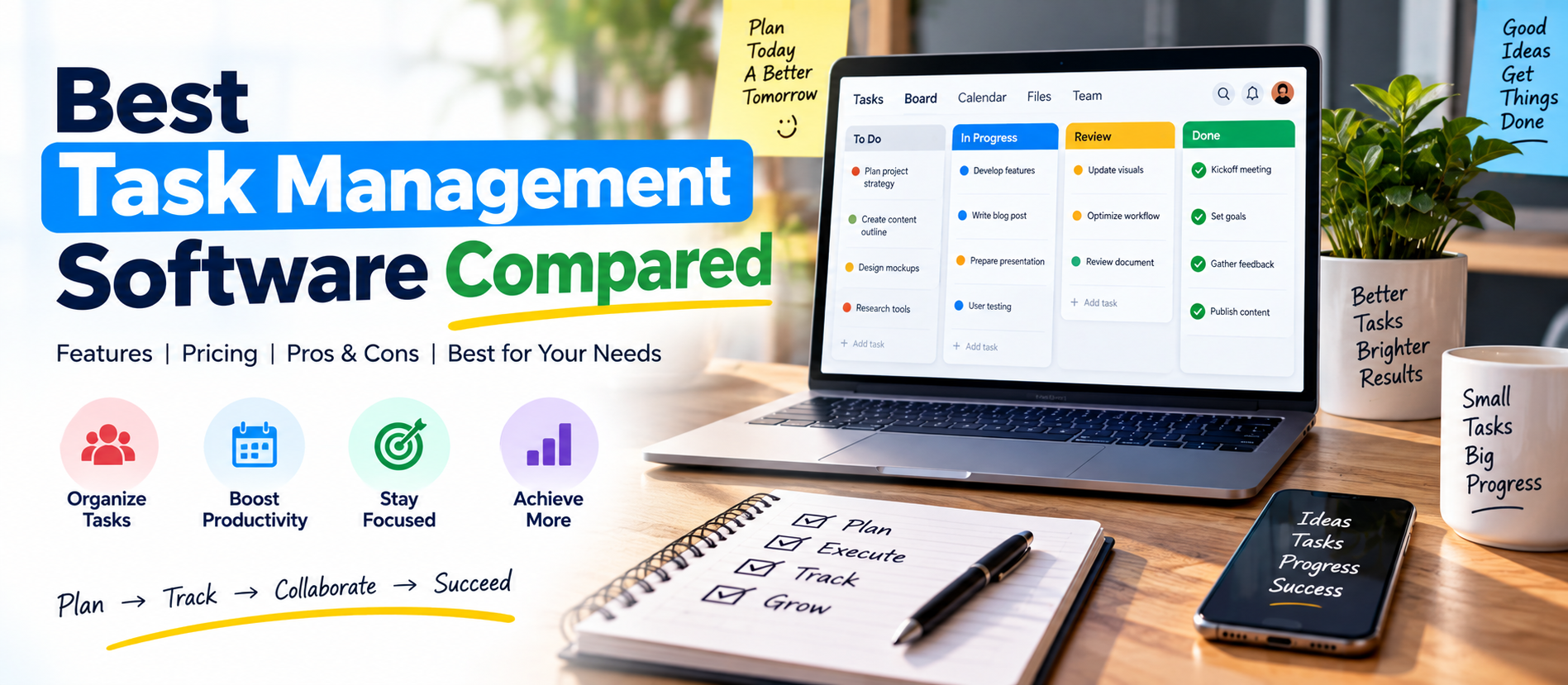
Trello is known for its board-and-card approach. A board can represent a project, while lists can represent workflow stages such as To Do, In Progress, Review, and Done.
This structure is easy to understand. It works well for editorial calendars, simple project pipelines, personal planning, and small teams. As a project becomes more complex, users may need more advanced dependencies, reporting, resource planning, or hierarchy.
5. Notion
Notion is a document-first workspace that also supports databases and task systems. This makes it useful when project information and documentation need to live together.
A content team, for example, can create a database containing article topics, writers, deadlines, keywords, status, and publication dates. The same workspace can contain research notes, guidelines, meeting records, and briefs.
The key consideration is workspace design. Notion gives teams flexibility, but that flexibility means teams need clear conventions for databases, statuses, ownership, and naming.
6. Microsoft Planner
Microsoft Planner is designed for work management within the Microsoft 365 ecosystem. Microsoft describes views such as My Day, My Tasks, and My Plans, along with lists, boards, timelines, sprints, templates, and Copilot capabilities. citeturn0search12
For businesses already using Microsoft 365, the ability to keep planning connected to the broader Microsoft environment can be important. Evaluate how Planner fits with Teams, Outlook, Microsoft 365 identity, and existing processes.
7. Jira
Jira is strongly associated with software development, agile planning, issue tracking, and sprint workflows. Development teams can use issues, backlogs, boards, workflows, and reporting to organize engineering work.
Jira can be more than a simple task list. Its depth can help teams with complex technical workflows, but businesses that only need basic assignments and deadlines may find that level of structure unnecessary.
8. Todoist
Todoist focuses on fast task capture and personal productivity. Users can organize tasks into projects, set due dates, create priorities, and manage recurring work.
It can be a practical choice for individuals and small teams that want a lightweight task system. Businesses with complex portfolios, advanced dependencies, or detailed resource planning should compare it with broader work-management platforms.
However, AI should support a clear workflow rather than become another source of notifications. Start with a specific problem. For example, if managers spend too much time writing status reports, test AI-generated summaries. If meeting actions are frequently forgotten, test automatic action-item creation.
ClickUp's current feature documentation includes AI notetaking, AI fields, AI cards, automated workflows, and AI agents. Microsoft Planner also documents Copilot-assisted planning and goal setting.
Automation Features That Matter
- Automatically assign tasks after a status change.
- Move tasks when work enters a new stage.
- Send reminders before deadlines.
- Create recurring tasks.
- Notify stakeholders when work is blocked.
💡 Key Insight
Automation should remove repetitive work without hiding important decisions. Keep approval steps visible when they affect quality, compliance, money, or customer commitments.
Good task descriptions also matter. A useful task should explain the desired outcome, owner, deadline, context, and acceptance criteria. Better task writing can improve results even when the software stays the same.
How to Choose the Right Task Management Software
1. Define the Main Problem
Start with one sentence. For example: “We lose track of client deadlines,” or “Managers cannot see project status.” This prevents the buying process from becoming a feature-shopping exercise.
2. Map Your Workflow
Write down how work enters the team, who approves it, where it is assigned, how it moves through stages, and how completion is recorded.
3. Choose the Required Views
Decide whether your team needs lists, boards, calendars, timelines, Gantt charts, dashboards, or a combination.
4. Check Integrations
Review connections to email, calendars, cloud storage, CRM systems, communication platforms, accounting systems, development tools, and automation services.
5. Run a Real Pilot
Use a real project for one or two weeks. Ask users where they struggle and which steps still happen outside the platform.
6. Calculate the Total Cost
Consider subscription fees, add-ons, implementation, training, migration, administration, and integration costs.
SEO, AEO, GEO, and AI Search Considerations
Businesses that publish task-management content should organize information around real search questions. Useful topics include “what is task management software,” “task management software for small business,” “task management vs project management,” “how to choose task management software,” and “best features of task management software.”
Use clear definitions, short answers, comparison tables, practical examples, descriptive headings, and FAQs. Keep claims specific and verifiable. Do not create pages only to repeat keywords.
Google's 2026 Search documentation says its guidance for generative AI features builds on established SEO practices and emphasizes useful, non-commodity content. Google also clarified that llms.txt is not required for Google Search and does not provide a ranking benefit.
For AI Search visibility, make the content easy to understand and easy to quote accurately. Explain who a tool is for, what it does, where it fits, and what trade-offs a buyer should examine. This is more useful than making unsupported “best” claims.
Frequently Asked Questions
What is task management software?
It is software that helps individuals and teams create, assign, organize, prioritize, schedule, and track work.
What is the difference between task management and project management?
Task management focuses on individual pieces of work and their status. Project management covers a broader process that can include scope, resources, budgets, schedules, risks, stakeholders, and groups of related tasks.
Can task management software use AI?
Yes. Depending on the platform, AI can summarize work, create subtasks, generate updates, capture meeting actions, search information, or automate parts of a workflow.
Is task management software useful for small businesses?
Yes. Small teams can use it to clarify ownership, manage deadlines, organize repeatable processes, and reduce follow-up work. A simple tool may be enough.
Should a business use one task management tool or several?
Use as few systems as practical. Multiple tools can make sense when they serve different workflows, such as engineering issue tracking and company-wide operations. The important point is to define where each system is the source of truth.
How long does implementation take?
A small team can often start with a simple workflow quickly. Larger organizations may need data migration, permissions, integrations, training, and process design. A pilot can help estimate the real effort before a full rollout.
Final Thoughts
The best task management software is not necessarily the platform with the most features. It is the system that fits the way your team actually works. A growing company may need dependencies, dashboards, automation, integrations, and structured workflows. A software team may need agile issue tracking. A documentation-heavy team may prefer tasks connected to knowledge and databases.
Start with your workflow. Define the problem. Test the tool with real work. Measure adoption. Expand only when the team needs more capability.
Digiifrog helps businesses improve digital workflows through web development, automation, and digital marketing. Visit www.digiifrog.com.
Sources and Further Reading
- Asana Help: Powerful Asana Features for Work Management
- ClickUp: Product Features
- Microsoft Planner
- Google Search Central: Latest Documentation Updates
Ready to Grow?
Talk to us about a strategy tailored to your brand — we will help you stand out in search, AI discovery and social.

Comments (0)
Log in to leave a comment.