📋 Quick Summary
In this article:
Why Corporate Governance Matters
1. Build an Effective and Balanced Board
2. Define Clear Roles and Responsibilities
3. Strengthen Board Independence
To Support Independent Thinking:
4. Create Strong Board Committees
5. Improve Financial Transparency
Financial Governance Best Practices:
6. Establish a Strong Audit Function
💡 Key Insight
Meta Description: Learn the most important corporate governance best practices, including board oversight, transparency, ethics, risk management, compliance, stakeholder engagement and digital governance.
Focus Keyword: Corporate Governance Best Practices
Strong corporate governance helps a business make better decisions. It creates accountability. It improves transparency. It also helps companies manage risk and build trust with shareholders, employees, customers, regulators and other stakeholders.
Corporate governance best practices are not only important for large listed companies. Private companies, startups, family businesses and growing organizations can also benefit from clear governance systems.
Good governance does not mean creating unnecessary meetings or paperwork. The real goal is to create a system where the right people have clear responsibilities, important decisions receive proper oversight, risks are identified early and the organization acts with integrity.
This guide explains the most important corporate governance best practices in simple and direct language. It is designed for business owners, directors, senior managers and professionals who want to build a stronger and more accountable organization.
Digiifrog creates clear, useful and search-friendly digital content using SEO, AEO, GEO and AI Search Optimization.
What Is Corporate Governance?
Corporate governance is the system of rules, practices, responsibilities and processes used to direct and control a company.
It defines important questions such as:
- Who has the authority to make decisions?
- Who supervises management?
- How are major risks monitored?
- How are conflicts of interest handled?
- How is financial information reviewed?
- How are stakeholders informed?
- Who is accountable when something goes wrong?
At its core, corporate governance is about balancing authority with accountability.
Why Corporate Governance Matters
A company can have a strong product and a profitable business model but still face serious problems if its governance is weak.
Poor governance can lead to:
- Weak financial controls
- Conflicts of interest
- Poor strategic decisions
- Fraud and misconduct
- Regulatory problems
- Data and cybersecurity risks
- Loss of investor confidence
- Damage to brand reputation
Strong governance helps the organization create clear lines of responsibility. It also helps leaders identify problems before they become major crises.
1. Build an Effective and Balanced Board
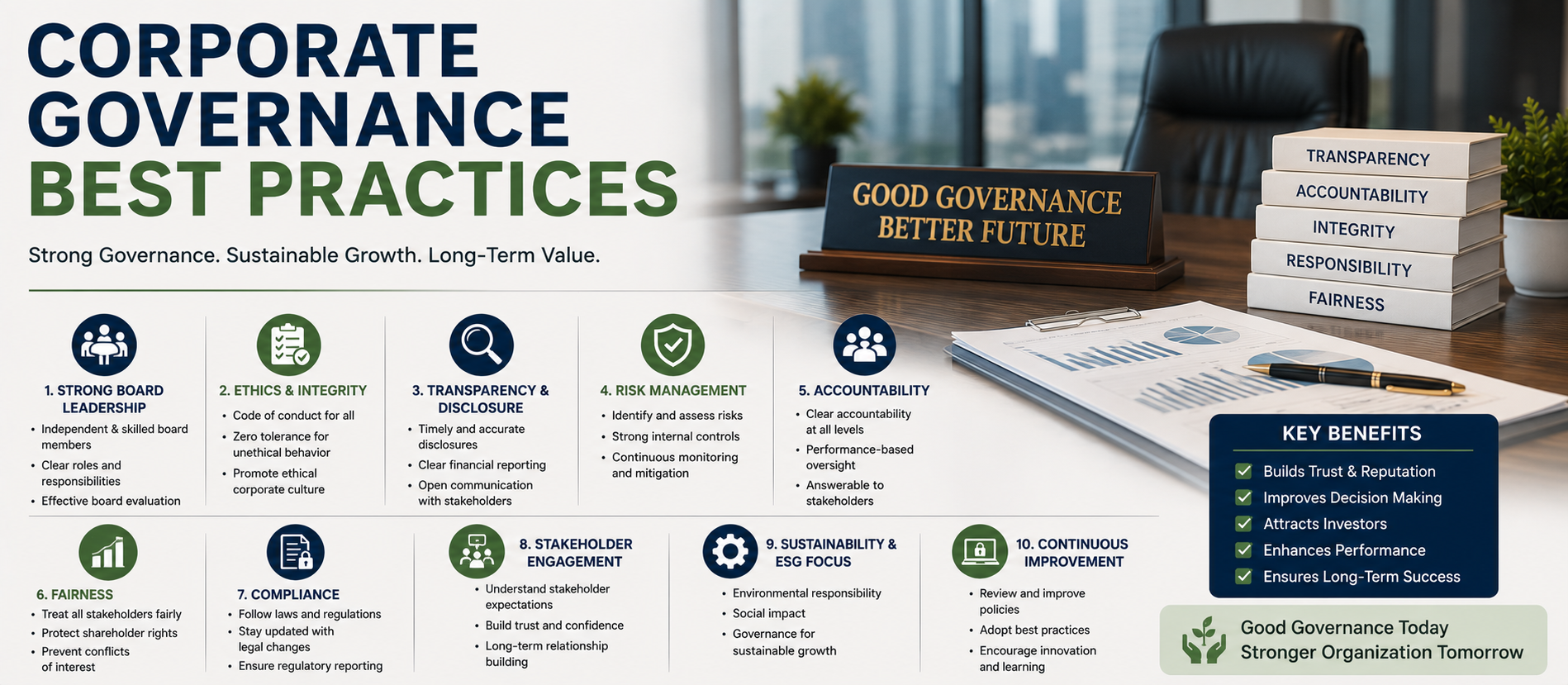
The board of directors plays a central role in governance. A strong board should provide oversight, challenge important decisions and help guide long-term strategy.
Under the Companies Act, 2013, companies are required to have a board of directors, with the minimum number of directors varying by company type. Listed public companies are also subject to additional board-composition requirements under applicable law and regulations.
Good Board Practices Include:
- Clearly defining the role of the board.
- Separating oversight from day-to-day management.
- Bringing together relevant skills and experience.
- Encouraging independent thinking.
- Providing directors with timely information.
- Evaluating board effectiveness regularly.
- Recording important decisions and discussions.
A board should not simply approve every proposal from management. Good directors ask questions, review assumptions and understand major risks.
2. Define Clear Roles and Responsibilities
Confusion creates governance problems.
The board, CEO, senior management and committees should understand their responsibilities. A written governance structure can help prevent duplication and gaps.
For Example:
- The board provides oversight and strategic direction.
- The CEO and management team manage daily operations.
- The audit committee focuses on financial reporting, controls and related oversight responsibilities.
- The risk function helps identify and monitor significant risks.
- The compliance function supports compliance with applicable laws and internal policies.
The exact structure will depend on the size and nature of the organization.
3. Strengthen Board Independence
Independent judgment is an important part of effective governance.
⚠ Watch Out
Independent directors and non-executive oversight can help challenge management decisions and reduce the risk of excessive concentration of power.
For listed entities, applicable SEBI regulations contain specific governance requirements relating to independent directors and board processes. These requirements are updated from time to time, so companies should review the current regulatory framework rather than relying on old compliance guidance.
To Support Independent Thinking:
- Avoid unnecessary conflicts of interest.
- Provide independent directors with relevant information.
- Allow meaningful discussion without management dominating every conversation.
- Encourage directors to record concerns when necessary.
- Provide regular training and familiarization.
Independence is not only about formal eligibility. It also requires the ability to speak honestly and challenge decisions.
4. Create Strong Board Committees
Committees can help the board focus on specialized areas.
Common committees may include:
- Audit Committee
- Nomination and Remuneration Committee
- Stakeholders Relationship Committee
- Risk Management Committee
The structure and legal requirements depend on the organization and applicable regulations.
For listed entities, SEBI's Listing Obligations and Disclosure Requirements framework includes detailed corporate governance provisions and committee-related obligations. Current requirements should always be checked against the latest applicable SEBI regulations and circulars.
5. Improve Financial Transparency
Reliable financial reporting is one of the foundations of corporate governance.
Decision-makers need accurate information. Investors and other stakeholders also need timely and meaningful disclosures where required.
Financial Governance Best Practices:
- Maintain accurate accounting records.
- Use clear internal financial controls.
- Separate approval and payment responsibilities where practical.
- Review unusual transactions.
- Monitor related-party transactions.
- Ensure appropriate internal and external audit processes.
- Provide accurate disclosures when legally required.
Transparency does not mean publishing every internal detail. It means providing accurate and relevant information to the appropriate stakeholders.
6. Establish a Strong Audit Function
An effective audit function helps identify weaknesses before they become major problems.
Internal audit can review processes, controls and compliance. External audit can provide an independent review of financial reporting within its scope.
A Strong Audit Process Should:
- Have a clear scope.
- Focus on material risks.
- Allow findings to reach the appropriate oversight level.
- Track corrective actions.
- Maintain appropriate independence.
- Review whether agreed improvements were actually implemented.
An audit report has limited value if management ignores the findings. Good governance requires follow-up.
7. Build a Practical Risk Management Framework
Every business faces risk. The goal is not to eliminate all risk. The goal is to understand and manage important risks.
Common Business Risks Include:
- Financial risk
- Operational risk
- Legal and regulatory risk
- Cybersecurity risk
- Data privacy risk
- Supply-chain risk
- Reputation risk
- Technology risk
- Strategic risk
Create a simple risk register that identifies major risks, their possible impact, the responsible owner and the mitigation plan.
A Basic Risk Process Can Follow These Steps:
- Identify the risk.
- Assess likelihood and impact.
- Assign an owner.
- Define controls or mitigation steps.
- Monitor the risk.
- Report material changes.
Risk management should be part of business planning, not a document created only for compliance.
8. Develop a Strong Code of Ethics
A company should clearly communicate the behavior it expects from directors, managers and employees.
A useful code of ethics can cover:
- Honesty and integrity
- Conflicts of interest
- Anti-bribery expectations
- Protection of company assets
- Confidential information
- Respectful workplace conduct
- Fair dealing
- Compliance with applicable law
A code of ethics should not exist only as a PDF on a company website. Employees and leaders should understand how it applies to real decisions.
9. Manage Conflicts of Interest Properly
A conflict of interest can arise when a person's personal interest may affect, or appear to affect, their professional judgment.
Good governance requires clear disclosure and management of such conflicts.
Best Practices Include:
- Require regular conflict disclosures.
- Update disclosures when circumstances change.
- Maintain a register where appropriate.
- Require conflicted persons to follow the applicable recusal process.
- Review related-party transactions carefully.
Transparency helps protect both the company and the individual.
10. Improve Disclosure and Communication
Trust grows when important information is communicated clearly and accurately.
For listed entities, SEBI's LODR framework contains principles and detailed requirements relating to disclosure, transparency and corporate governance. The current SEBI regulations also include reporting and disclosure requirements that companies must follow where applicable.
Good communication practices include:
- Providing accurate information.
- Avoiding misleading statements.
- Using clear language.
- Communicating material information through appropriate channels.
- Maintaining consistency across investor and public communications.
11. Protect Whistleblowers and Encourage Reporting
Employees often see problems before senior leaders do.
A whistleblower or reporting mechanism can provide a channel for reporting suspected misconduct, fraud, unethical behavior or control failures.
An Effective Reporting System Should:
- Explain what can be reported.
- Provide a clear reporting channel.
- Protect confidentiality where appropriate.
- Prohibit retaliation.
- Ensure reports are reviewed.
- Track investigations and corrective action.
A company should create a culture where raising a genuine concern is viewed as responsible behavior.
12. Use Technology and Data Responsibly
Modern governance must address digital risk.
Companies now depend on cloud platforms, AI tools, customer data, automation and connected systems. This creates new responsibilities.
Digital Governance Should Address:
- Cybersecurity controls
- Data access management
- Vendor risk
- Data retention
- Incident response
- Business continuity
- AI governance
- Responsible use of automated systems
For listed entities, current SEBI corporate governance reporting requirements also address disclosure of cybersecurity incidents, breaches or loss of data or documents as specified under the applicable framework.
13. Introduce AI Governance
Artificial intelligence is becoming part of business operations. Companies may use AI for customer service, recruitment, marketing, analytics, financial analysis and automation.
This creates a new governance challenge: who is responsible for AI-supported decisions?
AI Governance Best Practices:
- Create an AI usage policy.
- Identify high-risk use cases.
- Protect confidential information.
- Review data quality.
- Maintain human oversight where necessary.
- Document important automated decisions.
- Test systems for errors and bias.
- Monitor third-party AI vendors.
AI governance should connect technology decisions with legal, ethical and business accountability.
14. Make Executive Compensation Transparent and Responsible
Compensation can influence behavior.
A governance system should consider whether incentives encourage responsible long-term performance or create pressure for excessive short-term risk-taking.
Good Compensation Practices May Include:
- Clear performance criteria.
- Appropriate board or committee oversight.
- Consideration of long-term business performance.
- Review of risk-related incentives.
- Transparent approval processes.
- Compliance with applicable legal and disclosure requirements.
15. Focus on Long-Term Value, Not Only Short-Term Results
A company can improve a quarterly number while damaging its long-term future.
Strong governance encourages leaders to consider:
- Long-term strategy
- Customer trust
- Employee retention
- Innovation
- Risk exposure
- Capital allocation
- Reputation
- Sustainability of business operations
The board should regularly ask whether short-term decisions support the company's long-term goals.
16. Improve Stakeholder Engagement
Corporate governance traditionally focuses heavily on shareholders. Modern business governance also requires companies to understand the interests of other stakeholders.
Important stakeholders may include:
- Employees
- Customers
- Suppliers
- Lenders
- Investors
- Regulators
- Local communities
Stakeholder engagement does not mean every group controls every decision. It means leadership understands how important decisions affect the people connected to the business.
17. Review Governance Performance Regularly
Governance systems should not remain unchanged forever.
Business models, technology, regulations and risks change. Therefore, governance practices should also be reviewed.
Questions to Ask During a Governance Review:
- Does the board have the right skills?
- Are directors receiving enough information?
- Are important risks being discussed?
- Are committees effective?
- Are conflicts being disclosed?
- Are internal controls working?
- Are whistleblower concerns handled properly?
- Are new technology risks covered?
- Are policies actually followed?
Corporate Governance Best Practices for Small Businesses
Small businesses may not need the same committee structure as a large listed company. However, the principles still matter.
Start With Simple Steps:
- Define decision-making authority.
- Separate personal and business finances.
- Maintain accurate records.
- Document major decisions.
- Review financial performance regularly.
- Identify key risks.
- Create basic approval controls.
- Develop a code of conduct.
- Plan for succession and leadership continuity.
Good governance can grow with the business.
Corporate Governance Best Practices for Startups
Startups often move quickly. Speed is important, but lack of governance can create problems during fundraising, acquisition or rapid growth.
Startups Should Focus On:
- Clear founder agreements.
- Proper board records.
- Investor communication.
- Intellectual property ownership.
- Financial controls.
- Data protection.
- AI and technology risk.
- Clear approval authority.
Investors often look at governance maturity when evaluating a growing business.
Common Corporate Governance Mistakes
1. Treating Governance as Only a Compliance Exercise
Compliance is important, but governance should also improve decision-making.
2. Giving the Board Too Little Information
Directors cannot provide effective oversight without timely and useful information.
3. Giving the Board Too Much Unstructured Information
Hundreds of pages without a clear summary can also create problems. Board reporting should be relevant and organized.
4. Ignoring Conflicts of Interest
Undisclosed conflicts can damage trust and create legal risk.
5. Failing to Follow Up on Audit Findings
A problem is not solved simply because it appears in an audit report.
6. Ignoring Cybersecurity and AI Risks
Digital governance is now a business issue, not only an IT issue.
A Simple Corporate Governance Checklist
- Define the board's responsibilities.
- Clarify management authority.
- Build an effective board structure.
- Support independent oversight.
- Create appropriate committees.
- Strengthen financial controls.
- Maintain an active risk register.
- Manage conflicts of interest.
- Use a clear code of ethics.
- Protect whistleblowers and reporters.
- Improve transparency and disclosure.
- Review cybersecurity and data risks.
- Develop AI governance rules.
- Review governance performance regularly.
SEO, AEO, GEO and AI Search Optimization for Governance Content
Business leaders increasingly ask direct questions through search engines and AI systems.
Examples include:
- What are corporate governance best practices?
- Why is board independence important?
- What is the role of an audit committee?
- How can a company improve transparency?
- What is AI governance?
SEO helps useful content become discoverable in traditional search.
AEO focuses on providing clear and direct answers to user questions.
GEO helps structure useful information for generative search environments.
AI Search Optimization focuses on clear structure, factual context, readable language and well-organized information.
For business and governance content, clarity is essential. AI systems and human readers both benefit from direct answers, meaningful headings and logical structure.
How Digiifrog Supports Modern Business Content
Digiifrog creates digital content designed for people and modern search experiences.
- SEO Content Strategy
- AEO and Answer-Focused Content
- GEO and Generative Search Optimization
- AI Search Optimization
- Website Content Development
- Digital Branding Strategy
Frequently Asked Questions
What are corporate governance best practices?
Corporate governance best practices include effective board oversight, clear responsibilities, financial transparency, risk management, ethical standards, conflict-of-interest controls, strong compliance systems and regular governance reviews.
Why is corporate governance important?
Corporate governance improves accountability and transparency. It can also help organizations manage risk, protect stakeholder trust and support better long-term decisions.
Does a small business need corporate governance?
Yes. A small business may use a simpler structure, but it still benefits from clear decision-making authority, financial controls, ethical rules and risk management.
What is the role of the board of directors?
The board generally provides oversight, strategic direction and accountability. Management handles day-to-day operations within the authority and structure established by the company.
What is AI governance?
AI governance is the framework used to manage the responsible, secure and accountable use of artificial intelligence within an organization.
How often should corporate governance be reviewed?
Governance should be reviewed regularly and whenever major changes occur in the business, strategy, technology environment, leadership structure or applicable regulatory requirements.
Conclusion
Strong corporate governance best practices help companies build trust and manage complexity. They create clear accountability. They improve oversight. They also support better long-term decisions.
The strongest governance systems are practical. They are not designed only to satisfy a checklist. They help people understand who is responsible, what information matters and how important risks should be managed.
Start with the basics. Build a capable board. Define responsibilities. Strengthen financial controls. Manage conflicts. Encourage ethical conduct. Monitor risks. Review technology and AI governance. Then improve the system as the business grows.
Legal and Compliance Disclaimer: This article is for general educational and informational purposes only. Corporate governance requirements vary depending on the type of company, jurisdiction, listing status, industry and applicable law. Listed entities and regulated businesses should review the current requirements issued by the relevant authorities and seek qualified professional advice where necessary.
Digiifrog
Website: www.digiifrog.com
Ready to Grow?
Talk to us about a strategy tailored to your brand — we will help you stand out in search, AI discovery and social.
Comments (0)
Log in to leave a comment.