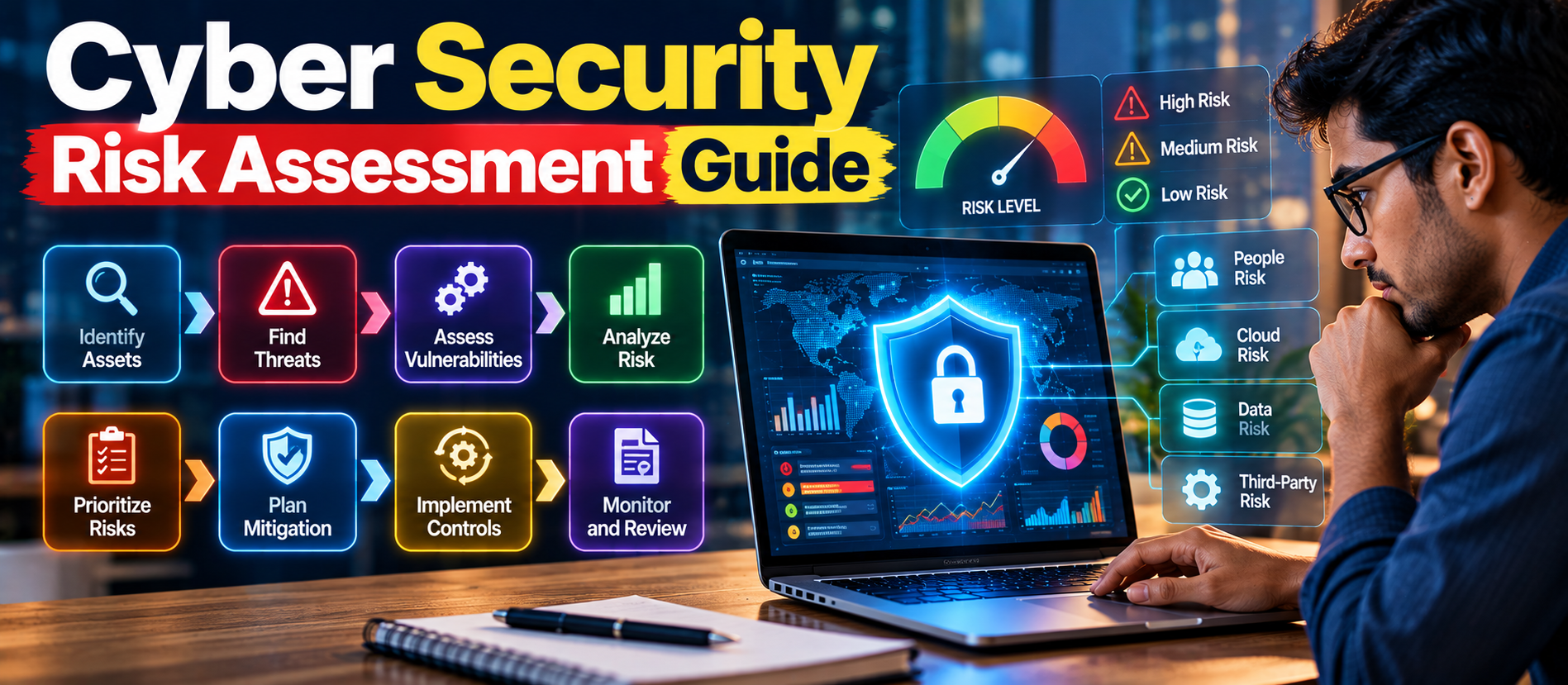
📋 Quick Summary
In this article:
What Is a Cyber Security Risk Assessment?
Why Cyber Security Risk Assessment Matters
Cyber Risk Assessment vs Vulnerability Assessment
Step 1: Define the Scope
Introduction
Cyber threats can affect every organization. A small business may face phishing, ransomware, account takeover, or data theft. A larger organization may also face supply-chain attacks, cloud misconfigurations, insider threats, third-party risks, and complex identity attacks.
The first step toward managing these risks is understanding them.
A cyber security risk assessment helps an organization identify what it needs to protect, understand possible threats, find weaknesses, estimate potential consequences, and decide which risks need attention first.
Risk assessment is not simply a technical exercise. It connects cybersecurity with business operations. A system that seems ordinary from an IT perspective may be critical to sales, payments, customer service, production, or regulatory obligations.
NIST Cybersecurity Framework 2.0 provides a common structure for organizations to understand, assess, prioritize, and communicate cybersecurity risk. NIST also provides guidance for integrating cybersecurity risk information into enterprise risk management.
What Is a Cyber Security Risk Assessment?
A cyber security risk assessment is a structured process for understanding cybersecurity risks that could affect an organization's systems, information, people, operations, and services.
It normally considers four core elements:
- Assets: What needs protection?
- Threats: What could cause harm?
- Vulnerabilities: What weaknesses could be exploited?
- Likelihood and impact: How plausible is the scenario and how serious could the result be?
CISA's cybersecurity risk assessment guidance defines threats, vulnerabilities, likelihood, and risk in this context and recommends regular assessments based on operational needs.
Why Cyber Security Risk Assessment Matters
Organizations rarely have unlimited cybersecurity budgets, staff, or time. A risk assessment helps direct resources toward meaningful risks instead of treating every security issue as equally urgent.
- Understand current security exposure
- Identify critical systems and data
- Prioritize security improvements
- Improve incident preparedness
- Strengthen business continuity planning
- Improve vendor oversight
- Support cybersecurity investment decisions
- Communicate risk to leadership
- Track security progress over time
- Support applicable audit and compliance work
NIST describes CSF 2.0 as a framework that can help organizations manage and reduce cybersecurity risks regardless of size, sector, or maturity.
Cyber Risk Assessment vs Vulnerability Assessment
These terms are related, but they are not identical.
A vulnerability assessment focuses on weaknesses. It may identify missing patches, insecure configurations, exposed services, weak passwords, or software vulnerabilities.
A cyber risk assessment goes further. It considers business context and asks what could happen if a threat exploited a weakness.
| Area Vulnerability Assessment Cyber Risk Assessment | ||
| Main focus | Security weaknesses | Business and security risk |
| Typical output | Vulnerability findings | Prioritized risk scenarios |
| Business context | Limited | Central |
| Impact | Often technical | Business, operational, financial, legal, and reputational |
Key Risk Terms
Asset
An asset is something valuable that the organization needs to protect. It may be data, hardware, software, a service, an application, a cloud environment, intellectual property, or a business process.
Threat
A threat is an actor, event, circumstance, or activity that could cause harm or exploit a weakness.
Vulnerability
A vulnerability is a weakness that could be exploited by a threat.
Likelihood
Likelihood estimates how plausible it is that a particular risk scenario will occur.
Impact
Impact describes the consequences if the risk event occurs.
Risk
Risk combines the possibility of an adverse event with its potential consequences. Real-world risk analysis can use more detail than a simple likelihood-times-impact formula.
Step 1: Define the Scope
Start by defining what the assessment covers. It may cover an entire organization, business unit, cloud environment, application, data-processing system, or project.
Define the systems, business processes, data, users, locations, third parties, cloud services, assessment period, and objectives. A clear scope prevents the assessment from becoming too broad to complete.
Step 2: Understand Business Objectives
Cybersecurity risk cannot be separated from business priorities. Ask which activities must continue during a major incident.
- Customer payments
- Customer service
- Product delivery
- Manufacturing
- Access to critical records
- Public websites
- Employee communication
- Contractual obligations
NIST CSF 2.0 encourages organizations to understand cybersecurity needs in relation to organizational objectives and risk tolerance. =
Step 3: Identify Critical Assets
Create an inventory of important assets. Include more than computers.
- Customer databases
- Employee information
- Financial systems
- Email platforms
- Cloud applications
- Websites
- Source code
- Production systems
- Backup systems
- Identity platforms
- Security tools
- Network infrastructure
- Mobile devices
- Third-party services
- Business-critical processes
NIST recommends maintaining inventories of hardware, software, services, and systems because these can become entry points for malicious activity.
Step 4: Classify Data
Not all data has the same value or sensitivity. Create practical categories such as public, internal, confidential, and highly sensitive.
Consider personal data, financial information, credentials, intellectual property, customer records, health information, business secrets, and regulated information where applicable.
Step 5: Map Information Flows
Knowing where data is stored is not enough. Understand where data moves between users, applications, databases, APIs, cloud services, vendors, payment providers, external integrations, and backup systems.
NIST's CSF 2.0 overview recommends documenting information flows and considering how data is collected, stored, used, and shared.
Step 6: Identify Threats
Think about realistic threats rather than creating a generic list.
- Phishing
- Ransomware
- Credential theft
- Account takeover
- Malware
- Insider misuse
- Cloud misconfiguration
- Software vulnerabilities
- DDoS attacks
- Data leakage
- Supply-chain compromise
- Third-party breaches
- Physical theft
- Social engineering
- AI-assisted attacks
Step 7: Identify Vulnerabilities
Identify weaknesses that could allow threats to cause harm.
- Unpatched software
- Weak passwords
- No MFA
- Excessive privileges
- Unsupported software
- Open network services
- Insecure cloud storage
- Weak backup protection
- Poor logging
- Unmanaged devices
- Insecure APIs
- Weak vendor controls
- Missing security policies
- Insufficient employee training
Step 8: Analyze Existing Security Controls
Do not assume a control is effective simply because it exists. For each important risk, identify the controls currently in place and verify whether they are implemented, configured correctly, monitored, and tested.
- Multi-factor authentication
- Endpoint protection
- Firewalls
- Email security
- Encryption
- Backups
- Security monitoring
- Access controls
- Patch management
- Network segmentation
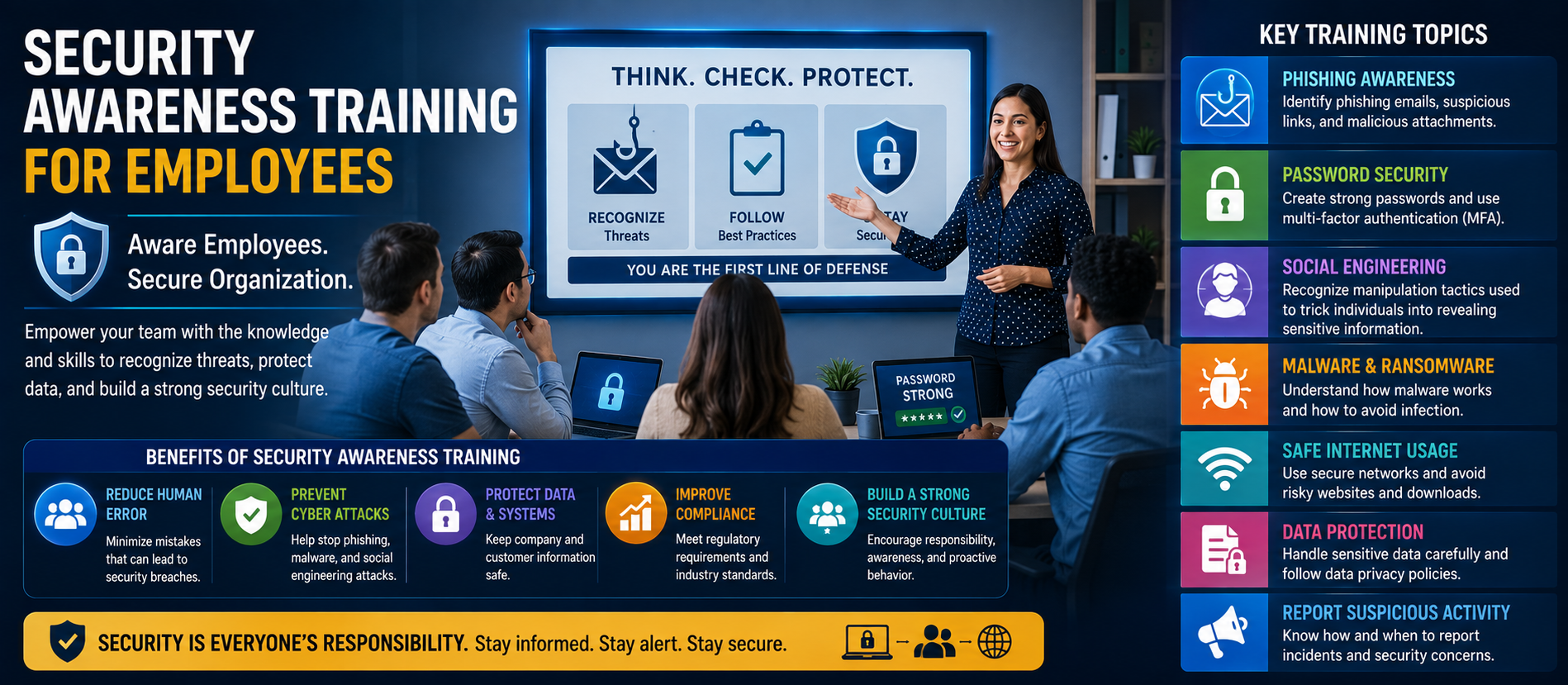
- Security awareness training
- Incident response plans
Step 9: Build Realistic Risk Scenarios
A useful assessment connects threats, vulnerabilities, assets, and consequences.
Example: A phishing attack targets a privileged employee. The account has no MFA. The attacker steals the password and accesses the cloud administration platform. The potential impact includes data exposure, unauthorized changes, service disruption, and recovery costs.
This is more useful than simply writing “phishing is a high risk.”
Step 10: Estimate Likelihood
Likelihood can use a simple scale. Define the scale for your organization rather than treating the labels as universal.
| Level Example Meaning | |
| Low | Unlikely under current conditions |
| Medium | Reasonably possible |
| High | Likely or frequently observed |
| Very High | Strong conditions exist for occurrence |
Step 11: Estimate Impact
Impact should consider more than financial loss.
- Confidentiality
- Integrity
- Availability
- Revenue
- Operations
- Customers
- Employees
- Legal obligations
- Regulatory requirements
- Reputation
- Safety
Step 12: Create a Risk Rating
A simple matrix can combine likelihood and impact.
| Likelihood Impact Example Priority | ||
| Low | Low | Monitor |
| Medium | Low | Planned improvement |
| High | Medium | Prioritized action |
| High | High | Urgent attention |
| Very High | High | Immediate management focus |
This is an example framework, not a universal scoring standard. Organizations should define criteria based on their own risk appetite and requirements.
Step 13: Build a Cyber Risk Register
A risk register is a central record of identified risks. A practical register can include risk ID, asset, threat, vulnerability, scenario, likelihood, impact, current controls, residual risk, risk owner, treatment action, due date, and status.
NIST CSF 2.0 resources describe risk registers as useful repositories of risk information and emphasize documenting, prioritizing, responding to, and monitoring risks.
Step 14: Prioritize Cyber Risks
Prioritization should consider business criticality, likelihood, impact, existing controls, regulatory requirements, threat activity, remediation cost, time, and dependencies.
NIST's CSF Tiers can provide context about the rigor of cybersecurity risk governance and management outcomes.
Step 15: Choose a Risk Treatment
Mitigate
Reduce likelihood or impact through security controls.
Avoid
Stop or redesign an activity when the risk is not acceptable and cannot reasonably be controlled.
Transfer
Shift some financial or contractual consequences through mechanisms such as insurance or agreements. Transfer does not eliminate the underlying cybersecurity risk.
Accept
Formally accept remaining risk when it falls within the organization's risk tolerance.
Residual Risk
Security controls rarely eliminate all risk. The risk remaining after controls is called residual risk. For example, MFA can reduce account-takeover risk, but it does not eliminate phishing, session theft, social engineering, or every authentication attack.
Step 16: Assign Risk Owners
Every important risk should have an accountable owner. The owner does not need to implement every technical control. The owner is responsible for ensuring that the risk is understood, treated, monitored, and reported.
Ownership may sit with IT leadership, security leadership, application owners, business process owners, data owners, risk management, or executive leadership.
Step 17: Assess Third-Party Cyber Risk
Your organization may be secure while a critical supplier is not. Review vendors that store customer data, process payments, provide cloud services, connect to internal networks, handle employee information, provide software, or operate critical business functions.
Review security requirements, contracts, access rights, incident notification processes, backup practices, authentication controls, and relevant assurance evidence.
NIST CSF 2.0 includes supply-chain risk management as part of cybersecurity risk governance.
Step 18: Assess Cloud Security Risk
Cloud environments create specific risks. Assess identity and access management, storage permissions, API security, logging, encryption, network exposure, configuration management, backup and recovery, third-party integrations, secrets management, and workload identities.
Cloud risk should be reassessed when configurations and workloads change.
Step 19: Assess Identity Risk
Identity is a major security control. Review privileged accounts, MFA coverage, inactive accounts, shared accounts, service accounts, external identities, access reviews, and administrative permissions.
Ask whether users and applications have more access than they need.
Step 20: Assess Ransomware Risk
Ransomware can affect availability, confidentiality, and business continuity. Assess endpoint protection, email security, MFA, patch management, network segmentation, backup isolation, recovery time, recovery point objectives, incident response, and employee awareness.
Step 21: Assess AI and Emerging Technology Risk
AI systems introduce new cybersecurity questions. Assess whether AI tools can access confidential documents, customer data, source code, internal systems, APIs, or business workflows.
Consider prompt injection, data leakage, excessive agent permissions, insecure integrations, model supply-chain issues, and unauthorized use of AI services.
NIST's 2026 CSF quick-start resources include a draft guide focused on using AI for CSF analysis and reporting, showing that AI is increasingly being considered within cybersecurity risk-management workflows.
Step 22: Assess Human Risk
People are part of the security environment. Assess phishing, social engineering, password reuse, unauthorized software, data sharing, remote work, shadow IT, and insufficient training.
Training should be practical. Employees should know how to identify suspicious activity and where to report it.
Step 23: Assess Business Continuity and Recovery
A risk assessment should ask what happens after a successful attack.
- How quickly can critical services be restored?
- Are backups available?
- Are backups protected from attackers?
- Who can authorize recovery?
- Are recovery procedures documented?
- Have recovery procedures been tested?
Step 24: Document Security Gaps
Document the gaps between the current state and the desired state. Examples include critical systems without tested backups, unsupported operating systems, unmonitored cloud accounts, excessive administrator permissions, unassessed vendors, and incomplete incident-response plans.
Step 25: Create a Cybersecurity Improvement Roadmap
| Priority Example Action | |
| Immediate | Fix actively exploitable critical weaknesses |
| Short Term | Enable MFA and strengthen privileged access |
| Medium Term | Improve monitoring and segmentation |
| Long Term | Modernize architecture and automate governance |
Each action should have an owner, target date, required resources, and success criteria.
Using NIST Cybersecurity Framework 2.0
NIST CSF 2.0 organizes cybersecurity outcomes into six Functions:
- Govern
- Identify
- Protect
- Detect
- Respond
- Recover
The Govern Function emphasizes cybersecurity strategy, expectations, policy, and oversight. NIST explains that CSF 2.0 is designed to help organizations manage cybersecurity risks and communicate outcomes without prescribing one implementation method.
How Often Should a Cyber Risk Assessment Be Performed?
There is no single schedule for every organization. Reassessments should reflect risk, operational needs, technology changes, and applicable requirements.
Consider reassessment after major technology changes, cloud migrations, acquisitions, new critical vendors, security incidents, regulatory changes, major application launches, organizational changes, or significant changes in threat conditions.
CISA recommends conducting cyber risk assessments regularly based on operational needs.
Cyber Security Risk Assessment for Small Businesses
Small businesses can perform useful risk assessments without building a large security department.
- Identify important data and systems.
- Identify how attackers could reach them.
- Find important weaknesses.
- Estimate the effect of downtime or data loss.
- Prioritize the security improvement that reduces the most important risk.
Focus first on strong authentication, patching, backups, endpoint security, email protection, access control, and employee awareness.
Cyber Security Risk Assessment for Enterprises
Large organizations may need a more formal program connecting cybersecurity with enterprise risk management, privacy, business continuity, vendor management, compliance, internal audit, and security architecture.
NIST SP 1303 specifically addresses integrating cybersecurity risk management information into enterprise risk management.
Common Cyber Risk Assessment Mistakes
- Assessing technology without understanding business priorities
- Creating a huge list without prioritization
- Confusing vulnerabilities with complete risk scenarios
- Ignoring third parties
- Ignoring cloud services
- Ignoring identity risks
- Failing to assign risk owners
- Using scores without defined criteria
- Failing to document residual risk
- Never updating the assessment
- Ignoring recovery requirements
- Producing a report but not an action plan
Cyber Risk Assessment Metrics
| Metric Purpose | |
| Critical risks open | Shows unresolved high-priority exposure |
| Critical vulnerabilities overdue | Measures remediation performance |
| MFA coverage | Shows authentication protection |
| Privileged accounts | Tracks high-impact identities |
| Backup recovery test rate | Measures recovery readiness |
| Vendor assessment coverage | Tracks third-party risk management |
| Security training completion | Measures workforce readiness |
| Incident-response exercise frequency | Measures preparedness |
How AI Can Support Cyber Risk Assessment
AI can help security teams process large amounts of information. Potential uses include summarizing vulnerability findings, grouping similar risks, analyzing logs, drafting risk descriptions, mapping controls to frameworks, identifying unusual patterns, supporting reporting, and tracking remediation.
AI output should still be reviewed. Risk decisions require business context, reliable data, governance, and accountable human judgment.
Cyber Risk Assessment Report Structure
- Executive summary
- Assessment scope
- Business context
- Critical assets
- Threat landscape
- Key vulnerabilities
- Existing controls
- Risk scenarios
- Risk ratings
- Top priorities
- Risk treatment plan
- Residual risks
- Risk owners
- Target dates
- Management decisions
- Appendices and evidence
Cyber Security Risk Assessment Checklist
- Define the assessment scope.
- Identify critical business processes.
- Inventory hardware and software.
- Inventory cloud services.
- Identify sensitive data.
- Map important information flows.
- Identify relevant threats.
- Identify vulnerabilities.
- Review existing controls.
- Create realistic risk scenarios.
- Estimate likelihood.
- Estimate impact.
- Document risks in a register.
- Assign risk owners.
- Prioritize treatment.
- Track remediation.
- Assess vendors.
- Review identity security.
- Review backup and recovery.
- Test incident response.
- Monitor changes continuously.
Frequently Asked Questions
What is a cyber security risk assessment?
It is a structured process for identifying cybersecurity threats, vulnerabilities, assets, potential consequences, and risk levels so an organization can make informed security decisions.
What are the main steps?
A practical process is to define scope, identify assets, identify threats and vulnerabilities, review controls, analyze likelihood and impact, prioritize risks, select treatments, assign owners, and monitor progress.
What is the difference between risk and vulnerability?
A vulnerability is a weakness. Risk considers how a threat could exploit that weakness and what the consequences could be.
What is a risk register?
A risk register is a structured record of identified risks, scenarios, likelihood, impact, controls, owners, treatment actions, and status.
How often should cybersecurity risk assessments be performed?
The frequency depends on organizational risk and operational needs. Reassess after major technology, business, vendor, regulatory, or threat changes. CISA recommends regular assessment based on operational needs.
Is a vulnerability scan the same as a risk assessment?
No. A vulnerability scan identifies technical weaknesses. A risk assessment adds business context, likelihood, impact, controls, and treatment decisions.
Can small businesses conduct a cybersecurity risk assessment?
Yes. Small organizations can begin with critical data, accounts, devices, applications, backups, vendors, and business processes.
Does NIST require one specific risk score?
NIST CSF 2.0 provides outcomes and guidance but does not prescribe one universal scoring method. Organizations can define methods appropriate to their context.
Can cybersecurity risk be eliminated?
No. Controls can reduce risk, but residual risk remains. The goal is to understand, reduce, monitor, and manage it.
Can AI perform a cybersecurity risk assessment automatically?
AI can assist with analysis, reporting, and pattern identification. High-impact risk decisions should still have appropriate validation, governance, and human accountability.
Conclusion
A strong cyber security risk assessment is not just a checklist. It is a structured way to understand how cyber events could affect real business operations.
The process starts with assets and business priorities. It connects threats to vulnerabilities and realistic scenarios. Likelihood and impact help establish priorities. Existing controls show what protection is already available. A risk register turns findings into trackable actions.
The most useful assessments also consider identity, cloud services, suppliers, employees, data flows, business continuity, incident response, and emerging technologies such as AI.
NIST CSF 2.0 provides a flexible structure built around Govern, Identify, Protect, Detect, Respond, and Recover. Its related enterprise risk-management guidance supports connecting cybersecurity risk information with broader organizational risk decisions.
Risk assessment should be continuous. Systems change. Vendors change. Threats change. Business priorities change.
💡 Key Insight
Know what matters. Understand what can go wrong. Measure the risk. Fix the most important gaps. Review the results regularly.
For more practical cybersecurity, AI, cloud, digital transformation, and technology insights, visit Digiifrog.
Disclaimer: This article is for general educational and informational purposes. Cybersecurity risk requirements vary by organization, industry, technology, contract, and jurisdiction. Adapt the assessment to your specific environment and risk tolerance. Professional cybersecurity, legal, compliance, or audit advice may be appropriate for high-risk environments.
Sources and Further Reading
- NIST Cybersecurity Framework 2.0.
- NIST SP 1299 — Cybersecurity Framework 2.0: Resource & Overview Guide.
- NIST SP 1303 — Cybersecurity Framework 2.0: Enterprise Risk Management Quick-Start Guide.
- NIST SP 1302 — Cybersecurity Framework 2.0: Quick-Start Guide for Using the CSF Tiers.
- NIST SP 1308 — Cybersecurity, Enterprise Risk Management, and Workforce Management Quick-Start Guide.
- CISA — Guide to Getting Started with a Cybersecurity Risk Assessment.
Ready to Grow?
Talk to us about a strategy tailored to your brand — we will help you stand out in search, AI discovery and social.

Comments (0)
Log in to leave a comment.