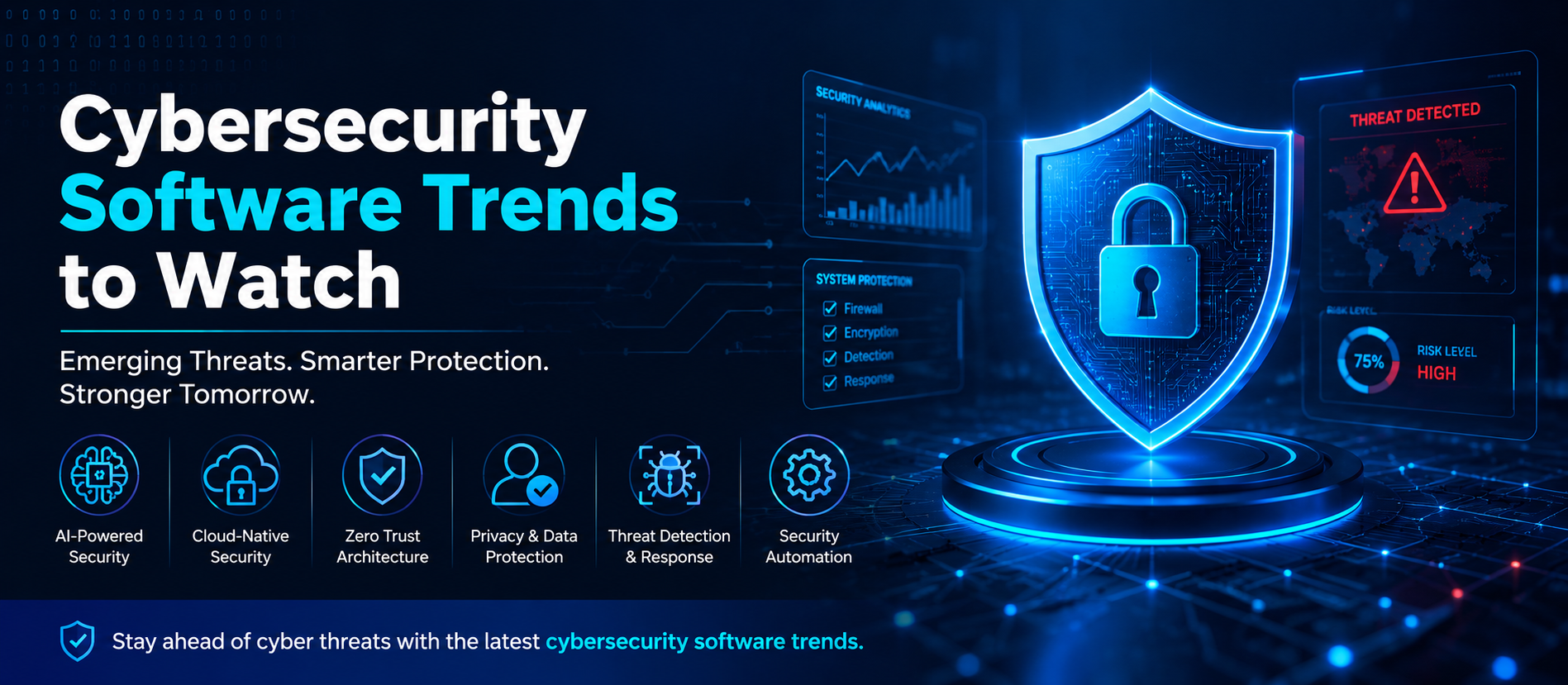
📋 Quick Summary
In this article:
The Growing Importance of Cybersecurity Software
1. Artificial Intelligence-Powered Cybersecurity
Key Benefits of AI Security Tools:
2. Zero Trust Security Architecture
3. Extended Detection and Response (XDR)
4. Cloud-Native Security Platforms
5. Cybersecurity Automation
6. Ransomware Defense Technologies
As businesses continue their digital transformation journeys, cybersecurity has become one of the most critical priorities for organizations worldwide. The rapid adoption of cloud computing, remote work, artificial intelligence, Internet of Things (IoT) devices, and interconnected digital systems has created new opportunities for growth—but it has also expanded the cyber threat landscape.
Cybercriminals are becoming more sophisticated, leveraging advanced techniques such as AI-powered attacks, ransomware-as-a-service, phishing automation, and supply chain compromises. As a result, organizations must rely on increasingly intelligent cybersecurity software to protect sensitive data, maintain compliance, and ensure business continuity.
💡 Key Insight
In 2026, cybersecurity software is evolving rapidly to address emerging threats while supporting modern business environments. This article explores the most important cybersecurity software trends businesses should watch, along with their implications for security strategies, digital transformation, SEO, AEO, GEO, and AI-powered search ecosystems.
The Growing Importance of Cybersecurity Software
Cybersecurity software encompasses a broad range of technologies designed to protect systems, networks, applications, devices, and data from unauthorized access, cyberattacks, and digital threats.
Organizations today face challenges including:
- Ransomware attacks
- Data breaches
- Phishing campaigns
- Insider threats
- Cloud security risks
- Identity theft
- Supply chain vulnerabilities
- AI-driven cyberattacks
Modern cybersecurity software is no longer limited to antivirus protection. It now incorporates advanced analytics, machine learning, behavioral monitoring, automation, and threat intelligence to provide proactive defense mechanisms.
1. Artificial Intelligence-Powered Cybersecurity
Artificial Intelligence (AI) has become one of the most transformative technologies in cybersecurity.
Cybersecurity software vendors are increasingly integrating AI and machine learning algorithms to detect anomalies, identify suspicious behavior, and respond to threats in real time.
Key Benefits of AI Security Tools:
- Faster threat detection
- Automated incident response
- Reduced false positives
- Behavioral analysis
- Predictive threat intelligence
- Enhanced malware detection
AI-driven cybersecurity platforms can analyze massive volumes of data and identify subtle indicators of compromise that traditional security tools may overlook.
2. Zero Trust Security Architecture
Zero Trust has become one of the most influential cybersecurity models in modern enterprise security.
⚠ Watch Out
The principle behind Zero Trust is simple: never trust, always verify.
Rather than assuming users or devices inside a network are trustworthy, Zero Trust continuously verifies identities, devices, permissions, and activities before granting access.
Key Components:
- Identity verification
- Multi-factor authentication (MFA)
- Least privilege access
- Continuous monitoring
- Micro-segmentation
- Device validation
Cybersecurity software vendors are increasingly building Zero Trust capabilities directly into their platforms.
3. Extended Detection and Response (XDR)
XDR is rapidly becoming a major cybersecurity software trend.
Traditional security tools often operate in silos, creating visibility gaps. XDR platforms unify data from multiple security layers, including endpoints, networks, cloud environments, email systems, and identity platforms.
XDR Advantages:
- Centralized threat visibility
- Improved threat correlation
- Faster incident response
- Reduced security complexity
- Enhanced investigation capabilities
Organizations are increasingly adopting XDR solutions to strengthen overall cybersecurity posture.
4. Cloud-Native Security Platforms
As cloud adoption continues to grow, cybersecurity software is evolving to protect cloud-first environments.
Traditional perimeter-based security models are no longer sufficient for distributed cloud infrastructures.
Cloud Security Priorities:
- Cloud workload protection
- Cloud access security brokers (CASB)
- Container security
- Multi-cloud monitoring
- Cloud compliance management
- Identity and access controls
Cloud-native security platforms provide real-time visibility across increasingly complex digital ecosystems.
5. Cybersecurity Automation
Security teams face a growing volume of alerts and incidents. Automation helps organizations manage threats more efficiently.
Security Orchestration, Automation, and Response (SOAR) platforms automate repetitive tasks and accelerate response times.
Automation Benefits:
- Faster threat containment
- Reduced analyst workload
- Consistent response procedures
- Improved operational efficiency
- Enhanced threat investigation
Automation is becoming essential as cybersecurity talent shortages continue worldwide.
6. Ransomware Defense Technologies
Ransomware remains one of the most dangerous cyber threats facing organizations.
Modern cybersecurity software now includes dedicated anti-ransomware capabilities designed to identify and stop encryption attacks before they cause significant damage.
Emerging Features:
- Behavior-based detection
- File integrity monitoring
- Automated backups
- Threat isolation
- Rapid recovery systems
- Attack surface reduction
Businesses are increasingly prioritizing ransomware resilience within their cybersecurity strategies.
7. Identity-Centric Security
Identity has become the new security perimeter.
Cybercriminals frequently target user credentials to gain unauthorized access to systems and data.
Cybersecurity software is increasingly focused on identity protection through:
- Passwordless authentication
- Biometric verification
- Adaptive authentication
- Identity threat detection
- Privileged access management
- Single sign-on solutions
Strong identity security significantly reduces attack risks.
8. Supply Chain Security Monitoring
Recent cyber incidents have demonstrated how attackers can exploit third-party vendors and software supply chains.
Organizations are investing in software that continuously monitors supplier risks, software dependencies, and third-party integrations.
Key Capabilities:
- Vendor risk assessment
- Dependency monitoring
- Software bill of materials (SBOM)
- Third-party visibility
- Continuous compliance tracking
9. Endpoint Security Evolution
With remote work remaining common, endpoint devices have become primary attack targets.
Modern endpoint protection software now includes:
- Behavioral analytics
- Threat hunting
- Device isolation
- Endpoint Detection and Response (EDR)
- AI-powered malware protection
- Remote remediation tools
Endpoint security continues to be a foundational component of cybersecurity programs.
10. Threat Intelligence Integration
Threat intelligence provides actionable insights into emerging attack techniques, vulnerabilities, and cybercriminal activities.
Cybersecurity software increasingly integrates global threat intelligence feeds directly into security platforms.
Benefits Include:
- Early warning capabilities
- Improved threat prioritization
- Enhanced risk management
- Faster incident response
- Better situational awareness
11. Privacy and Compliance Automation
Organizations must comply with an expanding range of data privacy regulations.
Cybersecurity software now includes compliance automation features that help businesses manage regulatory requirements efficiently.
Common Compliance Areas:
- Data protection policies
- Consent management
- Audit logging
- Risk assessments
- Data retention controls
- Regulatory reporting
Automation reduces compliance costs and improves accountability.
12. AI-Powered Cyber Threats
While AI strengthens cybersecurity defenses, attackers are also using AI to launch more advanced attacks.
Examples include:
- Automated phishing campaigns
- Deepfake social engineering
- AI-generated malware
- Credential attacks
- Adaptive attack techniques
Cybersecurity software vendors are actively developing countermeasures to combat AI-driven threats.
13. Security for Internet of Things (IoT)
The growing number of connected devices introduces new security challenges.
Modern cybersecurity platforms now offer dedicated IoT protection features such as:
- Device discovery
- Network segmentation
- Behavior monitoring
- Firmware vulnerability management
- Device authentication
IoT security is expected to remain a major focus area for businesses and software providers.
14. Cybersecurity Mesh Architecture
Cybersecurity Mesh is emerging as a flexible approach to securing distributed environments.
Instead of relying on a single perimeter, security controls are deployed closer to users, devices, applications, and data.
This model supports hybrid work, cloud environments, and decentralized infrastructures more effectively.
15. Generative AI Security Platforms
Generative AI is increasingly being integrated into cybersecurity software.
Security professionals can use AI assistants to:
- Analyze incidents
- Generate threat reports
- Investigate anomalies
- Summarize attack activity
- Recommend remediation actions
These capabilities improve efficiency and accelerate decision-making.
How Cybersecurity Software Supports SEO, AEO, GEO, and AI Search
Cybersecurity is not only a technical issue—it also impacts digital visibility and online trust.
SEO (Search Engine Optimization) benefits from secure websites, HTTPS encryption, fast infrastructure, and reduced downtime.
AEO (Answer Engine Optimization) depends on trusted, accurate, and secure content delivery systems.
GEO (Generative Engine Optimization) requires reliable digital assets that AI search platforms can safely reference.
Businesses that invest in cybersecurity software strengthen both their security posture and digital marketing performance.
Why Digiifrog Recommends Modern Cybersecurity Software
Digiifrog recognizes cybersecurity as a critical business investment rather than a technical expense.
Organizations that proactively adopt advanced cybersecurity software are better equipped to protect customer data, maintain operational continuity, support AI-driven innovation, and build long-term trust.
Whether a business operates locally or globally, cybersecurity software provides the foundation for secure digital growth.
Website: www.digiifrog.com
The Future of Cybersecurity Software
The cybersecurity landscape will continue evolving as technology advances. AI, automation, cloud computing, identity protection, and real-time analytics will play increasingly important roles in defending against sophisticated threats.
Businesses that remain informed about emerging cybersecurity software trends can strengthen resilience, reduce risk, and gain competitive advantages in the digital economy.
Cybersecurity is no longer optional—it is a strategic necessity. The organizations that invest in intelligent, adaptive, and scalable cybersecurity software today will be best positioned to navigate the challenges of tomorrow.
Ready to Grow?
Talk to us about a strategy tailored to your brand — we will help you stand out in search, AI discovery and social.
Comments (0)
Log in to leave a comment.