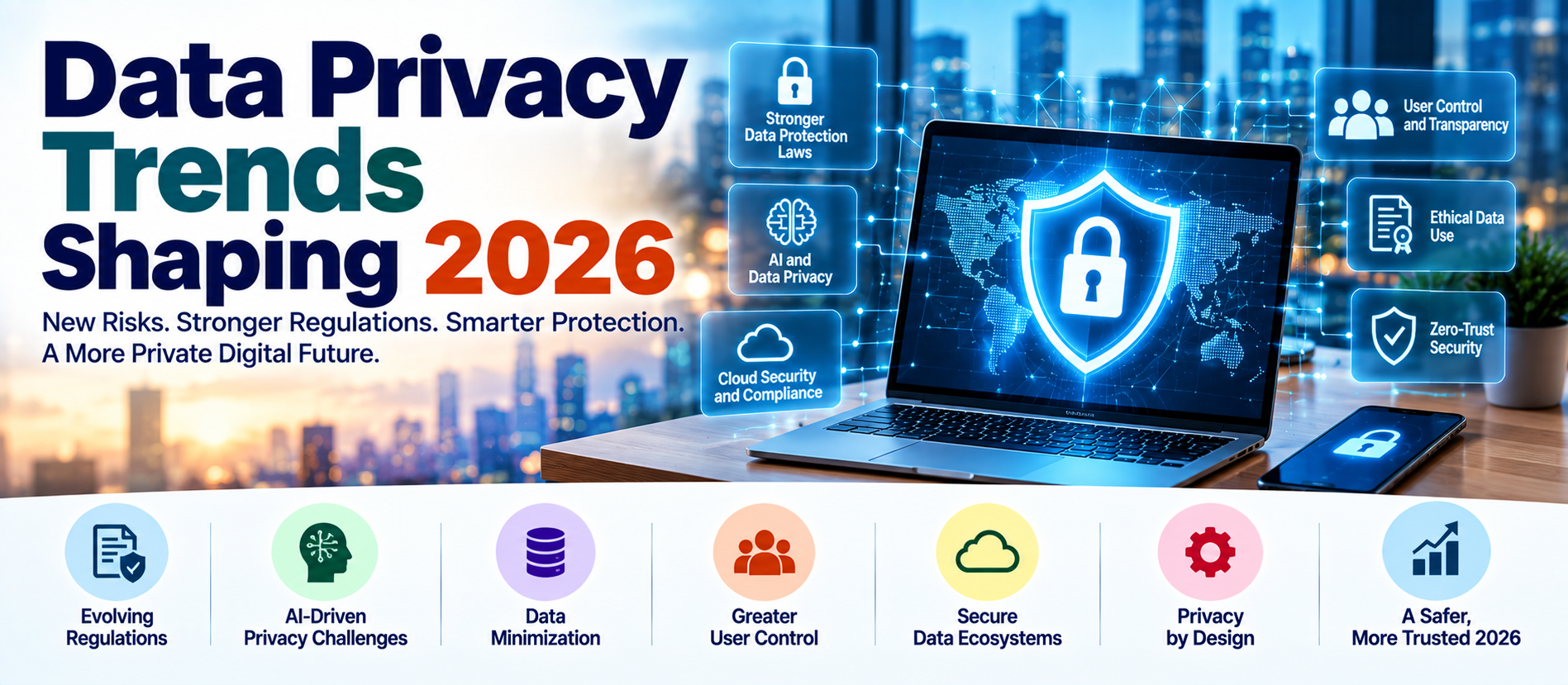
Introduction
Data privacy is becoming a bigger business and consumer issue in 2026. Companies collect information through websites, mobile apps, e-commerce systems, customer databases, connected devices, analytics tools, and AI platforms.
At the same time, artificial intelligence is changing how organizations use that information. AI can summarize records, identify patterns, personalize services, generate predictions, and create new insights from information that may look harmless on its own.
This means privacy is no longer only about protecting a database from a security breach. Organizations also need to understand what data enters an AI system, where it travels, how long it remains available, who can access it, and what the system can infer.
Gartner reported in 2026 that privacy risk is increasingly shifting from direct exposure of personal information toward AI-generated inferences about individuals.
This guide explains the major data privacy trends shaping 2026 in clear language. It is designed for businesses, marketers, technology teams, and consumers.
What Is Data Privacy in 2026?
Data privacy covers how personal information is collected, used, shared, stored, protected, and deleted.
Modern privacy programs must track data across cloud platforms, SaaS applications, CRM systems, advertising tools, analytics platforms, APIs, mobile apps, and AI services.
The rise of AI adds another layer. A company may give an AI system customer messages, documents, transaction data, or other records. The system may then generate a summary, prediction, profile, or recommendation.
Privacy teams therefore need to understand both the original information and the outputs created from it.
Why Data Privacy Matters More in 2026
- AI needs data. Many AI systems depend on data for training, retrieval, personalization, testing, or operation.
- Data moves across more systems. Businesses use many cloud and third-party services.
- Rules are becoming more complex. Privacy, AI, cybersecurity, and digital governance increasingly overlap.
The 2026 IAPP Reg Tech Report describes a digital regulatory environment where privacy, AI governance, cybersecurity, operational resilience, and other compliance requirements increasingly intersect.
Trend 1: AI Governance Is Becoming a Privacy Priority
AI governance is one of the biggest privacy trends of 2026.
Organizations are creating rules for approved AI tools, permitted data, employee use, vendor selection, risk assessment, monitoring, and human review.
This matters because an employee could accidentally paste customer information into an unapproved public AI service. A formal AI policy can reduce that risk.
Forrester identified AI governance and risk management as major priorities for privacy teams in 2026.
Trend 2: Privacy and AI Governance Are Converging
Privacy and AI teams increasingly need to work together. An AI system may process personal information, create a profile, generate an inference, or influence a decision.
Privacy questions therefore become AI governance questions. Modern programs are increasingly combining data governance, AI risk, cybersecurity, legal review, product controls, and responsible technology practices.
Trend 3: Data Minimization Is Becoming More Important
Data minimization means collecting and keeping only the information needed for a defined purpose.
AI can make large datasets look more valuable. But collecting more information also creates more responsibility. Extra data can increase breach exposure, unauthorized access, accidental disclosure, inappropriate reuse, and AI inference risks.
In 2026, organizations are placing more emphasis on purposeful collection instead of collecting information simply because it might be useful later.
Trend 4: Data Retention Is Getting More Attention
Keeping information forever is difficult to justify when there is no clear purpose.
Organizations are reviewing retention periods for customer records, marketing data, support tickets, logs, backups, and other information.
Shorter retention can reduce exposure, but deletion must account for legal, contractual, operational, and security requirements. The goal is to keep information for a defined reason and remove it when that reason no longer exists.
Trend 5: Privacy by Design Is Moving Earlier
Privacy by design means considering privacy before a product or system is launched.
Teams can ask whether they really need a particular data field, whether less sensitive information can be used, whether processing can happen locally, how long data should be retained, and who needs access.
ISACA's 2026 privacy research shows that privacy professionals continue to face pressure from rapidly changing technology and regulations, making privacy-by-design practices increasingly important.
Trend 6: Privacy-Enhancing Technologies Are Growing
Privacy-enhancing technologies, or PETs, are designed to help organizations use data while reducing privacy risk.
- Differential privacy
- Federated learning
- Secure multi-party computation
- Homomorphic encryption
- Synthetic data
- Tokenization
The U.S. Government Accountability Office reported in 2026 that PETs are expanding and can support more secure collaboration involving sensitive information. It also noted implementation barriers such as cost, guidance, and workforce needs.
Trend 7: AI-Generated Inferences Are a New Privacy Risk
An AI system does not need to receive a sensitive fact directly to create a sensitive conclusion. It may combine several ordinary data points and infer behavior, preferences, risk, or other personal characteristics.
Gartner's 2026 research recommends that privacy programs address AI-generated inference risk alongside data minimization, lifecycle controls, and privacy-enhancing technologies.
This creates a new privacy question: What can the system infer from the information it receives?
Trend 8: Zero-Trust Data Governance Is Emerging
Zero trust traditionally means that users and devices should not be trusted automatically. The same idea is now being applied to data.
Gartner predicted that by 2028, half of organizations will adopt a zero-trust posture for data governance because of growing amounts of unverified AI-generated data.
For businesses, this means verifying data sources, access rights, identity, purpose, and important AI-generated information instead of assuming that everything inside a company system is trustworthy.
Trend 9: AI-Generated Data Needs Verification
AI can generate text, images, summaries, classifications, and other information at enormous scale.
💡 Key Insight
If AI-generated information is stored and later reused as business data or training data, errors can spread. Organizations therefore need source tracking, metadata, validation, and review for important information.
Gartner has highlighted metadata management and verification as important responses to the growth of unverified AI-generated data.
Trend 10: Consent Management Is Becoming More Structured
Consent is more than a checkbox. Organizations need to know what a person agreed to, when, for which purpose, and whether the choice was later changed or withdrawn.
Modern consent management is increasingly connected to identity systems, CRM platforms, analytics, marketing tools, and customer data platforms.
Businesses should treat consent as a changing data record rather than a static document.
Trend 11: Data Subject Requests Are Becoming More Automated
Depending on the applicable law, individuals may have rights to access, correct, delete, restrict, or otherwise control personal information.
Automation can help organizations locate records, verify identity, route requests, apply exceptions, and document completion.
However, automation must be tested carefully. A system that deletes the wrong information can create a serious operational problem.
Trend 12: Data Discovery and Mapping Are Essential
You cannot protect data that you cannot find.
Businesses need visibility into what information they hold and how it moves.
- What data is collected?
- Where is it stored?
- Who can access it?
- Why is it processed?
- Which vendors receive it?
- How long is it retained?
- Does it cross borders?
- Which AI systems use it?
As organizations add more SaaS applications and AI tools, data mapping must become an ongoing process.
Trend 13: Third-Party AI Privacy Risk Is Increasing
Businesses increasingly use external AI services for customer support, analytics, marketing, document processing, and productivity.
Each vendor can create another data flow. Before using a third-party AI service, organizations should review privacy terms, security controls, retention practices, training use, sub processors, data location, breach procedures, and contract terms.
Current Indian privacy analysis also highlights concerns about limited visibility into how third-party and cloud-based AI services store or reuse prompts and datasets.
Trend 14: Shadow AI Is a Privacy Challenge
Shadow AI means employees use AI tools without formal approval.
An employee may paste a customer email or confidential document into a public chatbot to save time. The intention may be harmless, but the data transfer may not be authorized.
Organizations need clear policies, approved tools, employee training, and simple processes for requesting new AI services.
Trend 15: Privacy Training Is Becoming AI Training
Employees now need to understand both privacy and AI risks.
Training should cover what data cannot be entered into public AI tools, how to recognize sensitive information, why AI outputs may be inaccurate, how to use approved systems, and how to report incidents.
Privacy awareness needs to become part of normal AI use rather than a once-a-year compliance exercise.
Trend 16: Cross-Border Data Transfers Face More Scrutiny
Global businesses often move information between countries. Cloud platforms and AI services can process data in multiple locations.
Cisco's 2026 Data Privacy Benchmark Study reported strong interest in data localization while also noting concerns that localization can limit seamless services across markets.
Organizations need visibility into international data flows and should evaluate the transfer rules and contractual requirements that apply to each jurisdiction.
Trend 17: Data Localization Is Becoming Strategic
Data localization can affect cloud architecture, vendor selection, AI deployment, disaster recovery, and operating costs.
Companies should consider geographic data requirements when designing systems rather than attempting to solve them after deployment.
Trend 18: Privacy and Cybersecurity Are More Connected
Privacy and cybersecurity are different disciplines, but they overlap strongly.
A breach can expose personal information. A privacy failure can also happen when legitimate access is used for an inappropriate purpose.
Modern programs increasingly combine identity management, access controls, encryption, monitoring, data classification, privacy rules, and incident response.
Trend 19: AI Agents Need New Privacy Controls
AI agents can perform tasks rather than simply answer questions. An agent may read records, call APIs, update systems, create documents, or send messages.
This creates a different risk from a basic chatbot. Agents may have permissions to access data and take actions.
Organizations need strong identity, authorization, least-privilege access, logging, approval workflows, and monitoring for AI agents.
Trend 20: Privacy Automation Is Growing
Privacy teams are automating repetitive work such as data discovery, consent monitoring, data-subject requests, vendor assessments, risk assessments, and compliance reporting.
ISACA's 2026 research shows that privacy professionals face increasing technology and compliance pressure while resources remain constrained.
Automation can help small teams manage larger environments, but complex decisions still need human review.
Trend 21: Continuous Privacy Monitoring Is Becoming Normal
Privacy cannot be checked only once a year.
Data flows change. Vendors change. Applications change. AI models change. New data sources are added.
Continuous monitoring can identify new data stores, unusual access, new vendors, consent changes, unexpected transfers, and retention failures earlier.
Trend 22: Privacy Risk Assessments Are Becoming Dynamic
Privacy assessments are increasingly connected to ongoing technology development.
A system may need another assessment when a new data source is added, an AI model changes, a new vendor is introduced, the purpose of processing changes, a new country is added, or a high-risk use case is introduced.
This reflects the reality that modern data systems are constantly changing.
Trend 23: Privacy Is Becoming a Customer Trust Issue
Privacy is not only about avoiding regulatory problems. Customers want to understand how companies use their information.
Cisco's 2026 study found that clear communication about data use was identified as an important way to build customer confidence.
Simple explanations can be more useful than long legal notices that ordinary users cannot understand.
Trend 24: Privacy Notices Need to Become More Human-Friendly
A useful privacy notice should clearly explain what data is collected, why it is collected, how it is used, who receives it, how long it is kept, what choices are available, and how to contact the organization.
AI can help create summaries and translations, but summaries must remain accurate and should not replace required legal disclosures.
Trend 25: Privacy and Marketing Are More Closely Connected
Marketing systems depend heavily on customer data. CRM platforms, customer data platforms, advertising tools, analytics systems, email platforms, and personalization engines can all process information.
AI can add audience predictions and personalization.
Businesses need to know which data can be used for which marketing purpose and whether the required permissions and legal conditions exist.
Trend 26: Data Quality Is a Privacy Issue
Privacy is often associated with confidentiality, but accuracy also matters.
If a company stores incorrect personal information, that information may affect customer service or automated decisions.
AI can amplify the problem because incorrect information may become an input for further predictions.
Strong privacy programs therefore need correction processes, source tracking, validation, and data-quality controls.
Trend 27: Synthetic Data Is Getting More Attention
Synthetic data is artificially generated information designed to resemble characteristics of real datasets.
It can support testing, development, analytics, and some AI workflows where using real personal data would create unnecessary risk.
However, synthetic data is not automatically anonymous or risk-free. Organizations must assess whether it actually reduces the privacy risk relevant to the use case.
Trend 28: Local and On-Device Processing Is More Attractive
Local processing can reduce the need to send sensitive information to an external service.
This is especially relevant for AI. On-device processing may keep information closer to the user and reduce some external data flows.
It can also create trade-offs involving performance, model size, security, storage, and updates. The right architecture depends on the use case.
Trend 29: Privacy Investment Is Increasing
Privacy requires technology, staff, training, legal review, security controls, and data management.
Cisco's 2026 study reported that 43% of surveyed organizations had increased privacy spending over the previous year and 93% planned to allocate more resources to privacy and data governance over the following two years.
This reflects a wider change: privacy is increasingly treated as an operational capability, not only a compliance expense.
Trend 30: Privacy Teams Need New Skills
Privacy professionals increasingly need knowledge of AI, cloud systems, cybersecurity, data architecture, analytics, vendor management, and product development.
Technical privacy skills are important because privacy decisions often depend on how data actually moves through systems.
Organizations should encourage collaboration between legal, privacy, security, data, product, and engineering teams.
What Data Privacy Means for Small Businesses
Small businesses also collect personal information. A business may hold customer names, phone numbers, email addresses, payment information, employee records, website analytics, or inquiry forms.
It may also use cloud software and AI tools.
A practical small-business privacy program can start with these steps:
- Create a data inventory.
- Identify sensitive information.
- Review tools that receive customer data.
- Limit unnecessary collection.
- Set retention rules.
- Use strong access controls.
- Review vendor terms.
- Create an AI-use policy.
- Train employees.
- Prepare an incident response process.
What Consumers Should Do in 2026
- Review app permissions.
- Use strong passwords and multi-factor authentication.
- Remove unused applications.
- Check privacy settings regularly.
- Be careful when entering personal information into AI tools.
- Do not upload sensitive documents to unknown AI services.
- Check whether an AI service stores conversations or files.
- Use official channels for financial and identity information.
Privacy does not require avoiding every digital service. It requires making informed choices about what information is shared and with whom.
How Businesses Can Prepare for the Next Privacy Wave
1. Map Your Data
Know what information you have, where it is stored, and where it goes.
2. Inventory AI Tools
Identify approved and unapproved AI applications that may process personal or confidential information.
3. Reduce Unnecessary Data
Collect only information that has a clear business purpose.
4. Review Vendors
Check how providers store, process, secure, and delete information.
5. Strengthen Access Controls
Give employees and AI systems only the permissions they need.
6. Create AI Privacy Rules
Define what employees can and cannot enter into AI systems.
7. Improve Data Quality
Correct inaccurate records and track important data sources.
8. Build Privacy Into Product Development
Review privacy risks before a product or AI system goes live.
9. Monitor Continuously
Track changes in data flows, vendors, applications, AI models, and permissions.
10. Train Employees
Make privacy and safe AI use part of regular employee education.
Data Privacy and AI Search Optimization
Privacy also matters to businesses publishing content online.
As search engines and AI assistants summarize web information, organizations should publish accurate content without exposing unnecessary personal information.
Good content governance means verifying facts, protecting personal information, removing sensitive details that are not needed, and clearly identifying reliable sources.
AI Search optimization should not become a reason to ignore privacy. Businesses can use clear headings, direct answers, FAQs, structured content, and trustworthy sources while still respecting data-protection requirements.
Data Privacy Trends 2026: Quick Summary
| Trend What It Means | |
| AI governance | Stronger rules for AI and personal data. |
| Data minimization | Less unnecessary information is collected and retained. |
| Privacy-enhancing technology | Technology helps reduce privacy risk during data use. |
| AI inference governance | Organizations control what AI can infer from data. |
| Zero-trust data governance | Data and AI-generated information are verified instead of automatically trusted. |
| Consent management | Consent becomes structured and trackable. |
| Privacy automation | Technology helps manage repetitive privacy tasks. |
| Third-party risk | Businesses assess how vendors handle information. |
| Cross-border governance | International data flows receive greater scrutiny. |
| Privacy by design | Privacy is considered earlier in product development. |
Frequently Asked Questions
What are the biggest data privacy trends in 2026?
Major trends include AI governance, AI-generated inference risk, data minimization, privacy-enhancing technologies, zero-trust data governance, consent management, privacy automation, third-party AI risk management, cross-border data controls, and privacy by design.
Why is AI changing data privacy?
AI can process large amounts of information and create new conclusions from data. Privacy programs therefore need to govern both the information collected and the insights generated from it.
What is AI inference privacy risk?
Inference privacy risk occurs when an AI system derives personal or sensitive conclusions from information that may appear less sensitive by itself.
What is data minimization?
Data minimization means collecting, using, and retaining only information that is necessary for a defined purpose.
What are privacy-enhancing technologies?
PETs are tools and methods designed to reduce privacy risk while enabling useful data processing. Examples include differential privacy, federated learning, synthetic data, tokenization, and certain forms of encryption.
What is zero-trust data governance?
It means verifying data, identity, access, purpose, and important AI-generated information instead of assuming that information is trustworthy simply because it exists inside an organization.
Why is third-party AI a privacy risk?
External AI services can create additional data flows. Businesses may have limited visibility into storage, retention, training use, sub processors, or international processing.
Why does privacy by design matter?
Privacy by design addresses risks before a product or system launches. Fixing a problem early is often easier than redesigning a system later.
How can small businesses improve privacy?
Start with a data inventory, reduce unnecessary collection, review vendors, protect accounts, set retention rules, control access, create an AI-use policy, and train employees.
What should consumers do about AI privacy?
Do not enter sensitive information into untrusted AI tools. Review app permissions, use strong authentication, and understand how services store and use personal information.
Conclusion
Data privacy in 2026 is becoming broader than traditional data protection.
Organizations need to understand the complete data life cycle. They need to know what is collected, where it goes, who can access it, how long it stays, which AI systems use it, and what those systems can infer.
The strongest privacy programs are becoming proactive. They combine data minimization, privacy by design, AI governance, security, privacy-enhancing technologies, vendor controls, employee training, and continuous monitoring.
For consumers, the message is simple: understand what information you share, question unnecessary collection, and be careful with sensitive information when using AI-powered services.
Privacy is not only a legal requirement. It is also a foundation for trust.
For more practical insights on AI, digital transformation, cybersecurity, marketing, and technology, visit Digiifrog.
Disclaimer: This article is for general educational and informational purposes. Privacy laws and regulatory requirements vary by country, state, industry, and organization. Businesses should obtain appropriate legal, privacy, and security advice for their specific situation.
Sources and Further Reading
- Gartner — 2026 research on AI-generated inference privacy risks.
- Gartner — 2026 research on zero-trust data governance and AI-generated data.
- ISACA — State of Privacy 2026.
- IAPP — Reg Tech Report 2026.
- U.S. Government Accountability Office — Privacy Enhancing Technologies, 2026.
- Cisco — 2026 Data Privacy Benchmark Study.
- Forrester — Privacy Trends for 2026.
Ready to Grow?
Talk to us about a strategy tailored to your brand — we will help you stand out in search, AI discovery and social.
Comments (0)
Log in to leave a comment.