📋 Quick Summary
In this article:
Quick Answer: What Financial Consulting Services Does a Business Need?
Why Financial Consulting Matters
1. Financial Planning and Strategy Consulting
What a financial plan may include
2. Budgeting and Budget Management
3. Cash Flow Management and Working Capital Consulting
Common areas of analysis include
4. Financial Forecasting and Scenario Planning
5. Cost Management and Expense Optimization
6. Profitability and Margin Analysis
7. Pricing and Revenue Model Consulting
Every business makes financial decisions. Some decisions are small, such as choosing a software subscription. Others can shape the future of the company, such as expanding into a new market, hiring a larger team, raising capital, acquiring another business, or investing in new technology.
Good financial decisions require more than basic bookkeeping. Business leaders need clear information about cash flow, profitability, costs, risks, growth opportunities, and future scenarios. This is where financial consulting services can provide value.
💡 Key Insight
A financial consultant can help a business understand its current financial position, identify weaknesses, create plans, improve controls, and support important decisions. The exact service depends on the company's size, industry, goals, and financial complexity.
This guide explains the main financial consulting services every business should consider. The content uses simple and direct language and is structured for SEO, AEO, GEO, and AI Search Optimization.
Digiifrog creates clear, structured, and search-friendly content for businesses, technology brands, professional services, and digital growth.
Quick Answer: What Financial Consulting Services Does a Business Need?
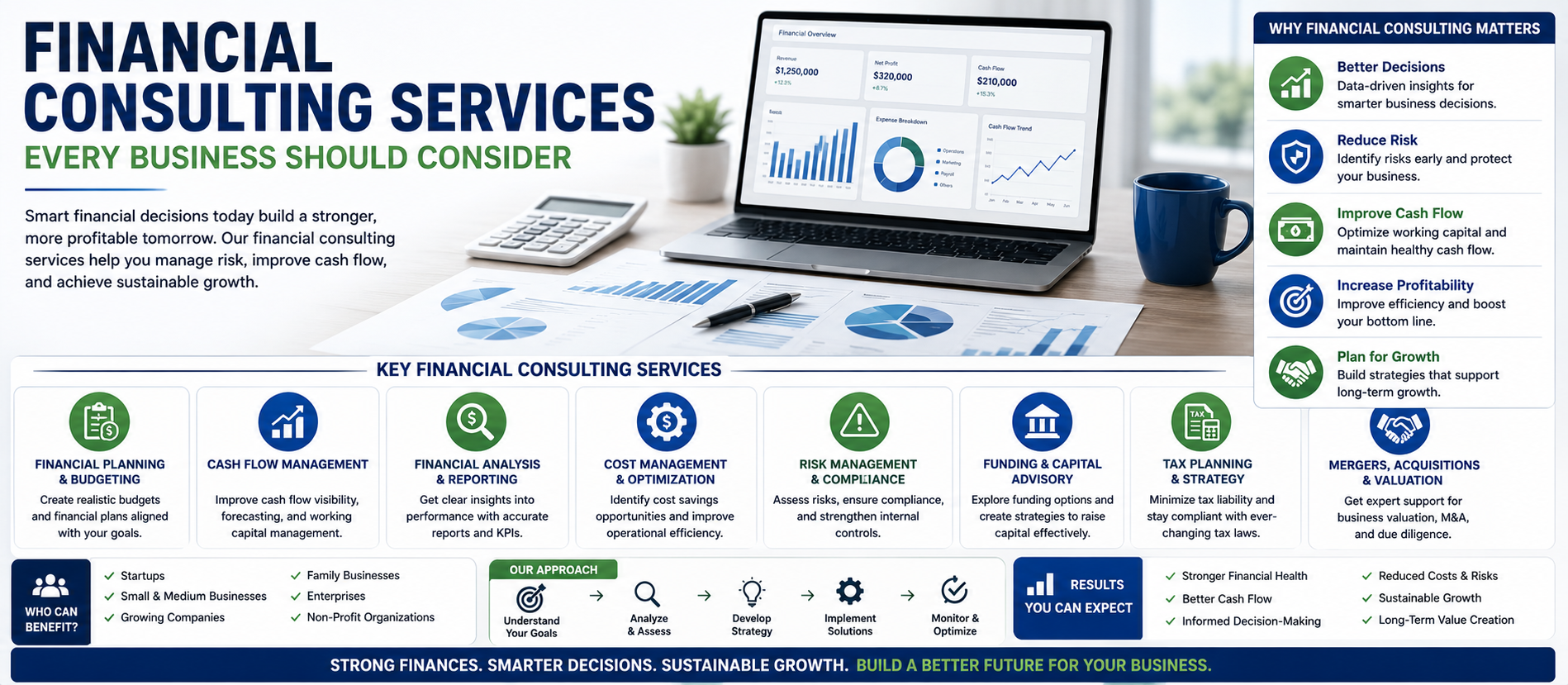
Most businesses should consider services related to financial planning, budgeting, cash flow management, forecasting, cost management, profitability analysis, financial risk management, tax planning, funding strategy, business valuation, and strategic CFO advisory.
Not every company needs every service at the same time. A small business may need help with cash flow and budgeting. A growing company may need forecasting, pricing analysis, and funding support. A larger organization may require scenario planning, risk management, finance transformation, and strategic CFO-level guidance.
Why Financial Consulting Matters
Financial data tells a story about the health of a business. Revenue may be increasing while profit margins are falling. A company may appear profitable but still experience cash shortages. Rapid growth can create new funding needs. High expenses may hide inefficient processes.
Financial consulting helps turn raw numbers into useful business insight.
The U.S. Small Business Administration emphasizes the importance of proper bookkeeping, understanding business finances, balance sheets, cash-flow projections, and cost-benefit analysis as foundations for sound financial management.
For 2026, finance leaders are also placing greater emphasis on advanced scenario planning, strategic cost management, AI, technology, and stronger finance participation in business strategy. Deloitte's Finance Trends 2026 research is based on a survey of more than 1,300 global finance leaders.
1. Financial Planning and Strategy Consulting
Financial planning is one of the most important consulting services for a business. It connects financial decisions with long-term business goals.
A consultant may help answer questions such as:
- Can the business afford its growth plan?
- How much capital will expansion require?
- Which products or services are most profitable?
- How much should the company invest in technology?
- What financial targets should management track?
- What happens if revenue grows slower than expected?
A financial strategy should not be a document that sits unused. It should support regular decision-making.
What a financial plan may include
- Revenue targets.
- Profit goals.
- Investment priorities.
- Capital requirements.
- Debt strategy.
- Cost targets.
- Growth scenarios.
- Key financial metrics.
2. Budgeting and Budget Management
A budget gives a business a structured view of expected income and expenses. It helps management allocate resources and compare plans with actual results.
However, budgeting should not mean simply copying last year's numbers and adding a percentage. A useful budget should reflect current conditions, strategic priorities, expected demand, staffing needs, operating costs, and investment plans.
A financial consultant can help create:
- Annual operating budgets.
- Department budgets.
- Project budgets.
- Capital expenditure budgets.
- Marketing budgets.
- Technology budgets.
- Rolling budgets.
The consultant can also create a budget review process so management understands why actual results differ from expectations.
3. Cash Flow Management and Working Capital Consulting
Profit and cash are not the same thing. A company can report a profit while still struggling to pay suppliers, employees, rent, or other obligations.
Cash flow consulting focuses on how money moves through the business.
Common areas of analysis include
- Accounts receivable.
- Accounts payable.
- Inventory levels.
- Payment terms.
- Recurring expenses.
- Short-term borrowing.
- Seasonal cash requirements.
- Cash reserves.
⚠ Watch Out
The goal is to improve visibility and reduce avoidable cash pressure. A consultant may also create weekly or monthly cash forecasts.
The SBA notes that a balance sheet can help businesses understand assets, liabilities, equity, and future cash-flow projections.
4. Financial Forecasting and Scenario Planning
A forecast estimates what may happen in the future based on available information and assumptions. Forecasting is especially important when markets are uncertain.
Modern financial consulting increasingly uses scenario planning. Instead of relying on one forecast, a business may prepare several possible situations.
For example
- Base case: Expected performance under normal assumptions.
- Growth case: Higher demand and faster expansion.
- Downside case: Lower revenue, higher costs, or delayed payments.
- Stress case: A major disruption or unexpected financial event.
Deloitte's 2026 finance research identifies advanced scenario planning and agile governance as a major trend for finance leaders navigating uncertainty.
Scenario planning helps leaders prepare before a problem occurs.
5. Cost Management and Expense Optimization
Reducing costs is not always the same as improving financial performance. Cutting useful investments can damage growth. Effective cost management focuses on understanding where money creates value and where waste exists.
A consultant may review:
- Vendor contracts.
- Software spending.
- Payroll costs.
- Marketing expenses.
- Operational processes.
- Procurement practices.
- Facilities costs.
- Unused subscriptions and services.
The goal is to create better cost discipline without damaging essential capabilities.
Deloitte's Finance Trends 2026 highlights finance-led cost management as an important area for creating measurable value and balancing growth with cost discipline.
6. Profitability and Margin Analysis
Revenue growth does not automatically mean healthy profitability. A business may have popular products or services that generate little profit after direct and indirect costs are included.
Profitability analysis can examine:
- Product profitability.
- Service profitability.
- Customer profitability.
- Project profitability.
- Channel profitability.
- Gross margin.
- Operating margin.
This analysis can support better pricing, customer selection, product investment, and resource allocation.
7. Pricing and Revenue Model Consulting
Pricing is both a financial and strategic decision. Setting prices too low can create strong sales but weak margins. Setting prices too high can reduce demand.
A financial consultant can help analyze:
- Cost structure.
- Desired margins.
- Customer willingness to pay.
- Competitor positioning.
- Discounting practices.
- Subscription economics.
- Recurring revenue models.
For service businesses, pricing analysis can also examine utilization, labor costs, delivery time, and project profitability.
8. Financial Risk Management
Every business faces financial risk. The risk may come from customers, suppliers, debt, currency changes, fraud, technology, market conditions, or operational disruption.
Risk management consulting helps identify important risks and determine how they should be monitored or controlled.
Common financial risks include
- Cash shortages.
- Customer concentration.
- Excessive debt.
- Interest-rate exposure.
- Fraud.
- Currency exposure.
- Supplier dependency.
- Weak internal controls.
The purpose is not to eliminate every risk. That is impossible. The purpose is to understand major risks and make informed decisions.
9. Internal Controls and Financial Process Improvement
As a business grows, informal financial processes can become a problem. The same person may approve payments, record transactions, and manage vendor relationships. Manual spreadsheets may become difficult to control.
A consultant can review financial processes and recommend improvements in:
- Approval workflows.
- Expense controls.
- Payment procedures.
- Financial reporting.
- Reconciliation processes.
- Documentation.
- Segregation of duties.
Better controls can improve accuracy and reduce operational and fraud risk.
10. Tax Planning Support
Tax planning should be proactive. Businesses should understand the potential tax effects of major decisions before those decisions are finalized.
Financial consulting may support broader tax planning by helping management model transactions, investments, business structures, or growth scenarios. Licensed tax professionals should handle advice that requires specific tax expertise.
Depending on the business and jurisdiction, planning may involve:
- Investment timing.
- Business structure.
- Capital expenditure planning.
- Cross-border activity.
- Compensation planning.
- Transaction planning.
Tax rules vary by country, state, and local jurisdiction. Always obtain advice from a qualified professional for specific tax decisions.
11. Fundraising and Capital Advisory
Growth often requires capital. The right funding method depends on the company's stage, cash flow, assets, risk profile, and long-term plans.
A consultant can help prepare the business for financing by improving forecasts, organizing financial information, modeling capital needs, and comparing funding options.
Potential funding options may include
- Bank financing.
- Business loans.
- Lines of credit.
- Equity investment.
- Private investment.
- Strategic investment.
- Revenue-based financing.
- Other legally available financing structures.
The right choice depends on the business. Debt may preserve ownership but create repayment obligations. Equity can provide growth capital but may dilute ownership.
12. Business Valuation Consulting
A business valuation estimates the economic value of a company or ownership interest. Valuation may be useful when selling a business, raising capital, planning ownership changes, resolving certain disputes, or preparing for acquisitions.
Financial consultants may analyze factors such as:
- Revenue.
- Profitability.
- Cash flow.
- Assets and liabilities.
- Growth potential.
- Market conditions.
- Comparable transactions.
Valuation methods and professional requirements can vary by purpose and jurisdiction.
13. Mergers, Acquisitions, and Transaction Support
Buying another business is a major financial decision. A consultant can support financial analysis before and during a transaction.
Services may include:
- Financial due diligence.
- Quality of earnings analysis.
- Cash-flow review.
- Valuation support.
- Synergy modeling.
- Integration planning.
The objective is to understand both opportunity and risk before making a commitment.
14. Fractional CFO and Strategic Finance Services
Many growing businesses need high-level financial leadership but are not ready to hire a full-time Chief Financial Officer.
A fractional or outsourced CFO arrangement can provide part-time strategic finance leadership.
A strategic CFO may support
- Financial strategy.
- Board reporting.
- Fundraising preparation.
- Forecasting.
- Cash management.
- Performance analysis.
- Capital allocation.
- Risk management.
This service can be particularly useful for startups and growing companies with increasing financial complexity.
15. Finance Technology and AI Transformation Consulting
Finance teams are increasingly using automation, cloud platforms, analytics, and AI to improve speed and decision-making.
Deloitte's 2026 finance research reports growing use of AI in finance and identifies AI, advanced technology, data, and new finance skills as important areas of transformation. Its CFO technology guide reports that 63% of surveyed finance departments were actively using AI solutions, while emphasizing that measurable value and governance remain important challenges.
Technology consulting may help a business improve:
- Financial reporting automation.
- Forecasting.
- Data dashboards.
- Expense management.
- Invoice processing.
- Cash-flow monitoring.
- Scenario analysis.
- Management reporting.
Technology should solve a real business problem. A business should not adopt AI simply because it is popular.
How to Choose the Right Financial Consulting Service
Start with the problem you want to solve.
| Business ChallengeUseful Consulting Area | |
| Unstable cash position | Cash flow and working capital consulting |
| Poor budget performance | Budgeting and variance analysis |
| Uncertain future | Forecasting and scenario planning |
| High operating costs | Cost management and process review |
| Low margins | Profitability and pricing analysis |
| Rapid growth | Strategic finance and fractional CFO support |
| Need for investment | Capital advisory and financial modeling |
| Complex financial processes | Controls and finance transformation |
| Potential acquisition | Valuation and transaction support |
Questions to Ask Before Hiring a Financial Consultant
- What business problem will this engagement solve?
- What experience does the consultant have in our type of business?
- What information and systems will the consultant need?
- What deliverables will we receive?
- How will success be measured?
- Who will own implementation after recommendations are made?
- What professional licenses or qualifications are required for this work?
- How will confidential financial information be protected?
How Financial Consulting Supports Sustainable Growth
Sustainable growth requires balance. A company must invest enough to grow while protecting cash, margins, and financial stability.
Financial consulting can support this balance by helping businesses:
- Plan before investing.
- Understand the cash impact of growth.
- Measure profitability.
- Control unnecessary costs.
- Prepare for multiple future scenarios.
- Identify major financial risks.
- Improve decision-making with better data.
In this way, finance becomes more than a reporting function. It becomes part of the business strategy.
Financial Consulting and SEO, AEO, GEO, and AI Search
Business leaders often search for direct answers to questions such as:
- What does a financial consultant do?
- Does my business need a fractional CFO?
- How can I improve business cash flow?
- What financial services help a growing company?
- How does scenario planning work?
- What is the difference between profit and cash flow?
SEO helps useful financial education content appear in traditional search results.
AEO focuses on answering important questions directly.
GEO helps organize content so generative search systems can understand the subject and context.
AI Search Optimization benefits from clear language, logical headings, direct answers, structured comparisons, and accurate context.
Frequently Asked Questions
What does a financial consultant do?
A financial consultant analyzes financial information and helps a business make better decisions. Services may include planning, budgeting, cash-flow management, forecasting, cost analysis, risk management, funding support, and strategic finance.
Does every business need a financial consultant?
Not necessarily on a full-time basis. However, most businesses can benefit from specialized financial guidance when facing growth, cash-flow problems, major investments, funding decisions, or increased financial complexity.
What is the difference between bookkeeping and financial consulting?
Bookkeeping focuses on recording and organizing financial transactions. Financial consulting focuses more on analysis, planning, decision support, forecasting, strategy, and financial improvement.
When should a company hire a fractional CFO?
A fractional CFO can be useful when a company needs strategic financial leadership but does not require or cannot justify a full-time CFO.
How can financial consulting improve cash flow?
A consultant can analyze payment cycles, receivables, expenses, inventory, debt, and future cash needs. The analysis can identify ways to improve visibility and reduce unnecessary cash pressure.
Can AI improve financial planning?
AI and automation can support forecasting, reporting, data analysis, and process efficiency. Businesses should also use appropriate controls, governance, validation, and human review.
Conclusion
The best financial consulting services depend on the current needs of the business. There is no single service that fits every organization.
A small company may benefit most from budgeting and cash-flow management. A growing company may need forecasting, profitability analysis, pricing support, and a fractional CFO. A larger business may need advanced scenario planning, risk management, finance transformation, or transaction support.
The important step is to identify the financial challenge clearly. Then choose a consultant or service with the right expertise, qualifications, and scope.
Strong financial decisions can help a business protect cash, manage risk, invest with greater confidence, and build a more sustainable path to growth.
Disclaimer: This article is for general educational and informational purposes only. It does not provide accounting, tax, investment, legal, lending, or other professional financial advice. Financial regulations and requirements vary by jurisdiction. Consult appropriately qualified professionals before making significant financial or business decisions.
Digiifrog
Website: www.digiifrog.com
Ready to Grow?
Talk to us about a strategy tailored to your brand — we will help you stand out in search, AI discovery and social.

Comments (0)
Log in to leave a comment.