📋 Quick Summary
In this article:
What Is Google Performance Max?
Why Performance Max Matters for Modern Advertising
1. Define the Right Campaign Goal
Ask These Questions Before Launch
2. Set Up Accurate Conversion Tracking
3. Choose the Right Bidding Strategy
4. Give Google High-Quality Creative Assets
5. Write Conversion-Focused Headlines and Descriptions
💡 Key Insight
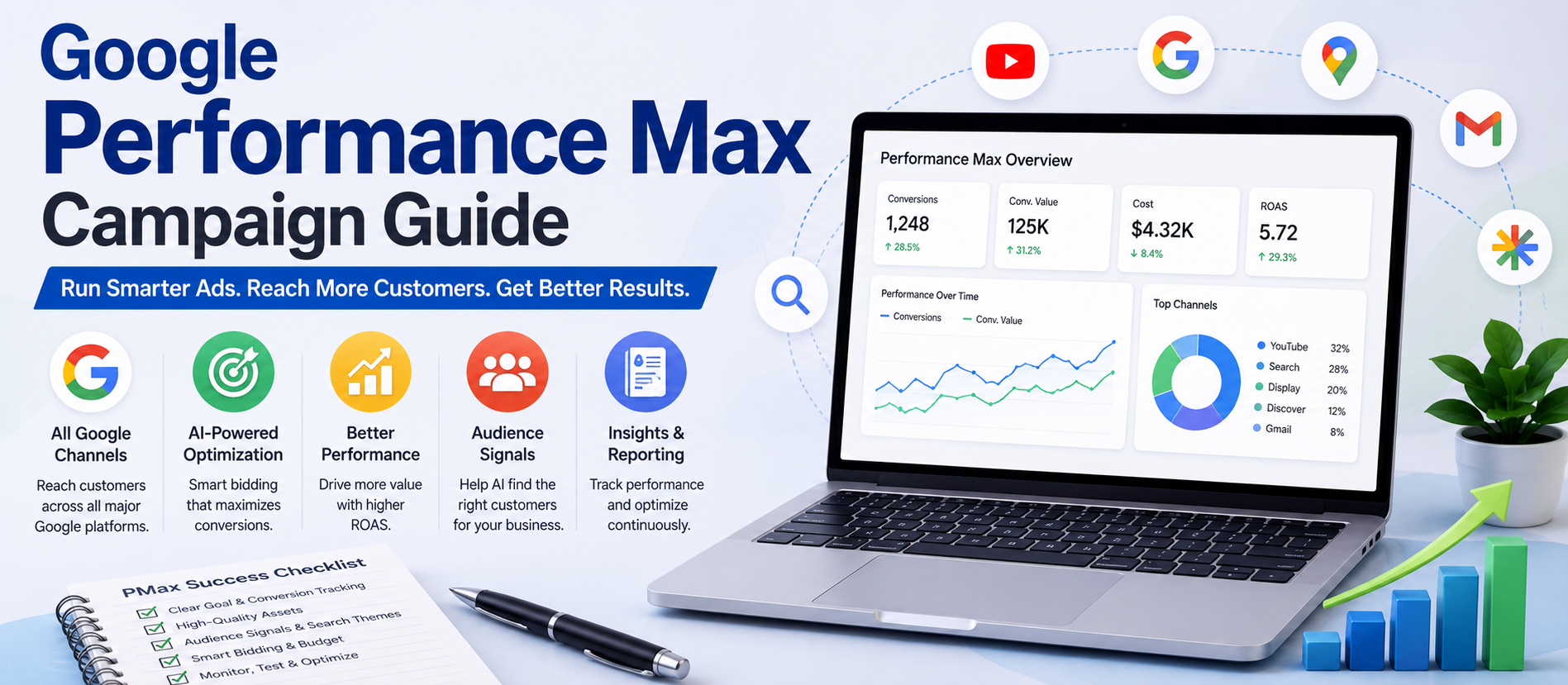
Google Performance Max has become one of the most important campaign types for advertisers who want to use Google's AI-powered advertising system across multiple channels from a single campaign. Instead of managing separate campaigns for every Google property, Performance Max can help advertisers reach potential customers across Search, YouTube, Display, Discover, Gmail, Maps, and other eligible inventory.
The biggest advantage of Performance Max is automation. Google AI uses campaign goals, conversion data, creative assets, audience signals, search themes, and other inputs to optimize bidding, targeting, budget allocation, and ad delivery. However, automation does not mean advertisers can simply launch a campaign and forget about it. Strong inputs, accurate conversion tracking, relevant creative assets, sensible campaign structure, and continuous evaluation remain essential.
⚠ Watch Out
This Google Performance Max Campaign Guide explains how Performance Max works, how to build a campaign, which assets to prepare, how to choose bidding and conversion goals, what mistakes to avoid, and how to optimize campaigns for sustainable business results.
Company: Designfo
Website: www.designfo.in
Contact: +91 9831037463
What Is Google Performance Max?
Performance Max is a goal-based Google Ads campaign type designed to help advertisers access Google's advertising inventory from one campaign. Google describes it as an AI-powered campaign that can optimize bidding, budget, audiences, creatives, and attribution based on the advertiser's chosen objective. It is designed to complement keyword-based Search campaigns rather than simply replace them.
Depending on the campaign and business objective, Performance Max can reach customers across multiple Google surfaces. This makes it particularly useful for businesses that want broader reach while allowing Google's automated systems to identify opportunities based on conversion goals.
Why Performance Max Matters for Modern Advertising
Consumer journeys are fragmented. A potential customer may first discover a brand on YouTube, search for it later, compare products on Google, visit a website, and eventually convert after seeing another relevant ad. Managing every touchpoint manually can be difficult.
Performance Max attempts to connect these opportunities through automated optimization.
- Access multiple Google advertising channels from one campaign.
- Use AI-assisted bidding and targeting.
- Optimize toward conversions or conversion value.
- Combine text, image, video, product, and other assets.
- Use audience signals and search themes to guide the system.
- Scale campaigns when conversion data supports automation.
How Performance Max Works
Performance Max starts with a business objective. Advertisers tell Google what outcome matters, such as purchases, qualified leads, phone calls, bookings, or another meaningful conversion. The system then uses available signals and campaign inputs to determine where and when ads should appear.
The Main Inputs Include
- Conversion goals
- Conversion values
- Daily budget
- Bidding strategy
- Creative assets
- Audience signals
- Search themes
- Landing pages
- Merchant Center product data when applicable
- Business information
The better the inputs, the more useful the optimization system becomes. Poor conversion tracking or weak creative assets can limit performance even when the campaign has a large budget.
1. Define the Right Campaign Goal
The first step is choosing an objective that reflects the actual business outcome you want to generate. Avoid optimizing toward easy but low-value actions if your real objective is revenue or qualified leads.
For an eCommerce business, a purchase may be the primary conversion. For a service company, a qualified enquiry, booked appointment, or completed phone call may be more valuable than a simple page view.
Ask These Questions Before Launch
- What business outcome matters most?
- Which customer action indicates genuine intent?
- Can the conversion be measured accurately?
- Does the conversion have a meaningful value?
- Can low-quality or duplicate conversions be excluded?
2. Set Up Accurate Conversion Tracking
Conversion tracking is one of the most important parts of a Performance Max campaign. Google's AI needs reliable signals to understand what success looks like.
Track meaningful actions rather than every possible interaction. Depending on your business, these might include:
- Completed purchases
- Qualified lead submissions
- Phone calls
- Bookings
- Subscriptions
- Offline sales
Review your conversion setup before increasing spend. If the campaign is optimizing toward weak, duplicated, or accidental conversions, the system may learn the wrong behavior.
3. Choose the Right Bidding Strategy
Performance Max uses automated bidding to pursue the selected campaign goal. Common strategies are based around maximizing conversions or maximizing conversion value, with optional target constraints depending on the campaign and account situation.
For lead generation, a conversion-focused approach can be appropriate when the account has reliable lead signals. For eCommerce, conversion value and return-on-ad-spend objectives may be more relevant when transaction values vary.
Do not choose a target simply because it looks attractive. Your target should be realistic relative to historical performance, conversion volume, margins, and growth objectives.
4. Give Google High-Quality Creative Assets
Creative quality matters because Performance Max can assemble and deliver different combinations of assets across Google's inventory.
Google's current best-practice guidance recommends providing a diverse range of high-quality assets and aiming for strong Ad Strength. Its published starting recommendations include at least 15 headlines, 5 descriptions, up to 20 images with varied content and aspect ratios, and at least one logo asset.
Useful Asset Types
- Short headlines
- Long headlines
- Descriptions
- Landscape images
- Square images
- Portrait images
- Videos
- Logos
- Product assets where relevant
Do not create multiple versions that say essentially the same thing. Provide genuinely different messages that communicate benefits, problems solved, offers, trust signals, and calls to action.
5. Write Conversion-Focused Headlines and Descriptions
Your creative messaging should communicate value quickly. A strong headline can identify the customer problem, highlight a benefit, or explain why your offer is different.
Effective Messaging Themes
- Customer benefit
- Specific service
- Unique selling proposition
- Price or offer when appropriate
- Trust and credibility
- Speed or convenience
- Call to action
Avoid vague phrases such as "Best Quality Services" unless you can support them with meaningful differentiation. Specific messaging usually gives customers more information to act on.
6. Use Audience Signals Strategically
Audience signals can help guide Google's AI toward useful customer groups. They can include remarketing audiences, customer lists, custom segments, and other relevant audience information available within the account.
Audience signals should be treated as guidance rather than a rigid manual targeting list. The system can use them as inputs while continuing to identify additional opportunities.
Useful Audience Sources
- Past customers
- Website visitors
- High-intent customer lists
- Relevant remarketing groups
- Custom intent-oriented segments
7. Add Relevant Search Themes
Search themes can provide additional context about the kinds of searches that matter to your business. Use them to communicate important customer needs, product categories, services, or high-intent topics.
Focus on themes that closely match your actual offerings. Do not add unrelated high-volume terms simply to increase reach.
8. Build Strong Landing Pages
Performance Max cannot compensate for a poor landing-page experience. When a user clicks an advertisement, the destination should immediately confirm that they are in the right place.
A Strong Landing Page Should
- Match the ad message.
- Explain the offer clearly.
- Load quickly.
- Work well on mobile devices.
- Provide strong trust signals.
- Make the next action obvious.
- Answer common objections.
For high-value services, include relevant case studies, testimonials, service details, FAQs, and clear enquiry options.
9. Give the Algorithm Enough Time to Learn
One common mistake is making major changes immediately after launching a campaign. Google's current Performance Max guidance recommends allowing a new campaign to run for at least six weeks so its machine-learning system can gather enough data and stabilize. It also recommends avoiding frequent changes during the initial learning period.
This does not mean advertisers should ignore serious tracking problems or policy issues. It means normal optimization should be based on sufficient data rather than reacting emotionally to a few days of performance.
10. Segment Campaigns Around Meaningful Business Differences
Performance Max should not be divided into dozens of tiny campaigns without a clear reason. Excessive fragmentation can make it harder for automated systems to collect enough data.
Separate campaigns when there is a genuine strategic difference, such as:
- Different business objectives
- Different countries or markets
- Major product categories
- Different profit margins
- Different conversion values
- Separate budgets or strategic priorities
Keep the structure simple enough that each campaign can gather meaningful data.
Performance Max for eCommerce
For online stores, Performance Max can work with product information from Google Merchant Center. Product titles, descriptions, prices, images, availability, categories, and other feed information therefore become important inputs.
Keep product data accurate and current. Poor product information can reduce relevance and create shopping-related problems.
eCommerce Optimization Checklist
- Accurate product titles
- Clear product descriptions
- High-quality product images
- Correct prices
- Accurate availability
- Correct product categorization
- Reliable purchase conversion tracking
- Relevant landing pages
Performance Max for Lead Generation
Lead-generation advertisers should focus heavily on lead quality. A campaign that produces many cheap form submissions can still be unprofitable if those leads are irrelevant, duplicated, or impossible to contact.
Where possible, connect advertising data with CRM outcomes so marketing teams can understand which leads become real opportunities or customers.
For lead generation, define:
- Lead conversion
- Qualified lead
- Sales opportunity
- Closed customer
The closer your optimization data is to actual revenue, the more useful your performance analysis becomes.
How to Evaluate Performance Max Campaigns
Do not judge Performance Max only by clicks or impressions. Focus on business outcomes.
- Conversions
- Conversion value
- Cost per conversion
- Return on ad spend
- Qualified lead rate
- Revenue
- Average order value
- Customer acquisition cost
Compare performance against your actual business targets rather than chasing benchmark numbers from unrelated industries.
Common Performance Max Mistakes
- Launching without accurate conversion tracking.
- Optimizing for low-value micro-conversions.
- Providing too few creative assets.
- Using repetitive or generic messaging.
- Changing budgets and settings too frequently.
- Creating too many fragmented campaigns.
- Sending all traffic to a generic homepage.
- Ignoring lead quality.
- Using poor product feed data.
- Judging results too quickly.
Performance Max Optimization Checklist
- Verify conversion tracking.
- Choose meaningful campaign goals.
- Set a realistic budget.
- Use an appropriate bidding strategy.
- Upload diverse creative assets.
- Add useful audience signals.
- Use relevant search themes.
- Improve landing pages.
- Monitor conversion quality.
- Allow sufficient learning time.
- Review performance against business goals.
- Make controlled, evidence-based changes.
How Designfo Helps Businesses with Google Ads and Performance Max
Designfo helps businesses build data-driven digital advertising strategies that combine paid search, Performance Max, conversion tracking, landing-page optimization, SEO, marketing automation, and AI Search Optimization.
Our approach focuses on connecting advertising activity with actual business outcomes. Instead of measuring success only by clicks, we look at qualified leads, conversions, revenue, customer acquisition, and long-term growth.
Designfo Digital Growth Services
- Google Ads Management
- Performance Max Campaign Management
- Search Advertising
- Conversion Tracking
- Landing Page Optimization
- SEO and Technical SEO
- AI Search Optimization
- Marketing Automation
- Conversion Rate Optimization
Frequently Asked Questions
What is Google Performance Max?
Google Performance Max is a goal-based Google Ads campaign type that uses AI-powered automation to help advertisers reach customers across Google's advertising inventory from a single campaign.
Is Performance Max suitable for small businesses?
It can be suitable for small businesses when the campaign has a clear objective, reliable conversion tracking, appropriate creative assets, and enough budget and conversion data to support optimization.
How long should a Performance Max campaign run before optimization?
Google's current guidance recommends allowing new campaigns to run for at least six weeks to gather sufficient learning data and avoiding frequent changes during the initial period.
How many assets should a Performance Max campaign have?
Google recommends a diverse set of assets. Its current general guidance suggests starting with at least 15 headlines, 5 descriptions, multiple image formats, and at least one logo, while encouraging advertisers to provide more distinct high-quality assets.
Does Performance Max replace Search campaigns?
No. Google describes Performance Max as a campaign type designed to complement keyword-based Search campaigns. Businesses can use both when their objectives and account structure justify it.
What is the most important Performance Max optimization?
There is no single universal optimization. Accurate conversion tracking, meaningful goals, strong creative assets, relevant inputs, suitable landing pages, and disciplined evaluation all contribute to better campaign management.
Conclusion
Google Performance Max is powerful because it combines Google's advertising inventory with AI-driven bidding, targeting, creative optimization, and budget management. But automation works best when advertisers provide high-quality information and clear business objectives.
The strongest Performance Max strategy begins with accurate conversion tracking, a realistic goal, strong creative assets, relevant audience and search signals, high-quality landing pages, and sufficient learning time. Businesses should resist the temptation to make constant changes based on short-term fluctuations.
For sustainable growth, treat Performance Max as part of a broader digital marketing system. Combine paid advertising with SEO, AEO, GEO, AI Search Optimization, conversion optimization, and marketing automation. This creates a stronger customer journey from discovery to conversion and gives businesses more opportunities to turn advertising investment into measurable growth.
Company: Designfo
Website: www.designfo.in
Contact: +91 9831037463
Reference: Google Ads Help — Performance Max campaign setup and optimization guidance.
Ready to Grow?
Talk to us about a strategy tailored to your brand — we will help you stand out in search, AI discovery and social.
Comments (0)
Log in to leave a comment.