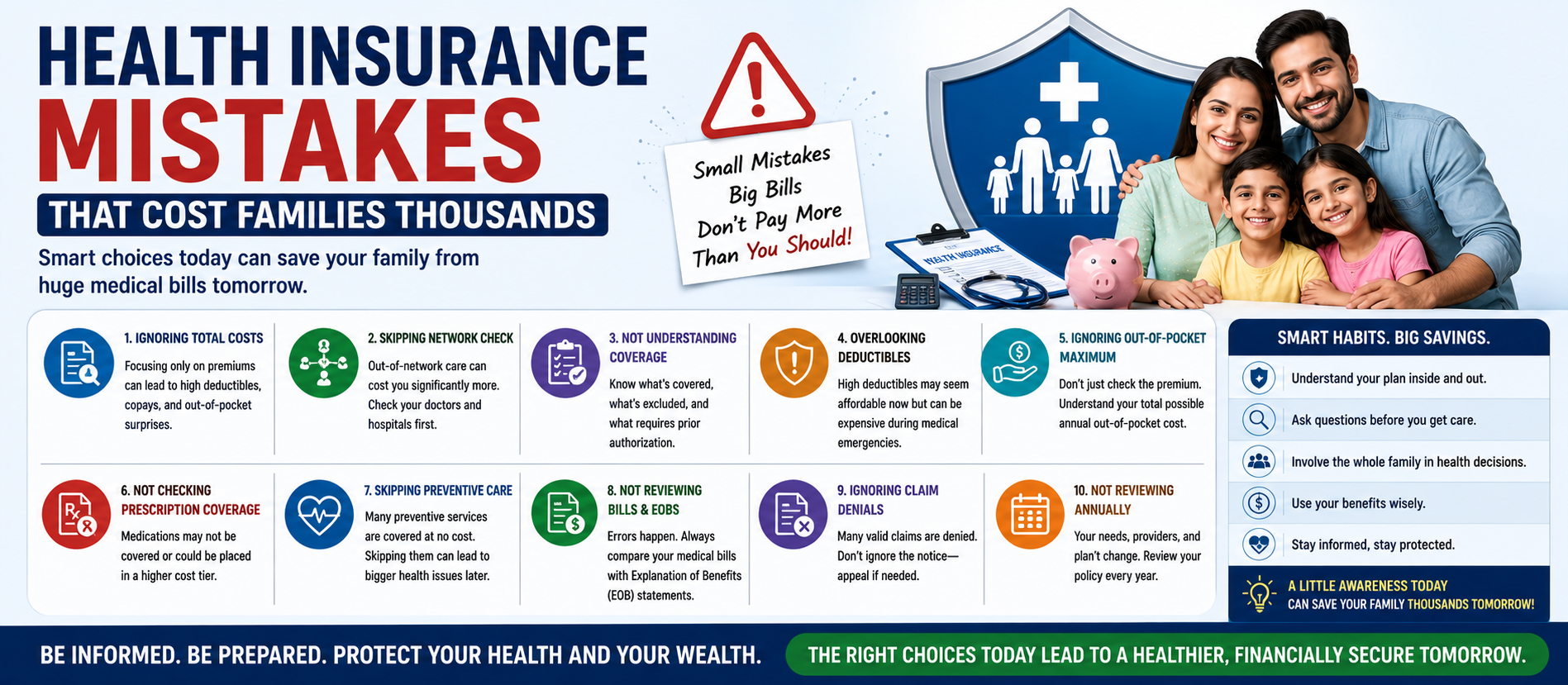
📋 Quick Summary
In this article:
1. Choosing a Plan Based Only on the Monthly Premium
2. Not Understanding the Deductible
3. Confusing the Deductible With the Out-of-Pocket Maximum
4. Failing to Check Whether Doctors Are In Network
5. Assuming Every Provider at an In-Network Facility Is Also In Network
6. Ignoring Prior Authorization Requirements
7. Not Reading the Explanation of Benefits
8. Paying Medical Bills Without Checking for Errors
9. Missing Enrollment or Coverage Deadlines
10. Forgetting to Update Family Information
11. Ignoring Prescription Drug Coverage
12. Skipping Covered Preventive Care Because of Cost Fears
⚠ Watch Out
Focus Keyword: Health Insurance Mistakes That Cost Families Thousands
Health insurance is designed to reduce the financial impact of medical care. However, many families still receive large and unexpected bills because they misunderstand how their health plan works.
A low monthly premium may come with a high deductible. A favorite doctor may not be in the plan's network. A hospital may be covered while another provider involved in the same treatment is not. A claim may be denied because a required step was missed. Even a simple billing error can cost money if nobody checks the statement.
💡 Key Insight
These problems do not always mean that a family chose a bad insurance plan. Health insurance can be complicated, and coverage rules vary by plan, provider, employer, insurer, and location. The best way to reduce expensive surprises is to understand the most important terms before care is needed.
This guide explains common health insurance mistakes that cost families thousands and practical steps that can help reduce unnecessary expenses. It uses simple, direct language for better readability.
1. Choosing a Plan Based Only on the Monthly Premium
One of the most common mistakes is choosing the plan with the lowest monthly premium without comparing the full cost of coverage.
The premium is the amount paid each month to maintain insurance coverage. But it is only one part of the total cost. Families may also pay deductibles, copayments, coinsurance, prescription costs, and expenses for services that are not covered.
A low-premium plan may be useful for some households, especially when they have limited expected medical expenses and can handle a larger deductible. However, the same plan may create serious financial pressure for a family that expects frequent doctor visits, ongoing treatment, expensive prescriptions, or a major medical procedure.
Before choosing a plan, compare:
- Monthly premium.
- Individual and family deductible.
- Copayments.
- Coinsurance.
- Out-of-pocket maximum.
- Prescription drug coverage.
- Provider and hospital network.
- Rules for specialists and prior authorization.
The cheapest premium is not always the lowest-cost plan over an entire year. Compare the likely total cost based on your family's expected use of health care.
2. Not Understanding the Deductible
A deductible is generally the amount you pay for covered health services before the plan begins paying its share, although some services may be covered before the deductible is met.
Families sometimes see a low monthly premium and do not fully notice that the plan has a large deductible. This can create a difficult situation when unexpected treatment is needed.
Family plans may also have both individual and family deductibles. Understanding how these work is important. Read the plan documents instead of assuming that every member of the household must meet the same requirement in the same way.
A higher deductible is not automatically a mistake. It can be part of a reasonable strategy when the family has enough savings and the plan fits its needs. The mistake is choosing a deductible without understanding whether the household could realistically manage the expense.
3. Confusing the Deductible With the Out-of-Pocket Maximum
The deductible and the out-of-pocket maximum are different.
After meeting a deductible, a family may still owe copayments or coinsurance for covered services. The out-of-pocket maximum is generally the most a member pays for covered in-network services during the plan year, subject to the specific rules of the plan.
However, premiums, non-covered services, and certain out-of-network expenses may not count toward that limit. This is why families should read the exact plan documents.
Knowing the maximum possible exposure for covered in-network care can help families plan for a serious illness or accident.
4. Failing to Check Whether Doctors Are In Network
Many families assume that if they have insurance, they can visit any doctor and receive the same level of coverage. This is often incorrect.
Health plans may use provider networks. Depending on the type of plan, out-of-network care can result in higher costs or limited coverage except in certain situations.
Before a non-emergency appointment, check whether the doctor, specialist, hospital, laboratory, imaging center, pharmacy, or other provider is currently in network for your exact plan.
Do not rely only on an old internet search result. Provider participation can change. Confirm with the insurer and, when possible, with the provider's office.
5. Assuming Every Provider at an In-Network Facility Is Also In Network
Going to an in-network hospital is important, but it does not always answer every billing question. Different professionals may participate in the same episode of care.
Ask questions before scheduled treatment. Find out which providers may be involved and whether the services are covered under your plan.
In the United States, federal surprise-billing protections apply in many situations involving emergency care and certain services provided by out-of-network providers at in-network facilities. However, families should still understand their plan, read notices carefully, and review bills for possible errors.
6. Ignoring Prior Authorization Requirements
Some health plans require prior authorization for certain treatments, procedures, tests, medical equipment, or prescription drugs. The exact rules depend on the plan and the service.
Families sometimes assume that a doctor's recommendation automatically guarantees insurance payment. A medical provider may recommend a service, but the insurance plan may have separate administrative or coverage requirements.
Before receiving a costly non-emergency service, ask:
- Is the service covered by my plan?
- Is prior authorization required?
- Who is responsible for submitting the request?
- What documentation is needed?
- What happens if approval is delayed or denied?
Keep copies of approvals, messages, and reference numbers. Administrative records can be important if a claim is later questioned.
7. Not Reading the Explanation of Benefits
An Explanation of Benefits, often called an EOB, is not simply a bill. It explains how the health plan processed a claim and may show the amount charged, the amount allowed, what the plan paid, and what the patient may owe.
Families sometimes ignore the EOB and pay the first bill they receive. This can lead to unnecessary payments when the provider bill does not match the insurance information or when a claim is still being processed.
Compare the provider's bill with the EOB. Check whether:
- The service date is correct.
- The services listed were actually received.
- The insurance payment was applied.
- The amount you are being asked to pay matches the plan information.
If something does not look right, contact the provider or insurer and ask for an explanation before assuming the bill is final.
8. Paying Medical Bills Without Checking for Errors
Medical billing can be complex. Errors may occur, including duplicate charges, incorrect patient information, incorrect service codes, or a failure to apply insurance information correctly.
Review bills carefully. If the bill is large or unclear, ask for an itemized statement and compare it with your insurance records.
Do not ignore a bill, because collection problems can become more difficult. At the same time, do not assume every charge is automatically correct.
If you believe a claim was processed incorrectly, learn about the insurer's review or appeal process. Keep copies of documents and notes from phone conversations.
9. Missing Enrollment or Coverage Deadlines
Another expensive mistake is failing to enroll, renew, or update coverage on time.
Employer plans, Marketplace plans, and other forms of coverage can have different enrollment rules and deadlines. A change in employment, marriage, divorce, birth, adoption, or other qualifying event may also affect coverage options.
Do not wait until a family member needs expensive treatment to discover that coverage has ended or that a deadline has passed.
Keep important dates on a calendar and review renewal notices carefully. Confirm that your chosen coverage is active and that family members are correctly listed.
10. Forgetting to Update Family Information
Life changes can affect health insurance. Marriage, divorce, a new child, a change of address, or changes in employment may require updates.
Outdated information can create administrative delays and coverage problems. Review your policy records after major life events and confirm that names, dependents, addresses, and other relevant details are correct.
Keep copies of important notices and confirmation documents.
11. Ignoring Prescription Drug Coverage
Prescription costs can create a major part of a family's health care spending. A plan may cover a medication, but the amount paid can depend on the drug tier, deductible, pharmacy network, quantity, prior authorization rules, or whether a generic or alternative medication is available.
Before selecting a plan, review the medications your family uses regularly. Check the plan's drug list, often called a formulary, and understand the expected out-of-pocket cost.
Do not stop or change medication without speaking with a qualified health professional. If a prescription is expensive, ask the prescriber or pharmacist whether there are medically appropriate lower-cost options or whether the plan requires a different process.
12. Skipping Covered Preventive Care Because of Cost Fears
Some families avoid checkups and screenings because they assume every medical visit will create a large bill.
Many health plans cover specified preventive services with no cost-sharing when the requirements are met, often including the use of an in-network provider. Coverage rules and exceptions can apply.
Preventive care may include screenings, immunizations, and other services depending on age, health needs, and plan rules.
Before an appointment, ask whether the visit is being billed as preventive care and whether additional services could result in separate charges.
13. Not Comparing Health Plans Every Year
A plan that worked well last year may not be the best choice next year. Premiums, deductibles, networks, drug coverage, and personal health needs can change.
Review your options during the appropriate enrollment period. Compare the plan you currently have with alternatives.
Consider changes in:
- Family size.
- Expected medical needs.
- Doctors and specialists.
- Prescription drugs.
- Income and budget.
- Travel or location.
Automatic renewal may be convenient, but it should not replace an annual review.
14. Choosing the Wrong Plan for Your Family's Actual Needs
There is no universally best health insurance plan. A young household with few expected medical expenses may prioritize different features than a family with young children, older adults, or members who require regular specialist care.
Make a simple list of expected needs before comparing plans. Include routine appointments, specialists, prescriptions, planned procedures, mental health services, maternity needs where relevant, and likely travel.
Then compare how each plan handles those needs. A plan should be evaluated based on your family's situation, not only on advertising or a single headline price.
15. Failing to Keep an Emergency Medical Fund
Health insurance reduces financial risk, but it does not eliminate every out-of-pocket cost. Deductibles, copayments, coinsurance, and non-covered expenses can still affect a household budget.
Where financially possible, build an emergency fund that can help cover unexpected expenses. The appropriate amount depends on the family's income, savings, insurance design, and overall financial obligations.
Review the plan's deductible and out-of-pocket maximum when setting financial goals. This does not mean that every family must keep the full amount in a separate account, but understanding possible exposure can support better planning.
16. Assuming a Claim Denial Is Always Final
A denied claim can be frustrating, but it is not always the final answer. Administrative mistakes, missing information, coding problems, or disagreements about coverage can sometimes be reviewed through an internal appeal or other process.
Read the denial notice carefully. It should explain the reason for the decision and provide information about available next steps.
Act within the required deadlines. Save documents, medical records when relevant, bills, EOBs, and written communications.
Appeal rights and procedures depend on the plan and applicable law. If the issue is complex or the financial amount is significant, consider obtaining appropriate professional or consumer assistance.
17. Using the Wrong Emergency or Urgent Care Option
Families should seek appropriate medical care based on the seriousness of the condition. However, from a financial perspective, it is useful to understand how the plan treats emergency rooms, urgent care centers, telehealth, primary care, and other options.
For a true emergency, health and safety come first. Do not delay emergency treatment simply to compare costs.
For non-emergency situations, knowing which options are available through your plan may help reduce unnecessary expenses.
18. Not Understanding What the Plan Does Not Cover
Health insurance is not unlimited coverage for every possible service. Plans can have exclusions, limits, medical-necessity requirements, network rules, and other conditions.
Read the Summary of Benefits and Coverage and other official plan documents. Pay special attention to services that may be expensive, including specialty treatment, rehabilitation, mental health services, medical equipment, fertility-related services, travel-related care, or other benefits relevant to your family.
When a major treatment is planned, ask the insurer for information about coverage before the service whenever possible.
19. Failing to Protect Health Insurance Information
Insurance fraud and identity theft can create financial and administrative problems. Treat insurance cards, account credentials, policy numbers, and personal information carefully.
Use secure passwords for online accounts and enable available security features. Be cautious when someone unexpectedly requests personal or insurance information.
Review claims and account activity periodically. Report suspicious activity through the appropriate official channels.
20. Waiting Until a Crisis to Learn How the Plan Works
The worst time to read a complicated insurance policy may be during a medical emergency. Families can reduce stress by learning the basics in advance.
Know where to find:
- Your insurance card and member identification.
- The customer service number.
- The provider directory.
- Urgent care and emergency care information.
- Prescription drug information.
- Deductible and out-of-pocket maximum details.
- Claim and appeal instructions.
A short family discussion about insurance can prevent confusion when fast decisions are required.
A Simple Health Insurance Checklist for Families
- Compare total annual costs, not only premiums.
- Understand individual and family deductibles.
- Know your out-of-pocket maximum and what counts toward it.
- Check doctors, hospitals, labs, and pharmacies before planned care.
- Confirm prior authorization requirements.
- Review prescription drug coverage.
- Read every major EOB and compare it with provider bills.
- Question duplicate or incorrect charges.
- Keep track of enrollment and renewal deadlines.
- Update the insurer after major family changes.
- Review coverage every year.
- Understand your rights to ask questions, request reviews, or appeal eligible decisions.
SEO, AEO, GEO, and AI Search Optimization for Health Insurance Content
Families searching for health insurance information usually want clear answers. Content should explain important terms directly and avoid misleading promises.
SEO helps useful content appear in traditional search results. AEO focuses on answering specific questions in a direct format. GEO and AI Search optimization help structured content remain understandable when AI systems summarize information for users.
Useful questions include:
- What health insurance mistakes are most expensive?
- What is the difference between a deductible and an out-of-pocket maximum?
- How can families avoid out-of-network medical bills?
- Why should I compare an EOB with a medical bill?
- Does prior authorization guarantee that a service will be covered?
- How should families compare health insurance plans?
- What should I do if an insurance claim is denied?
Clear headings, short paragraphs, direct definitions, checklists, and careful explanations make complex insurance topics easier for readers and AI-powered search systems to understand.
Frequently Asked Questions
What is the biggest health insurance mistake families make?
One of the most common mistakes is choosing a plan based only on the monthly premium. Families should compare the premium with the deductible, copayments, coinsurance, out-of-pocket maximum, network, and expected medical needs.
How can I avoid unexpected medical bills?
For planned care, check whether providers and facilities are in network, understand prior authorization requirements, ask about estimated costs, and compare provider bills with your insurance EOB. Consumer protections may also apply in certain situations.
Should I always choose the plan with the lowest deductible?
Not necessarily. A lower deductible may come with a higher premium. The best choice depends on your expected health care use, savings, budget, and risk tolerance.
What should I do if my health insurance claim is denied?
Read the denial notice, understand the reason, gather relevant records, and review the plan's process for requesting reconsideration or filing an appeal. Deadlines may apply.
Why is an EOB important?
An EOB shows how an insurance claim was processed. Comparing it with a provider bill can help you identify amounts that do not match or charges that need clarification.
Does an out-of-pocket maximum include my monthly premium?
Generally, monthly premiums do not count toward the out-of-pocket maximum. Other exclusions may also apply, so review the specific plan documents.
Final Thoughts
Health insurance mistakes can become expensive when families make assumptions instead of checking the details.
A low premium does not tell the whole story. A familiar doctor may not be in network. A deductible may not be the same as the out-of-pocket maximum. A medical bill may contain an error. A denied claim may have a review or appeal process.
The most effective approach is simple: understand your plan before you need expensive care. Compare total costs, verify networks, check authorization rules, review claims, protect your account information, and update coverage when family circumstances change.
Health insurance rules vary by country, state, insurer, employer, and plan. For decisions involving a specific policy or large medical expense, contact the insurer or seek qualified professional or consumer assistance.
For practical SEO, AEO, GEO, and AI Search optimized content, visit Digiifrog at www.digiifrog.com.
Disclaimer: This article is for general educational and informational purposes only. It is not medical, legal, insurance, or financial advice. Health insurance benefits, costs, networks, claims procedures, consumer protections, and regulations vary by plan and location. Always review your official plan documents and contact your insurer or a qualified professional for guidance about your specific circumstances.
Ready to Grow?
Talk to us about a strategy tailored to your brand — we will help you stand out in search, AI discovery and social.


Comments (0)
Log in to leave a comment.