📋 Quick Summary
In this article:
What Are HR Consulting Services?
Why Workforce Management Matters
1. HR Consulting Aligns Workforce Strategy With Business Strategy
2. Better Workforce Planning
3. Skills Gap Analysis
4. More Effective Recruitment and Talent Acquisition
5. Improve Employee Retention
6. Improve Organizational Design
7. Strengthen Performance Management
8. Improve Workforce Productivity
9. HR Technology Transformation
10. Use People Analytics for Better Decisions
Managing a modern workforce is more complex than hiring employees and paying salaries. Businesses must plan talent needs, develop skills, improve productivity, manage performance, support employee experience, control workforce costs, meet employment requirements, and adapt to changing technology.
Artificial intelligence is adding another layer of complexity. Companies are redesigning jobs, workflows, skills, and decision-making as AI becomes part of everyday work. Deloitte's 2026 Global Human Capital Trends research found that seven in ten business leaders say their primary competitive strategy for the next three years is to be fast and nimble, while leaders identify the orchestration of people and resources and the ability to adapt as major drivers of success.
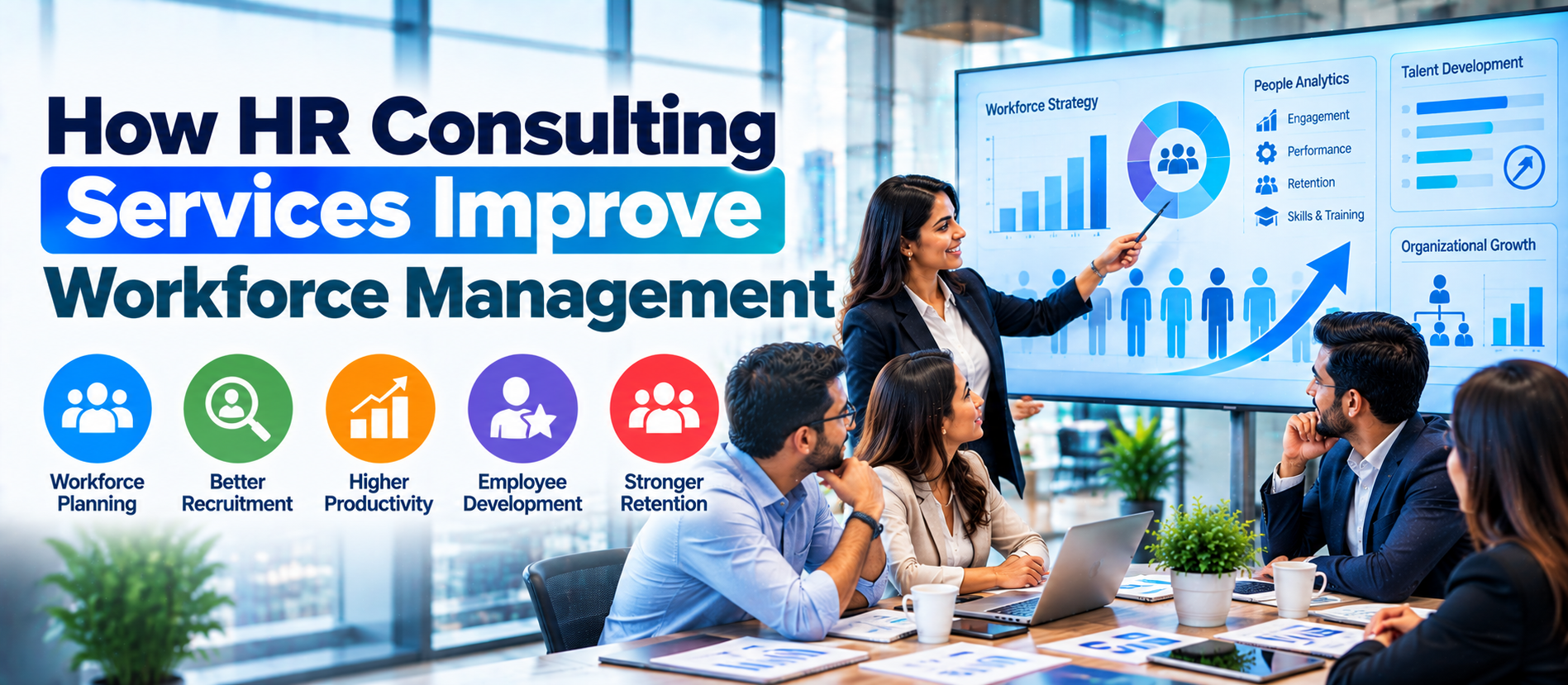
This is where HR consulting services can create measurable value. HR consultants help organizations evaluate their workforce, identify gaps, improve people processes, build better talent strategies, introduce suitable technology, and connect HR decisions with business goals.
The objective is not simply to make HR more efficient. It is to build a workforce that can support business performance today while adapting to future changes.
What Are HR Consulting Services?
HR consulting services are professional advisory and implementation services that help organizations improve how they manage people and work.
Depending on the business, an HR consultant may support:
- Workforce planning
- HR strategy
- Talent acquisition
- Organizational design
- Performance management
- Compensation and benefits
- Employee engagement
- Learning and development
- Leadership development
- HR technology
- People analytics
- HR process improvement
- Compliance and policy
- Change management
- AI and workforce transformation
Some consulting projects focus on a specific problem. Others cover a broader HR transformation program.
Why Workforce Management Matters
Workforce management connects people, capacity, skills, schedules, processes, and business demand.
A company can have talented employees and still experience poor workforce performance if the right people are not assigned to the right work at the right time.
Common workforce challenges include:
- Hiring too slowly.
- Hiring the wrong skills.
- High employee turnover.
- Unclear job responsibilities.
- Low productivity.
- Skills gaps.
- Poor workforce forecasting.
- Weak management practices.
- Manual HR processes.
- Disconnected HR systems.
- Inconsistent employee experiences.
- Rising labor costs.
- Difficulty adapting to AI and automation.
HR consulting can bring structure to these problems and help leadership make better workforce decisions.
1. HR Consulting Aligns Workforce Strategy With Business Strategy
HR should not operate separately from business strategy.
If a company plans to enter new markets, launch new products, expand internationally, automate operations, or grow revenue significantly, the workforce must be prepared for those goals.
HR consultants can translate business plans into workforce requirements.
For example, a growth plan may require:
- New leadership roles.
- Additional sales capacity.
- Specialist technical skills.
- New training programs.
- Regional hiring.
- Different organizational structures.
- New performance metrics.
This creates a direct connection between workforce management and business growth.
2. Better Workforce Planning
Workforce planning helps organizations estimate how many employees and which skills they will need in the future.
Consultants can analyze current headcount, turnover, productivity, business forecasts, skills, retirement risk, hiring pipelines, and technology changes.
The resulting workforce plan can answer questions such as:
- Which roles will grow?
- Which skills are becoming scarce?
- Where do we have excess capacity?
- Which roles can be redesigned?
- Which capabilities should be built internally?
- Which work could be automated?
- Where should external talent be used?
This reduces reactive hiring and helps businesses prepare before workforce shortages become urgent.
3. Skills Gap Analysis
Job titles alone do not show whether an organization has the capabilities it needs.
A skills gap analysis looks at the actual capabilities required for future work and compares them with current employee skills.
HR consultants can help create skills frameworks, assess existing capabilities, identify critical gaps, and develop plans to close them.
Possible actions include:
- Reskilling existing employees.
- Upskilling teams.
- Hiring specialists.
- Using contractors or external partners.
- Redesigning roles.
- Introducing AI-assisted workflows.
Deloitte's 2026 human capital research emphasizes that organizations need workers who can continually learn, adapt, and reinvent their capabilities as the pace of change accelerates.
4. More Effective Recruitment and Talent Acquisition
Recruitment affects both workforce quality and operating cost.
Hiring too slowly can delay growth. Hiring too quickly without strong assessment can increase turnover and poor-fit costs.
HR consultants can review the full recruitment process, including job descriptions, sourcing, screening, interviews, assessments, offers, onboarding, and candidate experience.
They can help businesses define:
- Ideal candidate profiles.
- Skills-based hiring criteria.
- Structured interview processes.
- Assessment methods.
- Recruitment KPIs.
- Employer branding priorities.
- Recruitment technology requirements.
A structured process can make hiring more consistent and easier to measure.
5. Improve Employee Retention
Employee turnover creates hidden costs. Businesses may lose institutional knowledge, productivity, customer relationships, and team stability when experienced employees leave.
HR consultants can analyze turnover patterns and identify possible causes.
These may include:
- Weak management.
- Limited career development.
- Compensation issues.
- Poor workload balance.
- Low recognition.
- Weak communication.
- Limited learning opportunities.
- Poor employee experience.
Consultants can then design targeted retention strategies rather than applying the same solution to every employee group.
6. Improve Organizational Design
As companies grow, organizational structures can become complicated.
Employees may report to multiple managers. Departments may duplicate work. Decisions may require too many approvals.
HR consulting can review organizational structures, spans of control, reporting relationships, decision rights, roles, and responsibilities.
The goal is not to create the smallest organization. It is to create an organization that can make decisions quickly and deliver outcomes clearly.
Modern workforce design is increasingly moving toward flexible combinations of people, technology, and AI. Deloitte's 2026 research describes new workforce choices such as blending human and machine capabilities, boosting people with AI, and redesigning work and organizational structures.
7. Strengthen Performance Management
Performance management should help employees understand expectations, receive useful feedback, develop skills, and contribute to business outcomes.
HR consultants can improve:
- Goal-setting frameworks.
- Performance review processes.
- Manager training.
- Feedback systems.
- Performance metrics.
- Career discussions.
- Recognition programs.
A modern performance system should focus on meaningful outcomes rather than simply measuring activity.
8. Improve Workforce Productivity
Productivity is not simply about making employees work faster. It is about removing unnecessary work and helping people spend more time on valuable activities.
Consultants can identify productivity barriers such as:
- Manual administration.
- Unclear priorities.
- Excessive meetings.
- Duplicated reporting.
- Slow approvals.
- Poor tools.
- Unclear decision rights.
- Skills mismatches.
Process redesign, automation, better technology, role clarity, and manager training can all improve workforce productivity.
9. HR Technology Transformation
Many organizations use multiple HR systems that do not communicate effectively.
Common HR technologies include:
- Human Resource Information Systems.
- Applicant Tracking Systems.
- Payroll platforms.
- Learning management systems.
- Performance management software.
- Employee engagement tools.
- Workforce scheduling systems.
- People analytics platforms.
HR consultants can evaluate the technology landscape, identify gaps, simplify workflows, define integration requirements, and support system selection or implementation.
The goal should not be buying more software. It should be creating a connected HR operating model.
10. Use People Analytics for Better Decisions
Workforce decisions improve when leaders can see reliable data.
People analytics can help organizations understand:
- Turnover.
- Absenteeism.
- Hiring performance.
- Time to hire.
- Employee productivity.
- Skills availability.
- Training effectiveness.
- Internal mobility.
- Workforce costs.
Consultants can help define the right metrics and build dashboards that connect workforce indicators with business performance.
Data quality and governance are critical. Employee data is sensitive, so access and usage should be controlled carefully.
11. Improve Learning and Development
Skills can become outdated quickly. Traditional annual training programs may not be enough when technology and job requirements change rapidly.
HR consultants can create learning strategies based on actual business capability needs.
Modern learning may include:
- Short learning modules.
- AI-supported coaching.
- Role-based learning paths.
- Peer learning.
- Project-based development.
- Continuous feedback.
- Internal mobility programs.
Deloitte reports that only a small share of organizations consider their current approaches highly effective at helping workers continuously grow and adapt, highlighting the need for more continuous and adaptive learning models.
12. Support Leadership Development
Managers have a major influence on employee performance and retention.
HR consulting can help organizations build leadership development programs that improve:
- Decision-making.
- Communication.
- Coaching.
- Conflict management.
- Change leadership.
- Team performance.
- Strategic thinking.
Leadership development should be linked to the actual challenges managers face rather than delivered only as classroom training.
13. Improve Compensation and Rewards
Compensation needs to balance competitiveness, fairness, affordability, and business performance.
Consultants can review salary structures, job levels, incentive plans, benefits, pay equity, and market benchmarks.
A well-designed reward system can support desired behaviors and improve employee retention.
14. Strengthen Employee Experience
Employee experience covers the full journey from recruitment to departure.
Consultants can map employee journeys and identify friction points in:
- Recruitment.
- Onboarding.
- Performance reviews.
- Learning.
- Internal transfers.
- Leave management.
- Employee support.
- Offboarding.
Improving these experiences can reduce administrative friction and help employees focus on their work.
15. Support Hybrid and Flexible Work
Hybrid work requires clear policies, collaboration norms, technology, manager capability, and performance expectations.
HR consultants can help businesses define a flexible work model that fits the nature of the work rather than applying a single policy to every role.
Important questions include:
- Which roles require physical presence?
- Which work can be performed remotely?
- How should teams collaborate?
- How should performance be measured?
- How should new employees be onboarded?
- How can culture remain strong?
16. Improve HR Compliance and Risk Management
HR processes can create legal and operational risk when policies are inconsistent or poorly documented.
Consultants can help organizations review employment policies, documentation, employee processes, records, classification practices, and HR governance.
Because employment requirements vary by jurisdiction, organizations should use qualified legal and compliance professionals for matters that require formal legal interpretation.
17. Support Workforce Cost Optimization
Workforce costs are often one of the largest business expenses.
Cost optimization does not necessarily mean reducing headcount. It can involve improving workforce allocation, reducing unnecessary overtime, redesigning roles, improving scheduling, reducing turnover, and automating repetitive work.
Consultants can analyze the relationship between workforce cost and business output.
This helps leaders answer a more useful question: “How can we create more business value from our workforce?”
18. Prepare the Workforce for AI
AI is changing work design, not only technology.
Some tasks will become automated. Other roles will use AI as an assistant. New responsibilities will emerge around AI governance, validation, data quality, prompt design, workflow management, and human oversight.
Deloitte's 2026 research argues that AI value depends heavily on redesigning work and intentionally shaping human-AI interaction. It reports that only 6% of leaders say their organizations are making progress in designing those interactions.
HR consultants can help define future roles, identify affected skills, build training programs, create AI policies, and design human-AI workflows.
19. Improve Change Management
New HR systems, organizational changes, AI adoption, restructuring, and new performance models can create employee resistance.
Change management helps employees understand what is changing, why it matters, and how they will be supported.
A practical change program can include:
- Leadership alignment.
- Stakeholder mapping.
- Clear communication.
- Manager preparation.
- Employee training.
- Feedback collection.
- Adoption measurement.
- Continuous improvement.
20. Build a More Agile Workforce
Traditional workforce planning often assumes that roles and structures remain stable for long periods.
Modern businesses need more flexibility.
HR consultants can help organizations create systems for moving people and skills toward changing priorities.
This can include internal talent marketplaces, project-based teams, cross-training, flexible staffing, skills inventories, and external talent networks.
Deloitte's 2026 Human Capital Trends research identifies dynamic orchestration of people and resources as an important capability for organizations trying to move quickly and adapt to change.
21. Build Better HR Metrics and KPIs
HR performance should be connected to business outcomes.
| KPI What It Measures | |
| Time to hire | Speed of filling important roles |
| Quality of hire | Effectiveness of new hires |
| Employee turnover | Retention and workforce stability |
| Absenteeism | Workforce availability |
| Employee engagement | Workforce experience and commitment |
| Training effectiveness | Impact of learning programs |
| Internal mobility | Movement of talent across the organization |
| Labor cost per output | Workforce efficiency |
| Manager effectiveness | Leadership and team performance |
| HR process cycle time | Efficiency of HR operations |
Tracking the right metrics helps leadership understand whether HR initiatives are improving the business.
HR Consulting vs. Internal HR Management
| AreaInternal HRHR Consulting | ||
| Company knowledge | Deep internal context | External perspective |
| Specialist expertise | Depends on internal team | Can provide specialized expertise |
| Objectivity | May be influenced by internal structures | Independent assessment |
| Project capacity | Balanced with daily HR work | Dedicated project focus |
| Benchmarking | Often internally focused | Can bring external benchmarks |
| Implementation | Strong internal ownership | Can provide implementation support |
The strongest model is often collaborative. Internal HR leaders provide organizational context while consultants bring external experience, structured methods, and additional capacity.
How to Choose the Right HR Consulting Partner
- Define the problem first. Be specific about the workforce challenge.
- Check relevant experience. Look for experience with similar industries and business models.
- Review methodology. Ask how the consultant will diagnose the issue.
- Ask for measurable outcomes. Look beyond presentations and recommendations.
- Assess technology expertise. HR technology and AI may be important to the project.
- Check change-management capability. Strategy must be adopted by employees.
- Define KPIs. Agree on success measures before implementation.
- Protect employee data. Confirm security, privacy, access, and governance practices.
Common HR Consulting Mistakes
- Starting a project without defining the business problem.
- Choosing a consultant only because of brand reputation.
- Focusing on HR activity instead of business outcomes.
- Implementing technology before fixing broken processes.
- Ignoring employee feedback.
- Creating too many HR metrics.
- Launching training without measuring skill improvement.
- Using AI without clear governance.
- Failing to assign internal owners.
- Trying to transform every HR process at once.
A Practical 90-Day HR Consulting Roadmap
Days 1–30: Diagnose. Review workforce data, organizational structure, HR processes, employee feedback, talent gaps, costs, technology, and key business goals.
Days 31–60: Design. Prioritize problems, define the future-state HR operating model, design process improvements, identify technology opportunities, and create workforce initiatives.
Days 61–90: Implement and measure. Launch priority improvements, train managers and employees, monitor adoption, measure KPIs, and refine the approach.
HR Consulting for SEO, AEO, GEO, and AI Search
HR consulting firms and HR departments can also use digital content to answer workforce questions and build authority.
A strong content strategy can support SEO, AEO, GEO, and AI Search optimization by creating clear answers to questions employees, HR leaders, and business owners actually ask.
Useful content topics include:
- What is workforce planning?
- How can businesses reduce employee turnover?
- What are the benefits of HR consulting?
- How can companies prepare employees for AI?
- What HR KPIs should businesses track?
- How can HR improve workforce productivity?
- How does skills-based workforce planning work?
Content should use clear definitions, direct answers, structured headings, useful examples, trustworthy evidence, and FAQ-style information. This makes information easier for people and AI-powered search systems to understand.
Frequently Asked Questions
What are HR consulting services?
HR consulting services help organizations improve workforce strategy, talent management, HR processes, organizational design, employee experience, HR technology, performance, and workforce planning.
How do HR consultants improve workforce management?
They analyze workforce needs, identify skills gaps, improve processes, strengthen talent strategies, optimize organizational structures, introduce better technology, and connect HR decisions with business goals.
Can small businesses use HR consulting services?
Yes. Small businesses can use consultants for specific needs such as hiring, policies, performance management, compliance, workforce planning, HR technology, or employee retention.
How does HR consulting support AI adoption?
HR consultants can help redesign jobs, identify future skills, create training plans, develop AI policies, assess workforce impact, and design effective human-AI workflows.
What is workforce planning?
Workforce planning is the process of determining what people, skills, roles, and capacity an organization will need to achieve its future business goals.
How can HR consulting reduce workforce costs?
Consultants can identify inefficient processes, excessive turnover, poor workforce allocation, unnecessary overtime, skills gaps, and opportunities for automation or role redesign.
How long does an HR consulting project take?
A focused HR assessment may take several weeks. Larger workforce transformation projects can take several months or longer depending on scope and implementation requirements.
Conclusion
How HR consulting services improve workforce management is ultimately about helping organizations make better decisions about people, skills, structure, technology, and work.
Effective HR consulting connects workforce strategy with business strategy. It can improve workforce planning, recruitment, retention, productivity, organizational design, performance management, learning, HR technology, employee experience, compliance, and change management.
💡 Key Insight
The role of HR is also expanding as AI changes how work is performed. Businesses need to redesign jobs, develop new skills, establish human-AI collaboration, and help employees adapt continuously. Current 2026 research reinforces that speed, adaptability, human judgment, and effective orchestration of people and technology are becoming important sources of competitive advantage.
The best HR consulting projects are therefore not limited to policies or administrative improvements. They create a stronger workforce system that supports productivity, growth, resilience, and long-term business performance.
About Digiifrog: Digiifrog focuses on digital marketing, SEO, AEO, GEO, AI Search optimization, content marketing, automation, and technology-led growth strategies. Visit www.digiifrog.com to explore solutions for modern businesses.
Research References
- Deloitte — 2026 Global Human Capital Trends.
- Deloitte UK — Human Capital Trends 2026.
- Deloitte — 2026 human capital research on human-AI collaboration, adaptability, and workforce orchestration.
Ready to Grow?
Talk to us about a strategy tailored to your brand — we will help you stand out in search, AI discovery and social.
Comments (0)
Log in to leave a comment.